.The Signature My Husband Thought He Could Steal Became the One Thing That Destroyed Everything He Built.
part2
“Did you ever speak to me before today?” I asked. Solange’s expression stiffened. “No.” I closed the file. Bram pushed a pen toward me. “Sign.” “No.” His face changed only slightly, but after nine years I knew exactly what the change meant. He had expected humiliation to make me compliant. Instead, I had begun asking questions. “Callie.” “No.” Solange leaned back and folded her hands. “The agreement has effectively already been executed.” I looked at her. “Then you don’t need my signature.” Neither of them answered. I asked for a complete copy. Bram objected. Solange hesitated. The title closer, perhaps sensing that she wanted no part of whatever this was becoming, made one anyway. Forty-one warm pages emerged from the copier. I tucked them beneath my arm and walked out.
Alabama heat hit my face like an oven door opening. I stood beneath the bank awning next door and called Marla. “Page thirty-one has my signature.” Her voice changed instantly. “Did you sign it?” “No.” “Where were you on the date?” “Texas.” Silence. Then five words. “Do not go home alone.” My grip tightened around the packet. While I had been focused on what Bram had done to my hair, someone had already taken something larger. Worse, I would learn the next morning that nine days earlier, they had taken me to court without telling me. Marla spread the paperwork across her cramped office above a hardware store. Thornfield Crossing Partners had filed a $40.2 million lawsuit against my grandmother’s trust and against me personally for supposedly backing out of the development agreement.
“There’s more,” Marla said. She turned over the service form. Bram’s signature sat at the bottom beside the words Accepted by spouse. He had received the lawsuit at our house nine days earlier and hidden it. “So the clock has been running?” I asked. “Nine days.” “And he knew?” “He signed for it.” The trust itself kept the situation from becoming immediately catastrophic. Grandma had written it like she expected future generations to marry idiots. The 180-acre Elk Fork tract could not be transferred without written direction from me, acknowledgment before a proper notary, thirty days’ notice, and trustee approval. Marla was trustee. Nobody had notified her. But Thornfield had filed a lis pendens against the entire property. I could not sell, borrow against, or grant an easement without litigating around it.
Then Marla opened Thornfield’s site plan. I recognized the ridge immediately. “They’ve already graded it.” Her glasses came off. “When?” “April.” That got her attention. “Good.” I stared. “Good?” She tapped the plan. “Paper can be backdated. Dirt can’t.” Monday morning, I walked into Colonel Harker’s office at Redstone Arsenal and disclosed everything. The lawsuit. Thornfield. The possible housing contract. My husband. The land. The signature. By nine o’clock, I had been removed from every housing-related file. Three years of work disappeared into a banker’s box. That hurt worse than my shaved head. Nobody punished me. They did exactly what federal ethics rules required. Still, I watched Sergeant Overstreet carry my largest portfolio away and understood what Bram had risked without asking me.
My marriage. My land. My professional reputation. My career trajectory. All because he wanted access to property he did not own and a development arrangement he apparently believed I would eventually ratify if frightened enough. At lunch, my phone showed thirty-seven texts from him. You’re destroying us. It’s paperwork. Stop embarrassing me. Come home and we’ll fix this. I answered none. That evening, while I was staying with my parents, my neighbor Lorraine Bagwell knocked on the door holding her phone. “Callie, I think I photographed your husband doing something you need to see.” Lorraine’s porch camera faced the gravel turnout across from our driveway. She had saved months of clips because construction trucks kept tearing up the county road. The first image was dated April 9.
Bram’s pickup. Solange’s white Mercedes SUV. A surveyor. All three standing near my grandmother’s gate with blueprints spread across Bram’s tailgate. Another clip showed Solange touching Bram’s shoulder. Then kissing him. Not a friendly kiss. Not close. Lorraine winced. “I wasn’t sure if that part mattered.” I stared at the image. “It does now.” The affair hurt, but not the way I expected. By then, I had already watched my husband shave my head, hide a lawsuit, produce a document bearing a forged signature, and risk my federal career. The kiss did not create a new betrayal. It simply explained the energy behind the old ones. Bram was not merely chasing money. He and Solange believed they were building a future that required me to surrender land, credibility, and eventually my place in his life.
I forwarded everything to Marla, then drove to Hallowell Bend. My cousin Sutton met me on a four-wheeler and took me up the ridge. The damage was worse than I imagined. A three-hundred-foot construction pad had been carved through the red clay. Culvert pipe lay stacked near survey stakes. A ninety-year-old post oak had been uprooted and pushed into the spoil pile. That tree stopped me. I sat on a length of pipe for two minutes. No screaming. No dramatic collapse. Just two minutes with my hands between my knees, staring at exposed roots. Grandma used to hang a tire swing from that oak. Bram knew that. Solange did not need to. He did. I stood. “Where’s Grandma’s cedar box?” My father looked at me from the farmhouse porch. “Hall closet.”
Inside the cedar box were ration books, an old pocketknife, a tortoiseshell comb, photographs, and a hand-drawn 1961 survey. We spread it across the kitchen table and held one corner flat with a salt shaker. I compared it to Thornfield’s legal description. Then again. The Elk Fork River had shifted after a major 1974 flood. The property boundary had not. Grandma’s deed followed the old channel. Thornfield’s survey followed the newer riverbank, adding land the trust never conveyed. “They added forty-one acres,” I said. Dad nodded slowly. “Where’s their construction pad?” I measured the drawings. My finger stopped. “Nine acres inside our actual boundary.” Bram and Solange had begun grading not only before valid site control existed, but partly on land their own description did not properly cover.
My mother’s old iPad chimed beside the refrigerator. Bram had once used it while visiting and apparently never logged out of his email. A message preview appeared across the screen. From Solange. Once Callie signs Tuesday, we’re clear. Then you and I can finally stop hiding. I photographed it. Mom watched my face. “You okay?” I locked the tablet. “No.” Then I pulled Grandma’s cedar box closer. “But they aren’t either.” Marla sent one letter. Eleven lines. No threats. No outrage. Just facts. The trust had never authorized Thornfield’s option. My signature was disputed. The property description included land beyond the tract. Construction had started before lawful site control. Nine days later, Anvil Creek Capital, the fund backing Thornfield, called me directly.
Their counsel invited me to a partner meeting in Huntsville. I wore my uniform again. Fourteen executives sat around a glass conference table. Solange stood beside a large screen displaying glossy renderings of six hundred twenty houses. Bram sat three chairs down. He went white when I entered. Anvil Creek’s lawyer began simply. “Solange, explain site control.” She smiled. “Exclusive option in April. Ratification in June.” I spoke. “Who signed the June ratification?” Her eyes found mine. “You did.” “I was in San Antonio.” Nobody moved. “Government travel records put me there.” Bram stood. “This is a marital dispute.” The fund’s forensic accountant rotated her laptop toward the room. “No,” she said. “This is a $61,400 grading invoice dated April 30.”
She looked directly at Solange. “Did Thornfield possess valid site control on April 30?” Solange swallowed. “I’d have to review the sequence.” The accountant enlarged the approval field. Initials: BK. Bram Kessinger. The meeting ended twenty minutes early. In the elevator hallway, Solange grabbed my elbow. “You’re going to cost hundreds of military families homes.” I pulled free. “You bulldozed land you didn’t own.” Her face hardened. “You think this makes you powerful?” “No.” I pressed the elevator button. “It makes you documented.” Three weeks later, despite everything, Thornfield announced a public ribbon cutting. Two hundred chairs. Local press. County commissioner. Barbecue trailer. Brass plaque. Solange was apparently betting on spectacle and momentum doing what valid ownership could not.
Marla called me the morning of the event. “You want to go?” “Yes.” “Take the cedar box.” So I did. I sat near the back while Solange praised economic development, community partnership, military-family housing, and regional growth. Bram sat several rows ahead with his mother, Hattie Kessinger. Hattie was seventy-three and had never liked me enough to hide it, which somehow made what happened later more meaningful. When Solange lifted the ceremonial scissors, I stood. “Before you cut that ribbon, I’d like four minutes.” Every head turned. Bram caught my sleeve as I moved past. “Don’t.” Hattie took his wrist and removed his hand from me. The gesture surprised both of us. I carried Grandma’s cedar box to the podium.
I removed two records. First, the properly recorded revocation of an old power of attorney Bram once held during a deployment years earlier. Second, the subpoenaed notary journal belonging to Bernita Shelnut. “Thornfield’s forty-million-dollar lawsuit relies on a notarized consent dated June fourteenth.” I held the journal up. “On June fourteenth, Ms. Shelnut notarized two documents: a vehicle title and a nursing-home power of attorney. That is all.” Whispers moved through the chairs. “There is no entry for me.” Solange stepped forward. “This is inappropriate.” I looked at her. “So was suing me with a document I never signed.” Bram stood abruptly. “CALLIE!” Two hundred people heard him. I did not look at him.
Anvil Creek’s lawyer rose from the back row. “Solange, have the original consent in my office Tuesday.” Then he left. Dozens of people followed. The county commissioner stepped away from the covered plaque. “I believe I’ll wait on the ribbon.” That evening, Thornfield’s attorney emailed a three-page defamation threat. Marla replied with one sentence: My client read public records aloud. We will happily do it again in court. At 1:03 a.m., Hattie called me. I sat upright in my parents’ guest bed. “I need to tell you what I saw June fourteenth.” My grip tightened around the phone. “You were there?” “Yes.” “Was I?” Silence. Then she said the sentence that finally broke her son’s defense. “I watched Bernita stamp that paper while you were nowhere in the room.”
Hattie agreed to testify. So did Bernita. Once subpoenaed and advised by counsel, Bernita admitted Bram had brought the document already bearing my supposed signature. She notarized it without me present. Her own journal proved she had not entered it as a legitimate act. By then, the forgery was no longer an inference built from travel records. We had witnesses. Bram responded by coming to my parents’ farmhouse at 10:40 on a Tuesday night. I met him on the porch. He looked exhausted, unshaven, and thinner. A part of me remembered loving him. That was the cruel thing about betrayal: it does not erase the history that made it possible. “Solange will dismiss the lawsuit,” he said. “What do you want?” I asked.
“One affidavit.” Of course. He wanted me to swear that I had verbally authorized him to negotiate the property and that the disputed paperwork merely memorialized prior consent. In exchange, he offered two hundred thousand dollars and agreed to surrender any claim to our marital house. I stared at him. “You’re offering me money to validate a forged document?” His face twisted. “Stop calling it forged.” “What should I call my signature when I didn’t write it?” He stepped closer. “Nine years, Callie.” “June fourteenth.” He frowned. “What?” “That’s my answer.” Bram put one hand against the storm door, blocking it. “You will not do this to me.” A flashlight appeared beside the equipment shed. Sutton. “Evening, Bram.” Bram removed his hand immediately.
What Bram did not know was that my parents had installed a new porch camera after package thefts. It recorded everything. The offer. The affidavit. The money. The threat. Two days later, Marla had the file preserved by a digital-forensics technician. At Bram’s deposition, she placed page thirty-one in front of him. “Who signed Callie Strathmore’s name?” His lawyer asked for a break. Eleven minutes later, they returned. Bram folded his hands. “On advice of counsel, I decline to answer.” He invoked the Fifth eleven more times. Solange’s deposition went worse. She admitted she had never spoken with me before the title-office meeting, never independently verified the trust, and never confirmed I had authority to convey the land under the terms she claimed.
Then Lorraine’s April photograph appeared. Solange stared at herself standing beside Bram on my property months before the supposed ratification. “That is me,” she finally said. Eight days later, Thornfield’s attorney withdrew from the lawsuit. I thought that might be the beginning of the end. Then Hattie asked me to come to her kitchen. Three folders sat beside the coffee pot. “Read that clause,” she said. It was a spendthrift provision inside the Kessinger family trust. Any beneficiary who pledged or attempted to assign his interest before lawful distribution automatically forfeited it. Hattie slid another document toward me. A bank guarantee. Bram’s real signature appeared on the final page. The amount secured was thirty-four million dollars.
He had pledged his future interest in Hattie’s trust as collateral months before Thornfield approached me. I stared at her. “He was financially trapped before he forged anything.” Hattie folded her hands. “Yes.” “And you have to enforce this?” “I do.” “He loses his inheritance.” “Yes.” “He’ll blame you.” Her expression barely moved. “He already does.” Hattie personally delivered the forfeiture letter. Twelve days later, she suffered a stroke. She died in an Athens hospital without waking. Her death hurt more than the lawsuit. More than my hair. More than the career disruption. She had chosen truth over protecting her son and never lived long enough to hear the court acknowledge that choice. At the funeral, Bram never looked at me.
Eleven days after Hattie’s burial, we returned to court. Judge Vandermull reviewed government travel records showing I was in San Antonio. Bernita’s journal. Dated camera footage. Lorraine’s photographs. Grandma’s 1961 survey. April grading invoices. The porch recording. Hattie’s sworn deposition. The judge asked questions for nearly two hours, moving slowly through each chain of evidence. Then she ruled from the bench. Thornfield’s $40.2 million claim was dismissed with prejudice. The option was void. The lis pendens against our 180 acres was dissolved. The consent document was formally described as a fabricated instrument. Thornfield and Solange were ordered to pay $140,000 in attorney fees and costs. The matter was referred to appropriate authorities.
Solange turned pale when the judge explained she could face personal exposure beyond the company. Bram stared at the table. I did not smile. I looked instead at the empty chair near the aisle. Hattie had wanted to hear the truth spoken in daylight. She missed it by eleven days. Her son would live with it for the rest of his life. Bram did not challenge the inheritance forfeiture because he could not. The document destroying his trust interest carried his actual signature. His brother and sister received his share. Neither speaks to him now. Anvil Creek withdrew its investment. The bank called the thirty-four-million-dollar guarantee. Thornfield Crossing Partners collapsed before the year ended. Solange lost the company, much of her wealth, and her access to Redstone-related contracting work.
The development died. Months later, a completely different company won the military-family housing project and built it fourteen miles away on land it actually owned. I liked that detail more than I should have. Solange had accused me of depriving military families of housing. In reality, the project survived just fine once separated from fraud, forgery, and my grandmother’s property. My divorce became final April 8. Bram signed each page his attorney marked with yellow tabs. I appreciated the irony. I sold my interest in the house on Tanyard Road, paid the legal bills, and moved permanently into the farmhouse at Hallowell Bend. I was not promoted that year. Fourteen months away from my largest portfolio created a gap in my record. That consequence was real.
Being right does not mean escaping cost. That was one of the hardest lessons in the entire ordeal. I followed the ethics rules, disclosed the conflict, and removed myself exactly when I should have. Still, professional timing does not pause because your husband forges your signature. Colonel Harker called me into his office after the case ended. He handed me a memorandum documenting that I had reported the conflict immediately, requested recusal, and complied with every restriction placed on me. Then he said, “You did it in the right order.” I had wanted promotion boards, glowing reports, maybe some official acknowledgment that losing a year of work had been unfair. Instead, I got one sentence. Strangely, it was enough. Doing it in the right order mattered more than winning quickly.
The next June, Sutton rented a dozer. Dad sat on the tailgate drinking gas-station coffee and criticizing every low spot while we filled Thornfield’s construction pad. We moved dirt back across the scar they had cut through the ridge. Reseeded grass. Reset boundary markers. A local arborist helped us plant two young oaks near the stump of Grandma’s old tree. They looked embarrassingly small beside the empty space. “Give them ninety years,” Dad said. I laughed. Grandma’s 1961 survey went into a frame in the farmhouse hallway. Marla insisted on archival glass. “After what this family put that poor piece of paper through, it deserves better treatment than most elected officials.” I told her that sounded expensive. She told me to stop whining.
Eventually, the clerk returned several original exhibits. The fake consent. Photographs. Copies of the title packet. Bram’s note from the pillow. I kept the court order. I burned the note. Lorraine came over that evening and stood beside me at the fire pit. I unfolded the paper one last time. I got tired of looking at the part of you that thinks you’re better than me. Eleven words. For months, I had treated them like evidence because they showed intent. But once the case was finished, they became something else: the last version of Bram’s voice I was voluntarily carrying. I held one corner over the flame. The page curled brown, then black. Eleven words disappeared faster than I expected. Lorraine handed me a Diet Coke. “Feel better?” I thought about it. “Lighter.”
My hair grew back. Thicker in places, shorter because I chose to keep it that way, and unexpectedly gray near the temples. Mom suggested coloring it. I refused. Not because Bram had taken something from me. Because I no longer wanted the old version of myself exactly as she had been. She had spent nine years apologizing whenever Bram hurt her correctly enough to make her angry. I had become skilled at explaining his behavior in ways that preserved the marriage. He was stressed. He felt excluded from my work. He resented the trust because Grandma never liked him. He felt emasculated by my rank. He was jealous of my career. All those things may have been true. None made me responsible for what he chose to do with them.
That realization took longer than the lawsuit. Legal facts were easier. Either a signature was mine or it was not. Either I appeared before Bernita or I did not. Either the old channel defined the boundary or it did not. Marriage was messier because I kept searching for the moment when Bram became the person who could shave my head while I slept. There was no single moment. There were smaller things. The first time he read my messages without asking. The time he told me my promotion embarrassed him in front of his friends. The first argument where he punched the cabinet beside my head and later said I made him feel trapped. The years of tiny permissions I granted because each seemed too small to destroy a marriage over.
One night after the case ended, I found an old photograph from our fifth anniversary. Bram and I stood beside the Elk Fork smiling beneath Grandma’s cottonwood trees. I remembered that day as happy. Maybe it was. People often want betrayal to rewrite every good memory into evidence of manipulation. I could not do that honestly. Bram had made me laugh. He had cared for me when I had pneumonia. We had once driven six hours for barbecue because we were bored. He was not a monster every minute. That was exactly why leaving took so long. Harm becomes difficult to name when it arrives between ordinary kindnesses. I put the photograph back into the box instead of destroying it. The marriage happened. So did the ending.
Last I heard, Bram found work with a pipeline company outside Cullman. He has never apologized. He has never admitted signing my name. According to someone who still knows his brother, he describes the case as a divorce dispute that got out of hand. Years ago, that would have infuriated me. I would have wanted everyone he met to know the whole record. Now I mostly feel tired imagining how much energy it would take to keep correcting him. The court order exists. The depositions exist. The notary journal exists. The dates exist. My life no longer depends on whether Bram tells strangers an accurate story. I had spent too long needing him to admit what he did because I thought acknowledgment would somehow make the damage more real. It was already real.
Solange’s collapse became local business gossip for months. She blamed Anvil Creek, the bank, county politics, the title company, and eventually Bram. Never herself. She claimed she had been deceived by a married man about his authority. That might have been partially true in the beginning. It stopped being persuasive once evidence showed she knew enough to hide their relationship, proceeded before title control was valid, and pushed a forged consent as though paperwork could substitute for ownership. I never contacted her after court. Once, nearly a year later, I saw her at a grocery store in Huntsville. She was standing near the produce section in leggings and a sweatshirt, looking entirely ordinary. She saw me. I saw her. Neither of us spoke. Sometimes the most complete ending is refusing to reopen a finished case.
Marla retired the following spring. At her retirement lunch, she handed me a copy of Grandma’s trust with a yellow sticky note attached. It read: READ BEFORE MARRIAGE NUMBER TWO. I glared at her. She ate cake. “Too soon?” “There will not be a marriage number two.” “That’s what everyone says right after number one.” My father nearly choked laughing. It felt good to hear laughter around the trust without panic attached. Marla had spent decades protecting my grandmother’s intentions through careful language, and I finally understood why Grandma chose her. Good legal drafting rarely looks dramatic when it is written. It becomes dramatic years later when one line prevents someone from taking what was never theirs.
The land itself recovered slowly. The first spring, grass came back patchy on the ridge. Rain carved channels through the fresh fill. Sutton complained about compaction. Dad blamed the seed mix. Mom blamed both of them for discussing soil through dinner. By the second spring, green covered most of the scar. The young oaks survived. Wild blackberry returned along the lower slope. I began walking there on Tuesday evenings after work with a cold Diet Coke. From the iron marker, I could see the Elk Fork bending through trees below. The river had changed course decades ago. The property line had not. That became a kind of private joke for me. Water moved. Men lied. Companies failed. Boundaries remained where the documents said they remained.
My career recovered more slowly than the land. I eventually received another large portfolio, though not the same one. For a while, I resented that. I had done everything correctly and still watched someone else gain the experience I had spent three years building toward. Then I realized I was repeating an old mistake: measuring the worth of my choices only by whether they protected me from consequences. Ethics do not promise reward. They tell you what order to do things in when every option costs something. Colonel Harker’s sentence returned often. You did it in the right order. Disclose. Recuse. Preserve evidence. Get counsel. Follow process. That sequence had protected me even when it could not preserve every opportunity.
A year after the divorce, I was invited to teach a contracting-ethics seminar for new officers. The organizers knew only the professional portion of my case. They asked me to discuss conflicts of interest and recusal obligations. Halfway through, a captain raised his hand. “Ma’am, what if the conflict isn’t your fault?” I looked at him. “Most conflicts aren’t your fault.” He frowned. “Then why should you lose the work?” “Because protecting the integrity of the decision matters more than protecting your feelings about fairness.” The room grew quiet. I thought about my housing portfolio leaving in a banker’s box. “Doing the right thing can still hurt. If your definition of ethical behavior requires it to be painless, you’re eventually going to invent reasons not to do it.”
Afterward, a young lieutenant caught me in the hallway. “Was that hypothetical?” I smiled. “Mostly.” He looked suspicious but let it go. I did not tell him about Bram, Solange, or the forged signature. Not every scar needs a briefing slide. I returned to my hotel room, took off my uniform, and looked at my reflection. Short hair. Gray at the temples. A face that seemed older than the woman who woke at 4:52 without her braid. For months after Bram shaved me, I hated photographs of my own head. The haircut made me feel exposed. Eventually, it became simply how I looked. That was another thing he failed to understand. Taking something from someone does not guarantee you get to define what remains.
Mom eventually asked whether I wanted Grandma’s old bedroom at the farmhouse remodeled. “Why?” “You live here now.” I looked around the room with its floral wallpaper and dresser that had belonged to three generations of women. “No.” She frowned. “You hate this wallpaper.” “I do.” “Then why keep it?” I touched the edge of Grandma’s cedar box. “Because not every old thing has to be replaced just because something bad happened nearby.” Mom considered that. “That sounds suspiciously wise.” “Don’t spread it around.” We kept the wallpaper. I bought a new mattress. Life does not always need renovation. Sometimes you just need a lock that belongs to you.
One afternoon, I found the blue dress Bram told me to wear to the title office. It was still hanging in a garment bag at the back of my closet. I had bought it for an anniversary dinner years earlier. Nice dress. Nothing wrong with it. Yet seeing it made my stomach tighten because I remembered Bram kissing my bare scalp and saying Solange liked things professional. For a minute I considered throwing it away. Then I wore it to Marla’s retirement dinner. She saw me and raised an eyebrow. “That the dress?” “Yep.” “Petty.” “Therapeutic.” She laughed. Reclaiming objects is a strange kind of victory. The dress stopped belonging to Bram’s plan the moment I chose another memory for it.
Sutton married the following summer. At the reception, his wife asked whether I wanted to catch the bouquet. “Absolutely not.” She laughed. Bram’s sister was there because rural Alabama family trees occasionally create guest lists nobody can untangle. We nodded politely from opposite sides of the room. Later she found me near the lemonade. “I’m sorry about Mom,” she said. Hattie. My chest tightened. “Me too.” She looked down. “She knew Bram would hate her for enforcing the trust.” “I know.” “She did it anyway.” I nodded. “That mattered.” His sister looked toward the dance floor. “He says she betrayed him.” “Truth feels like betrayal to people who expected protection from consequences.” She looked at me. “You rehearse lines like that?” “Occupational hazard.”
We both laughed, though neither of us found the situation funny. Before leaving, she handed me Hattie’s old recipe for cornbread. “Mom wanted you to have something that wasn’t evidence.” I almost cried in the parking lot. Not during court. Not when Bram invoked the Fifth. Not when the judge dismissed the forty-million-dollar claim. Cornbread nearly took me out. Grief is rude like that. It ignores the moments when tears would make narrative sense and ambushes you beside a pickup truck. I drove home with the recipe on the passenger seat and made it the following Sunday. Dad complained it needed more salt. Mom told him Hattie could still haunt him. He added butter and stopped talking.
Two years after the divorce, I received promotion orders. Not on the schedule I once expected, but they came. Colonel Harker called me before the official announcement. “You’re going to act surprised.” “Sir, I am surprised.” “Then you’re a better actress than I thought.” At the small office ceremony, my parents attended. Sutton came. Lorraine came wearing a dress that looked suspiciously purchased for the occasion. Marla appeared twenty minutes late because she claimed retirement meant clocks were now advisory. When the new insignia was pinned on, I thought briefly about Bram telling me the part of me that thought I was better than him needed to disappear. He had misunderstood confidence as contempt because equality had never felt safe to him.
I did not become stronger because he shaved my head. I dislike that kind of story. Trauma does not automatically improve people. Sometimes it simply hurts them. What made me stronger were the decisions afterward. Calling Marla. Reading forty-one pages. Saying no when signing would have been easier. Reporting the conflict before anyone could accuse me of hiding it. Accepting the damage to my career rather than protecting appearances. Letting other people preserve evidence. Trusting professionals. Letting Bram expose himself rather than trying to win every argument. Strength was not a personality trait revealed by suffering. It was a sequence of choices I kept making while frightened, angry, exhausted, and occasionally unsure whether I was ruining my own life.
There were nights I doubted everything. One in particular, before Hattie called, I sat in my parents’ kitchen at midnight staring at the lawsuit. Forty million dollars is an absurd number when printed beside your name. Even when lawyers tell you a claim is weak, seeing that amount attached to a complaint makes your body react. I imagined losing the land. Losing security clearance. Losing my career. Bram telling everyone I was unstable. Solange finishing the subdivision and hanging some polished sign on Grandma’s ridge. Mom came in for water and found me crying silently. She sat across from me. “You can be scared and still be right,” she said. I wrote that sentence down later. It became more useful than most legal advice.
Fear had been Bram’s real strategy. The shaved head was not about hair. It was about destabilizing me before the meeting. The hidden lawsuit was about shrinking my response time. The forged consent was about creating momentum. The grading work was about making the project look too advanced to stop. The forty-million-dollar claim was about turning resistance into financial terror. His offer on the porch was about giving me a smaller pain in exchange for legitimizing the larger fraud. Once I saw the pattern, I understood why he hated documentation. Documentation slows panic. It breaks one overwhelming disaster into dates, signatures, locations, and questions. Bram needed me reacting to everything at once. Marla taught me to respond one fact at a time.
That habit stayed. Years later, whenever something went wrong professionally, I still reached for a legal pad. What happened? When? Who knew? What document controls? What is assumption and what is evidence? Some colleagues joked about it. One called the yellow pads my emotional support stationery. Maybe they were. Writing facts down gave me back scale. A thirty-seven-text message barrage became thirty-seven unanswered messages. A threat became preserved footage. A betrayal became a photograph with a timestamp. A forged signature became a date when I was eight hundred miles away. There is power in refusing to let someone else choose the unit of measurement for your fear.
The river property changed too. We eventually placed most of it under a conservation easement that still allowed farming and limited family use while protecting the ridge from large-scale development. That decision surprised some relatives who assumed winning the case meant I would eventually cash out. I could have sold the tract for far more after clearing the title. I did not. Grandma did not preserve the land so I could prove a point to Bram by becoming the developer he failed to be. I wanted the river to remain a river. I wanted those young oaks to have a chance at ninety years. I wanted children in the family to understand that ownership can mean responsibility rather than extraction.
Once, during a conservation meeting, an appraiser asked whether my attachment to the land was emotional. “Very,” I said. He seemed surprised by the answer. People sometimes think emotion makes decisions irrational. Emotion is information too, if you know where it belongs. I did not use sentiment to rewrite the boundary. The 1961 survey did that. I did not use grief to prove forgery. Travel records and witnesses did that. But love explained why I fought instead of selling my interest and walking away. Evidence told me what was mine. Emotion told me why keeping it mattered. Bram had never understood either distinction. To him, ownership was the ability to use something before another person stopped you.
Solange once told me I was going to cost military families homes. That accusation stayed with me because my work at Redstone genuinely mattered. For weeks, I questioned whether stopping Thornfield might delay needed housing. Eventually, the replacement project proved what should have been obvious: a good purpose does not purify a corrupt process. You cannot build public trust on forged consent because you promise families kitchens and playgrounds. Ethics do not become optional when the rendering looks noble. The replacement developer did the surveys, acquired the land, disclosed ownership, competed properly, and built the homes elsewhere. No one lost housing because I refused fraud. Solange lost control because she assumed mission language could disguise private theft.
My relationship with my parents changed after everything. Dad became strangely protective of the property line. He bought iron markers heavier than necessary and checked them after storms as if Thornfield might return at night with survey equipment. Mom kept Grandma’s cedar box on a shelf in the hallway. Sometimes I caught her dusting it. Neither asked whether I planned to marry again. That was a kindness. They saw more than I had wanted them to see during the case: the fear, the career damage, the humiliation of having my marriage dissected through exhibits. Families like tidy endings because tidy endings let everyone relax. Mine learned to tolerate an unfinished one.
Bram’s assault was never undone. The forgery could not be un-forged. Hattie stayed dead. The promotion delay stayed in my record. Grandma’s old oak did not grow back. Winning did not restore what had been taken. But winning was never really about restoration. It was about refusing to allow the damage to become authority. Bram cut my hair. He did not get to decide what I signed. He hid the lawsuit. He did not get to decide whether I responded. He forged my name. He did not get to own it. That distinction became the center of my life afterward.
Some Tuesday evenings, I still walk to the ridge carrying a cold Diet Coke. I stop beside the iron boundary marker where Thornfield once planned a line of houses. Below me, Elk Fork bends through the trees. On summer evenings, mosquitoes rise over the low ground. In winter, the river turns dark beneath bare branches. The channel does not follow the old survey anymore. It shifted half a century ago. The property line did not. Neither did Grandma’s recorded deed. Neither did the notary dates. Neither did the travel records. Neither did my name.
I think about Bram in our kitchen saying, “A wife’s name is just a signature nobody has gotten around to using yet.” At the time, the sentence frightened me because I heard possession in it. Now I hear ignorance. A name is not an available blank. Consent is not implied by marriage. Ownership does not transfer because one spouse finds paperwork inconvenient. Trust does not equal authority. Love does not create a power of attorney. Marriage does not erase the legal existence of the person standing beside you. Bram learned those things in the most expensive way possible.
It cost him his marriage.
His inheritance.
His relationship with his siblings.
His business connections.
The development.
The woman he risked everything for lost her company trying to steal ground that never belonged to either of them.
People sometimes ask whether that feels like justice.
I usually say yes, with qualifications.
Justice is not the same thing as balance.
Nothing that happened to Bram gives Hattie another day.
Nothing Solange lost replants Grandma’s old oak at ninety years old.
No court order gives me back the career year I lost.
But justice put the boundary where it belonged.
It gave the trust back control of the tract.
It put the forged document into the record for what it was.
It forced people who depended on ambiguity to live with dates.
That mattered.
One autumn evening, I stood on the ridge while the farmhouse lights came on below. Mom was cooking dinner. Dad had the radio playing through the screen door. Sutton’s truck was parked near the barn because he had stopped by to help repair fencing. Grandma’s cedar box sat inside where it belonged. My phone was silent. No messages from Bram. No lawyers. No emergency title meeting. Just crickets, river noise, and the smell of wood smoke drifting from somewhere down the valley.
I set my drink on the fence post.
For years, I thought freedom would feel dramatic.
It did not.
It felt like nobody waiting at home to explain why my anger was the real problem.
It felt like sleeping without wondering who might touch me while I was unconscious.
It felt like documents carrying my real signature and no one else’s.
It felt like a locked door I chose.
A haircut I chose.
A career I still owned.
A piece of land whose boundary could be found on a survey older than my marriage.
I picked up the Diet Coke and started downhill.
Halfway to the farmhouse, I stopped and looked back once.
The ridge was green again.
The young oaks moved slightly in the evening wind.
The construction pad was almost impossible to see unless you knew exactly where to look.
That seemed right.
Scars do not have to remain the most visible thing about a place.
Or a person.
I walked the rest of the way without turning around.
There was nothing left on that ridge I needed to fight for.
The land was secure.
The lie was documented.
The forged signature was void.
The marriage was over.
My name was still mine.
And after everything Bram had tried to take, that was the part he never understood.
It had always been mine.
𝗧𝗛𝗘 𝗘𝗡𝗗
The Signature My Husband Thought He Could Steal Became the One Thing That Destroyed Everything He Built.
My husband thought cutting away my hair would make me frightened enough to sign whatever he put in front of me.
He had no idea someone had already used my name months before I ever saw the documents.
By the time I learned why he needed me silent, the land beneath their entire plan was already telling a different story.
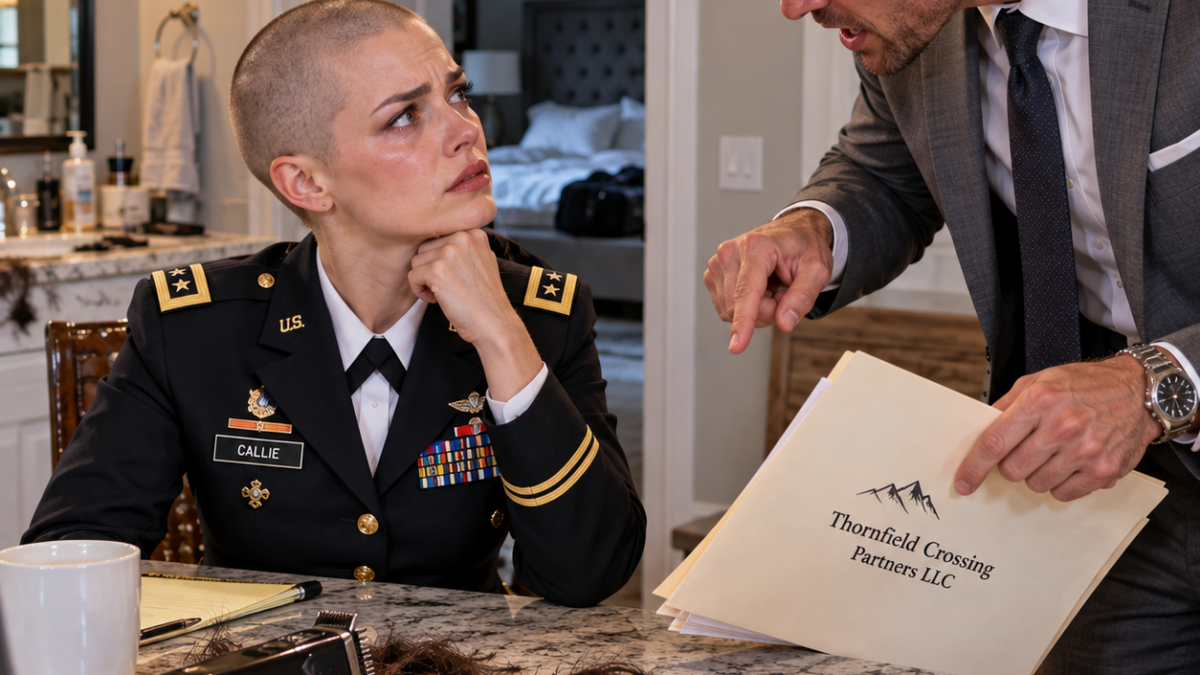
I knew something was wrong before I opened my eyes. My neck felt cold in a way the bedroom air could not explain, and when I reached behind my head for the thick braid I had slept with since college, my palm slid across stubble. I sat upright so fast the room tilted. “What the hell?” The clock beside the bed read 4:52 a.m. Bram’s side was empty, but not merely empty. Made. His pillow sat squared against the headboard like we were staging the house for a real-estate listing. Then I noticed the folded sheet of paper where my head had been. Eleven printed words waited on it: I got tired of looking at the part of you that thinks you’re better than me.
For several seconds, I simply stared at the note. Then I walked into the bathroom. Hair covered the white sink. Dark strands clung to damp porcelain, the bath mat, the counter, even the handle of my toothbrush. Electric clippers were still plugged into the wall. Bram had not cleaned up because cleanliness would have suggested regret, panic, or shame. This was deliberate. He had shaved his sleeping wife’s head, printed a message, dressed, made his side of the bed, and left. That was not a momentary loss of control. It was theater. I stood in front of the mirror studying the woman looking back at me. Thirty-four years old. Army major. Federal contracting officer at Redstone Arsenal. Nine years married. Zero hair.
I should have screamed. Instead, I turned on the faucet and pushed my hair toward the drain with one hand. That was when I noticed the paper Bram had used. He had printed his little masterpiece on expensive stationery. When I flipped it over, faint lettering showed through: Thornfield Crossing Partners LLC. Huntsville phone number. I stopped moving. Bram had been talking about Thornfield for months, always vaguely, always using phrases like development opportunity and family upside. Every time I asked what that meant, he changed the subject or told me not to turn everything into a contracting review. I folded the note again, slipped it into a sandwich bag, and made coffee. At 6:03, my phone lit up with a calendar alert: 2:00 PM — Elk Fork Abstract & Title. Sign documents.
The appointment. Bram had been pestering me about it all week. “Routine paperwork,” he called it. My grandmother’s river tract was somehow involved, but every time I asked what I was supposedly consenting to, he told me I was overcomplicating a simple matter. At seven, I called my supervisor. “I’ll be late.” He paused. “Everything okay, Major?” I looked toward the hallway where the bathroom light was still on, illuminating the clippers Bram had left behind. “No.” My supervisor waited. “But it will be.” I spent the next three hours at the kitchen island with stale coffee, a yellow legal pad, and a turkey sandwich I never opened. Bram’s unexplained trips to Huntsville. Survey flags near Grandma’s land. Construction trucks on the county road. A bulldozed patch on the ridge Bram called utility maintenance.
At 9:41, tires rolled across our gravel driveway. Bram came through the laundry room carrying his good gray suit and a slim folder. He saw me sitting at the island, and his eyes flicked toward my bare scalp before he smiled. “You’re up.” “I noticed.” He placed the folder beside my legal pad. “Don’t make today weird.” I almost laughed. “My head is bald.” Bram opened the refrigerator. “It grows back.” “You assaulted me while I was asleep.” He turned around holding orange juice. “Oh, Jesus, Callie. You’re going to use words like assault now?” “What word would you prefer?” “Haircut.” He said it like I was the unreasonable one, like we were discussing bangs I had not liked. For nine years, Bram had perfected that maneuver.
He would do something cruel. I would react. He would suddenly become calm. Then we would spend hours discussing my tone instead of what he had done. Not that morning. I pointed toward the folder. “What happens at two?” His mouth tightened. “Consent paperwork.” “For what?” “The Thornfield option.” “On whose property?” “Ours.” “No.” He frowned. “My grandmother’s river tract belongs to her trust.” Bram stepped closer. “We’re married, Callie.” “That doesn’t answer my question.” He leaned both palms against the island. “A wife’s name is just a signature nobody has gotten around to using yet.” He was not joking. Not drunk. Not angry enough to claim later he had said something he did not mean. He believed it.
I lifted my coffee. “Two o’clock?” His shoulders relaxed. “Exactly.” “I’ll be there.” Bram bent and kissed my shaved scalp as though he had not caused it. “Wear the blue dress. Solange likes things professional.” I waited until his truck disappeared beyond our mailbox, then called Marla Brassfield, my grandmother’s attorney and trustee. Seventy-one years old, twice widowed, owner of an ancient Buick, and entirely without patience for foolish men. “Happy anniversary, Callie,” she said. “Marla, don’t record anything involving the river property today.” Silence. Then the click of a pen. “What happened?” “My husband shaved my head at four this morning.” A pause. “And?” “He left a note printed on Thornfield Crossing stationery.” The pen stopped. “Bring me everything.”
At 1:52, I walked into Elk Fork Abstract & Title wearing my Army service uniform instead of the blue dress. Bram was already there. So was Solange Bickerstaff, a polished blonde developer in her forties who wore the particular smile of a woman who had already discussed me with my husband. “Major Strathmore. Finally.” Finally. Interesting word. Bram pulled out my chair. “This won’t take ten minutes.” Solange pushed a thick packet toward me. “You can just initial the tabs.” I counted forty-one pages. “You said one.” Bram nodded toward the final page. “The signature page.” I opened page one and began reading. Page nine described six hundred twenty housing units. Page twenty-two referenced potential military-family housing contracts near Redstone Arsenal. Page thirty-one stopped me cold.
Consent and Ratification. My full legal name appeared underneath: Calliope R. Strathmore. Above it sat my signature. Except I had never signed it. The date was June 14. A notary named Bernita Shelnut claimed I had personally appeared before her in Limestone County. I knew exactly where I had been June 14. San Antonio. Government training conference. Four nights in a Marriott paid through official travel. Badge scans. Airline receipts. Travel authorization. Three hundred federal employees. Bram tapped the line. “Initial beside it.” I looked at Solange. “Who brought this document to your office?” Her eyes moved toward Bram. “Your husband.” “Already signed?” Bram interrupted. “Callie.” I kept looking at her. “Already signed?” “Yes.” “Did you ever see me sign it?” Her smile disappeared. “No.”
part2
“Did you ever speak to me before today?” I asked. Solange’s expression stiffened. “No.” I closed the file. Bram pushed a pen toward me. “Sign.” “No.” His face changed only slightly, but after nine years I knew exactly what the change meant. He had expected humiliation to make me compliant. Instead, I had begun asking questions. “Callie.” “No.” Solange leaned back and folded her hands. “The agreement has effectively already been executed.” I looked at her. “Then you don’t need my signature.” Neither of them answered. I asked for a complete copy. Bram objected. Solange hesitated. The title closer, perhaps sensing that she wanted no part of whatever this was becoming, made one anyway. Forty-one warm pages emerged from the copier. I tucked them beneath my arm and walked out.
Alabama heat hit my face like an oven door opening. I stood beneath the bank awning next door and called Marla. “Page thirty-one has my signature.” Her voice changed instantly. “Did you sign it?” “No.” “Where were you on the date?” “Texas.” Silence. Then five words. “Do not go home alone.” My grip tightened around the packet. While I had been focused on what Bram had done to my hair, someone had already taken something larger. Worse, I would learn the next morning that nine days earlier, they had taken me to court without telling me. Marla spread the paperwork across her cramped office above a hardware store. Thornfield Crossing Partners had filed a $40.2 million lawsuit against my grandmother’s trust and against me personally for supposedly backing out of the development agreement.
“There’s more,” Marla said. She turned over the service form. Bram’s signature sat at the bottom beside the words Accepted by spouse. He had received the lawsuit at our house nine days earlier and hidden it. “So the clock has been running?” I asked. “Nine days.” “And he knew?” “He signed for it.” The trust itself kept the situation from becoming immediately catastrophic. Grandma had written it like she expected future generations to marry idiots. The 180-acre Elk Fork tract could not be transferred without written direction from me, acknowledgment before a proper notary, thirty days’ notice, and trustee approval. Marla was trustee. Nobody had notified her. But Thornfield had filed a lis pendens against the entire property. I could not sell, borrow against, or grant an easement without litigating around it.
Then Marla opened Thornfield’s site plan. I recognized the ridge immediately. “They’ve already graded it.” Her glasses came off. “When?” “April.” That got her attention. “Good.” I stared. “Good?” She tapped the plan. “Paper can be backdated. Dirt can’t.” Monday morning, I walked into Colonel Harker’s office at Redstone Arsenal and disclosed everything. The lawsuit. Thornfield. The possible housing contract. My husband. The land. The signature. By nine o’clock, I had been removed from every housing-related file. Three years of work disappeared into a banker’s box. That hurt worse than my shaved head. Nobody punished me. They did exactly what federal ethics rules required. Still, I watched Sergeant Overstreet carry my largest portfolio away and understood what Bram had risked without asking me.
My marriage. My land. My professional reputation. My career trajectory. All because he wanted access to property he did not own and a development arrangement he apparently believed I would eventually ratify if frightened enough. At lunch, my phone showed thirty-seven texts from him. You’re destroying us. It’s paperwork. Stop embarrassing me. Come home and we’ll fix this. I answered none. That evening, while I was staying with my parents, my neighbor Lorraine Bagwell knocked on the door holding her phone. “Callie, I think I photographed your husband doing something you need to see.” Lorraine’s porch camera faced the gravel turnout across from our driveway. She had saved months of clips because construction trucks kept tearing up the county road. The first image was dated April 9.
Bram’s pickup. Solange’s white Mercedes SUV. A surveyor. All three standing near my grandmother’s gate with blueprints spread across Bram’s tailgate. Another clip showed Solange touching Bram’s shoulder. Then kissing him. Not a friendly kiss. Not close. Lorraine winced. “I wasn’t sure if that part mattered.” I stared at the image. “It does now.” The affair hurt, but not the way I expected. By then, I had already watched my husband shave my head, hide a lawsuit, produce a document bearing a forged signature, and risk my federal career. The kiss did not create a new betrayal. It simply explained the energy behind the old ones. Bram was not merely chasing money. He and Solange believed they were building a future that required me to surrender land, credibility, and eventually my place in his life.
I forwarded everything to Marla, then drove to Hallowell Bend. My cousin Sutton met me on a four-wheeler and took me up the ridge. The damage was worse than I imagined. A three-hundred-foot construction pad had been carved through the red clay. Culvert pipe lay stacked near survey stakes. A ninety-year-old post oak had been uprooted and pushed into the spoil pile. That tree stopped me. I sat on a length of pipe for two minutes. No screaming. No dramatic collapse. Just two minutes with my hands between my knees, staring at exposed roots. Grandma used to hang a tire swing from that oak. Bram knew that. Solange did not need to. He did. I stood. “Where’s Grandma’s cedar box?” My father looked at me from the farmhouse porch. “Hall closet.”
Inside the cedar box were ration books, an old pocketknife, a tortoiseshell comb, photographs, and a hand-drawn 1961 survey. We spread it across the kitchen table and held one corner flat with a salt shaker. I compared it to Thornfield’s legal description. Then again. The Elk Fork River had shifted after a major 1974 flood. The property boundary had not. Grandma’s deed followed the old channel. Thornfield’s survey followed the newer riverbank, adding land the trust never conveyed. “They added forty-one acres,” I said. Dad nodded slowly. “Where’s their construction pad?” I measured the drawings. My finger stopped. “Nine acres inside our actual boundary.” Bram and Solange had begun grading not only before valid site control existed, but partly on land their own description did not properly cover.
My mother’s old iPad chimed beside the refrigerator. Bram had once used it while visiting and apparently never logged out of his email. A message preview appeared across the screen. From Solange. Once Callie signs Tuesday, we’re clear. Then you and I can finally stop hiding. I photographed it. Mom watched my face. “You okay?” I locked the tablet. “No.” Then I pulled Grandma’s cedar box closer. “But they aren’t either.” Marla sent one letter. Eleven lines. No threats. No outrage. Just facts. The trust had never authorized Thornfield’s option. My signature was disputed. The property description included land beyond the tract. Construction had started before lawful site control. Nine days later, Anvil Creek Capital, the fund backing Thornfield, called me directly.
Their counsel invited me to a partner meeting in Huntsville. I wore my uniform again. Fourteen executives sat around a glass conference table. Solange stood beside a large screen displaying glossy renderings of six hundred twenty houses. Bram sat three chairs down. He went white when I entered. Anvil Creek’s lawyer began simply. “Solange, explain site control.” She smiled. “Exclusive option in April. Ratification in June.” I spoke. “Who signed the June ratification?” Her eyes found mine. “You did.” “I was in San Antonio.” Nobody moved. “Government travel records put me there.” Bram stood. “This is a marital dispute.” The fund’s forensic accountant rotated her laptop toward the room. “No,” she said. “This is a $61,400 grading invoice dated April 30.”
She looked directly at Solange. “Did Thornfield possess valid site control on April 30?” Solange swallowed. “I’d have to review the sequence.” The accountant enlarged the approval field. Initials: BK. Bram Kessinger. The meeting ended twenty minutes early. In the elevator hallway, Solange grabbed my elbow. “You’re going to cost hundreds of military families homes.” I pulled free. “You bulldozed land you didn’t own.” Her face hardened. “You think this makes you powerful?” “No.” I pressed the elevator button. “It makes you documented.” Three weeks later, despite everything, Thornfield announced a public ribbon cutting. Two hundred chairs. Local press. County commissioner. Barbecue trailer. Brass plaque. Solange was apparently betting on spectacle and momentum doing what valid ownership could not.
Marla called me the morning of the event. “You want to go?” “Yes.” “Take the cedar box.” So I did. I sat near the back while Solange praised economic development, community partnership, military-family housing, and regional growth. Bram sat several rows ahead with his mother, Hattie Kessinger. Hattie was seventy-three and had never liked me enough to hide it, which somehow made what happened later more meaningful. When Solange lifted the ceremonial scissors, I stood. “Before you cut that ribbon, I’d like four minutes.” Every head turned. Bram caught my sleeve as I moved past. “Don’t.” Hattie took his wrist and removed his hand from me. The gesture surprised both of us. I carried Grandma’s cedar box to the podium.
I removed two records. First, the properly recorded revocation of an old power of attorney Bram once held during a deployment years earlier. Second, the subpoenaed notary journal belonging to Bernita Shelnut. “Thornfield’s forty-million-dollar lawsuit relies on a notarized consent dated June fourteenth.” I held the journal up. “On June fourteenth, Ms. Shelnut notarized two documents: a vehicle title and a nursing-home power of attorney. That is all.” Whispers moved through the chairs. “There is no entry for me.” Solange stepped forward. “This is inappropriate.” I looked at her. “So was suing me with a document I never signed.” Bram stood abruptly. “CALLIE!” Two hundred people heard him. I did not look at him.
Anvil Creek’s lawyer rose from the back row. “Solange, have the original consent in my office Tuesday.” Then he left. Dozens of people followed. The county commissioner stepped away from the covered plaque. “I believe I’ll wait on the ribbon.” That evening, Thornfield’s attorney emailed a three-page defamation threat. Marla replied with one sentence: My client read public records aloud. We will happily do it again in court. At 1:03 a.m., Hattie called me. I sat upright in my parents’ guest bed. “I need to tell you what I saw June fourteenth.” My grip tightened around the phone. “You were there?” “Yes.” “Was I?” Silence. Then she said the sentence that finally broke her son’s defense. “I watched Bernita stamp that paper while you were nowhere in the room.”
Hattie agreed to testify. So did Bernita. Once subpoenaed and advised by counsel, Bernita admitted Bram had brought the document already bearing my supposed signature. She notarized it without me present. Her own journal proved she had not entered it as a legitimate act. By then, the forgery was no longer an inference built from travel records. We had witnesses. Bram responded by coming to my parents’ farmhouse at 10:40 on a Tuesday night. I met him on the porch. He looked exhausted, unshaven, and thinner. A part of me remembered loving him. That was the cruel thing about betrayal: it does not erase the history that made it possible. “Solange will dismiss the lawsuit,” he said. “What do you want?” I asked.
“One affidavit.” Of course. He wanted me to swear that I had verbally authorized him to negotiate the property and that the disputed paperwork merely memorialized prior consent. In exchange, he offered two hundred thousand dollars and agreed to surrender any claim to our marital house. I stared at him. “You’re offering me money to validate a forged document?” His face twisted. “Stop calling it forged.” “What should I call my signature when I didn’t write it?” He stepped closer. “Nine years, Callie.” “June fourteenth.” He frowned. “What?” “That’s my answer.” Bram put one hand against the storm door, blocking it. “You will not do this to me.” A flashlight appeared beside the equipment shed. Sutton. “Evening, Bram.” Bram removed his hand immediately.
What Bram did not know was that my parents had installed a new porch camera after package thefts. It recorded everything. The offer. The affidavit. The money. The threat. Two days later, Marla had the file preserved by a digital-forensics technician. At Bram’s deposition, she placed page thirty-one in front of him. “Who signed Callie Strathmore’s name?” His lawyer asked for a break. Eleven minutes later, they returned. Bram folded his hands. “On advice of counsel, I decline to answer.” He invoked the Fifth eleven more times. Solange’s deposition went worse. She admitted she had never spoken with me before the title-office meeting, never independently verified the trust, and never confirmed I had authority to convey the land under the terms she claimed.
Then Lorraine’s April photograph appeared. Solange stared at herself standing beside Bram on my property months before the supposed ratification. “That is me,” she finally said. Eight days later, Thornfield’s attorney withdrew from the lawsuit. I thought that might be the beginning of the end. Then Hattie asked me to come to her kitchen. Three folders sat beside the coffee pot. “Read that clause,” she said. It was a spendthrift provision inside the Kessinger family trust. Any beneficiary who pledged or attempted to assign his interest before lawful distribution automatically forfeited it. Hattie slid another document toward me. A bank guarantee. Bram’s real signature appeared on the final page. The amount secured was thirty-four million dollars.
He had pledged his future interest in Hattie’s trust as collateral months before Thornfield approached me. I stared at her. “He was financially trapped before he forged anything.” Hattie folded her hands. “Yes.” “And you have to enforce this?” “I do.” “He loses his inheritance.” “Yes.” “He’ll blame you.” Her expression barely moved. “He already does.” Hattie personally delivered the forfeiture letter. Twelve days later, she suffered a stroke. She died in an Athens hospital without waking. Her death hurt more than the lawsuit. More than my hair. More than the career disruption. She had chosen truth over protecting her son and never lived long enough to hear the court acknowledge that choice. At the funeral, Bram never looked at me.
Eleven days after Hattie’s burial, we returned to court. Judge Vandermull reviewed government travel records showing I was in San Antonio. Bernita’s journal. Dated camera footage. Lorraine’s photographs. Grandma’s 1961 survey. April grading invoices. The porch recording. Hattie’s sworn deposition. The judge asked questions for nearly two hours, moving slowly through each chain of evidence. Then she ruled from the bench. Thornfield’s $40.2 million claim was dismissed with prejudice. The option was void. The lis pendens against our 180 acres was dissolved. The consent document was formally described as a fabricated instrument. Thornfield and Solange were ordered to pay $140,000 in attorney fees and costs. The matter was referred to appropriate authorities.
Solange turned pale when the judge explained she could face personal exposure beyond the company. Bram stared at the table. I did not smile. I looked instead at the empty chair near the aisle. Hattie had wanted to hear the truth spoken in daylight. She missed it by eleven days. Her son would live with it for the rest of his life. Bram did not challenge the inheritance forfeiture because he could not. The document destroying his trust interest carried his actual signature. His brother and sister received his share. Neither speaks to him now. Anvil Creek withdrew its investment. The bank called the thirty-four-million-dollar guarantee. Thornfield Crossing Partners collapsed before the year ended. Solange lost the company, much of her wealth, and her access to Redstone-related contracting work.
The development died. Months later, a completely different company won the military-family housing project and built it fourteen miles away on land it actually owned. I liked that detail more than I should have. Solange had accused me of depriving military families of housing. In reality, the project survived just fine once separated from fraud, forgery, and my grandmother’s property. My divorce became final April 8. Bram signed each page his attorney marked with yellow tabs. I appreciated the irony. I sold my interest in the house on Tanyard Road, paid the legal bills, and moved permanently into the farmhouse at Hallowell Bend. I was not promoted that year. Fourteen months away from my largest portfolio created a gap in my record. That consequence was real.
Being right does not mean escaping cost. That was one of the hardest lessons in the entire ordeal. I followed the ethics rules, disclosed the conflict, and removed myself exactly when I should have. Still, professional timing does not pause because your husband forges your signature. Colonel Harker called me into his office after the case ended. He handed me a memorandum documenting that I had reported the conflict immediately, requested recusal, and complied with every restriction placed on me. Then he said, “You did it in the right order.” I had wanted promotion boards, glowing reports, maybe some official acknowledgment that losing a year of work had been unfair. Instead, I got one sentence. Strangely, it was enough. Doing it in the right order mattered more than winning quickly.
The next June, Sutton rented a dozer. Dad sat on the tailgate drinking gas-station coffee and criticizing every low spot while we filled Thornfield’s construction pad. We moved dirt back across the scar they had cut through the ridge. Reseeded grass. Reset boundary markers. A local arborist helped us plant two young oaks near the stump of Grandma’s old tree. They looked embarrassingly small beside the empty space. “Give them ninety years,” Dad said. I laughed. Grandma’s 1961 survey went into a frame in the farmhouse hallway. Marla insisted on archival glass. “After what this family put that poor piece of paper through, it deserves better treatment than most elected officials.” I told her that sounded expensive. She told me to stop whining.
Eventually, the clerk returned several original exhibits. The fake consent. Photographs. Copies of the title packet. Bram’s note from the pillow. I kept the court order. I burned the note. Lorraine came over that evening and stood beside me at the fire pit. I unfolded the paper one last time. I got tired of looking at the part of you that thinks you’re better than me. Eleven words. For months, I had treated them like evidence because they showed intent. But once the case was finished, they became something else: the last version of Bram’s voice I was voluntarily carrying. I held one corner over the flame. The page curled brown, then black. Eleven words disappeared faster than I expected. Lorraine handed me a Diet Coke. “Feel better?” I thought about it. “Lighter.”
My hair grew back. Thicker in places, shorter because I chose to keep it that way, and unexpectedly gray near the temples. Mom suggested coloring it. I refused. Not because Bram had taken something from me. Because I no longer wanted the old version of myself exactly as she had been. She had spent nine years apologizing whenever Bram hurt her correctly enough to make her angry. I had become skilled at explaining his behavior in ways that preserved the marriage. He was stressed. He felt excluded from my work. He resented the trust because Grandma never liked him. He felt emasculated by my rank. He was jealous of my career. All those things may have been true. None made me responsible for what he chose to do with them.
That realization took longer than the lawsuit. Legal facts were easier. Either a signature was mine or it was not. Either I appeared before Bernita or I did not. Either the old channel defined the boundary or it did not. Marriage was messier because I kept searching for the moment when Bram became the person who could shave my head while I slept. There was no single moment. There were smaller things. The first time he read my messages without asking. The time he told me my promotion embarrassed him in front of his friends. The first argument where he punched the cabinet beside my head and later said I made him feel trapped. The years of tiny permissions I granted because each seemed too small to destroy a marriage over.
One night after the case ended, I found an old photograph from our fifth anniversary. Bram and I stood beside the Elk Fork smiling beneath Grandma’s cottonwood trees. I remembered that day as happy. Maybe it was. People often want betrayal to rewrite every good memory into evidence of manipulation. I could not do that honestly. Bram had made me laugh. He had cared for me when I had pneumonia. We had once driven six hours for barbecue because we were bored. He was not a monster every minute. That was exactly why leaving took so long. Harm becomes difficult to name when it arrives between ordinary kindnesses. I put the photograph back into the box instead of destroying it. The marriage happened. So did the ending.
Last I heard, Bram found work with a pipeline company outside Cullman. He has never apologized. He has never admitted signing my name. According to someone who still knows his brother, he describes the case as a divorce dispute that got out of hand. Years ago, that would have infuriated me. I would have wanted everyone he met to know the whole record. Now I mostly feel tired imagining how much energy it would take to keep correcting him. The court order exists. The depositions exist. The notary journal exists. The dates exist. My life no longer depends on whether Bram tells strangers an accurate story. I had spent too long needing him to admit what he did because I thought acknowledgment would somehow make the damage more real. It was already real.
Solange’s collapse became local business gossip for months. She blamed Anvil Creek, the bank, county politics, the title company, and eventually Bram. Never herself. She claimed she had been deceived by a married man about his authority. That might have been partially true in the beginning. It stopped being persuasive once evidence showed she knew enough to hide their relationship, proceeded before title control was valid, and pushed a forged consent as though paperwork could substitute for ownership. I never contacted her after court. Once, nearly a year later, I saw her at a grocery store in Huntsville. She was standing near the produce section in leggings and a sweatshirt, looking entirely ordinary. She saw me. I saw her. Neither of us spoke. Sometimes the most complete ending is refusing to reopen a finished case.
Marla retired the following spring. At her retirement lunch, she handed me a copy of Grandma’s trust with a yellow sticky note attached. It read: READ BEFORE MARRIAGE NUMBER TWO. I glared at her. She ate cake. “Too soon?” “There will not be a marriage number two.” “That’s what everyone says right after number one.” My father nearly choked laughing. It felt good to hear laughter around the trust without panic attached. Marla had spent decades protecting my grandmother’s intentions through careful language, and I finally understood why Grandma chose her. Good legal drafting rarely looks dramatic when it is written. It becomes dramatic years later when one line prevents someone from taking what was never theirs.
The land itself recovered slowly. The first spring, grass came back patchy on the ridge. Rain carved channels through the fresh fill. Sutton complained about compaction. Dad blamed the seed mix. Mom blamed both of them for discussing soil through dinner. By the second spring, green covered most of the scar. The young oaks survived. Wild blackberry returned along the lower slope. I began walking there on Tuesday evenings after work with a cold Diet Coke. From the iron marker, I could see the Elk Fork bending through trees below. The river had changed course decades ago. The property line had not. That became a kind of private joke for me. Water moved. Men lied. Companies failed. Boundaries remained where the documents said they remained.
My career recovered more slowly than the land. I eventually received another large portfolio, though not the same one. For a while, I resented that. I had done everything correctly and still watched someone else gain the experience I had spent three years building toward. Then I realized I was repeating an old mistake: measuring the worth of my choices only by whether they protected me from consequences. Ethics do not promise reward. They tell you what order to do things in when every option costs something. Colonel Harker’s sentence returned often. You did it in the right order. Disclose. Recuse. Preserve evidence. Get counsel. Follow process. That sequence had protected me even when it could not preserve every opportunity.
A year after the divorce, I was invited to teach a contracting-ethics seminar for new officers. The organizers knew only the professional portion of my case. They asked me to discuss conflicts of interest and recusal obligations. Halfway through, a captain raised his hand. “Ma’am, what if the conflict isn’t your fault?” I looked at him. “Most conflicts aren’t your fault.” He frowned. “Then why should you lose the work?” “Because protecting the integrity of the decision matters more than protecting your feelings about fairness.” The room grew quiet. I thought about my housing portfolio leaving in a banker’s box. “Doing the right thing can still hurt. If your definition of ethical behavior requires it to be painless, you’re eventually going to invent reasons not to do it.”
Afterward, a young lieutenant caught me in the hallway. “Was that hypothetical?” I smiled. “Mostly.” He looked suspicious but let it go. I did not tell him about Bram, Solange, or the forged signature. Not every scar needs a briefing slide. I returned to my hotel room, took off my uniform, and looked at my reflection. Short hair. Gray at the temples. A face that seemed older than the woman who woke at 4:52 without her braid. For months after Bram shaved me, I hated photographs of my own head. The haircut made me feel exposed. Eventually, it became simply how I looked. That was another thing he failed to understand. Taking something from someone does not guarantee you get to define what remains.
Mom eventually asked whether I wanted Grandma’s old bedroom at the farmhouse remodeled. “Why?” “You live here now.” I looked around the room with its floral wallpaper and dresser that had belonged to three generations of women. “No.” She frowned. “You hate this wallpaper.” “I do.” “Then why keep it?” I touched the edge of Grandma’s cedar box. “Because not every old thing has to be replaced just because something bad happened nearby.” Mom considered that. “That sounds suspiciously wise.” “Don’t spread it around.” We kept the wallpaper. I bought a new mattress. Life does not always need renovation. Sometimes you just need a lock that belongs to you.
One afternoon, I found the blue dress Bram told me to wear to the title office. It was still hanging in a garment bag at the back of my closet. I had bought it for an anniversary dinner years earlier. Nice dress. Nothing wrong with it. Yet seeing it made my stomach tighten because I remembered Bram kissing my bare scalp and saying Solange liked things professional. For a minute I considered throwing it away. Then I wore it to Marla’s retirement dinner. She saw me and raised an eyebrow. “That the dress?” “Yep.” “Petty.” “Therapeutic.” She laughed. Reclaiming objects is a strange kind of victory. The dress stopped belonging to Bram’s plan the moment I chose another memory for it.
Sutton married the following summer. At the reception, his wife asked whether I wanted to catch the bouquet. “Absolutely not.” She laughed. Bram’s sister was there because rural Alabama family trees occasionally create guest lists nobody can untangle. We nodded politely from opposite sides of the room. Later she found me near the lemonade. “I’m sorry about Mom,” she said. Hattie. My chest tightened. “Me too.” She looked down. “She knew Bram would hate her for enforcing the trust.” “I know.” “She did it anyway.” I nodded. “That mattered.” His sister looked toward the dance floor. “He says she betrayed him.” “Truth feels like betrayal to people who expected protection from consequences.” She looked at me. “You rehearse lines like that?” “Occupational hazard.”
We both laughed, though neither of us found the situation funny. Before leaving, she handed me Hattie’s old recipe for cornbread. “Mom wanted you to have something that wasn’t evidence.” I almost cried in the parking lot. Not during court. Not when Bram invoked the Fifth. Not when the judge dismissed the forty-million-dollar claim. Cornbread nearly took me out. Grief is rude like that. It ignores the moments when tears would make narrative sense and ambushes you beside a pickup truck. I drove home with the recipe on the passenger seat and made it the following Sunday. Dad complained it needed more salt. Mom told him Hattie could still haunt him. He added butter and stopped talking.
Two years after the divorce, I received promotion orders. Not on the schedule I once expected, but they came. Colonel Harker called me before the official announcement. “You’re going to act surprised.” “Sir, I am surprised.” “Then you’re a better actress than I thought.” At the small office ceremony, my parents attended. Sutton came. Lorraine came wearing a dress that looked suspiciously purchased for the occasion. Marla appeared twenty minutes late because she claimed retirement meant clocks were now advisory. When the new insignia was pinned on, I thought briefly about Bram telling me the part of me that thought I was better than him needed to disappear. He had misunderstood confidence as contempt because equality had never felt safe to him.
I did not become stronger because he shaved my head. I dislike that kind of story. Trauma does not automatically improve people. Sometimes it simply hurts them. What made me stronger were the decisions afterward. Calling Marla. Reading forty-one pages. Saying no when signing would have been easier. Reporting the conflict before anyone could accuse me of hiding it. Accepting the damage to my career rather than protecting appearances. Letting other people preserve evidence. Trusting professionals. Letting Bram expose himself rather than trying to win every argument. Strength was not a personality trait revealed by suffering. It was a sequence of choices I kept making while frightened, angry, exhausted, and occasionally unsure whether I was ruining my own life.
There were nights I doubted everything. One in particular, before Hattie called, I sat in my parents’ kitchen at midnight staring at the lawsuit. Forty million dollars is an absurd number when printed beside your name. Even when lawyers tell you a claim is weak, seeing that amount attached to a complaint makes your body react. I imagined losing the land. Losing security clearance. Losing my career. Bram telling everyone I was unstable. Solange finishing the subdivision and hanging some polished sign on Grandma’s ridge. Mom came in for water and found me crying silently. She sat across from me. “You can be scared and still be right,” she said. I wrote that sentence down later. It became more useful than most legal advice.
Fear had been Bram’s real strategy. The shaved head was not about hair. It was about destabilizing me before the meeting. The hidden lawsuit was about shrinking my response time. The forged consent was about creating momentum. The grading work was about making the project look too advanced to stop. The forty-million-dollar claim was about turning resistance into financial terror. His offer on the porch was about giving me a smaller pain in exchange for legitimizing the larger fraud. Once I saw the pattern, I understood why he hated documentation. Documentation slows panic. It breaks one overwhelming disaster into dates, signatures, locations, and questions. Bram needed me reacting to everything at once. Marla taught me to respond one fact at a time.
That habit stayed. Years later, whenever something went wrong professionally, I still reached for a legal pad. What happened? When? Who knew? What document controls? What is assumption and what is evidence? Some colleagues joked about it. One called the yellow pads my emotional support stationery. Maybe they were. Writing facts down gave me back scale. A thirty-seven-text message barrage became thirty-seven unanswered messages. A threat became preserved footage. A betrayal became a photograph with a timestamp. A forged signature became a date when I was eight hundred miles away. There is power in refusing to let someone else choose the unit of measurement for your fear.
The river property changed too. We eventually placed most of it under a conservation easement that still allowed farming and limited family use while protecting the ridge from large-scale development. That decision surprised some relatives who assumed winning the case meant I would eventually cash out. I could have sold the tract for far more after clearing the title. I did not. Grandma did not preserve the land so I could prove a point to Bram by becoming the developer he failed to be. I wanted the river to remain a river. I wanted those young oaks to have a chance at ninety years. I wanted children in the family to understand that ownership can mean responsibility rather than extraction.
Once, during a conservation meeting, an appraiser asked whether my attachment to the land was emotional. “Very,” I said. He seemed surprised by the answer. People sometimes think emotion makes decisions irrational. Emotion is information too, if you know where it belongs. I did not use sentiment to rewrite the boundary. The 1961 survey did that. I did not use grief to prove forgery. Travel records and witnesses did that. But love explained why I fought instead of selling my interest and walking away. Evidence told me what was mine. Emotion told me why keeping it mattered. Bram had never understood either distinction. To him, ownership was the ability to use something before another person stopped you.
Solange once told me I was going to cost military families homes. That accusation stayed with me because my work at Redstone genuinely mattered. For weeks, I questioned whether stopping Thornfield might delay needed housing. Eventually, the replacement project proved what should have been obvious: a good purpose does not purify a corrupt process. You cannot build public trust on forged consent because you promise families kitchens and playgrounds. Ethics do not become optional when the rendering looks noble. The replacement developer did the surveys, acquired the land, disclosed ownership, competed properly, and built the homes elsewhere. No one lost housing because I refused fraud. Solange lost control because she assumed mission language could disguise private theft.
My relationship with my parents changed after everything. Dad became strangely protective of the property line. He bought iron markers heavier than necessary and checked them after storms as if Thornfield might return at night with survey equipment. Mom kept Grandma’s cedar box on a shelf in the hallway. Sometimes I caught her dusting it. Neither asked whether I planned to marry again. That was a kindness. They saw more than I had wanted them to see during the case: the fear, the career damage, the humiliation of having my marriage dissected through exhibits. Families like tidy endings because tidy endings let everyone relax. Mine learned to tolerate an unfinished one.
Bram’s assault was never undone. The forgery could not be un-forged. Hattie stayed dead. The promotion delay stayed in my record. Grandma’s old oak did not grow back. Winning did not restore what had been taken. But winning was never really about restoration. It was about refusing to allow the damage to become authority. Bram cut my hair. He did not get to decide what I signed. He hid the lawsuit. He did not get to decide whether I responded. He forged my name. He did not get to own it. That distinction became the center of my life afterward.
Some Tuesday evenings, I still walk to the ridge carrying a cold Diet Coke. I stop beside the iron boundary marker where Thornfield once planned a line of houses. Below me, Elk Fork bends through the trees. On summer evenings, mosquitoes rise over the low ground. In winter, the river turns dark beneath bare branches. The channel does not follow the old survey anymore. It shifted half a century ago. The property line did not. Neither did Grandma’s recorded deed. Neither did the notary dates. Neither did the travel records. Neither did my name.
I think about Bram in our kitchen saying, “A wife’s name is just a signature nobody has gotten around to using yet.” At the time, the sentence frightened me because I heard possession in it. Now I hear ignorance. A name is not an available blank. Consent is not implied by marriage. Ownership does not transfer because one spouse finds paperwork inconvenient. Trust does not equal authority. Love does not create a power of attorney. Marriage does not erase the legal existence of the person standing beside you. Bram learned those things in the most expensive way possible.
It cost him his marriage.
His inheritance.
His relationship with his siblings.
His business connections.
The development.
The woman he risked everything for lost her company trying to steal ground that never belonged to either of them.
People sometimes ask whether that feels like justice.
I usually say yes, with qualifications.
Justice is not the same thing as balance.
Nothing that happened to Bram gives Hattie another day.
Nothing Solange lost replants Grandma’s old oak at ninety years old.
No court order gives me back the career year I lost.
But justice put the boundary where it belonged.
It gave the trust back control of the tract.
It put the forged document into the record for what it was.
It forced people who depended on ambiguity to live with dates.
That mattered.
One autumn evening, I stood on the ridge while the farmhouse lights came on below. Mom was cooking dinner. Dad had the radio playing through the screen door. Sutton’s truck was parked near the barn because he had stopped by to help repair fencing. Grandma’s cedar box sat inside where it belonged. My phone was silent. No messages from Bram. No lawyers. No emergency title meeting. Just crickets, river noise, and the smell of wood smoke drifting from somewhere down the valley.
I set my drink on the fence post.
For years, I thought freedom would feel dramatic.
It did not.
It felt like nobody waiting at home to explain why my anger was the real problem.
It felt like sleeping without wondering who might touch me while I was unconscious.
It felt like documents carrying my real signature and no one else’s.
It felt like a locked door I chose.
A haircut I chose.
A career I still owned.
A piece of land whose boundary could be found on a survey older than my marriage.
I picked up the Diet Coke and started downhill.
Halfway to the farmhouse, I stopped and looked back once.
The ridge was green again.
The young oaks moved slightly in the evening wind.
The construction pad was almost impossible to see unless you knew exactly where to look.
That seemed right.
Scars do not have to remain the most visible thing about a place.
Or a person.
I walked the rest of the way without turning around.
There was nothing left on that ridge I needed to fight for.
The land was secure.
The lie was documented.
The forged signature was void.
The marriage was over.
My name was still mine.
And after everything Bram had tried to take, that was the part he never understood.
It had always been mine.