.The Scar My Cousin Mocked Was the First Thing That Made His Commander Look at Me Differently.
part2
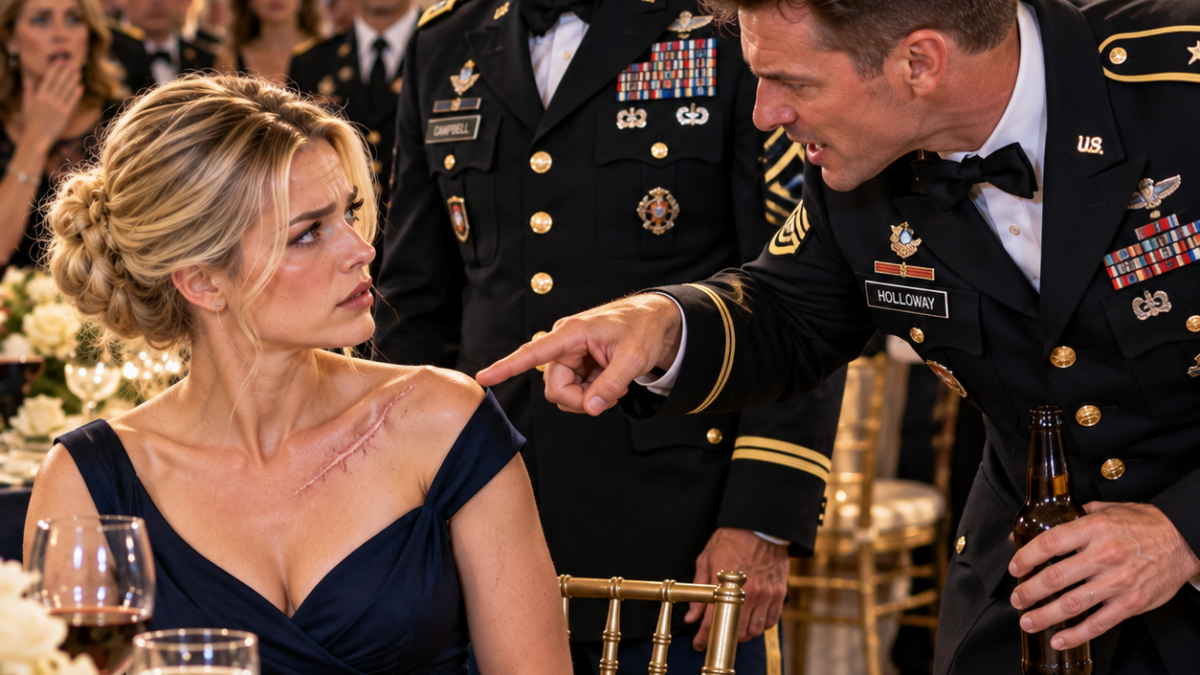
Colonel Nathan Keene stood less than six feet away with the unit’s senior enlisted adviser and another officer. He was in his late fifties now, silver-haired, tall, with the kind of expression that made people stop embellishing stories when he entered the room. Evan straightened immediately and started explaining that we were cousins sharing a harmless family joke. Keene barely seemed to hear him. His eyes settled on my face, then on the scar across my collarbone. I watched recognition move slowly through his expression.
“Mara Bell?”
I had last seen Nathan Keene six years earlier in a military hospital. He had been a lieutenant colonel then, exhausted and frightened, both hands wrapped around a paper coffee cup he never drank from. His younger brother, Owen, lay in a bed ten feet away recovering from injuries everyone initially believed might kill him.
Keene took one careful step closer.
“Captain Bell,” he said quietly, “my brother is alive because you brought him out of that convoy.”
The room did not actually become silent all at once. That is something stories exaggerate. Plates still moved. Someone near the bar laughed at something unrelated. A server asked whether a guest wanted more water. But the space immediately around us changed. Evan’s face tightened. Uncle Dean stopped moving. One of the soldiers who had laughed looked at the floor.
“It’s good to see you, sir,” I said.
Keene shook his head slightly. “We tried to contact you after your medical retirement. I was told you preferred privacy.”
“I did.”
“Owen still talks about you.”
The familiar pressure returned beneath my ribs.
“Tell him I’m glad he’s doing well.”
Evan finally found his voice. “Captain?”
The word sounded strange coming from him.
Keene looked toward him. “Do you understand who you were speaking to?”
I interrupted before the moment became something theatrical. “Sir, I’m here because Evan is family. My previous service isn’t relevant to his recognition.”
That was true.
I had not come for applause. I did not want forty people hearing the story of the worst afternoon of my life because my cousin had made a cruel joke. I did not want strangers turning toward the scar and deciding it belonged to them now that they knew what caused it.
Keene understood immediately.
He stepped aside.
But he did not let Evan leave.
“Sergeant Holloway, remain here.”
Command Sergeant Major Alicia Warren took out a small notebook. The younger soldiers who had witnessed the exchange were quietly separated and asked what they had seen. Keene’s reaction was not dramatic. That almost made it worse for Evan. A public explosion can be dismissed later as temper. A commander calmly documenting conduct is harder to escape.
Across the room, Mom stared at me with tears in her eyes.
Dean approached.
“You were really a captain?”
I looked at him.
“Yes.”
“I thought you were civilian support.”
“I was later.”
Evan shook his head. “You hid it.”
I stared at him.
“What?”
“You deliberately hid this so I’d look stupid.”
There it was.
The family machinery trying to repair itself.
He mocked me.
Someone corrected him.
Now I had somehow caused the humiliation.
“I didn’t make you say those things.”
His mouth opened.
Closed.
Command Sergeant Major Warren returned with her notebook.
The matter had become professional.
Not because of my old rank.
Because a soldier had publicly mocked and physically touched a guest after being told to stop, in front of subordinates, at an official function.
Mom followed me into the hallway when I stepped out for air.
“Why didn’t you tell Evan you were an officer?”
I turned.
“You knew.”
“I knew you had responsibility overseas.”
“You sat beside my hospital bed.”
“I didn’t understand…”
“What?”
She looked down.
“How important it was.”
That sentence hurt more than Evan’s joke.
Not because I needed Mom to consider me important.
Because she still thought importance was the relevant issue.
If I had been a private instead of a captain, would the scar have deserved less respect? If I had been injured changing a tire instead of pulling someone from a convoy, would Evan have been entitled to touch me and laugh?
Mom dabbed at her eyes.
“I thought those complicated things were behind you.”
“So did I.”
Before she could answer, Uncle Dean appeared.
He wanted me to speak privately with Evan and tell Colonel Keene that everything had been family humor. “You don’t understand what you could cost this family,” he said.
Then he corrected himself.
“I mean Evan’s future.”
I studied him.
Something about his urgency felt wrong.
Too large for the situation.
Evan might receive counseling, reprimand, maybe other administrative consequences depending on what witnesses reported. But Dean sounded frightened in a way that did not match a stupid joke.
“I won’t lie to his commander.”
Dean’s jaw tightened.
“You always have to make everything difficult.”
“No. I’m just not making it easier for you.”
I returned to the dining room because I had left my clutch at the table. Colonel Keene waited nearby. He apologized for recognizing me publicly and handed me a card with Owen’s contact information. Then he noticed the Ridgeway logo on the folder beneath my arm.
“Ridgeway Logistics?”
“Yes.”
“You’re doing compliance work?”
“Yes.”
He hesitated.
“Fort Bellamy’s vehicle-maintenance supply chain?”
I looked at him.
“I can’t discuss an active review.”
“Good.”
His expression changed.
“There have been concerns about equipment acceptance records here.”
He did not say more.
Neither did I.
Then Keene said something that stayed with me.
“Whatever your current work involves, keep it completely separate from what happened tonight.”
“I will.”
I left shortly afterward.
Rain had started by the time I reached the parking lot. Evan came jogging out after me, tie loosened and polished shoes splashing through shallow water.
“Mara.”
I opened the car door.
He caught the edge of it.
“Please tell Keene I was joking.”
“I told him you were family.”
“That’s not enough.”
“You’ll answer whatever your command asks.”
His grip tightened.
“You don’t understand. Dad’s business depends on things staying normal here.”
I stopped.
“What does that mean?”
Evan seemed to realize what he had said.
He released the door.
“Nothing.”
“Evan.”
“I’m sorry, okay?”
The apology had the structure of a negotiation.
Not remorse.
I got into the car.
His final sentence followed me all the way to the gate.
Dad’s business depends on things staying normal here.
The next morning, I opened my work laptop and reviewed the unfinished inspection reports from the week before. Holloway Vehicle Solutions appeared on several subcontractor schedules. That was not surprising. Dean had spent years building regional government business. What caught my attention was the number of recent deliveries accepted without the supporting inspection photographs normally required.
I marked the discrepancies and notified my supervisor, Denise Walker.
I did not mention the banquet beyond disclosing the family relationship.
By lunchtime, Denise removed me from reviewing those specific transactions until legal could evaluate whether my relationship created a conflict.
That was frustrating.
Necessary.
Professional.
Two days after the dinner, Mom called three times. Dean left a voicemail asking me to come to Sunday lunch. Evan sent a message promising never to joke about my injury again.
I answered none.
That evening, Denise called.
“Government investigators requested access to several supplier records. They want to speak with you.”
“As an analyst?”
“As a potential witness.”
I sat upright.
She continued.
“They also asked you to bring your current signature authorization.”
Three days after Evan mocked my scar, I sat across from Special Agent Celia Park of Army Criminal Investigation Division.
She placed a government receiving certificate on the table.
Then an inspection summary.
The paperwork supported payment for twenty-four replacement brake assemblies.
My printed name appeared beneath the certification.
My Ridgeway credentials were listed correctly.
And at the bottom sat a signature that looked almost exactly like mine.
Park asked, “Did you inspect or approve this shipment?”
I looked at the date.
That week, I had been hundreds of miles away attending Hannah Ruiz’s memorial service.
“No.”
Park turned another page.
Beneath the signature, somebody had identified me as a medically retired Army captain and Silver Star recipient.
I stared at the line.
Someone had known exactly who I was long before Evan pretended otherwise.
Park showed me three more documents. Together, they created the appearance of a clean transaction. Shipment received. Inspected. Approved. Paid.
The problem was that my signature appeared as the independent compliance attestation.
The Army receiving representative was listed as Staff Sergeant Evan Holloway.
I leaned closer.
Arrival February 12.
Accepted February 13.
Cleared February 16.
Efficient.
Suspiciously efficient.
The contract required verification of manufacturer markings for each assembly.
“Did you know your cousin worked these deliveries?” Park asked.
“Not specifically.”
“He never discussed them?”
“He mostly discussed how unimportant my job was.”
Park wrote something down.
She asked about Holloway Vehicle Solutions.
I explained Dean owned it.
I explained he had been asking casual questions about the Ridgeway review.
I explained that I had never served as a consultant, inspector, technical adviser, or compliance representative for his company.
Then Park showed me something I recognized.
A legitimate deficiency notice I had issued eighteen months earlier.
I remembered the case immediately. Broken inspection seals on a shipment transported by one of Dean’s commercial subcontractors. I had required corrective documentation before acceptance.
Dean called me furious that afternoon.
He said I was threatening a customer relationship over “a paperwork technicality.”
I refused to withdraw the notice.
The corrective work was eventually completed.
I assumed that was the end.
It wasn’t.
Someone had copied the bottom portion of that old notice.
My signature.
Employee identifier.
Formatting.
The copied signature had been resized slightly, but a tiny gray blemish from the original scanner appeared beside the final letter of my name.
The same blemish appeared on the false certificates.
“Did Dean ever receive the original document?” Park asked.
“Yes.”
“Directly?”
“Yes.”
For the first time, anger arrived.
Not family irritation.
Not humiliation.
Something colder.
Dean had spent years laughing at my job while apparently preserving the one document that allowed someone to borrow my professional credibility.
Park could not share the full investigation, but she confirmed preliminary warehouse counts did not match some recorded quantities. Several parts supposedly supplied as new showed indications of prior use or refurbishment.
I completed a written denial without speculating about motive.
Outside, I sat in my car beneath a sycamore tree and called Denise.
She listened.
Then said, “Mara, understand something. If your credentials were used to validate false inspections, whoever did it may try to make you part of their defense whether you cooperate or not.”
Ridgeway legal preserved my original notice, emails, metadata, and distribution history.
Dean’s company had received the legitimate notice directly.
There was no mystery about where the copied signature came from.
At six that evening, a woman named Lena Ortiz called my office.
She worked quality control at Fort Bellamy.
Nine years.
Precise voice.
Tired.
She asked if I was the Mara Bell whose name appeared on the certificates.
“Yes.”
She exhaled.
“I told them those parts didn’t match the specifications.”
I sat straighter.
“What happened?”
“They told me an outside expert had already approved everything.”
“And they showed you my name.”
“Yes.”
Lena had submitted discrepancy reports.
Twice.
Both came back with instructions to verify quantities against paperwork instead of opening sealed containers.
Her supervisor warned that repeated objections could affect supply schedules and contractor relationships.
She kept copies.
“My dad used to say a signed warning is worth more than twelve conversations nobody remembers.”
“Your dad was smart.”
“Annoying. But smart.”
I referred her through the proper investigative channel instead of requesting anything directly.
Still, I could not stop thinking about her.
One person standing inside a warehouse saying something was wrong while everyone around her preferred the clean paperwork.
I knew that feeling.
Mom left another voicemail that evening.
She asked me to come home before the situation became impossible to repair.
Then she added, “Dean has helped this family many times. He deserves a chance to explain.”
I preserved the message.
The next morning, Park requested a second interview.
Investigators had obtained files from Holloway Vehicle Solutions.
Among supplier certificates was a folder labeled BELL, MARA.
Inside were copies of my old Ridgeway notice.
Military background information.
Former rank.
Abbreviated service history.
The public citation for my Silver Star.
Some of it was obtainable publicly.
Then Park turned the folder over.
A handwritten note appeared on the front.
I knew the handwriting before I finished reading it.
My mother’s.
For Dean—everything Mara received after coming home.
I stared at the blue ink.
Mom opened the front door before I reached the porch that afternoon.
She was wearing the cream cardigan my father used to call her Sunday sweater. The house smelled like coffee and cinnamon toast. Most of the photographs now showed Evan in uniform. One old picture of my college graduation sat partly hidden behind a plant.
I put the photocopy of her note on the kitchen table.
“Why?”
Mom looked at it.
Then at me.
“Dean needed information about family members who had served.”
“For what?”
“A veteran-employment contract. Transportation support. I don’t remember.”
“You gave him my medical retirement documents.”
Her hands tightened.
“I thought it was family.”
That word.
Family.
The universal solvent used whenever someone wanted something they knew they could not request honestly.
“Did he pay you?”
Mom recoiled.
“No.”
Then she looked toward the breakfast nook roof.
The one repaired after storm damage two years earlier.
Dean had paid fourteen thousand dollars for repairs after insurance denied part of the claim.
Mom never told me.
“He helped me,” she whispered.
“And later he asked for my records.”
“Yes.”
“You knew I didn’t want those shared.”
Tears filled her eyes.
That made the answer worse.
Because she understood the boundary.
She simply decided gratitude to Dean mattered more.
I gave her a tissue.
Then forced myself not to comfort her so thoroughly that the real conversation disappeared.
“Did you know he was using my credentials?”
“Not then.”
“Then when?”
She looked away.
“Last month.”
My body went still.
“What happened?”
“Dean said your name was on some paperwork.”
“And?”
“I asked if you knew.”
“What did he say?”
“That everything was authorized. That you were too busy to discuss routine things.”
“You believed him.”
“I wanted to.”
There it was.
The sentence that explained half my family.
She wanted the comfortable explanation.
“Why didn’t you call me?”
No answer.
Before I left, Mom said she had been afraid of losing Dean’s support as she got older.
I understood fear.
I understood debt.
I understood loneliness.
I also understood she had my phone number.
“You could have asked me.”
She cried harder.
“You didn’t have to choose between him and me until you decided I wasn’t entitled to know.”
The investigation expanded after a training vehicle experienced severe braking problems during a maintenance movement. The driver managed to stop against a gravel embankment. One soldier suffered a broken wrist. The vehicle took significant damage.
Investigators had not yet established whether the suspect assemblies caused the failure.
But verifying their origin suddenly became urgent.
Several vehicles were taken out of service.
Training schedules changed.
Maintenance crews worked long hours inspecting equipment that paperwork had already declared safe.
Ridgeway reassigned my work because I could no longer touch transactions involving the supplier.
Nobody blamed me.
Nobody accused me.
Still, documenting years of family conversations for legal review was humiliating.
Dean’s jokes.
Evan’s questions.
Their sudden interest in my assignments.
I realized how many warnings I had ignored because familiar voices wrapped them in normal family irritation.
Lena provided her discrepancy reports.
She also had photographs showing mixed manufacturer markings inside containers labeled as a single approved batch.
Commercial records suggested several serialized assemblies had been refurbished by an unauthorized supplier, despite being billed as new approved parts.
The price difference was substantial.
Money suddenly had a shape.
One afternoon, Denise closed her office door.
“Ridgeway’s internal review found no evidence you approved these shipments.”
I exhaled.
“But this will take time.”
“I know.”
“You’re keeping your position.”
“That wasn’t my biggest concern.”
She nodded.
“I know.”
I went to the restroom anyway and stood at the sink with cold water running over my hands.
Someone might have put unsafe equipment into service because a document carried my name.
That frightened me in a way losing a job never could.
I remembered the canal crossing.
Not the medal.
Not Colonel Keene.
The vehicle.
The sound it made when everything went wrong.
That night, I pulled out an old photograph of our convoy team. Hannah stood on the left with one arm around Owen Keene. I was squinting into the sunlight, clipboard beneath my arm.
We looked ordinary.
That was what military service usually looked like before the moment everyone later called heroic.
Ordinary people checking straps.
Counting supplies.
Complaining about heat.
Arguing about fuel.
Then something fails.
And suddenly the tiny details matter.
Friday morning, Agent Park called.
Investigators had recovered messages between Evan and Dean discussing Ridgeway before the banquet.
They worried I might recognize irregular shipment numbers.
Park could not give me the full exchange.
But she confirmed something that changed everything.
Evan knew about my military history before the banquet.
He knew I had been a captain.
He knew I was decorated.
He knew enough about my current professional background to understand I could cause trouble.
I sat very still.
“So why mock me?”
Park paused.
“We’re examining whether the confrontation was intended to undermine your credibility.”
The room seemed to shift.
For years, I had assumed Evan belittled me because he genuinely thought I was insignificant.
Now I had reason to believe he was frightened that I wasn’t.
His apology letter arrived Monday.
Handwritten.
He blamed alcohol.
Excitement.
Our family’s strange sense of humor.
He said he had never understood how serious my injury was or how distinguished my service had been.
A lie.
Investigators had documents proving he knew.
The letter ended by asking me to tell Colonel Keene we had resolved everything privately.
I scanned it for legal counsel.
Gave the original to Park.
Then returned to comparing invoices for municipal maintenance vehicles.
By lunch, I understood what bothered me most.
Evan never apologized for touching me.
Never apologized for humiliating me.
Never apologized for encouraging younger soldiers to laugh.
He apologized because consequences had arrived.
Two days later, Aunt Paula appeared at my townhouse carrying a casserole wrapped in foil.
She said she was not there to defend Evan.
She wanted to tell me Dean had become secretive about company finances over the previous year.
Unusual transfers.
Consulting fees.
Arguments.
“Why are you telling me this now?”
Paula looked down.
“Because I heard Dean and Evan arguing before the banquet.”
I waited.
“They were talking about you recognizing shipment numbers.”
My hand tightened around the doorframe.
“What exactly did they say?”
Paula swallowed.
“Evan said the deliveries were outside your normal responsibilities, so you probably wouldn’t look closely.”
“And Dean?”
She looked sick.
“He said the safest thing was making sure nobody at Fort Bellamy considered you reliable.”
I stared at her.
Paula continued.
“I heard Evan say, ‘If she gets upset enough in front of the colonel, nobody will take her accusations seriously.’”
The joke.
The scar.
Touching me.
Blocking my path.
The younger soldiers.
The audience.
It had been deliberate.
Maybe not every word.
But the confrontation itself.
They wanted me angry.
Emotional.
Uncontrolled.
They wanted witnesses remembering me as the unstable cousin who ruined Evan’s recognition dinner.
Instead, Colonel Keene recognized me.
Their plan collapsed in the exact room where they intended to weaken me.
I told Paula to take everything directly to investigators.
She agreed.
Before leaving, she apologized for years of watching Dean and Evan belittle me.
“I told myself you didn’t care.”
I looked at her.
“I stopped arguing.”
“I know.”
“That isn’t the same thing.”
“No.”
After she left, I sat at my kitchen table and remembered the canal crossing.
The explosion had disabled our lead vehicle beside a narrow road near water. Gunfire scattered the convoy. Hannah coordinated defensive positions while I moved between wounded soldiers. Owen Keene was trapped beneath part of a damaged vehicle door.
I crawled through broken glass to reach him.
A metal fragment struck near my collarbone while I dragged him clear.
For several seconds, I lost feeling in my left hand.
I kept moving because someone else nearby needed help.
That was the action behind the scar Evan touched.
I received the Silver Star afterward, although the citation never captured the chaos accurately. Hannah kept communications functioning under fire. Medics treated people in mud. Helicopter crews risked themselves reaching us.
Seven people survived who were not expected to.
I accepted the medal because refusing would have felt disrespectful to everyone who submitted the nomination.
Then I spent years not talking about it.
My family turned that silence into emptiness.
Dean and Evan turned the emptiness into camouflage.
They privately borrowed authority from the career they publicly mocked.
The technical investigation found more problems.
A replacement assembly installed on the damaged training vehicle did not meet approved specifications. Investigators still had to determine the exact failure sequence, but markings were consistent with parts from the questionable shipments.
Deliveries were restricted.
Reviews expanded.
Costs increased.
That is what happens when somebody decides inspections are an inconvenience.
Mom called crying because Evan had been removed from receiving duties and Dean’s customers were asking questions.
Then she said something that ended our relationship as I had known it.
“Could you tell them the signatures might be yours?”
I said nothing.
She rushed forward.
“Not lie. Just leave room for a misunderstanding.”
“You want me to tell investigators I might have forgotten signing government documents.”
“People forget things.”
“I was at Hannah’s memorial.”
“You’ve had trauma, Mara. Memory can—”
I cut her off.
“Do not use my injury to help them explain a forgery.”
Silence.
Then I understood.
Her fear of losing Dean’s support had become stronger than her willingness to protect me.
“I won’t discuss the investigation with you again.”
“Mara—”
I ended the call.
Then documented it for Park.
The next morning, another discovery arrived.
Months before the banquet, a quality supervisor had issued an internal warning about inconsistent serial numbers, questionable manufacturer labels, and equipment represented as new after refurbishment.
The warning went to the maintenance coordination office where Evan worked.
The response said the issue had already been resolved by an independent compliance specialist.
Me.
Except the warning predated the first false certificate.
They had not created one forged approval after a careless shipment.
They had created a trail.
A false history.
A record designed to make later questions appear already investigated.
My name was not merely being used to collect money.
It had been positioned to absorb blame.
By the following month, Holloway Vehicle Solutions stopped receiving new government orders under the affected agreements. Investigators began examining years of transactions.
Dean publicly called it a misunderstanding involving administrative procedures.
Paula moved out.
Evan stopped contacting me directly.
Family gossip carried the rest.
Then Mom invited me to lunch.
She neglected to mention Dean would be there.
I saw his truck and nearly left.
Instead, I went inside.
Three place settings waited on the kitchen table.
Dean sat with a folder.
Mom stood at the stove pretending the lunch was normal.
Dean began by saying he respected my service and regretted the “misunderstanding” over the inspection documents.
Then came the explanation.
Outside refurbishing vendors.
Junior employee.
Template error.
Evan trusted routine paperwork.
Everything accidental.
I listened.
Then asked why the false approvals carried dates when I was not working.
Why my copied signature came from a document his company received directly.
Why warnings existed before the approvals.
Why payments were made to Evan.
Dean leaned forward.
He had a solution.
Of course he did.
He pushed a statement toward me.
If I signed it, I would acknowledge that I had provided informal technical assistance to Holloway Vehicle Solutions in prior years.
“This is false.”
“We can adjust the language.”
“It says I consulted for your company.”
“You helped us before.”
“I issued a deficiency notice.”
“That’s still technical input.”
“No.”
His expression hardened.
“You think you’re better than everyone because a colonel remembered your name?”
I stared at him.
He still did not understand.
“This has nothing to do with Colonel Keene.”
Mom set soup in front of me.
“Please. We need to save what this family built.”
I looked at her.
“Someone was injured.”
“We don’t know Dean’s parts caused that.”
True.
But she said it like relief.
Like uncertainty canceled danger.
Dean showed me a payroll summary.
Names of employees.
Families.
Wages.
People who might lose jobs if the company failed.
Their livelihoods mattered.
But using employees as emotional shields after management created the risk was another kind of dishonesty.
“I won’t sign anything.”
Dean warned the company could collapse.
Mom cried.
I stood.
“If your explanation is true, give it to investigators.”
Then I left the soup untouched.
Colonel Keene called before I reached the end of the street.
He wanted to make sure nobody at Fort Bellamy was contacting me improperly.
I told him Park knew about the pressure.
Then he said Owen would be in Georgia and wanted to see me.
I almost refused.
I did not want another conversation about my military past.
Then Keene explained Owen was developing a transportation-career program for disabled veterans.
That changed things.
We met at a quiet restaurant outside Savannah.
Owen arrived with a cane, faded blue shirt, and baseball cap from his old unit. He was forty-three now. The terrified young sergeant I remembered had become a calm man with dry humor.
He hugged me carefully.
We spent most of lunch talking about work.
Veterans transitioning to civilian employment.
Fleet administration.
Warehousing.
Scheduling.
Paperwork.
Only near the end did he mention the canal crossing.
“Thank you.”
“You’ve thanked me.”
“Not for what I’m about to say.”
I waited.
“I hope you don’t still think everybody we lost was somehow yours to carry.”
That hit harder than anything I expected.
I looked away.
Owen continued.
“I spent months ashamed that I needed you to pull me out. I thought a real soldier should’ve saved himself.”
I looked back.
“That’s ridiculous.”
“So is believing one captain was responsible for every casualty.”
Fair.
He slid a brochure across the table.
A vocational program teaching veterans fleet maintenance, warehouse operations, and commercial transportation scheduling.
“We need people who understand both the equipment and the paperwork.”
“You mean desk work?”
He smiled.
“Terrifying, I know.”
I laughed for the first time in weeks.
I agreed to review the training material as long as everything stayed separated from Ridgeway’s government contracts.
Owen emailed later:
Hannah would tell you to stop overthinking and get to work.
He was right.
Meanwhile, Park identified payments from Holloway Vehicle Solutions into an account controlled by Evan.
The records called them consulting expenses.
Investigators could not find legitimate work supporting the payments.
His claim that he merely trusted documents became increasingly difficult to reconcile with money arriving from his father’s company.
Paula gave investigators financial records she had preserved after leaving.
The payments started earlier than anyone first realized.
Dean had instructed her to call them family loans if accountants asked.
“I can’t undo what I ignored,” Paula told me, “but I can stop helping him hide it.”
I wished Mom could say the same.
Eventually, investigators formally warned family members not to contact me about changing testimony or signing statements.
Reading the notice felt strange.
Behavior I had minimized for years as “family pressure” now existed in official language.
I thought about all the times people told me love meant overlooking mistakes.
Nobody ever explained why that obligation always belonged to the person being hurt.
Four months after the banquet, the Army completed the technical examination of the failed training vehicle.
A refurbished braking component, falsely represented as new and compliant, contributed to the loss of braking pressure.
Specialist Daniel Price recovered, but his wrist required months of therapy.
Additional review found multiple shipments containing equipment inconsistent with invoices.
Some parts were used.
Some came from unauthorized refurbishing facilities.
Some could not be reliably traced to the listed manufacturers.
The government had paid for new approved equipment.
Holloway Vehicle Solutions supplied cheaper substitutes.
Paperwork falsely represented them as compliant.
Evan’s role was no longer peripheral.
Records showed he approved questionable receipts, dismissed discrepancies, and received money through supposed consulting arrangements.
Investigators also found evidence that he discussed using my credentials to discourage further review.
His promotion was withheld.
He was removed from sensitive maintenance responsibilities.
Military justice proceedings followed.
No colonel ruined his career at a banquet.
Evidence did.
That mattered.
Ridgeway eventually received formal confirmation that our systems had not generated or approved the disputed inspection certificates.
More than four hundred thousand dollars in questionable billings had been identified, although final restitution would depend on the legal process.
Denise came to my office.
“You want back into equipment compliance?”
“Yes.”
“Away from Fort Bellamy?”
“For now.”
“Done.”
Then she smiled slightly.
“For what it’s worth, nobody here thought you did this.”
I looked at her.
“Some days it didn’t feel that way.”
“I know.”
Months of seeing my professional name attached to transactions I never touched had felt like carrying a suitcase I could not put down.
That afternoon, I finally set part of it down.
The next time I saw Evan was at a military proceeding more than nine months after the banquet.
He looked thinner.
The confidence was gone.
His lawyers had advised him to accept responsibility for certain false official statements after investigators proved he knowingly certified inaccurate receiving information.
I watched him acknowledge what he had done.
I felt no triumph.
No satisfaction large enough to erase the memory of his fingers touching my scar while younger soldiers laughed.
His punishment included reduction in rank, financial penalties, and separation from the Army after the applicable proceedings.
The promotion dinner became an artifact of a career that never reached the rank printed on its program.
Dean’s case continued through federal court.
Investigators traced false invoices, altered supplier records, and payments connected to military deliveries.
Eventually, he entered a guilty plea involving the procurement scheme.
Holloway Vehicle Solutions lost eligibility for the affected government business.
Restitution followed.
The company collapsed.
Longtime employees lost jobs.
That part hurt.
People who had never forged a signature still paid for leadership decisions they did not make.
Paula helped some recover unpaid wages and benefit records.
There are rarely clean consequences.
Dean’s sentencing took place in a smaller courtroom than I expected.
Fluorescent lights.
Wooden benches.
No drama.
The prosecutor explained false quality assurances, concealed deficiencies, substituted equipment, financial gain.
Dean’s attorney talked about community involvement, employees, family history.
Both descriptions were partly true.
Neither changed the evidence.
Dean received a prison sentence, financial penalties, and restitution obligations.
The judge emphasized that the danger extended beyond money because defective equipment had been placed into military service.
Mom sat two rows ahead of me.
Paula sat separately.
When Dean turned before being taken away, his eyes found mine.
For one second, I remembered being sixteen while he taught me how to change a tire.
Then I remembered the false statement he pushed across Mom’s kitchen table.
Outside the courtroom, Mom confronted me.
“I hope you’re satisfied.”
Years earlier, I would have rushed to reassure her.
I would have explained that I never wanted this.
That I loved her.
That I wished things were different.
Instead, I looked at her.
“I’m relieved the defective equipment was found.”
“He’s going to prison.”
“Yes.”
“This destroyed the family.”
“No.”
Her face tightened.
“This family started destroying itself when dishonesty became easier than embarrassment.”
She followed me toward the exit.
“What am I supposed to do now?”
That question hurt.
Because I had spent years being the answer.
Appointments.
Bills.
Emergencies.
Holidays.
Practical problems.
I still cared about her.
But caring no longer meant returning to the old arrangement.
“I can help you find resources. I’ll help with essential things when there’s no other option.”
“You’re my daughter.”
“Yes.”
“But you won’t forgive me.”
“I didn’t say that.”
“What are you saying?”
“I’m saying forgiveness is not the same as going back.”
She looked like I had spoken a language she did not understand.
Maybe I had.
Outside, Specialist Price stood near the courthouse steps with his wife.
He introduced himself.
His wrist still required therapy.
His future assignment remained uncertain.
He thanked me for cooperating.
I told him Lena Ortiz deserved more credit.
His wife asked whether Dean was really my uncle.
“Yes.”
She looked embarrassed.
Then said, “I’m sorry.”
Not because Dean had been punished.
Because finding dishonesty inside your family changes the way you trust people.
It was the first sympathy I had heard in months that did not ask anything from me.
That night, I opened the drawer where I kept the banquet program.
Evan’s name sat beneath Selected for Promotion.
Holloway Vehicle Solutions appeared among the sponsors.
I remembered Dean pointing proudly at the logo.
I placed the program inside the folder containing the investigators’ findings.
Not as a trophy.
As a reminder.
Public admiration is not private integrity.
The following morning, Owen called.
The transportation program had received funding for another training group.
He wanted me to teach inspection documentation and safety reporting.
I looked at Hannah’s photograph.
“When?”
“Next month.”
“I’ll do it.”
One year after Evan’s promotion dinner, I stood inside a training warehouse outside Savannah explaining to fourteen veterans why a receiving certificate is never a substitute for examining the equipment it describes.
Shelves held demonstration parts.
Old vehicle assemblies sat on workbenches.
A battered whiteboard was covered with serial numbers.
Two trainees argued about whether a manufacturer label was authentic.
Another used a bright work lamp to examine a fitting.
I loved it.
More than I expected.
Owen’s organization had expanded. Veterans with physical limitations studied fleet administration, warehouse operations, and equipment compliance.
The work respected their experience without demanding that they repeatedly perform their injuries for sympathy.
That mattered to me.
Lena came one afternoon to teach discrepancy reporting.
She described what happens when people pressure employees to accept paperwork over observable facts.
The trainees listened.
I introduced her as someone whose documentation helped prevent more defective equipment from entering service.
She blushed.
Then corrected one of my technical examples.
The room immediately respected her.
After class, we sat outside beneath a covered picnic area.
She asked about my family.
“Smaller,” I said.
“Better?”
“Different.”
Mom sent cards.
Most talked about sadness and distance without naming what she had done.
I answered one letter.
I told her I would maintain permanent boundaries around money, work, and family events connected to Dean or Evan.
Evan wrote twice after leaving the Army.
The first blamed Dean.
I did not answer.
The second was different.
He admitted accepting money.
Admitted signing inaccurate records.
Admitted he wanted recognition and a lifestyle he believed his career should provide.
Then he wrote something I believed.
I mocked you because you never competed with me, and that made me feel like I was competing alone.
I read that sentence several times.
He had spent years trying to beat someone who refused to race.
His success depended on my inferiority.
My silence made him angry because it denied him the victory.
I wrote back once.
I acknowledged his statement.
I told him I hoped he continued accepting responsibility.
I also told him I did not want further personal contact.
Sincerity does not create an obligation to rebuild trust.
My relationship with Mom remained the hardest.
She had fed me soup after surgery.
Sat beside my hospital bed.
Helped me dress when my shoulder would not move.
Those things were true.
She also shared private records, ignored evidence, asked me to undermine an investigation, and watched Dean and Evan belittle me for years.
Those things were also true.
Healing required accepting that both versions belonged to the same woman.
I stopped attending gatherings where my presence was expected to prove the family had healed.
I still called on her birthday.
Sent flowers.
Helped with practical medical arrangements when necessary.
But I stopped treating access to me as something family automatically inherited.
Paula eventually divorced Dean.
She found work managing records for a commercial repair company.
We occasionally had coffee.
I respected that she had eventually told the truth.
She respected that truth did not automatically restore every relationship damaged before it arrived.
Ridgeway promoted me to lead a new team focused on supplier-documentation reliability.
I accepted only after negotiating enough staff for real inspections instead of measuring success by how quickly files moved.
Denise laughed.
“You turned a promotion meeting into a staffing argument.”
“Quality control is romantic.”
“I’m beginning to see why you’re single.”
“Careful.”
She raised both hands.
We laughed.
The following autumn, the veterans’ program held graduation in a community hall with folding chairs and paper decorations.
No decorated banquet.
No sponsor logos designed to impress anyone.
Owen distributed certificates.
Colonel Keene, nearing retirement, sat in the second row.
Several employers had offered internships.
One trainee waited after the ceremony.
Brooke Ellis.
Former Army mechanic.
Thirty-two.
A burn scar ran along her forearm.
She spent her first weeks hiding it beneath long sleeves despite Georgia heat.
During the final inspection exercise, she identified a concealed defect two others missed.
“Thank you,” she told me.
“For what?”
“Treating me like I’m capable instead of fragile.”
“You are capable.”
She glanced toward my collarbone.
“Were you always comfortable with people seeing that?”
I smiled.
“No.”
She looked relieved.
“And some days I’m still not.”
She nodded.
That was enough.
I did not turn it into a speech.
People do not need every scar transformed into a lesson.
Afterward, Colonel Keene approached with two coffees.
He told me Owen wanted to expand the program into neighboring states.
Then he handed me an envelope.
Inside was an old hospital photograph.
Hannah wore borrowed scrubs.
Owen sat in a wheelchair with one arm in a sling.
I stood behind them with my shoulder heavily bandaged.
All three of us were laughing.
I stared at the picture.
I had forgotten the photograph existed.
Forgotten that the hospital held moments other than pain.
The convoy had been more than the worst afternoon.
That mattered.
I put the photograph beside the older picture on my shelf at home.
Before and after.
Neither complete by itself.
My scars became easier to live with once I stopped believing they had to tell one story.
I still owned the navy dress from Evan’s banquet.
For nearly a year, I could not look at it without remembering his fingers near my neck.
Then the transportation program scheduled an awards dinner.
I opened the closet.
Saw the dress.
Almost chose something else.
Then stopped.
I liked that dress.
Evan did not get to own it.
I wore it.
The scar showed.
At dinner, I sat with Lena, Owen, and several graduates who had started new jobs.
We talked about restaurants.
Bad supervisors.
Vehicle inspections.
Traffic.
Nobody asked me to prove anything.
Nobody touched me.
Nobody treated my scar as an invitation to hear the story.
I drove home through Georgia pines feeling lighter.
The banquet had exposed my past.
The investigation exposed theirs.
There was a difference.
Evan believed his uniform made him important enough to be cruel.
Dean believed money made him important enough to be dishonest.
Mom believed keeping everyone comfortable was more important than confronting either of them.
Their consequences did not come because a decorated officer recognized me.
They came because records survived.
Signatures could be compared.
Parts could be inspected.
Payments could be traced.
Witnesses eventually stopped cooperating with lies.
The truth did not arrive as revenge.
It arrived as documentation.
I never returned to Dean’s Sunday dinners.
I never asked Evan to explain the joke again.
Some relationships ended.
Others became smaller.
That hurt.
I stopped pretending it didn’t.
Boundaries are not painless simply because they are necessary.
The difference was that I no longer measured my goodness by how much mistreatment I could absorb without complaining.
Two years after the banquet, Colonel Keene retired.
At his small retirement reception, he introduced me to his wife simply as “Mara.”
No captain.
No Silver Star.
No convoy story.
I appreciated that.
Owen stood nearby complaining about the coffee.
“You saved my life,” he said, “and somehow you still make terrible coffee.”
“I didn’t make this.”
“Excuses.”
Keene looked between us.
“I spent years hoping you two would become friends.”
“We survived you arranging lunch,” I said.
“That’s close enough.”
We laughed.
Normal.
That was the gift.
The past no longer entered every room before I did.
One afternoon, Mom called.
She had fallen in her garden.
Nothing severe.
Sprained ankle.
A neighbor took her to urgent care.
She sounded embarrassed asking for help.
I drove over.
Made dinner.
Moved a few things downstairs.
She watched me from the kitchen table.
“Thank you.”
“You’re welcome.”
Then she said, “I know helping me doesn’t mean everything is fixed.”
I stopped.
“No.”
“I just wanted you to know I understand that now.”
That was the most honest thing she had said in years.
I looked at her.
“Good.”
She nodded.
No tears.
No request.
No speech.
Our relationship never returned to what it had been.
Maybe it became something more truthful.
Sometimes smaller is healthier.
My professional life kept moving.
More responsibility.
More teams.
More inspections.
I eventually became the person younger analysts called when a record looked too clean.
One new hire once asked how I learned to distrust perfect paperwork.
I looked at him.
“I trust paperwork.”
He seemed confused.
“I just verify what it says.”
That distinction mattered.
Distrust everything and you become useless.
Trust everything and you become dangerous.
Verify.
That was the lesson.
Years after Evan’s case, I received an email from a former trainee working in fleet compliance.
She had stopped a shipment after noticing manufacturer markings inconsistent with the invoice.
The supplier corrected the issue.
No scandal.
No investigation.
No injured soldier.
Just a shipment that never entered service because someone looked closely.
She ended the email with:
Thought you’d like to know the boring system worked.
I smiled.
That was exactly what I wanted.
Boring systems prevent dramatic failures.
Good inspections rarely make news.
Accurate paperwork rarely earns applause.
Integrity is usually invisible until someone removes it.
I printed the email.
Pinned it near my desk.
Not beside my medal.
Beside Hannah’s photograph.
Years passed.
My scar faded slightly.
Not much.
The skin remained irregular.
Sometimes strangers still glanced at it.
I stopped noticing most of the time.
One morning before teaching another class, I stood in my bedroom wearing a collared shirt that left part of it visible.
For an instant, I remembered Mom suggesting another blouse before the banquet.
Then I remembered Brooke Ellis asking whether I had always been comfortable showing it.
No.
Still not always.
That was okay.
Healing does not require complete comfort.
It requires freedom to choose despite discomfort.
I picked up my keys.
Hannah’s laughing face was visible on the shelf beside the door.
Owen had added another photograph later.
Lena had sent a Christmas card.
My life contained people who knew the story and did not use it to define me.
That mattered more than making everyone in my family finally understand.
At the training warehouse, fourteen new veterans waited around the workbenches.
One wore a prosthetic leg.
Another had limited movement in one hand.
A woman near the back seemed nervous about speaking.
I placed a receiving certificate on the table.
“First rule,” I said.
A trainee raised his hand.
“Never trust paperwork?”
I smiled.
“No.”
I turned the page over.
“Never confuse paperwork with reality.”
Then I opened the container.
We inspected the part.
That was the work.
Simple.
Useful.
Real.
By the end of class, the nervous woman near the back had found a discrepancy nobody else noticed.
She pointed at the serial number.
“This doesn’t match.”
I looked closer.
She was right.
“Good catch.”
She smiled.
Not because I had inspired her.
Because she had done the work correctly.
That was enough.
After class, I drove home beneath the Georgia pines.
The road was quiet.
No banquet.
No court.
No investigators.
No family crisis.
Just late-afternoon sunlight across the dashboard.
I thought about Evan touching my scar all those years ago.
At the time, I believed the worst thing he had done was humiliate me.
I was wrong.
The humiliation was only the surface.
The real danger was that he and Dean believed they could borrow my credibility, destroy it if necessary, and leave me holding the blame.
They were wrong too.
My name survived.
My work survived.
My career survived.
My relationships changed, but the people who remained no longer required me to make myself smaller so they could feel larger.
I reached home and unlocked the door.
The navy dress hung in the closet.
Hannah’s photograph sat on the shelf.
My Silver Star remained in a box I rarely opened.
I did not need any of them to prove what happened.
The record existed.
More importantly, so did I.
The next morning, I had another class to teach.
Another group of veterans learning how to trust what they knew.
Another stack of inspection exercises waiting on my desk.
I put on my work jacket.
Picked up my keys.
Caught my reflection in the hallway mirror.
The scar showed above the collar.
For years, I would have adjusted the fabric.
That morning, I didn’t.
I had somewhere to go where nobody expected me to hide it.
Nobody expected me to explain it.
And nobody expected me to make myself smaller.
So I left it exactly where it was.
Then I went to work.