𝗙𝗨𝗟𝗟 𝗦𝗧𝗢𝗥𝗬 The Lieutenant Who Took My Radio Had No Idea Why the Pilot Already Knew My Voice
𝗣𝗔𝗥𝗧 𝟮
Silence.
Long enough for rotor noise to become audible through the headset.
Then a man’s voice came back.
Older.
Careful.
“Sergeant First Class Keene, I need to ask you something.”
My fingers tightened around the radio.
“Go ahead.”
“Were you a medic on a mountain ridge in eastern Afghanistan in May 2012?”
The clearing disappeared.
So did Mercer.
So did the trucks.
For one second I was twenty-four again with cold stone under my knees and somebody else’s blood soaking through my sleeves.
Nobody at Fort Irwin knew that story.
I had spent fourteen years making sure of it.
“Yes, sir.”
The pilot did not respond immediately.
Then he said, “This is Chief Warrant Officer Four Caleb Rowan. I was the copilot on Dustoff Three-One that night.”
My knees became strangely unreliable.
I remembered a young aviator on a broken radio channel asking me to describe a landing place he could reach without killing everyone aboard. I remembered answering him while Nate Callahan died against my chest.
I remembered six minutes.
Six minutes I had believed were mine.
“Sir,” I managed, “we’re in the middle of an exercise.”
Rowan’s voice stayed calm.
“Understood. Secure your people first. We’ll speak afterward.”
Then he returned to the current work.
That professionalism steadied me more than any reassurance would have.
Quinn ordered the platoon to hold while her team reviewed the coordinates. Mercer protested that the helicopter had never been in actual danger because the crew maintained visual separation from terrain.
Quinn looked at him.
“That is one reason professional pilots exist, Lieutenant. It does not excuse sending them wrong information.”
A captain from the evaluation team pulled the radio traffic.
Another inspected the intended landing area.
June stood near Price’s litter, no longer chewing her lip. She watched Mercer with the expression young soldiers get when authority stops looking magical.
Redd quietly took Mercer’s radio and assumed temporary control.
Mercer looked toward me.
I recognized anger building behind his eyes.
He waited until evaluators moved away before approaching the truck where he had ordered me to stand.
“You could have corrected me privately.”
I stared at him.
“I attempted to, sir.”
“You called out in front of my platoon.”
“I warned you before the aircraft entered approach.”
His jaw tightened.
“You’re turning a routine communications mistake into a major safety event.”
“The safety officer decides that.”
He stepped closer.
“Don’t use deployment history to turn people against me. Whatever that pilot remembers has nothing to do with my lane.”
I could have told him I had spent fourteen years wishing nobody remembered Afghanistan at all.
Instead, I lifted my medical bag.
“There’s still a patient on a litter, sir.”
I walked past him.
June appeared a minute later.
“Are officers allowed to talk to senior sergeants like that?”
“People are allowed to talk.”
She waited.
I added, “They’re also responsible for what they say.”
Quinn suspended the lane.
Not because the helicopter nearly crashed.
It had not.
The crew’s own checks worked.
The safety system worked.
That mattered.
But once the radio sequence, ignored warning, and intervention were compromised, restarting would teach the wrong lesson.
During the review, nobody laughed.
A captain read the sequence.
My first grid: correct.
Mercer interrupted.
Mercer repeated: incorrect.
I warned him.
June heard the warning.
Redd heard it.
Mercer dismissed me.
Quinn stopped the approach.
Those details mattered because they removed the easiest excuse.
A single mistake.
Everyone makes them.
Ignoring correction was different.
Afterward, Redd found me cleaning dust from my medical bag.
“You know that pilot?”
“Not really.”
“He knows you.”
“We were on the same mission.”
He studied me.
“You never mentioned Afghanistan.”
“It wasn’t relevant.”
Redd sat on the truck bumper.
“Maybe it shouldn’t take knowing someone’s worst day before people trust them on an ordinary one.”
I looked at him.
That sentence stayed.
The aviation team sent word that Rowan wanted to meet after flight paperwork was complete. Quinn offered to come, partly because she needed his statement about the current exercise and partly because she had seen what his question had done to me.
We drove across post in a government pickup while late sun turned the desert orange.
I kept my medical bag at my feet.
No reason.
Habit.
Rowan waited near an aviation support building. Silver showed through his close-cropped hair. His face had aged, just as mine had, but once he spoke I recognized the careful rhythm of the young copilot I had heard through static and gunfire.
We found a small room near operations.
Rectangular table.
Humming air conditioner.
Window overlooking parked aircraft.
Rowan set a black notebook in front of him.
“I’ve wondered what happened to you.”
I looked at the notebook.
“If this is about Staff Sergeant Nathan Callahan, I don’t have anything new to tell you.”
His expression softened.
“Actually, Mara, I have something to tell you about him.”
Hearing Nate’s name out loud tightened my chest.
He had been my friend, my squad leader, the person who could make me laugh on days when I did not remember why any of us had volunteered.
Twenty-nine years old.
New Yorker.
Bad singer.
Good card player only because he cheated.
Mother in Queens who mailed bread across an ocean.
Wife waiting for him before Christmas.
He never made it.
Every May, I opened his mother’s phone number.
Every May, I found a reason not to press call.
Rowan opened the notebook.
Compact handwriting.
Grid references.
Flight times.
Pencil notes.
He turned to a page dated May 2012.
“I kept this because the official debrief never matched what I remembered.”
My hands went cold.
“Especially the six minutes.”
I swallowed.
“We lost six minutes because I couldn’t bring you into the right landing zone.”
Rowan stared at me.
Not sympathetic.
Confused.
“No.”
I looked at him.
“What?”
“That’s what the ground command told investigators afterward. It isn’t why we held.”
He turned the notebook.
HOLD — GROUND COMMAND.
My vision narrowed.
“Explain.”
“We had your location.”
“No.”
“We did.”
“I changed grids.”
“Later.”
He tapped the line.
“We were ordered to hold before that because friendly troops were moving across part of the approach route.”
My mouth went dry.
“That’s not what the report said.”
“I know.”
He reached into the back of the notebook and removed a folded photocopy.
The creases had nearly erased the middle.
Ground-unit after-action summary.
Medical evacuation coordination delayed due to medical team’s failure to provide reliable landing-zone information.
My name was there.
Sergeant Mara Keene.
For fourteen years, I had been carrying guilt written in somebody else’s handwriting.
I read it twice.
Then again.
“Where did this come from?”
“Our aviation unit received a copy during review. We challenged it. Our timelines didn’t support it.”
“What happened?”
“We sent corrections through channels.”
“And?”
Rowan looked tired.
“War kept moving.”
That answer was not enough.
He knew it.
“I should’ve tried harder to find out where it went.”
Quinn leaned forward.
“Are you saying the official ground account contradicted your aircrew report?”
“Yes.”
“But your notebook alone doesn’t establish every decision.”
“Correct.”
I appreciated that immediately.
Evidence.
Not certainty.
Rowan could prove his crew had usable coordinates before the hold.
He could prove ground command ordered the hold.
He could prove friendly movement had been reported near the approach.
He could not prove why someone later blamed the medic.
Quinn asked whether the old mission had ever been used for training.
Rowan hesitated.
“Yes.”
My stomach tightened.
“How?”
“I’ve seen it discussed as an example of evacuation delay caused by unclear ground communication.”
I looked away.
Nate’s death had become a lesson.
A false lesson.
On the drive back, Quinn said, “Mercer’s packet has an old evacuation case study about a six-minute delay.”
I turned toward her.
The next morning, she brought me into a portable classroom. Evaluation materials covered folding tables.
Captain Thomas Avery, who designed the medevac lane, handed us the packet.
Near the back was an anonymized case study.
Wrong mountain name removed.
Unit removed.
Names removed.
But the date.
The timing.
Six-minute delay.
Medical uncertainty.
It was us.
The lesson emphasized decisive leadership when support personnel failed to provide clear direction.
I stood reading a simplified version of the worst night of my life, transformed into justification for people like Mercer.
One discussion question asked how a platoon leader should assume control when a medical specialist’s uncertainty threatened evacuation.
Another asked evaluators to measure whether the leader maintained control despite competing input.
Nothing explicitly said ignore corrections.
But the assumption underneath everything was obvious.
The medic had failed.
Decisive leadership had to overcome her.
Redd read it.
“I’ve heard Mercer reference this.”
Avery looked at him.
“When?”
“He said the lane was about not letting support personnel slow tactical decisions.”
“Did you challenge that interpretation?”
“Yes.”
“And?”
“He pointed to the notes.”
I felt something ugly settle inside me.
Mercer had brought his own arrogance.
The packet had given it a uniform.
Quinn withdrew the case study pending review.
She ordered all current records preserved.
Current incident and old history would remain separate.
That mattered.
One could not become proof of the other.
If someone had shown that discipline fourteen years earlier, perhaps I would not have spent half my adult life punishing myself.
That afternoon, soldiers submitted individual statements.
June wrote that she heard me warn Mercer before the helicopter reached approach.
Redd confirmed it.
Radio logs supported both.
For several hours, I believed facts would be enough.
Then June found me behind the medical tent.
She looked pale.
She held a paper.
“Can I talk to you?”
We moved behind a truck.
She unfolded it.
Mercer’s incident summary.
The report claimed I had continued transmitting after being ordered to stop, causing confusion that required Mercer to seize control of the radio.
No mention of my warning.
No mention of his incorrect grid.
The approach suspension was described as an unnecessary safety precaution caused by conflicting information from medical staff.
June’s finger trembled over the signature line.
“He wants me to sign as a witness.”
I stared.
“What did you tell him?”
“That I already submitted my statement.”
“What did he say?”
“He said evaluations are coming up. He said being seen as disloyal to the platoon leader could make things difficult.”
For one second, I was back in Afghanistan.
A correct timeline becoming someone else’s failure.
A young soldier standing between truth and career.
June whispered, “What happens if I refuse?”
I folded the paper carefully.
“We make sure you’re not the only one telling the truth.”
Quinn read Mercer’s account.
Then June’s.
Then the transcript.
Her expression hardened.
“I hoped this could remain a training correction.”
I looked at the report.
“I hoped he’d listen when I said the grid was wrong.”
She sealed the document inside an evidence folder.
“He made that harder for himself.”
By the next afternoon, Mercer’s battalion commander had arrived.
Lieutenant Colonel Diane Foster interviewed everyone separately.
Pilot.
Quinn.
Evaluators.
Redd.
June.
Me.
She separated the mistake from the response after the mistake.
That distinction mattered.
During my statement, she asked why I obeyed when Mercer took the radio.
“Direct order, ma’am. Another qualified person remained on the net.”
“When did you decide intervention was necessary?”
“When I heard the incorrect grid and he dismissed correction.”
“Why didn’t you formally raise his behavior during the previous eleven days?”
That question was harder.
“I believed I could work around him.”
“Could you?”
“No.”
I let silence sit.
Then added, “I underestimated how far he would take being challenged.”
Later, Redd sat beside me behind the barracks.
“You did tell me something was wrong.”
“I didn’t file anything.”
“I saw enough.”
“We both did.”
He nodded.
“He didn’t become this officer yesterday.”
“No.”
“We explained away small things until there was a big one.”
That sentence stayed too.
Mercer was temporarily removed from the lane.
Another lieutenant handled administration.
Redd prepared the platoon.
Mercer passed me near the dining facility without speaking.
He no longer looked angry.
He looked like a man beginning to understand paperwork lasts longer than performance.
But Afghanistan still occupied me.
Rowan called that night.
He had found a former aviation operations officer who remembered the mission.
Their unit had challenged the ground report.
Flight data and aircrew statements showed a hold ordered because friendly soldiers had moved near the planned approach.
“My coordinates weren’t why you waited?” I asked.
“No.”
“Could six minutes have saved Nate?”
Silence.
“I don’t know.”
That hurt.
It also felt honest.
Then Rowan said, “I found Ricky Delgado.”
I stopped breathing.
Ricky had been our radio operator.
Shot through the arm.
Still trying to work the handset.
“He’s alive. Outside Tucson. He agreed I could give you his number.”
I stared at the contact information for ten minutes before calling.
He answered on the fourth ring.
“Mara?”
His voice was deeper.
I knew it immediately.
We talked around everything first.
Work.
His daughters.
My civilian flights.
Then he asked, “This about Nate?”
I told him about Rowan’s notes and the report.
Ricky went quiet.
“I knew that report was wrong.”
My hand tightened around the phone.
“What?”
“I told them during review.”
“What did you say?”
“That your first grid was right. I heard it repeated. Then the captain ordered the aircraft to hold while another section moved through the approach.”
“What did they tell you?”
“That the timeline had already been reconciled.”
I closed my eyes.
Ricky continued.
“I wrote everything down the next morning because I was afraid I’d forget.”
“Do you still have it?”
“Yes.”
Another pause.
“There’s something else.”
“What?”
“I wrote down what Nate said to you.”
My throat tightened.
“I remember what he said.”
“I don’t think you understood what he meant.”
We arranged to meet.
Three days later, I drove home from Fort Irwin.
The investigation stayed open.
The historical review began moving through records channels.
None of that mattered as much as the brown cardboard box Ricky carried into a diner near Victorville.
He was thirty-four now.
Beard.
Slight limp.
Permanent stiffness in the shoulder I had treated.
We hugged awkwardly.
Then spent breakfast talking about everything except Afghanistan.
That was easier.
His daughters.
Industrial repair work.
My flight-medic schedule.
Coffee.
Traffic.
Normal life between two people who once assumed neither would reach middle age.
After the plates were cleared, Ricky opened the box.
Photographs.
Military forms.
A paperback Nate had loaned him.
A damaged notebook.
Yellowed pages.
He slid one toward me.
The timeline matched Rowan’s.
My correct landing coordinates.
Ground command hold.
Friendly movement.
Western approach authorized.
My alternate suggestion came later.
I put the paper down because my hands were shaking.
Fourteen years of memory.
For once, something outside my head agreed with me.
Ricky placed another page on the table.
Near the bottom:
Nate told Doc to go to the others — said she could help them.
I stared.
“I remember.”
“Do you?”
“He told me to take care of the others.”
“You always acted like that meant you abandoned him.”
I looked up.
Ricky’s eyes were steady.
“You treated two more guys and kept coming back to Nate.”
“I left him.”
“You moved fifteen feet.”
“I left.”
“He asked you to.”
My throat closed.
“He knew what was happening.”
“No.”
“Mara.”
“No.”
“He knew you wanted to stay with him. He knew there were other wounded.”
I looked down.
For fourteen years, I had remembered moving away from Nate as betrayal.
Ricky remembered it as obedience.
“He kept telling you,” Ricky said. “You were trying to save everybody. He was trying to help you do it.”
I wiped my face with one hand.
I had not realized I was crying.
Ricky leaned back.
“You didn’t leave him.”
I could barely speak.
“Could six minutes have mattered?”
He did not give me comfort I had not earned.
“Maybe.”
That was painful.
“But maybe isn’t the same as you caused them.”
I looked at the notes.
“We were in a firefight on a mountain,” he said. “You were doing three jobs while men bled everywhere. Stop turning everything that went wrong into something you did.”
Weeks later, the records review confirmed a ground-command hold had occurred.
The old instructional summary inaccurately blamed medical uncertainty.
They could not reconstruct every decision.
They could not prove why the ground report changed.
They could not tell me whether Nate would have survived six minutes earlier.
But they could remove one false accusation.
That mattered.
The current investigation moved too.
Quinn called.
Radio records confirmed Mercer transmitted the wrong grid after being warned.
His written account omitted my warning.
It misrepresented why the safety officer stopped the approach.
Foster still had to decide consequences.
Then she asked if I would speak before the platoon’s final medevac rehearsal.
I nearly said no.
Then I thought about June.
A twenty-year-old private told truth while an officer hinted her evaluation could suffer.
I agreed.
No ceremony.
No honoring me.
Training.
Before that happened, there was one call I could no longer avoid.
Rose Callahan.
Nate’s mother.
I sat at my kitchen table with Ricky’s notes beside Rowan’s photocopies.
Opened her contact.
Fourteen years.
I pressed call.
Rose answered cautiously.
“Hello?”
“Mrs. Callahan. This is Mara Keene.”
Silence.
I started apologizing.
She interrupted.
“Mara Keene.”
Her voice became softer.
“I’ve been wondering when you were finally going to call me.”
Every speech I had rehearsed disappeared.
She asked whether I still lived in California.
Whether I was healthy.
Whether the Army had finally learned to let people sleep.
Ordinary questions.
They hurt more than anger.
Then she asked how long.
“Fourteen years.”
She repeated it.
Not accusing.
Just measuring.
I told her why I stayed away.
“I believed my mistakes delayed the helicopter.”
Rose listened.
I told her about Rowan.
Ricky.
The records.
The hold.
The false training summary.
When I finished, she asked, “Would you come see me?”
I looked at my work calendar.
The old instinct started building excuses.
Flights.
Cost.
Schedule.
Then I heard Nate.
Do the next right thing.
“Yes.”
Three weeks later, I stood outside a narrow brick house in Queens holding an overnight bag and a box of deployment photographs.
Wet pavement.
Coffee.
Bread from a nearby bakery.
Rose opened the door before I rang.
She was smaller than the woman in Nate’s photographs.
Silver hair.
Lines around her mouth.
She looked at me for several seconds.
Then hugged me.
I froze.
Then hugged back.
When she released me, she wiped her eyes.
“Come inside before the neighbors think somebody died.”
I laughed.
Nate would have said exactly that.
Her kitchen was crowded with family photos.
A picture of Nate sat near the window.
Civilian clothes.
Head tilted.
Half-smile.
He looked so young.
That surprised me.
The photograph had not changed.
I had.
Rose told me about the years after his death.
Lauren packing his clothes.
Lauren eventually remarrying.
Rose being glad she found happiness while still missing her son.
Then she asked the question I had feared most.
“What was he like when nobody was watching?”
I talked for two hours.
Bad poker.
Worse singing.
His ability to recognize soldiers by footsteps outside the barracks.
The bread he hid from everyone after sharing most of it already.
Rose laughed.
Then cried.
So did I.
Eventually she asked about the ridge.
I told her carefully.
No unnecessary gore.
What Nate said.
How he worried about his soldiers.
How he did not die alone.
How I kept coming back.
Rose listened with both hands around a coffee mug.
“That sounds like him.”
I showed her the timelines.
Explained what we knew.
What we did not.
She asked if earlier arrival would have saved him.
“I don’t know.”
She stared at his photograph.
“I’m sorry I spent years acting as if I did.”
Rose looked at me.
“You thought feeling guilty was the same as remembering him.”
The words went through me.
I had.
Guilt had become my memorial.
Punishment had become loyalty.
She continued.
“I’m angry you didn’t call.”
“I know.”
“I wanted to know the woman he trusted when he couldn’t come home.”
I took out the battered deck of cards Nate and I used overseas.
Two queens missing.
Ace of spades bent where he once cheated.
Rose smiled through tears.
For the next hour, I taught her our version of poker.
Neither of us agreed on the rules.
That felt right.
Before I left, she packed bread in plastic and handed it to me.
“You’re allowed back before another fourteen years pass.”
“I will.”
When I landed in California, Quinn had left a message.
Revised training materials approved.
Historical summary corrected.
Foster had completed Mercer’s administrative review.
I read the message twice.
Then sent Rose a photograph of the bread on my kitchen counter.
For the first time in fourteen years, remembering Nate did not feel like solitary confinement.
When I returned to Fort Irwin, the desert looked exactly the same.
Same mountains.
Same dust.
Same heat radiating from vehicles.
The briefing room was different.
Every soldier had a communications card open.
First slide:
CRITICAL LOCATION INFORMATION REQUIRES VERIFIED READBACK.
Quinn did not mention me.
Good.
The new packet described how incorrect coordinates, unclear authority, and ignored corrections could combine into risk.
It included a corrected summary of the 2012 evacuation.
Documented ground-command hold.
Prior instructional version inaccurate.
No dramatic blame.
Just facts.
Rowan sat at the back.
“I wish people had listened fourteen years ago,” he whispered.
“I do too.”
“But you kept your notes.”
“So did Ricky.”
“That matters.”
Foster spoke with me privately before the practical lane.
Mercer had received formal administrative action, an adverse evaluation, and removal from platoon leadership duties.
His career was not automatically over.
The consequences would follow him.
I asked about June.
No retaliation reported.
Her statement preserved.
Command made clear truthful safety reporting was protected.
Policies cannot stop every whisper or resentment.
But she would not stand alone.
Mercer found me later outside an equipment building.
Without soldiers around him, he looked younger.
Tired.
“Sergeant, can I talk to you?”
I stayed near the open doorway.
“Yes, sir.”
He stared at the concrete.
“I owe you an apology.”
I waited.
“I was afraid of failing.”
Still waited.
“I thought taking control of the radio would show confidence.”
He swallowed.
“I knew the coordinates were wrong after Major Quinn stopped the approach. My report afterward was… I was trying to protect myself.”
There it was.
Not misunderstanding.
Not confusion.
Choice.
“I was wrong to dismiss you.”
“Yes, sir.”
He looked up, almost surprised I agreed so easily.
“And I was wrong to put responsibility on you afterward.”
“Yes.”
Silence.
Then he asked, “Do you think I can still become a good officer?”
Years earlier, I would have rescued him from that question.
Given him encouragement.
Made him feel better so the conversation could end.
Instead I said, “That depends on what you do the next time someone corrects you.”
He nodded.
I continued.
“Especially when nobody important is watching.”
He thanked me.
No handshake.
No promise to forget.
The practical exercise started that afternoon.
June handled casualty evacuation communications under Redd’s supervision.
I stood beside her.
She checked the map.
Grid.
Landing-zone marker.
Request.
Her hands trembled slightly.
“Ready, Sergeant?”
“Make every number count.”
She keyed the radio.
Transmitted.
The aircrew read back.
June compared each digit.
Confirmed.
When evaluators injected a simulated landing-zone change, she stopped.
Verified.
Repeated.
Nobody laughed.
Nobody called the pause indecision.
Nobody punished accuracy.
The aircraft approached beneath a hard blue sky.
Dust rose.
Soldiers moved into safe positions.
June kept track of every piece.
Afterward, Rowan climbed down from the aircraft and walked over.
“That was a better day.”
I looked at the platoon gathering equipment.
“It was.”
“Why?”
I thought about Mercer.
Nate.
Rose.
June.
“Because the people making decisions listened.”
A month later, Nate’s family received the supplemental historical report.
Corrected timeline.
Corroborating flight information.
Ground communications.
Acknowledgment that earlier training materials unsupportedly blamed the medical team.
It did not restore him.
It did not answer everything.
It did not give Rose fourteen years back.
But it stopped the lie from being taught to someone else.
Rose called after reading it.
She was grateful.
And angry.
Both were allowed.
We started talking on Sundays.
Sometimes an hour.
Sometimes five minutes.
Weather.
Neighbors.
My strange flight calls.
Her bread.
Lauren joined one call.
We talked about her children.
No one pretended grief had ended.
We learned grief could share a room with ordinary affection.
Back at my civilian air-medical base, life returned to its irregular normal.
Night shifts.
Highway landings.
Mountain rescues.
Patients who thanked us.
Patients who never knew our names.
One evening, a younger flight medic named Allison sat beside me before launch.
She watched me check coordinates twice.
“Dispatch already confirmed.”
“I know.”
“Then why?”
“Because computers, radios, and people exist to verify one another.”
She nodded.
I added, “Confidence is not a backup system.”
She smiled.
“Sounds like a story.”
“It is.”
“You going to tell me?”
“Not tonight.”
She accepted that.
The helicopter lifted into darkness.
Highway lights curved below us like a loose ribbon.
I thought about Nate.
Not the ridge.
Nate.
His bad poker face.
His mother’s bread.
The way he said Doc even when I reminded him I was not a doctor.
For years, I had remembered him almost entirely through death.
That was unfair.
He had lived twenty-nine years before one night took him.
Rose helped me understand that.
Ricky did too.
The first anniversary after the records correction, I flew to Queens.
No dramatic reason.
Sunday dinner.
Rose made bread.
Lauren came with her family.
We told stories that had nothing to do with gunfire.
At one point Rose disappeared into the hallway and returned with a framed photograph.
Nate wearing a ridiculous Christmas sweater.
She handed it to me.
“You should have this.”
“I can’t.”
“Yes, you can.”
“Rose.”
“He’d hate that I framed it.”
I looked at the sweater.
She was right.
I laughed.
I took it home.
It now sits in my living room.
Not beside medals.
I do not display those.
Beside a photograph of my flight crew.
The man he was belongs with living people too.
June kept in touch.
Not constantly.
An occasional message.
Promoted.
Passed a medical course.
Had a bad day.
Had a good one.
Two years after Fort Irwin, she sent me a photograph of herself teaching junior soldiers casualty evacuation procedures.
Caption:
Made them read back every coordinate. You ruined me.
I wrote:
Good.
She replied:
Knew you’d say that.
Redd retired.
Quinn promoted.
Rowan kept flying longer than his wife thought sensible.
Mercer transferred.
I heard through Redd that he became a staff officer for a while before returning to leadership in another unit.
Years later, one of my reserve contacts mentioned that Mercer had a reputation for asking junior NCOs for dissenting opinions during planning.
Maybe he learned.
Maybe consequences did what embarrassment could not.
I never needed to know more.
Forgiveness is not surveillance.
The Army eventually removed the old case study entirely.
A new one replaced it.
The current Fort Irwin incident became part of a communications lesson, anonymized carefully and written with one point:
An initial error is not the same as refusing correction.
I liked that.
Because error is human.
Defensiveness is choice.
There is a difference.
Four years after the Black Hawk recognized my voice, I found myself teaching a joint class of medics, pilots, and young officers.
The classroom was too cold.
Projector hummed.
Coffee terrible.
Army tradition survives.
I put a grid coordinate on the screen.
Then changed two digits.
“Who catches it?”
Hands went up.
“What happens next?”
One lieutenant said, “Correct the sender.”
“And if the sender outranks you?”
Silence.
Good.
A medic finally answered.
“Correct the information.”
“Again.”
“Correct the information.”
“Louder.”
The room laughed.
I did not.
“Rank does not move terrain.”
That quieted them.
“An aircraft does not land safely because the lieutenant sounds confident. Blood does not clot because the medic has more years. Anyone can be wrong.”
I looked around.
“The question is what kind of team you become after someone says so.”
After class, a young officer waited.
“Sergeant, can I ask something?”
“Sure.”
“How do you know when pushing back becomes insubordination?”
“That depends.”
He looked disappointed.
Everyone wants rules.
I continued.
“If the issue is ego, probably slow down. If the issue is safety, legality, or something irreversible, be clear.”
“What if you’re wrong?”
“Then you own it.”
“What if they’re wrong?”
“Give them the chance to own it.”
“And if they won’t?”
I smiled.
“Documentation is a beautiful thing.”
Years passed.
I eventually retired from the Army Reserve.
Nineteen became twenty.
Then twenty-three.
My retirement ceremony was intentionally small.
No ballroom.
No exaggerated speech.
Redd came.
June flew in.
Quinn attended.
Rowan sent a video because he was overseas.
Rose sat in the front row wearing a blue coat.
That almost undid me.
My commander said nice things.
Too many.
Then handed me the microphone.
I looked at the room.
People expected a speech about service.
Sacrifice.
Duty.
I had written one.
Then folded it.
“I spent a lot of years believing experience meant knowing the answer.”
The room quieted.
“It doesn’t.”
I looked toward June.
“Experience means knowing how expensive the wrong answer can become.”
Then toward Redd.
“And knowing when someone else may have the right one.”
Rose smiled.
I finished quickly.
“Listen before rank makes you deaf.”
That was enough.
Afterward, Rose hugged me.
“Nate would’ve liked that.”
“He would’ve made fun of it.”
“Also true.”
She handed me a loaf of bread wrapped in plastic.
Some traditions should survive.
My civilian medical career continued.
I eventually became a training supervisor.
That felt dangerous in a different way.
Authority sneaks up on you.
One day, a new medic corrected me during simulation.
I had entered an incorrect medication concentration.
Small mistake.
Training.
No patient.
Still wrong.
He said, “Ma’am, check the concentration.”
My first internal response was irritation.
Instant.
Embarrassing.
I had been teaching this lesson for years and still felt the sting.
I looked again.
He was right.
“Good catch.”
That night I sat in my car thinking about Mercer.
That is the dangerous thing about arrogance.
It does not always announce itself as contempt.
Sometimes it appears as one hot second where you want the other person to be wrong because being corrected feels bad.
The difference is what you do next.
I called the medic the following morning.
“You handled that properly.”
He sounded confused.
“Okay.”
“I’m saying it because senior people don’t say it enough.”
“Thanks.”
“And next time, be louder.”
He laughed.
“Copy.”
Maybe that is how culture changes.
Not by producing flawless people.
By making correction survivable.
Rose died when I was fifty-one.
Peacefully.
Lauren called.
I flew to Queens.
The kitchen looked smaller without Rose inside it.
Her family gave me a box.
Photographs.
Letters.
Recipes.
One envelope had my name.
Inside was a card.
Mara,
Nate trusted you. I learned why.
Do not disappear again.
Love,
Rose
I sat at her table and cried until Lauren put coffee beside me and said nothing.
Grief returned.
Different.
Not punishment.
Love with nowhere to go for a while.
That is manageable.
We buried Rose near Nate.
After the service, I stood beside his headstone.
For years, I had imagined what I would say if I ever felt forgiven.
Nothing came.
So I said, “Your mother still made terrible poker decisions.”
Wind moved through the cemetery trees.
I laughed.
That was enough.
I still fly sometimes.
Not full-time.
Training and occasional missions.
One evening, years after Fort Irwin, I sat in a helicopter beside Allison, now a senior medic herself.
She handed me a tablet.
“Confirm destination.”
I checked.
Correct.
“Confirmed.”
She looked at me.
“Again.”
I laughed.
“Still doing this?”
“Your fault.”
I read it again.
Correct.
The helicopter lifted.
Below us, California highways glowed in the dark.
I thought about the first time a pilot recognized my voice.
At the time, I believed the question dragged me backward.
It did not.
It opened a door I had kept closed because I thought guilt was the only thing holding Nate close.
The truth was harder.
And kinder.
I had made mistakes in Afghanistan.
Of course I had.
Every person on that mountain did.
War is a machine built from imperfect decisions under impossible pressure.
But I had not caused the six-minute hold.
I had not abandoned Nate.
I had not deserved fourteen years of self-imposed silence.
The report was wrong.
The lesson built from it was wrong.
Mercer absorbed that wrong lesson because it matched something he already wanted to believe.
Then he repeated the pattern himself.
That may be the part I think about most.
Bad information does more than misdescribe the past.
It trains the future.
A false report can become doctrine.
A convenient excuse can become culture.
A young officer can read an old lie and call it leadership.
That is why facts matter beyond fairness.
That is why readbacks matter.
That is why witnesses matter.
That is why June mattered.
That is why Rowan’s notebook mattered.
Why Ricky’s notes mattered.
Why Rose’s questions mattered.
Why the truth sometimes needs fourteen years and five different people before it becomes loud enough to survive.
I used to hate radio silence.
Too many memories lived inside it.
Now I understand silence differently.
Sometimes silence means nobody is listening.
Sometimes it means everyone is waiting for the next transmission.
And sometimes it means the person holding the radio finally knows her voice does not become less true because someone with a higher rank refuses to hear it.
The last lesson Nate ever gave me came back through Ricky’s notebook.
Do the next right thing.
I had remembered those words as comfort.
They became a rule.
When Mercer took the radio, the next right thing was obeying until safety required intervention.
When he transmitted the wrong grid, the next right thing was correction.
When Quinn needed facts, documentation.
When June was pressured, protection.
When Rowan showed me the old report, questions.
When Ricky gave me the truth, acceptance.
When Rose answered, honesty.
None of those steps fixed everything.
They did not bring Nate home.
They did not return fourteen years.
They did not erase shame overnight.
But they moved the story in the right direction.
That is often all anyone gets.
A direction.
One correct coordinate after another.
Years after the original exercise, I visited Fort Irwin for a training conference.
The desert looked unchanged.
I drove past the same training area where Mercer once took the radio from my hand.
No trucks.
No platoon.
Just sand and wind.
I pulled over.
Not dramatically.
I wanted to see it.
Somewhere out there, the wrong coordinate had once pointed toward a wash.
The correct landing zone lay ninety meters away.
Ninety meters.
Such a small distance on a map.
Large enough to reveal everything.
I stood beside the road and thought about the lieutenant’s words.
Go stand by the trucks, ma’am. Let the professionals work.
At the time, I thought the insult was about age.
Reserve status.
Gender.
Pride.
Maybe it was all of those.
But the deeper mistake was simpler.
He thought professionalism belonged to the person controlling the microphone.
It does not.
Professionalism is what happens when the person with the microphone is willing to give truth more authority than ego.
Mercer learned that painfully.
So did I.
I had spent fourteen years giving an old report more authority than my own memory because blaming myself felt safer than accepting uncertainty.
The paper said medic failure.
I obeyed.
The Army had trained me to trust documentation.
It took me years to learn documentation can be wrong too.
That does not mean facts are meaningless.
It means facts require care.
Verification.
Readback.
Corroboration.
Humility.
Same lesson.
Different scale.
I returned to my car.
Before starting the engine, I opened a small notebook I still carry.
Not Rowan’s.
Mine.
Inside are names.
Nate.
Ricky.
June.
Rose.
Redd.
Quinn.
Rowan.
People who changed the shape of that story.
Under them, one sentence:
Listen before rank makes you deaf.
I added another.
Trust your voice enough to verify it.
Then I closed the book.
The desert wind moved dust across the road.
No helicopter.
No radio traffic.
No laughter.
Just quiet.
Good quiet.
The kind that does not hide anything.
I started the engine.
On the drive back toward Barstow, my phone connected to the car.
A message from Allison appeared.
Training tomorrow. New medic wants to argue about LZ procedure. You created another monster.
I smiled.
Then typed at the next stoplight:
Good. Make them prove it.
She sent back a thumbs-up.
I drove on.
For most of my life, I believed competence meant having the right answer under pressure.
Now I know better.
Competence is also hearing the warning you do not want.
Leadership is the same.
And grief, strange as it sounds, taught me that too.
Nate’s death did not need a villain to be tragic.
I did not need guilt to prove I loved him.
Rose did not need perfect answers to remember her son.
The Army did not need to pretend every historical question could be solved before correcting what was provably wrong.
Mercer did not need his career destroyed to learn consequences.
June did not need rank to tell the truth.
And I did not need anyone’s permission to speak when the coordinates were wrong.
Fourteen years after the ridge, a helicopter pilot recognized my voice and gave back something I did not know I had lost.
Not innocence.
Not certainty.
Trust.
In myself.
In the value of verification.
In the possibility that the story you carry longest can still be wrong.
That is why I still check every coordinate twice.
Not because I am afraid.
Because getting it right matters.
And if somebody takes the radio from my hand again?
I will obey the order if it is lawful.
I will stand beside the trucks if that is where I belong.
I will let rank be rank.
Until the numbers are wrong.
Then I will speak.
Once.
Twice if necessary.
As many times as safety requires.
Because one thing took me nineteen years in uniform, one dead friend, one arrogant lieutenant, one young private, one old pilot, and fourteen years of silence to understand:
Experience does not make your voice important.
Truth does.
And truth deserves a readback.
𝗧𝗛𝗘 𝗘𝗡𝗗
The Lieutenant Who Took My Radio Had No Idea Why the Pilot Already Knew My Voice
A young lieutenant humiliated me in front of forty soldiers because he thought nineteen years in uniform had made me slow instead of useful. I followed his order until he transmitted the wrong coordinates to an approaching helicopter and turned his pride into a safety problem. Then the pilot heard my voice and asked about a mountain ridge in Afghanistan that I had spent fourteen years trying not to remember.
The radio cord snapped across my wrist hard enough to leave a red line, and First Lieutenant Grant Mercer did not bother pretending the movement was accidental. He pulled the handset from my fingers, stepped between me and the casualty collection point, and said, “Go stand by the trucks, Sergeant. Let the people assigned to this mission do their jobs.” Forty soldiers were scattered across the training area, and enough of them heard him that laughter traveled through the clearing in small waves. I looked at the silver bars on his chest, then at the radio in his hand, and answered, “Roger, sir.” I had learned long ago that sometimes obeying an order exposed more truth than arguing with the person giving it.
My name is Mara Keene. I was thirty-eight years old and had spent nineteen years in the Army, most of them learning the difference between a mistake that embarrassed someone and a mistake that buried someone. In civilian life, I flew medical emergencies out of Southern California, where landing zones were highways, parking lots, backyards, dry fields, or patches of darkness that looked safe until rotor wash revealed what the ground was really made of. I had treated people inside burning vehicles, intubated patients while aircraft vibration rattled my teeth, and watched good soldiers die with their hands wrapped around mine. None of that mattered to Mercer. I was a reservist temporarily attached to his platoon, and he had decided what that meant before I introduced myself.
The October sun hung over Fort Irwin like a white coin, bleaching the Mojave until the mountains seemed painted onto the horizon. Three tan Humvees sat beside a dirt track, engines ticking as they cooled, and the air smelled of diesel, heated rubber, and creosote. Near the middle of the clearing, Private First Class Wesley Price lay strapped to a litter with a simulated thigh wound, chewing gum while two soldiers checked the straps. It was supposed to be a routine medical evacuation exercise. Real helicopter. Real crew. Simulated casualty. The sort of training designed to make errors happen before actual blood forced everyone to discover whether they had learned anything.
I walked toward the trucks because Mercer’s order was lawful and because turning his public display into an argument would only make him more determined to prove he was in control. Behind me, he keyed the radio and repeated the evacuation request I had been transmitting. His voice was louder than mine had been, faster too, as if volume could improve accuracy. Then he reached the grid coordinates. He reversed the final two digits of the northing. My stomach tightened. On a parade field, ninety meters sounded trivial. Out there, it placed the aircraft toward a dry wash full of loose shale and a sloped bank outside the approved landing zone.
I turned. “Lieutenant, verify the grid. Last two digits are reversed.” Mercer raised one finger without looking back, the universal gesture for an important person telling an inconvenient person to stop speaking. “I’ve got it, Sergeant.” A soldier nearby grinned. I looked toward the eastern horizon, where the faint hammering of rotor blades had begun pressing through the desert air. The aircraft was real. The terrain was real. The pilot would visually confirm before landing, but every layer of safety existed because one layer could fail.
Private First Class June Navarro appeared beside the nearest truck holding her helmet with both hands. She was twenty years old, from outside Albuquerque, and had spent the previous eleven days trying so hard to become the soldier everyone expected that she sometimes forgot breathing was allowed. “Sergeant,” she whispered, staring toward Mercer. “I heard it too.” I nodded. “Then remember what you heard.” She looked at me. “Why?” I kept my eyes on the lieutenant. “Because later, someone may tell you it happened differently.”
part2
June’s face changed at that answer. She was young enough to believe facts stayed where everyone left them. I had lived long enough to know that facts sometimes needed witnesses. On paper, Price’s injury was fake. The helicopter approaching us was not. Its crew was making real decisions based partly on what Mercer transmitted, and I had seen how quickly simple errors multiplied when everyone assumed someone else had already checked.
Eleven days earlier, when I arrived carrying my medical bag, Mercer had glanced at my name tape before giving my face a quick inspection. “You’re the Reserve medic?” The way he said reserve made it sound like substitute. I introduced myself properly, but he interrupted halfway through. “We have our own procedures here, Sergeant, so follow the platoon and try not to complicate anything.” I had heard versions of that sentence from people who mistook familiarity for competence. It rarely helped to explain yourself before someone decided they wanted to know.
During the first briefing, Mercer placed me behind the younger soldiers, far enough from the maps that I had to stand to read casualty routes. On the third night, one of his privates twisted an ankle during navigation training. I stabilized it under a red flashlight while Mercer asked whether I thought I could manage without calling an ambulance. I answered him, helped the soldier up, and returned to my place without mentioning that I practiced medicine inside aircraft moving faster than most highway traffic.
Two nights later, I found June struggling through a simulated hemorrhage-control drill beside a Humvee. Her hands shook, and she was packing gauze in a way that looked convincing until you understood how pressure actually stopped bleeding. I knelt beside her and made her start over. Again. Again. Again. “Why didn’t anyone teach us that?” she asked. “Somebody should have,” I told her.
Sergeant First Class Elias Redd watched from the shadows. Redd was broad-shouldered, quiet, seventeen years in, the kind of senior NCO who listened before deciding what mattered. The following evening, he sat beside me outside the temporary barracks and handed me coffee that tasted like melted plastic. “Mercer thinks you’re here to make him look inexperienced,” he said.
“He doesn’t need me for that.”
Redd almost smiled.
Then his expression went serious.
“Tomorrow’s lane matters to him. Real aircraft. Evaluators. Battalion people watching.”
“Has he ever controlled a medevac approach under anything more complicated than classroom conditions?”
“He passed rehearsals.”
Not the same answer.
That night, I unfolded the laminated communications card and checked the landing-zone coordinates twice.
I had been doing that with aircraft information for fourteen years.
Ever since a dark ridge in Afghanistan taught me that numbers could become the last thing a wounded soldier heard.
Some memories fade into smell or weather. Others remain exact.
Mine had six minutes attached to it.
Back in the Mojave, the Black Hawk appeared above the eastern ridge. Mercer told the crew the landing zone was clear. Sergeant Redd moved closer. The aircraft adjusted toward the wrong location, and the pilot requested confirmation of the ground marking.
Mercer repeated the same incorrect grid.
That was the moment embarrassment stopped mattering.
I moved toward Major Rebecca Quinn, the exercise safety officer, who stood beside a folding table holding a clipboard and separate radio.
“Ma’am, transmitted grid does not match the approved landing zone.”
I opened my communications card and pointed.
She compared the numbers once.
Then twice.
Her expression changed.
Quinn keyed the safety frequency. “Dustoff, suspend approach. Hold position.”
The aircraft climbed away from the wash.
Mercer turned.
“What are you doing?”
Quinn ignored him. “Lieutenant, complete readback. Slowly.”
He did.
When he reached the final digits, his face tightened.
He started explaining.
“She interrupted—”
The pilot cut across the frequency.
“Safety, identify the senior medic who flagged the grid.”
Quinn looked toward me, then handed over the radio.
I took it.
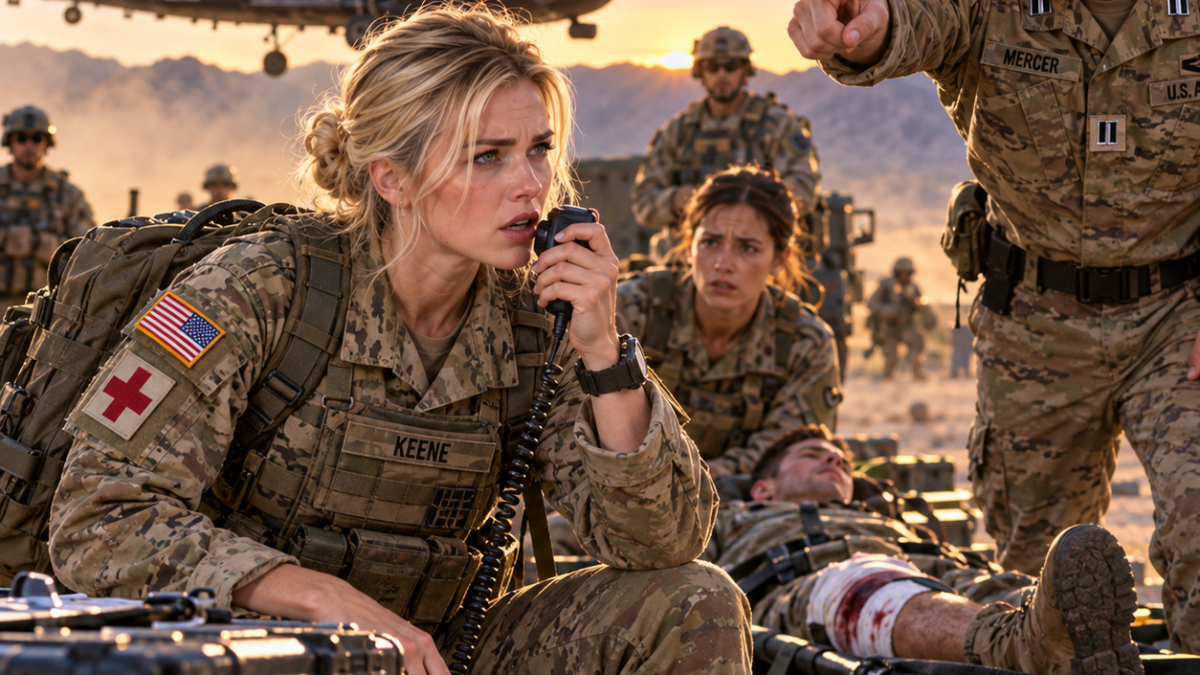
“Sergeant First Class Mara Keene.”
Silence.
Long enough for rotor noise to become audible through the headset.
Then a man’s voice came back.
Older.
Careful.
“Sergeant First Class Keene, I need to ask you something.”
My fingers tightened around the radio.
“Go ahead.”
“Were you a medic on a mountain ridge in eastern Afghanistan in May 2012?”
The clearing disappeared.
So did Mercer.
So did the trucks.
For one second I was twenty-four again with cold stone under my knees and somebody else’s blood soaking through my sleeves.
Nobody at Fort Irwin knew that story.
I had spent fourteen years making sure of it.
“Yes, sir.”
The pilot did not respond immediately.
Then he said, “This is Chief Warrant Officer Four Caleb Rowan. I was the copilot on Dustoff Three-One that night.”
My knees became strangely unreliable.
I remembered a young aviator on a broken radio channel asking me to describe a landing place he could reach without killing everyone aboard. I remembered answering him while Nate Callahan died against my chest.
I remembered six minutes.
Six minutes I had believed were mine.
“Sir,” I managed, “we’re in the middle of an exercise.”
Rowan’s voice stayed calm.
“Understood. Secure your people first. We’ll speak afterward.”
Then he returned to the current work.
That professionalism steadied me more than any reassurance would have.
Quinn ordered the platoon to hold while her team reviewed the coordinates. Mercer protested that the helicopter had never been in actual danger because the crew maintained visual separation from terrain.
Quinn looked at him.
“That is one reason professional pilots exist, Lieutenant. It does not excuse sending them wrong information.”
A captain from the evaluation team pulled the radio traffic.
Another inspected the intended landing area.
June stood near Price’s litter, no longer chewing her lip. She watched Mercer with the expression young soldiers get when authority stops looking magical.
Redd quietly took Mercer’s radio and assumed temporary control.
Mercer looked toward me.
I recognized anger building behind his eyes.
He waited until evaluators moved away before approaching the truck where he had ordered me to stand.
“You could have corrected me privately.”
I stared at him.
“I attempted to, sir.”
“You called out in front of my platoon.”
“I warned you before the aircraft entered approach.”
His jaw tightened.
“You’re turning a routine communications mistake into a major safety event.”
“The safety officer decides that.”
He stepped closer.
“Don’t use deployment history to turn people against me. Whatever that pilot remembers has nothing to do with my lane.”
I could have told him I had spent fourteen years wishing nobody remembered Afghanistan at all.
Instead, I lifted my medical bag.
“There’s still a patient on a litter, sir.”
I walked past him.
June appeared a minute later.
“Are officers allowed to talk to senior sergeants like that?”
“People are allowed to talk.”
She waited.
I added, “They’re also responsible for what they say.”
Quinn suspended the lane.
Not because the helicopter nearly crashed.
It had not.
The crew’s own checks worked.
The safety system worked.
That mattered.
But once the radio sequence, ignored warning, and intervention were compromised, restarting would teach the wrong lesson.
During the review, nobody laughed.
A captain read the sequence.
My first grid: correct.
Mercer interrupted.
Mercer repeated: incorrect.
I warned him.
June heard the warning.
Redd heard it.
Mercer dismissed me.
Quinn stopped the approach.
Those details mattered because they removed the easiest excuse.
A single mistake.
Everyone makes them.
Ignoring correction was different.
Afterward, Redd found me cleaning dust from my medical bag.
“You know that pilot?”
“Not really.”
“He knows you.”
“We were on the same mission.”
He studied me.
“You never mentioned Afghanistan.”
“It wasn’t relevant.”
Redd sat on the truck bumper.
“Maybe it shouldn’t take knowing someone’s worst day before people trust them on an ordinary one.”
I looked at him.
That sentence stayed.
The aviation team sent word that Rowan wanted to meet after flight paperwork was complete. Quinn offered to come, partly because she needed his statement about the current exercise and partly because she had seen what his question had done to me.
We drove across post in a government pickup while late sun turned the desert orange.
I kept my medical bag at my feet.
No reason.
Habit.
Rowan waited near an aviation support building. Silver showed through his close-cropped hair. His face had aged, just as mine had, but once he spoke I recognized the careful rhythm of the young copilot I had heard through static and gunfire.
We found a small room near operations.
Rectangular table.
Humming air conditioner.
Window overlooking parked aircraft.
Rowan set a black notebook in front of him.
“I’ve wondered what happened to you.”
I looked at the notebook.
“If this is about Staff Sergeant Nathan Callahan, I don’t have anything new to tell you.”
His expression softened.
“Actually, Mara, I have something to tell you about him.”
Hearing Nate’s name out loud tightened my chest.
He had been my friend, my squad leader, the person who could make me laugh on days when I did not remember why any of us had volunteered.
Twenty-nine years old.
New Yorker.
Bad singer.
Good card player only because he cheated.
Mother in Queens who mailed bread across an ocean.
Wife waiting for him before Christmas.
He never made it.
Every May, I opened his mother’s phone number.
Every May, I found a reason not to press call.
Rowan opened the notebook.
Compact handwriting.
Grid references.
Flight times.
Pencil notes.
He turned to a page dated May 2012.
“I kept this because the official debrief never matched what I remembered.”
My hands went cold.
“Especially the six minutes.”
I swallowed.
“We lost six minutes because I couldn’t bring you into the right landing zone.”
Rowan stared at me.
Not sympathetic.
Confused.
“No.”
I looked at him.
“What?”
“That’s what the ground command told investigators afterward. It isn’t why we held.”
He turned the notebook.
HOLD — GROUND COMMAND.
My vision narrowed.
“Explain.”
“We had your location.”
“No.”
“We did.”
“I changed grids.”
“Later.”
He tapped the line.
“We were ordered to hold before that because friendly troops were moving across part of the approach route.”
My mouth went dry.
“That’s not what the report said.”
“I know.”
He reached into the back of the notebook and removed a folded photocopy.
The creases had nearly erased the middle.
Ground-unit after-action summary.
Medical evacuation coordination delayed due to medical team’s failure to provide reliable landing-zone information.
My name was there.
Sergeant Mara Keene.
For fourteen years, I had been carrying guilt written in somebody else’s handwriting.
I read it twice.
Then again.
“Where did this come from?”
“Our aviation unit received a copy during review. We challenged it. Our timelines didn’t support it.”
“What happened?”
“We sent corrections through channels.”
“And?”
Rowan looked tired.
“War kept moving.”
That answer was not enough.
He knew it.
“I should’ve tried harder to find out where it went.”
Quinn leaned forward.
“Are you saying the official ground account contradicted your aircrew report?”
“Yes.”
“But your notebook alone doesn’t establish every decision.”
“Correct.”
I appreciated that immediately.
Evidence.
Not certainty.
Rowan could prove his crew had usable coordinates before the hold.
He could prove ground command ordered the hold.
He could prove friendly movement had been reported near the approach.
He could not prove why someone later blamed the medic.
Quinn asked whether the old mission had ever been used for training.
Rowan hesitated.
“Yes.”
My stomach tightened.
“How?”
“I’ve seen it discussed as an example of evacuation delay caused by unclear ground communication.”
I looked away.
Nate’s death had become a lesson.
A false lesson.
On the drive back, Quinn said, “Mercer’s packet has an old evacuation case study about a six-minute delay.”
I turned toward her.
The next morning, she brought me into a portable classroom. Evaluation materials covered folding tables.
Captain Thomas Avery, who designed the medevac lane, handed us the packet.
Near the back was an anonymized case study.
Wrong mountain name removed.
Unit removed.
Names removed.
But the date.
The timing.
Six-minute delay.
Medical uncertainty.
It was us.
The lesson emphasized decisive leadership when support personnel failed to provide clear direction.
I stood reading a simplified version of the worst night of my life, transformed into justification for people like Mercer.
One discussion question asked how a platoon leader should assume control when a medical specialist’s uncertainty threatened evacuation.
Another asked evaluators to measure whether the leader maintained control despite competing input.
Nothing explicitly said ignore corrections.
But the assumption underneath everything was obvious.
The medic had failed.
Decisive leadership had to overcome her.
Redd read it.
“I’ve heard Mercer reference this.”
Avery looked at him.
“When?”
“He said the lane was about not letting support personnel slow tactical decisions.”
“Did you challenge that interpretation?”
“Yes.”
“And?”
“He pointed to the notes.”
I felt something ugly settle inside me.
Mercer had brought his own arrogance.
The packet had given it a uniform.
Quinn withdrew the case study pending review.
She ordered all current records preserved.
Current incident and old history would remain separate.
That mattered.
One could not become proof of the other.
If someone had shown that discipline fourteen years earlier, perhaps I would not have spent half my adult life punishing myself.
That afternoon, soldiers submitted individual statements.
June wrote that she heard me warn Mercer before the helicopter reached approach.
Redd confirmed it.
Radio logs supported both.
For several hours, I believed facts would be enough.
Then June found me behind the medical tent.
She looked pale.
She held a paper.
“Can I talk to you?”
We moved behind a truck.
She unfolded it.
Mercer’s incident summary.
The report claimed I had continued transmitting after being ordered to stop, causing confusion that required Mercer to seize control of the radio.
No mention of my warning.
No mention of his incorrect grid.
The approach suspension was described as an unnecessary safety precaution caused by conflicting information from medical staff.
June’s finger trembled over the signature line.
“He wants me to sign as a witness.”
I stared.
“What did you tell him?”
“That I already submitted my statement.”
“What did he say?”
“He said evaluations are coming up. He said being seen as disloyal to the platoon leader could make things difficult.”
For one second, I was back in Afghanistan.
A correct timeline becoming someone else’s failure.
A young soldier standing between truth and career.
June whispered, “What happens if I refuse?”
I folded the paper carefully.
“We make sure you’re not the only one telling the truth.”
Quinn read Mercer’s account.
Then June’s.
Then the transcript.
Her expression hardened.
“I hoped this could remain a training correction.”
I looked at the report.
“I hoped he’d listen when I said the grid was wrong.”
She sealed the document inside an evidence folder.
“He made that harder for himself.”
By the next afternoon, Mercer’s battalion commander had arrived.
Lieutenant Colonel Diane Foster interviewed everyone separately.
Pilot.
Quinn.
Evaluators.
Redd.
June.
Me.
She separated the mistake from the response after the mistake.
That distinction mattered.
During my statement, she asked why I obeyed when Mercer took the radio.
“Direct order, ma’am. Another qualified person remained on the net.”
“When did you decide intervention was necessary?”
“When I heard the incorrect grid and he dismissed correction.”
“Why didn’t you formally raise his behavior during the previous eleven days?”
That question was harder.
“I believed I could work around him.”
“Could you?”
“No.”
I let silence sit.
Then added, “I underestimated how far he would take being challenged.”
Later, Redd sat beside me behind the barracks.
“You did tell me something was wrong.”
“I didn’t file anything.”
“I saw enough.”
“We both did.”
He nodded.
“He didn’t become this officer yesterday.”
“No.”
“We explained away small things until there was a big one.”
That sentence stayed too.
Mercer was temporarily removed from the lane.
Another lieutenant handled administration.
Redd prepared the platoon.
Mercer passed me near the dining facility without speaking.
He no longer looked angry.
He looked like a man beginning to understand paperwork lasts longer than performance.
But Afghanistan still occupied me.
Rowan called that night.
He had found a former aviation operations officer who remembered the mission.
Their unit had challenged the ground report.
Flight data and aircrew statements showed a hold ordered because friendly soldiers had moved near the planned approach.
“My coordinates weren’t why you waited?” I asked.
“No.”
“Could six minutes have saved Nate?”
Silence.
“I don’t know.”
That hurt.
It also felt honest.
Then Rowan said, “I found Ricky Delgado.”
I stopped breathing.
Ricky had been our radio operator.
Shot through the arm.
Still trying to work the handset.
“He’s alive. Outside Tucson. He agreed I could give you his number.”
I stared at the contact information for ten minutes before calling.
He answered on the fourth ring.
“Mara?”
His voice was deeper.
I knew it immediately.
We talked around everything first.
Work.
His daughters.
My civilian flights.
Then he asked, “This about Nate?”
I told him about Rowan’s notes and the report.
Ricky went quiet.
“I knew that report was wrong.”
My hand tightened around the phone.
“What?”
“I told them during review.”
“What did you say?”
“That your first grid was right. I heard it repeated. Then the captain ordered the aircraft to hold while another section moved through the approach.”
“What did they tell you?”
“That the timeline had already been reconciled.”
I closed my eyes.
Ricky continued.
“I wrote everything down the next morning because I was afraid I’d forget.”
“Do you still have it?”
“Yes.”
Another pause.
“There’s something else.”
“What?”
“I wrote down what Nate said to you.”
My throat tightened.
“I remember what he said.”
“I don’t think you understood what he meant.”
We arranged to meet.
Three days later, I drove home from Fort Irwin.
The investigation stayed open.
The historical review began moving through records channels.
None of that mattered as much as the brown cardboard box Ricky carried into a diner near Victorville.
He was thirty-four now.
Beard.
Slight limp.
Permanent stiffness in the shoulder I had treated.
We hugged awkwardly.
Then spent breakfast talking about everything except Afghanistan.
That was easier.
His daughters.
Industrial repair work.
My flight-medic schedule.
Coffee.
Traffic.
Normal life between two people who once assumed neither would reach middle age.
After the plates were cleared, Ricky opened the box.
Photographs.
Military forms.
A paperback Nate had loaned him.
A damaged notebook.
Yellowed pages.
He slid one toward me.
The timeline matched Rowan’s.
My correct landing coordinates.
Ground command hold.
Friendly movement.
Western approach authorized.
My alternate suggestion came later.
I put the paper down because my hands were shaking.
Fourteen years of memory.
For once, something outside my head agreed with me.
Ricky placed another page on the table.
Near the bottom:
Nate told Doc to go to the others — said she could help them.
I stared.
“I remember.”
“Do you?”
“He told me to take care of the others.”
“You always acted like that meant you abandoned him.”
I looked up.
Ricky’s eyes were steady.
“You treated two more guys and kept coming back to Nate.”
“I left him.”
“You moved fifteen feet.”
“I left.”
“He asked you to.”
My throat closed.
“He knew what was happening.”
“No.”
“Mara.”
“No.”
“He knew you wanted to stay with him. He knew there were other wounded.”
I looked down.
For fourteen years, I had remembered moving away from Nate as betrayal.
Ricky remembered it as obedience.
“He kept telling you,” Ricky said. “You were trying to save everybody. He was trying to help you do it.”
I wiped my face with one hand.
I had not realized I was crying.
Ricky leaned back.
“You didn’t leave him.”
I could barely speak.
“Could six minutes have mattered?”
He did not give me comfort I had not earned.
“Maybe.”
That was painful.
“But maybe isn’t the same as you caused them.”
I looked at the notes.
“We were in a firefight on a mountain,” he said. “You were doing three jobs while men bled everywhere. Stop turning everything that went wrong into something you did.”
Weeks later, the records review confirmed a ground-command hold had occurred.
The old instructional summary inaccurately blamed medical uncertainty.
They could not reconstruct every decision.
They could not prove why the ground report changed.
They could not tell me whether Nate would have survived six minutes earlier.
But they could remove one false accusation.
That mattered.
The current investigation moved too.
Quinn called.
Radio records confirmed Mercer transmitted the wrong grid after being warned.
His written account omitted my warning.
It misrepresented why the safety officer stopped the approach.
Foster still had to decide consequences.
Then she asked if I would speak before the platoon’s final medevac rehearsal.
I nearly said no.
Then I thought about June.
A twenty-year-old private told truth while an officer hinted her evaluation could suffer.
I agreed.
No ceremony.
No honoring me.
Training.
Before that happened, there was one call I could no longer avoid.
Rose Callahan.
Nate’s mother.
I sat at my kitchen table with Ricky’s notes beside Rowan’s photocopies.
Opened her contact.
Fourteen years.
I pressed call.
Rose answered cautiously.
“Hello?”
“Mrs. Callahan. This is Mara Keene.”
Silence.
I started apologizing.
She interrupted.
“Mara Keene.”
Her voice became softer.
“I’ve been wondering when you were finally going to call me.”
Every speech I had rehearsed disappeared.
She asked whether I still lived in California.
Whether I was healthy.
Whether the Army had finally learned to let people sleep.
Ordinary questions.
They hurt more than anger.
Then she asked how long.
“Fourteen years.”
She repeated it.
Not accusing.
Just measuring.
I told her why I stayed away.
“I believed my mistakes delayed the helicopter.”
Rose listened.
I told her about Rowan.
Ricky.
The records.
The hold.
The false training summary.
When I finished, she asked, “Would you come see me?”
I looked at my work calendar.
The old instinct started building excuses.
Flights.
Cost.
Schedule.
Then I heard Nate.
Do the next right thing.
“Yes.”
Three weeks later, I stood outside a narrow brick house in Queens holding an overnight bag and a box of deployment photographs.
Wet pavement.
Coffee.
Bread from a nearby bakery.
Rose opened the door before I rang.
She was smaller than the woman in Nate’s photographs.
Silver hair.
Lines around her mouth.
She looked at me for several seconds.
Then hugged me.
I froze.
Then hugged back.
When she released me, she wiped her eyes.
“Come inside before the neighbors think somebody died.”
I laughed.
Nate would have said exactly that.
Her kitchen was crowded with family photos.
A picture of Nate sat near the window.
Civilian clothes.
Head tilted.
Half-smile.
He looked so young.
That surprised me.
The photograph had not changed.
I had.
Rose told me about the years after his death.
Lauren packing his clothes.
Lauren eventually remarrying.
Rose being glad she found happiness while still missing her son.
Then she asked the question I had feared most.
“What was he like when nobody was watching?”
I talked for two hours.
Bad poker.
Worse singing.
His ability to recognize soldiers by footsteps outside the barracks.
The bread he hid from everyone after sharing most of it already.
Rose laughed.
Then cried.
So did I.
Eventually she asked about the ridge.
I told her carefully.
No unnecessary gore.
What Nate said.
How he worried about his soldiers.
How he did not die alone.
How I kept coming back.
Rose listened with both hands around a coffee mug.
“That sounds like him.”
I showed her the timelines.
Explained what we knew.
What we did not.
She asked if earlier arrival would have saved him.
“I don’t know.”
She stared at his photograph.
“I’m sorry I spent years acting as if I did.”
Rose looked at me.
“You thought feeling guilty was the same as remembering him.”
The words went through me.
I had.
Guilt had become my memorial.
Punishment had become loyalty.
She continued.
“I’m angry you didn’t call.”
“I know.”
“I wanted to know the woman he trusted when he couldn’t come home.”
I took out the battered deck of cards Nate and I used overseas.
Two queens missing.
Ace of spades bent where he once cheated.
Rose smiled through tears.
For the next hour, I taught her our version of poker.
Neither of us agreed on the rules.
That felt right.
Before I left, she packed bread in plastic and handed it to me.
“You’re allowed back before another fourteen years pass.”
“I will.”
When I landed in California, Quinn had left a message.
Revised training materials approved.
Historical summary corrected.
Foster had completed Mercer’s administrative review.
I read the message twice.
Then sent Rose a photograph of the bread on my kitchen counter.
For the first time in fourteen years, remembering Nate did not feel like solitary confinement.
When I returned to Fort Irwin, the desert looked exactly the same.
Same mountains.
Same dust.
Same heat radiating from vehicles.
The briefing room was different.
Every soldier had a communications card open.
First slide:
CRITICAL LOCATION INFORMATION REQUIRES VERIFIED READBACK.
Quinn did not mention me.
Good.
The new packet described how incorrect coordinates, unclear authority, and ignored corrections could combine into risk.
It included a corrected summary of the 2012 evacuation.
Documented ground-command hold.
Prior instructional version inaccurate.
No dramatic blame.
Just facts.
Rowan sat at the back.
“I wish people had listened fourteen years ago,” he whispered.
“I do too.”
“But you kept your notes.”
“So did Ricky.”
“That matters.”
Foster spoke with me privately before the practical lane.
Mercer had received formal administrative action, an adverse evaluation, and removal from platoon leadership duties.
His career was not automatically over.
The consequences would follow him.
I asked about June.
No retaliation reported.
Her statement preserved.
Command made clear truthful safety reporting was protected.
Policies cannot stop every whisper or resentment.
But she would not stand alone.
Mercer found me later outside an equipment building.
Without soldiers around him, he looked younger.
Tired.
“Sergeant, can I talk to you?”
I stayed near the open doorway.
“Yes, sir.”
He stared at the concrete.
“I owe you an apology.”
I waited.
“I was afraid of failing.”
Still waited.
“I thought taking control of the radio would show confidence.”
He swallowed.
“I knew the coordinates were wrong after Major Quinn stopped the approach. My report afterward was… I was trying to protect myself.”
There it was.
Not misunderstanding.
Not confusion.
Choice.
“I was wrong to dismiss you.”
“Yes, sir.”
He looked up, almost surprised I agreed so easily.
“And I was wrong to put responsibility on you afterward.”
“Yes.”
Silence.
Then he asked, “Do you think I can still become a good officer?”
Years earlier, I would have rescued him from that question.
Given him encouragement.
Made him feel better so the conversation could end.
Instead I said, “That depends on what you do the next time someone corrects you.”
He nodded.
I continued.
“Especially when nobody important is watching.”
He thanked me.
No handshake.
No promise to forget.
The practical exercise started that afternoon.
June handled casualty evacuation communications under Redd’s supervision.
I stood beside her.
She checked the map.
Grid.
Landing-zone marker.
Request.
Her hands trembled slightly.
“Ready, Sergeant?”
“Make every number count.”
She keyed the radio.
Transmitted.
The aircrew read back.
June compared each digit.
Confirmed.
When evaluators injected a simulated landing-zone change, she stopped.
Verified.
Repeated.
Nobody laughed.
Nobody called the pause indecision.
Nobody punished accuracy.
The aircraft approached beneath a hard blue sky.
Dust rose.
Soldiers moved into safe positions.
June kept track of every piece.
Afterward, Rowan climbed down from the aircraft and walked over.
“That was a better day.”
I looked at the platoon gathering equipment.
“It was.”
“Why?”
I thought about Mercer.
Nate.
Rose.
June.
“Because the people making decisions listened.”
A month later, Nate’s family received the supplemental historical report.
Corrected timeline.
Corroborating flight information.
Ground communications.
Acknowledgment that earlier training materials unsupportedly blamed the medical team.
It did not restore him.
It did not answer everything.
It did not give Rose fourteen years back.
But it stopped the lie from being taught to someone else.
Rose called after reading it.
She was grateful.
And angry.
Both were allowed.
We started talking on Sundays.
Sometimes an hour.
Sometimes five minutes.
Weather.
Neighbors.
My strange flight calls.
Her bread.
Lauren joined one call.
We talked about her children.
No one pretended grief had ended.
We learned grief could share a room with ordinary affection.
Back at my civilian air-medical base, life returned to its irregular normal.
Night shifts.
Highway landings.
Mountain rescues.
Patients who thanked us.
Patients who never knew our names.
One evening, a younger flight medic named Allison sat beside me before launch.
She watched me check coordinates twice.
“Dispatch already confirmed.”
“I know.”
“Then why?”
“Because computers, radios, and people exist to verify one another.”
She nodded.
I added, “Confidence is not a backup system.”
She smiled.
“Sounds like a story.”
“It is.”
“You going to tell me?”
“Not tonight.”
She accepted that.
The helicopter lifted into darkness.
Highway lights curved below us like a loose ribbon.
I thought about Nate.
Not the ridge.
Nate.
His bad poker face.
His mother’s bread.
The way he said Doc even when I reminded him I was not a doctor.
For years, I had remembered him almost entirely through death.
That was unfair.
He had lived twenty-nine years before one night took him.
Rose helped me understand that.
Ricky did too.
The first anniversary after the records correction, I flew to Queens.
No dramatic reason.
Sunday dinner.
Rose made bread.
Lauren came with her family.
We told stories that had nothing to do with gunfire.
At one point Rose disappeared into the hallway and returned with a framed photograph.
Nate wearing a ridiculous Christmas sweater.
She handed it to me.
“You should have this.”
“I can’t.”
“Yes, you can.”
“Rose.”
“He’d hate that I framed it.”
I looked at the sweater.
She was right.
I laughed.
I took it home.
It now sits in my living room.
Not beside medals.
I do not display those.
Beside a photograph of my flight crew.
The man he was belongs with living people too.
June kept in touch.
Not constantly.
An occasional message.
Promoted.
Passed a medical course.
Had a bad day.
Had a good one.
Two years after Fort Irwin, she sent me a photograph of herself teaching junior soldiers casualty evacuation procedures.
Caption:
Made them read back every coordinate. You ruined me.
I wrote:
Good.
She replied:
Knew you’d say that.
Redd retired.
Quinn promoted.
Rowan kept flying longer than his wife thought sensible.
Mercer transferred.
I heard through Redd that he became a staff officer for a while before returning to leadership in another unit.
Years later, one of my reserve contacts mentioned that Mercer had a reputation for asking junior NCOs for dissenting opinions during planning.
Maybe he learned.
Maybe consequences did what embarrassment could not.
I never needed to know more.
Forgiveness is not surveillance.
The Army eventually removed the old case study entirely.
A new one replaced it.
The current Fort Irwin incident became part of a communications lesson, anonymized carefully and written with one point:
An initial error is not the same as refusing correction.
I liked that.
Because error is human.
Defensiveness is choice.
There is a difference.
Four years after the Black Hawk recognized my voice, I found myself teaching a joint class of medics, pilots, and young officers.
The classroom was too cold.
Projector hummed.
Coffee terrible.
Army tradition survives.
I put a grid coordinate on the screen.
Then changed two digits.
“Who catches it?”
Hands went up.
“What happens next?”
One lieutenant said, “Correct the sender.”
“And if the sender outranks you?”
Silence.
Good.
A medic finally answered.
“Correct the information.”
“Again.”
“Correct the information.”
“Louder.”
The room laughed.
I did not.
“Rank does not move terrain.”
That quieted them.
“An aircraft does not land safely because the lieutenant sounds confident. Blood does not clot because the medic has more years. Anyone can be wrong.”
I looked around.
“The question is what kind of team you become after someone says so.”
After class, a young officer waited.
“Sergeant, can I ask something?”
“Sure.”
“How do you know when pushing back becomes insubordination?”
“That depends.”
He looked disappointed.
Everyone wants rules.
I continued.
“If the issue is ego, probably slow down. If the issue is safety, legality, or something irreversible, be clear.”
“What if you’re wrong?”
“Then you own it.”
“What if they’re wrong?”
“Give them the chance to own it.”
“And if they won’t?”
I smiled.
“Documentation is a beautiful thing.”
Years passed.
I eventually retired from the Army Reserve.
Nineteen became twenty.
Then twenty-three.
My retirement ceremony was intentionally small.
No ballroom.
No exaggerated speech.
Redd came.
June flew in.
Quinn attended.
Rowan sent a video because he was overseas.
Rose sat in the front row wearing a blue coat.
That almost undid me.
My commander said nice things.
Too many.
Then handed me the microphone.
I looked at the room.
People expected a speech about service.
Sacrifice.
Duty.
I had written one.
Then folded it.
“I spent a lot of years believing experience meant knowing the answer.”
The room quieted.
“It doesn’t.”
I looked toward June.
“Experience means knowing how expensive the wrong answer can become.”
Then toward Redd.
“And knowing when someone else may have the right one.”
Rose smiled.
I finished quickly.
“Listen before rank makes you deaf.”
That was enough.
Afterward, Rose hugged me.
“Nate would’ve liked that.”
“He would’ve made fun of it.”
“Also true.”
She handed me a loaf of bread wrapped in plastic.
Some traditions should survive.
My civilian medical career continued.
I eventually became a training supervisor.
That felt dangerous in a different way.
Authority sneaks up on you.
One day, a new medic corrected me during simulation.
I had entered an incorrect medication concentration.
Small mistake.
Training.
No patient.
Still wrong.
He said, “Ma’am, check the concentration.”
My first internal response was irritation.
Instant.
Embarrassing.
I had been teaching this lesson for years and still felt the sting.
I looked again.
He was right.
“Good catch.”
That night I sat in my car thinking about Mercer.
That is the dangerous thing about arrogance.
It does not always announce itself as contempt.
Sometimes it appears as one hot second where you want the other person to be wrong because being corrected feels bad.
The difference is what you do next.
I called the medic the following morning.
“You handled that properly.”
He sounded confused.
“Okay.”
“I’m saying it because senior people don’t say it enough.”
“Thanks.”
“And next time, be louder.”
He laughed.
“Copy.”
Maybe that is how culture changes.
Not by producing flawless people.
By making correction survivable.
Rose died when I was fifty-one.
Peacefully.
Lauren called.
I flew to Queens.
The kitchen looked smaller without Rose inside it.
Her family gave me a box.
Photographs.
Letters.
Recipes.
One envelope had my name.
Inside was a card.
Mara,
Nate trusted you. I learned why.
Do not disappear again.
Love,
Rose
I sat at her table and cried until Lauren put coffee beside me and said nothing.
Grief returned.
Different.
Not punishment.
Love with nowhere to go for a while.
That is manageable.
We buried Rose near Nate.
After the service, I stood beside his headstone.
For years, I had imagined what I would say if I ever felt forgiven.
Nothing came.
So I said, “Your mother still made terrible poker decisions.”
Wind moved through the cemetery trees.
I laughed.
That was enough.
I still fly sometimes.
Not full-time.
Training and occasional missions.
One evening, years after Fort Irwin, I sat in a helicopter beside Allison, now a senior medic herself.
She handed me a tablet.
“Confirm destination.”
I checked.
Correct.
“Confirmed.”
She looked at me.
“Again.”
I laughed.
“Still doing this?”
“Your fault.”
I read it again.
Correct.
The helicopter lifted.
Below us, California highways glowed in the dark.
I thought about the first time a pilot recognized my voice.
At the time, I believed the question dragged me backward.
It did not.
It opened a door I had kept closed because I thought guilt was the only thing holding Nate close.
The truth was harder.
And kinder.
I had made mistakes in Afghanistan.
Of course I had.
Every person on that mountain did.
War is a machine built from imperfect decisions under impossible pressure.
But I had not caused the six-minute hold.
I had not abandoned Nate.
I had not deserved fourteen years of self-imposed silence.
The report was wrong.
The lesson built from it was wrong.
Mercer absorbed that wrong lesson because it matched something he already wanted to believe.
Then he repeated the pattern himself.
That may be the part I think about most.
Bad information does more than misdescribe the past.
It trains the future.
A false report can become doctrine.
A convenient excuse can become culture.
A young officer can read an old lie and call it leadership.
That is why facts matter beyond fairness.
That is why readbacks matter.
That is why witnesses matter.
That is why June mattered.
That is why Rowan’s notebook mattered.
Why Ricky’s notes mattered.
Why Rose’s questions mattered.
Why the truth sometimes needs fourteen years and five different people before it becomes loud enough to survive.
I used to hate radio silence.
Too many memories lived inside it.
Now I understand silence differently.
Sometimes silence means nobody is listening.
Sometimes it means everyone is waiting for the next transmission.
And sometimes it means the person holding the radio finally knows her voice does not become less true because someone with a higher rank refuses to hear it.
The last lesson Nate ever gave me came back through Ricky’s notebook.
Do the next right thing.
I had remembered those words as comfort.
They became a rule.
When Mercer took the radio, the next right thing was obeying until safety required intervention.
When he transmitted the wrong grid, the next right thing was correction.
When Quinn needed facts, documentation.
When June was pressured, protection.
When Rowan showed me the old report, questions.
When Ricky gave me the truth, acceptance.
When Rose answered, honesty.
None of those steps fixed everything.
They did not bring Nate home.
They did not return fourteen years.
They did not erase shame overnight.
But they moved the story in the right direction.
That is often all anyone gets.
A direction.
One correct coordinate after another.
Years after the original exercise, I visited Fort Irwin for a training conference.
The desert looked unchanged.
I drove past the same training area where Mercer once took the radio from my hand.
No trucks.
No platoon.
Just sand and wind.
I pulled over.
Not dramatically.
I wanted to see it.
Somewhere out there, the wrong coordinate had once pointed toward a wash.
The correct landing zone lay ninety meters away.
Ninety meters.
Such a small distance on a map.
Large enough to reveal everything.
I stood beside the road and thought about the lieutenant’s words.
Go stand by the trucks, ma’am. Let the professionals work.
At the time, I thought the insult was about age.
Reserve status.
Gender.
Pride.
Maybe it was all of those.
But the deeper mistake was simpler.
He thought professionalism belonged to the person controlling the microphone.
It does not.
Professionalism is what happens when the person with the microphone is willing to give truth more authority than ego.
Mercer learned that painfully.
So did I.
I had spent fourteen years giving an old report more authority than my own memory because blaming myself felt safer than accepting uncertainty.
The paper said medic failure.
I obeyed.
The Army had trained me to trust documentation.
It took me years to learn documentation can be wrong too.
That does not mean facts are meaningless.
It means facts require care.
Verification.
Readback.
Corroboration.
Humility.
Same lesson.
Different scale.
I returned to my car.
Before starting the engine, I opened a small notebook I still carry.
Not Rowan’s.
Mine.
Inside are names.
Nate.
Ricky.
June.
Rose.
Redd.
Quinn.
Rowan.
People who changed the shape of that story.
Under them, one sentence:
Listen before rank makes you deaf.
I added another.
Trust your voice enough to verify it.
Then I closed the book.
The desert wind moved dust across the road.
No helicopter.
No radio traffic.
No laughter.
Just quiet.
Good quiet.
The kind that does not hide anything.
I started the engine.
On the drive back toward Barstow, my phone connected to the car.
A message from Allison appeared.
Training tomorrow. New medic wants to argue about LZ procedure. You created another monster.
I smiled.
Then typed at the next stoplight:
Good. Make them prove it.
She sent back a thumbs-up.
I drove on.
For most of my life, I believed competence meant having the right answer under pressure.
Now I know better.
Competence is also hearing the warning you do not want.
Leadership is the same.
And grief, strange as it sounds, taught me that too.
Nate’s death did not need a villain to be tragic.
I did not need guilt to prove I loved him.
Rose did not need perfect answers to remember her son.
The Army did not need to pretend every historical question could be solved before correcting what was provably wrong.
Mercer did not need his career destroyed to learn consequences.
June did not need rank to tell the truth.
And I did not need anyone’s permission to speak when the coordinates were wrong.
Fourteen years after the ridge, a helicopter pilot recognized my voice and gave back something I did not know I had lost.
Not innocence.
Not certainty.
Trust.
In myself.
In the value of verification.
In the possibility that the story you carry longest can still be wrong.
That is why I still check every coordinate twice.
Not because I am afraid.
Because getting it right matters.
And if somebody takes the radio from my hand again?
I will obey the order if it is lawful.
I will stand beside the trucks if that is where I belong.
I will let rank be rank.
Until the numbers are wrong.
Then I will speak.
Once.
Twice if necessary.
As many times as safety requires.
Because one thing took me nineteen years in uniform, one dead friend, one arrogant lieutenant, one young private, one old pilot, and fourteen years of silence to understand:
Experience does not make your voice important.
Truth does.
And truth deserves a readback.