𝗙𝗨𝗟𝗟 𝗦𝗧𝗢𝗥𝗬 My Sister’s Fiancé Entered My Social Security Number at Sunday Dinner and Suddenly Stopped Smiling
part2
I remember Natalie’s voice more clearly than the digits.
Slow.
Careful.
Cheerful.
As though she were reading raffle numbers.
Mom folded and unfolded the corner of her napkin.
Uncle Raymond leaned forward.
Cousin Derek joked that maybe the federal government paid me enough to replace my antique Honda.
Nobody seemed especially concerned that personal information belonging to me was being passed around the dinner table after I had explicitly said no.
“That’s enough,” I said.
Natalie waved me off.
“Almost done.”
She read the last digits.
Evan thanked her with a theatrical flourish.
I sat down.
Not because Dad ordered me to.
Because I wanted the next part to contain no ambiguity.
No one would later say I had not warned him.
Evan typed my full name.
Checked the number.
Held his thumb above the search command.
“Ladies and gentlemen,” he announced, “we’re about to discover whether the federal government is paying Claire enough to keep driving that museum piece.”
Laughter.
Natalie looped her arm through his.
Dad folded his arms.
Satisfied.
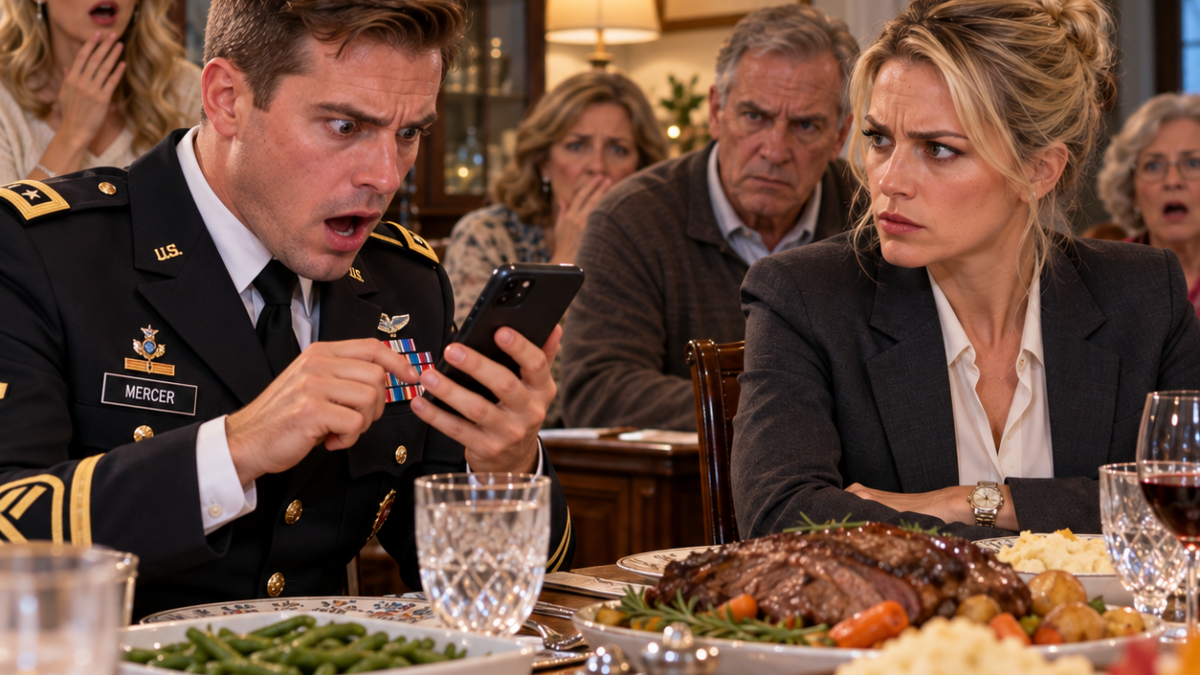
Evan pressed the screen.
A spinning icon appeared.
Five seconds.
Six.
Eight.
He frowned.
“Connection’s slow.”
Then his shoulders stiffened.
Tiny movement.
I saw it before anyone else.
The spinning icon vanished.
The screen turned red.
A sharp electronic tone cut through the dining room.
Natalie stopped smiling.
Evan brought the phone closer.
Read.
Swallowed.
Then a second notification appeared.
“What happened?” Dad asked.
Evan didn’t answer.
Natalie tugged his sleeve.
“Did it crash?”
“No.”
His voice sounded different.
“What?”
“That’s not what happened.”
He angled the phone slightly.
The people nearest him could see.
I caught the warning.
TS/SCI COMPARTMENT OMEGA-9
UNAUTHORIZED ACCESS
CREDENTIAL SUSPENDED
SESSION TERMINATED
ATTEMPT LOGGED FOR SECURITY REVIEW
Evan’s face lost color.
Dad squinted.
“What does all that mean?”
Evan looked at me.
Then back at the screen.
“TS/SCI is highly restricted classified access.”
Natalie laughed nervously.
“So it’s a glitch.”
Evan shook his head.
“A normal civilian personnel lookup wouldn’t return this.”
She reached for the phone.
He pulled it away.
Tried reopening the personnel application.
Another warning.
ACCOUNT DISABLED PENDING REVIEW.
I spoke quietly.
“Stop touching it.”
His hand froze.
He looked at me.
Something in my voice finally connected with every warning I had given him.
He set the phone down carefully.
Then, for the first time since meeting me, he used the proper form of address.
“Ma’am.”
Dad’s fork hit his plate.
Evan swallowed.
“Why does your file require Pentagon clearance?”
I looked around the table.
Fifteen relatives.
Faces that had been laughing five minutes earlier.
Now nobody knew where to look.
I could not answer his question.
More importantly, I had no interest in satisfying the curiosity that had caused the problem.
“You accessed information without authorization after I told you not to.”
He shook his head.
“The system shouldn’t have let a normal search reach—”
“That is now somebody else’s problem.”
Dad recovered first.
Naturally.
“What is this nonsense about the Pentagon?”
I turned toward him.
“Dad.”
“If you’ve been lying about your job—”
That sentence landed harder than I expected.
Natalie had disclosed my Social Security number.
Evan had misused a government system.
Dad somehow found a path back to my dishonesty.
“I have never lied about working for the Defense Department.”
“You said administrative oversight.”
“Some of my work is administrative.”
“So what aren’t you telling us?”
“Things I am not allowed to tell you.”
His face reddened.
“That’s ridiculous.”
I took out my personal phone.
Dialed a number I had memorized years earlier.
Identified myself.
Explained that a credentialed Army staff sergeant had attempted unauthorized access to protected information from a private residence.
Provided the address.
Confirmed the device remained in the room.
Answered whether anyone had photographed the screen.
Then I ended the call.
“Security personnel will contact Evan.”
Natalie stared.
“You reported him?”
“Yes.”
“For a joke?”
“I warned him.”
“You’re ruining everything because you can’t stand him being more successful than you.”
For a second, nobody spoke.
Mom finally whispered:
“Natalie. Enough.”
Dad turned toward her.
“Don’t take sides.”
Aunt June pushed her chair back.
“Frank.”
Dad looked at her.
June stood.
“Your daughter told a man not to use her Social Security number.”
Nobody moved.
“You ordered her to sit down.”
“Aunt June—”
She raised one hand toward Dad.
“I spent forty years listening to adults make excuses for bullies.”
Her voice stayed level.
“I’m retired. I don’t have to anymore.”
Dad opened his mouth.
Closed it.
Evan had become very quiet.
Too quiet.
He kept glancing toward the hallway.
Mom noticed.
“Should we call your commanding officer?”
“No.”
Too fast.
Everybody heard it.
Mom frowned.
“Why not?”
“They’ll contact me if they need to.”
Aunt June looked at me.
I looked at Evan.
His fear suddenly seemed larger than a suspended credential.
Twenty-five minutes later, two vehicles stopped outside.
A woman in civilian clothes entered first.
Special Agent Iris Shaw.
Behind her came Colonel Miriam Calder.
I knew Calder professionally.
She entered the dining room, looked at the blue binder still open on the sideboard, Evan’s phone on the table, his badge, the witnesses.
Then she looked at me.
“Colonel Voss.”
Dad stared.
“Colonel?”
I nodded.
“Yes, Dad.”
“That’s my rank.”
Silence.
Evan stood so quickly his chair struck the wall.
Calder raised one hand.
“Leave the device and your identification exactly where they are.”
He obeyed.
Agent Shaw began documenting the room.
Who entered the number?
Who provided it?
What reason had Evan claimed for the search?
Had anyone photographed the warning?
Had he conducted similar queries before?
Evan tried explaining that this had been entertainment.
Shaw interrupted.
“Have you accessed personnel records outside authorized duties on other occasions?”
His face changed.
There it was again.
That fear.
Not humiliation.
Recognition.
The investigators took statements.
Calder avoided discussing my assignment.
I did too.
Dad kept staring at me as if rank should explain personality.
It didn’t.
Nothing about my being a colonel changed the fact that he should have listened when I said no.
Before leaving, Calder asked me to step outside.
Cold air hit my face.
Leaves moved across the driveway.
My Honda sat under the streetlamp.
She waited until the front door closed.
“Claire.”
“Yes?”
“This didn’t start tonight.”
I watched her.
“We’ve been reviewing irregular personnel searches for several weeks.”
My stomach tightened.
“Mercer’s?”
“His name is connected to some of them.”
I looked toward the dining room window.
Natalie stood with Evan.
Crying.
Calder checked her notes.
“Did he choose your record himself?”
“Yes.”
“Anybody encourage it?”
“Natalie gave him my number.”
Calder’s jaw tightened slightly.
Then she hesitated.
“There’s something else.”
I waited.
“He searched for you before.”
That was the moment the dinner stopped feeling like stupidity.
The next morning, I drove back to Virginia.
Mom called before I reached the interstate.
“Natalie didn’t sleep.”
“I’m sorry.”
“Can’t you tell Colonel Calder Evan didn’t mean anything?”
“No.”
“Claire, he made one mistake.”
“You don’t know that.”
“That sounds ominous.”
“It means I don’t know what investigators know.”
Dad had apparently spent the morning telling everyone the system had malfunctioned.
Mom told me he was worried people in town would hear.
Not once did she ask how I felt about fifteen relatives hearing my Social Security number.
I stopped at a gas station near Columbus.
Sat in the car.
Looked at my phone.
Eleven messages.
Congratulations on the rank.
So what do you really do?
Pentagon???
One cousin sent:
Okay, Colonel Secret Squirrel.
I deleted that one.
Aunt June sent a photograph.
The apple pie nobody touched after I left.
Caption:
Your slice survived the war.
I smiled.
Then she added:
Are you okay?
Only person who asked.
Tuesday was almost normal.
I worked from my apartment.
Reviewed a report.
Corrected somebody’s incomplete analysis.
Sat through a meeting where three intelligent adults argued about a deadline nobody had authority to change.
Ordinary work helped.
Then Agent Shaw called.
Secure interview the next morning.
The interview lasted almost two hours.
Relationship with Evan.
Relationship with Natalie.
Exact wording of my warnings.
How Natalie obtained the Social Security number.
Had I ever authorized Evan to search my information?
No.
Had he shown previous interest in my assignments?
That question brought back Christmas.
Evan beside my parents’ fireplace.
“So which Pentagon offices do you work with?”
“I didn’t say I work at the Pentagon.”
“But you go there?”
“Sometimes.”
“What kind of clearance do you need for administrative work?”
“I’m not discussing clearance.”
He had laughed.
“You probably don’t need much.”
Then:
“You know anyone involved in personnel compliance reviews?”
At the time, I thought he was showing off.
“Why did he ask?” Shaw said.
“He claimed a friend was starting a business helping military families transition into civilian housing.”
“Name?”
“I don’t remember.”
“What kind of business?”
“Relocation. Employment. Something like that.”
Shaw wrote.
I watched her.
“Is this connected to what Calder said?”
“I can’t discuss the entire investigation.”
That answer meant yes.
Or close enough.
Back home, Natalie called.
“Claire, this is getting ridiculous.”
Hello to you too.
“You’re telling people Evan committed a crime.”
“I’m not telling people anything.”
“You’re using your rank to intimidate him.”
“The security system suspended him automatically.”
“You could have warned him more seriously.”
I put the phone down for three seconds.
Picked it back up.
“I told him he could lose his credentials.”
“Everybody thought you were exaggerating.”
“Why?”
“You get weird whenever people ask about work.”
“You mean I say no.”
“You act suspicious.”
“If a stranger asked Mom for my Social Security number, would you hand it over?”
Silence.
Then:
“Evan isn’t a stranger.”
“That is not the same thing as authorization.”
She exhaled angrily.
“You always make everything legalistic.”
“I work in security.”
“You never told us that.”
“You never asked without mocking the answer.”
That ended the call.
The following week, Mom mentioned investigators had requested records involving an organization called Welcome Harbor Veterans Project.
The name stirred something.
Glossy brochure on the refrigerator.
Dad praising a charity Evan introduced.
Helping veterans find housing.
Assisting military spouses during relocations.
Natalie organizing a fundraiser.
Dad persuading retired coworkers to donate.
“Why are investigators asking about Welcome Harbor?”
“I don’t know.”
“Mom.”
“They wanted donation receipts.”
She paused.
“And some of Natalie’s event paperwork.”
“What event paperwork?”
“The blue binder.”
I stood up.
“The binder with our Social Security numbers?”
“She kept everything together.”
A cold feeling moved through me.
“That binder was not just for the wedding.”
Silence.
“No.”
Three days later, Agent Shaw called again.
She asked me to review a document recovered in a separate financial investigation.
“Only confirm whether you authorized it.”
The document carried the Welcome Harbor letterhead.
Professional endorsement.
Favorable security guidance.
My full name.
My professional affiliation.
A signature that looked almost exactly like mine.
I stared.
“I didn’t write this.”
“You’re certain?”
“Yes.”
“Never reviewed Welcome Harbor?”
“No.”
“Never approved their procedures?”
“No.”
Shaw turned the page.
“Any family member have access to samples of your signature?”
I immediately thought of Mom’s wooden box.
Letters from deployments.
Birthday cards.
Old forms.
Handwritten notes.
“My mother has letters.”
Shaw nodded.
Then turned to the final certification.
Someone had supposedly witnessed my approval.
The signature beneath the witness line was familiar.
Looping N.
Long tail on the V.
Natalie Voss.
Program Coordinator.
My sister.
I sat back.
For a moment, the room felt too small.
Natalie had not simply helped Evan humiliate me.
She had been using my identity months before Sunday dinner.
Shaw asked whether I needed a break.
“No.”
“You sure?”
“Yes.”
“What are you feeling?”
“That is not relevant.”
She studied me.
Then nodded.
Professional courtesy.
I appreciated it.
She explained that investigators still had to determine what Natalie knew.
A signature proved participation in a document.
Not automatically knowledge of every underlying act.
That distinction mattered.
I understood evidence.
I also understood anger.
The two should not be confused.
The endorsement had circulated in fundraising materials.
Military families.
Potential donors.
Financial partners.
That made everything worse.
People in transition are vulnerable to authority.
A government name.
A uniformed sponsor.
A supposed Defense Department approval.
Those details cause trust.
Trust causes money to move.
I went home and opened an old storage box.
Photograph from Natalie’s college graduation.
She stood between Mom and Dad.
Diploma raised.
I stood slightly behind them in civilian clothes after traveling twelve hours to attend.
Dad spent that afternoon telling everyone how proud he was of Natalie.
I had been proud too.
Genuinely.
Looking at the photograph, I wondered when loving my sister became permission for her to borrow pieces of my identity whenever her future needed reinforcement.
Aunt June visited me two days later.
She arrived with chicken soup.
Of course.
We sat at my kitchen counter.
She ate.
I mostly moved the spoon.
Then she said:
“Your father knew someone complained about that veterans charity.”
I looked up.
“What?”
“A woman from church.”
“When?”
“August.”
Before the dinner.
Before Evan’s search.
Before Dad called him responsible.
“What kind of complaint?”
June looked ashamed.
“She paid them money for housing assistance. Couldn’t get calls returned.”
“How much?”
“I think nine thousand.”
I stopped moving.
“Name?”
“Teresa Navarro.”
Her husband had served nearly twenty years.
Died of cancer.
She wanted to move closer to her sister.
Welcome Harbor promised housing-placement help.
Processing fees.
Administrative charges.
Nine thousand dollars.
No apartment.
No refund.
“She went to Dad?”
“Yes.”
“What did he do?”
“He told her Evan was trustworthy.”
I closed my eyes.
“He told her to be patient.”
June continued.
“Your father asked her not to spread rumors because Natalie and Evan were planning another fundraiser.”
There are moments when anger arrives hot.
Mine arrived cold.
Dad had evidence.
Not proof of a crime.
But evidence that deserved questions.
He chose the wedding.
The image.
The confident soldier he liked.
Over a widow asking where her money went.
I gave June Agent Shaw’s contact information.
“Tell her exactly what you told me.”
“I will.”
Then she reached across the counter.
“I’m sorry I didn’t ask more.”
“That part isn’t yours.”
“Some of it is.”
I looked at her.
Aunt June had defended me at dinner.
Still, she refused easy innocence.
That mattered.
Mom called later that week.
She asked whether Dad was in the room before speaking.
“No.”
She sounded exhausted.
“The blue binder wasn’t originally for the wedding.”
“I know.”
Silence.
“Natalie said Welcome Harbor needed family background forms for charity events.”
“So you collected Social Security numbers?”
“She said they were routine.”
“Did you ask anyone?”
“No.”
“Why?”
“I trusted her.”
“At dinner, I told you not to let her use mine.”
“I know.”
“Why didn’t you stop her?”
Mom began crying.
“I should have.”
I waited.
No explanation came immediately.
Then she said:
“Evan told me you were paranoid because you worked some low-level office job and didn’t understand how military programs operate.”
I almost laughed.
Not because it was funny.
Because the absurdity finally had shape.
My family had trusted Evan’s description of my professional judgment over mine.
Because he said it confidently.
Because Dad liked him.
Because Natalie loved him.
Because I had spent years refusing to compete for credibility inside my own house.
Natalie requested a conversation after investigators completed her interview.
She arrived at my apartment wearing jeans and a large sweatshirt.
Engagement ring still on.
No makeup.
She looked younger.
Not innocent.
Younger.
I offered her water.
She declined.
Then I asked:
“Why did you sign a document claiming you witnessed my approval?”
She twisted the ring.
“Evan said it was a formality.”
“That is not an answer.”
“He needed the application submitted.”
“So?”
“He said your government background would help.”
“You copied my signature.”
Silence.
“You copied it from Mom’s letters.”
“Yes.”
“Did you plan to ask me later?”
“That was the idea.”
“After you used it.”
She started crying.
“I was helping him build something.”
“Using my name.”
“I didn’t think you would ever see the document.”
I stared.
“That makes it worse.”
“I know.”
“Do you?”
She wiped her face.
“Everybody kept telling me how good our future would be.”
There it was.
Not greed exactly.
Fear.
Fear of the beautiful future disappearing if she looked too closely at what supported it.
I asked about complaints.
She knew there had been delayed refunds.
Evan called them accounting problems.
She kept fundraising.
“Why?”
Her eyes moved toward the window.
“Because I didn’t want everything to fall apart.”
That answer hurt because I understood it.
We grew up in a house where the person exposing a problem often received more blame than the person creating it.
Dad hated uncomfortable facts.
Mom hated conflict.
Natalie learned preservation.
I learned silence.
Evan learned how to exploit both.
Before she left, I asked the question I needed answered.
“Sunday dinner.”
She froze.
“What about it?”
“Did Evan decide to search me that night?”
No answer.
“Natalie.”
Her face told me before her mouth did.
“He wanted to know whether you really had security authority.”
I went still.
“He thought you might cause problems if you looked into Welcome Harbor.”
The room narrowed.
“So he planned the search.”
“He called it checking.”
“And you knew.”
Tears again.
“Yes.”
“He asked whether Mom still had my personal information.”
“Yes.”
My chest tightened.
Sunday dinner had not been a spontaneous joke.
The humiliation was tactical.
Evan expected Dad to laugh.
Expected Natalie to help.
Expected everyone to treat my objection as difficult behavior.
If the search showed I was insignificant, he could relax.
If I reacted strongly, my family would make me look unreasonable.
He had built the gamble around one assumption.
My family would pressure me to cooperate.
He had been right.
I opened the door.
Natalie stood.
“Claire.”
“I need you to leave.”
“Please.”
“No.”
“Can’t we—”
“No.”
For the first time in our lives, my sister left without me comforting her.
The investigation expanded.
Welcome Harbor was smaller than its advertising suggested.
Founded by Evan’s longtime friend Marcus Bell.
Civilian.
Claimed relocation expertise.
Military families paid upfront fees for housing placement, employment help, benefit support.
Donors were told contributions funded emergency assistance.
Evan’s military status gave Welcome Harbor credibility.
His access apparently gave something more.
Investigators examined personnel searches unrelated to his duties.
Transitioning service members.
Families experiencing changes.
People who could become clients.
I did not receive every detail.
I was not entitled to them.
But the picture became clear enough.
Authority had become a sales tool.
Dad kept defending Evan.
Told relatives I had personal connections making the investigation worse.
Claimed I was jealous of Natalie.
Said I never liked Evan.
June challenged him.
“Was Claire jealous when she told him not to use her Social Security number?”
Dad ended the conversation.
Then Mom forwarded a fundraising invitation.
Welcome Harbor luncheon.
Dad had personally signed the appeal.
One paragraph said the program had been favorably reviewed by a Defense Department professional.
My name.
He dismissed my job at dinner.
Used it in fundraising when useful.
That hypocrisy hurt more than I wanted to admit.
I gave the letter to Shaw.
Mom later found a folder of donor complaints.
Teresa Navarro’s letter was inside.
Dad received it before Sunday dinner.
She described the missing money.
No apartment.
No returned calls.
Dad had spoken to Evan.
Accepted the explanation.
Kept promoting the charity.
Mom started crying.
“I didn’t know it would become this.”
“Become what?”
“A criminal investigation.”
I looked at her.
“Mom, the harm happened before investigators arrived.”
She went quiet.
That was the first time I think she understood.
An investigation does not create the wrongdoing it uncovers.
In January, federal authorities announced charges.
Evan.
Marcus Bell.
Fraud-related conduct.
Unauthorized access.
Multiple victims.
I read the public announcement over coffee.
The relief lasted about fifteen seconds.
Then I saw the number of families.
People still without recovered money.
Debts.
Housing instability.
Natalie called that night.
Sobbing.
“Evan’s been arrested.”
“I know.”
“Marcus did everything.”
“You don’t know that.”
“Everybody’s treating Evan like a monster.”
“He has counsel.”
“You could help.”
“How?”
“Say you gave him permission.”
I stopped breathing for half a second.
“What?”
“The dinner search. Say it was a misunderstanding.”
“Natalie.”
“He might get less—”
“No.”
“He never meant—”
“No.”
“You know this could ruin his life.”
I looked at the refrigerator.
A photograph Aunt June had stuck there.
The two of us laughing.
“Families lost money they needed to stay housed.”
Silence.
“Evan helped create that problem.”
“Marcus handled the finances.”
“And Evan tried to determine whether I could threaten the operation.”
She said nothing.
“Then he used my family to do it.”
The call ended.
Aunt June later told me Teresa returned to church asking for legal-aid referrals.
Her husband had served nearly twenty years.
After he died, she was trying to move closer to her sister so she could work full time while raising her son.
Nine thousand dollars.
That money had been the bridge to a different life.
Welcome Harbor took it.
The apartment was never secured.
Teresa’s son packed photographs into boxes.
Then unpacked them.
I did not contact her directly.
The case was active.
Boundaries matter even when helping feels morally obvious.
I asked June to connect her with legitimate legal services.
Then Shaw showed me one more email.
From Evan to Marcus.
Weeks before Sunday dinner.
Need to determine whether Claire actually has security authority.
Then:
Family thinks she’s harmless. I can run a normal personnel inquiry and see whether her position is worth worrying about.
Final sentence:
Her parents will make Claire cooperate if she gets difficult.
I read it twice.
Then a third time.
That was the sentence I could not forget.
Not because he underestimated me.
Because he understood my family correctly.
He knew my objections would be treated as inconvenience.
He knew Dad would protect confidence over caution.
He knew Natalie would help.
He knew Mom would choose peace.
Evan had turned our family pattern into operational leverage.
That realization hurt more than the dinner.
I returned to Ohio in February because Aunt June had knee surgery.
Her bungalow was twenty minutes from my parents.
I made breakfast.
Sorted medications.
Listened to June insult physical therapy.
Simple care.
No debt attached.
Dad found out I was in town.
Called.
Asked me to come over.
I agreed under conditions.
No confidential investigation questions.
No lectures about loyalty.
He said he understood.
I found him in the garage beside a dismantled lawn mower.
Brown jacket.
Grease on the sleeves.
He looked older.
“I never knew what kind of work you did.”
“That isn’t relevant.”
“If I’d known you were a colonel with security responsibilities, I would have stopped Evan.”
I stared at him.
That sentence contained the entire problem.
“Dad.”
He looked at me.
“I was your daughter asking him not to use my private information.”
Silence.
“You should not have needed my rank.”
He looked down.
“I thought he was showing off.”
“You ordered me to sit down.”
“I didn’t understand.”
“If Natalie told someone not to use her Social Security number, would you have told her to sit down?”
He did not answer.
There it was.
Eventually he admitted Evan made him feel respected.
Asked about the plant.
Listened to his stories.
Shared military talk.
Dad liked having him around.
I understood the loneliness underneath it.
Retirement had left Dad without the factory, the identity, the younger men asking questions.
Evan filled that space.
Understanding did not excuse anything.
Then I asked about Teresa.
Dad stiffened.
“She showed you receipts.”
“Yes.”
“She told you she couldn’t get her money back.”
“Yes.”
“You still encouraged donations.”
“I believed Evan.”
“Why?”
“He said there were temporary problems.”
“Did you verify?”
“No.”
“Why?”
He looked toward the lawn mower.
No machine could rescue him.
Finally:
“I wanted the wedding to happen.”
There.
Truth.
He wanted Natalie happy.
Wanted Evan in the family.
Wanted the future everyone had advertised.
Evidence threatened the picture.
So he chose the picture.
He brought out a folder.
Fundraising invitations.
His signature.
My fake endorsement referenced prominently.
“Evan told me you reviewed it informally.”
“Did you ask me?”
“No.”
“Why?”
“I thought your government job was—”
He stopped.
“Simple?”
His face changed.
“Yes.”
I almost laughed.
My work was unimportant enough to dismiss.
Important enough to exploit.
He said quietly:
“I should have asked.”
“Yes.”
Then, after finally admitting all of that, Dad asked:
“Is there anything you can say that might help Evan get a lighter sentence?”
I stared at him.
He looked ashamed.
Still asking.
“Have you apologized to Teresa?”
“No.”
“Offered to help replace what she lost?”
“I didn’t know what to say.”
“Start there.”
I stood.
“I will tell the truth if asked.”
“Claire—”
“I won’t exaggerate what Evan did.”
His shoulders relaxed slightly.
“I also won’t minimize it.”
They tightened again.
Mom met me in the driveway.
She carried a cardboard box.
My old letters.
The ones used to copy my signature.
“I want you to have these.”
I took the box.
“Thank you.”
“I don’t trust myself with them anymore.”
“The problem wasn’t storage.”
“I know.”
She looked at me.
For once, no explanation followed.
“I know.”
Then she invited me to Easter.
I said no.
Her eyes filled.
I did not change my answer.
On the drive back to June’s house, I realized something had shifted.
For most of my life, other people’s discomfort activated responsibility in me.
Dad upset?
Fix it.
Mom crying?
Soften.
Natalie afraid?
Reassure.
That pattern had trained them as much as it exhausted me.
Boundaries felt cruel only because I had spent decades proving they would eventually disappear.
The administrative consequences reached me too.
My identity had circulated through unauthorized materials.
Protected affiliations.
False endorsements.
I had interviews.
Security reviews.
Additional documentation.
Nothing improper on my part.
Still a cost.
My family never considered that.
For several nights, I slept badly.
Not because of the red warning screen.
Because I kept hearing Dad say:
Sit down.
Natalie reading the digits.
Evan laughing.
Those sounds represented something simpler than classification.
I said no.
People who loved me heard it.
They continued anyway.
When I returned to Virginia, I wrote letters.
Parents.
Indefinite distance.
No discussion of the case outside legal channels.
Natalie.
No contact until she could acknowledge her choices without asking me to excuse them.
Mailing the letters felt strange.
Calm.
For once I made a decision before learning whether my family approved.
By late summer, Welcome Harbor was mostly evidence.
Records.
Claims.
Families waiting for restitution.
Prosecutors identified more than two dozen victims.
Unauthorized personnel information.
Misleading fundraising.
Client payments used beyond promised services.
Some ordinary operating costs.
Some personal purchases.
Promotional events designed to make the organization look larger.
Evan entered a guilty plea.
Marcus did too.
I received notice that my testimony might be needed.
Federal courthouse.
Dark blue suit.
Grandmother’s watch.
Small folder.
Mom and Dad sat several rows behind Evan’s relatives.
Natalie was with them.
No engagement ring.
Aunt June sat near the back.
She gave me one nod.
That was enough.
When asked about Sunday dinner, I described it precisely.
Evan’s claims.
My warnings.
Natalie obtaining the binder.
Social Security number.
The search.
The security alert.
No dramatics.
No embellishment.
The prosecutor asked:
“Did you ever indicate the search was a joke you welcomed?”
“No.”
“What did you say?”
“I told him not to do it.”
“More than once?”
“Yes.”
I could hear papers shifting.
That was all.
Truth did not need performance.
Then the victims spoke.
Teresa Navarro.
Housing help promised.
Thousands paid.
No apartment.
Months of calls.
She described her son repacking school photographs because he no longer knew when they would move.
Another family paid for employment placement after medical retirement.
A job opportunity supposedly confirmed.
Relocation preparations.
Money spent.
Nothing real waiting at the destination.
Rent fell behind.
Emergency savings disappeared.
By then Sunday dinner felt small.
Important.
But small.
Evan’s attorney spoke about honorable prior service.
Good record.
Original intent.
He argued Evan became involved in something that grew beyond what he first understood.
The court considered that.
As it should.
Evan stood.
Apologized.
Admitted abusing access.
Admitted ambition overrode responsibility.
Some victims looked away.
I did not decide whether his remorse was sincere.
That was no longer my job.
The judge imposed thirty months in federal prison.
Restitution.
Financial penalties.
Marcus received longer.
Evan’s Army career was effectively over.
The government credentials he once displayed at my parents’ dinner became evidence of a trust he violated.
Natalie was not criminally charged.
That did not mean nothing happened.
Civil settlement.
Repayment.
Corrective disclosures.
Restrictions involving charitable fundraising.
Her employer reviewed her conduct.
She eventually left the rehabilitation clinic.
After the hearing, Dad approached me near the elevators.
He looked smaller.
Not physically.
Structurally.
As though the framework he used to hold himself upright had changed.
“I listened to them.”
“The victims.”
“Yes.”
He swallowed.
“I understand why you wouldn’t help Evan.”
I said nothing.
“I wish we could put this behind us now.”
There it was.
End of proceeding.
Therefore end of pain.
I looked at him.
“Teresa cannot put it behind her because a judge finished speaking.”
He lowered his eyes.
“And I cannot forget that you defended Evan after somebody had already shown you missing money.”
Dad nodded.
“I was protecting Natalie’s future.”
“I know.”
“I thought…”
He stopped.
Then reached into his coat.
Folded letter.
“I wrote this.”
I took it.
“I’m sorry I told you to sit down.”
My throat tightened slightly.
“I’m sorry I treated your work like it was unimportant because I didn’t understand it.”
That mattered.
Specific.
Not complete.
But specific.
“Thank you.”
His eyes filled.
“Can you forgive me?”
“I don’t know.”
Pain moved across his face.
I continued.
“I’m not going to say yes so you feel better standing here.”
He nodded.
Then stepped aside.
No final argument.
One of the first times in my life Dad allowed me to leave without winning the last sentence.
Outside, Aunt June waited with coffee.
Two cups.
Of course.
We stood near a stone planter.
Across the plaza, Teresa stood beside another woman.
Folders in their hands.
June watched them.
Then said:
“That man spent years wanting everybody to see how much power he had.”
“Evan?”
“Yes.”
She sipped her coffee.
“In the end, all he showed was what he did with it.”
I carried that sentence home.
Almost exactly one year after the Sunday dinner, Mom sent me another invitation.
Dad’s seventieth birthday.
Cream stationery.
Careful handwriting.
Inside was a photograph of the dining room.
Old table polished.
Fresh placemats.
My name card beside Dad at the head.
I stared at it.
A year earlier, that seat might have meant everything.
Recognition.
Importance.
Proof.
Now it seemed sincere.
And insufficient.
I did not need a better chair at the same table where no had once become entertainment.
I wrote back.
Thank you.
Happy birthday.
I would not attend.
Mom called two days later.
I expected persuasion.
Instead:
“I understand.”
That surprised me.
“Okay.”
“Is there anything I can send?”
“No.”
“All right.”
She accepted the answer.
Small.
Important.
Natalie’s life shrank.
Cheaper apartment.
New job.
Counseling.
Repayment.
She wrote emails.
At first they were progress reports.
Volunteer work.
Therapy.
Good deeds.
I rarely answered.
I realized she was still using me as an audience for rehabilitation.
Eventually one letter changed.
She wrote:
I spent months telling myself Evan manipulated me. He did. But I also chose things.
Then she listed them.
Ignored complaints.
Wanted the wedding.
Copied my signature.
Gave Evan my Social Security number.
Knew he intended to investigate me.
No misunderstanding.
No Dad said.
No I was afraid.
Just choices.
I read it twice.
Then replied.
I hope you keep making better ones.
I am not ready to rebuild our relationship.
Sending that letter felt clean.
No guilt.
My own life expanded quietly.
The security review concluded.
Additional safeguards.
Some duties adjusted.
I stayed in service.
Kept working.
Stopped caring whether Dad could explain my job to neighbors.
I began investing more in friendships.
Rebecca, a civilian analyst I had known for a decade, dragged me into a supper club.
I started hiking.
Took a pottery class.
Discovered I had no artistic ability.
Made a bowl that looked mildly injured.
Loved it anyway.
I learned how pleasant it was to enter a room where nobody needed me to establish my value before dinner.
Aunt June connected old life to new.
She visited.
Brought too much food.
Gave family updates only when I asked.
Dad wrote apologies to Teresa and other donors he encouraged.
Contributed money to a legitimate veterans’ assistance fund.
Good.
I did not treat that as a demand on my boundaries.
People can improve without being rewarded with restored access.
Mom became careful about other people’s personal information.
Natalie rebuilt professionally.
All good.
None required me to become who I had been.
Some Welcome Harbor victims eventually received partial restitution.
Not enough.
Recovered assets rarely restore time, trust, missed opportunities, or the fear produced by financial instability.
June started volunteering with a legitimate military-family legal organization.
Listening changed her.
She told me one evening:
“I used to think fraud was mostly losing money.”
“What do you think now?”
“It steals planning.”
I looked at her.
“That’s a good way to put it.”
People had planned moves.
Jobs.
Housing.
School.
Childcare.
Welcome Harbor sold futures it could not provide.
Then consumed the time needed to recover.
Sometimes I wondered what would have happened if Evan had listened at dinner.
His earlier searches were already under scrutiny.
The investigation might still have found Welcome Harbor.
Maybe later.
Maybe differently.
My family’s role might have remained hidden.
I might have continued attending Sunday dinners.
Kitchen seat.
Jokes.
Paperwork girl.
Low-level office position.
Smile.
Ignore.
Endure.
I once thought that version of events would have been easier.
Now it frightened me.
Because I had confused endurance with loyalty.
Silence with maturity.
Access with love.
A family does not need your classification level to respect a boundary.
They do not need rank.
Awards.
Clearance.
A red security screen.
They need to hear no and believe it matters.
One spring, Aunt June visited Virginia for a long weekend.
Farmers market Saturday morning.
Argument about overpriced strawberries.
Dinner that evening with Rebecca and two friends.
June made pecan pie.
I handled roast chicken.
By five, the apartment smelled like rosemary and butter.
I set five places.
No kitchen door seat.
No head table.
Just places.
June noticed a photograph on the shelf.
Military ceremony.
Me beside colleagues.
Exhausted faces.
She picked it up.
“You look happy.”
I studied it.
She was right.
“I was.”
“Do you miss it?”
“Some people.”
Not status.
Not secrecy.
People.
People who knew me through shared work.
People who respected me when I said no.
People who saw mistakes without converting them into worth.
Rebecca arrived with flowers.
The others brought sparkling cider and too much dessert.
Conversation stayed ordinary.
Construction.
Vacation plans.
Terrible television.
Dead houseplants.
Nobody asked what I really did.
Nobody needed to rank careers.
When June dropped a spoon, everybody laughed.
Warm laughter.
Including her.
Not at her.
There is a difference.
During dinner, Mom texted a childhood photograph.
Me at twelve beneath the maple tree with Dad.
We were repairing a bicycle.
I remembered the afternoon.
Dad teaching me to change a tire.
Patient.
Proud.
Good memory.
I let it be good.
I did not need every past moment to become evidence for the worst one.
I sent:
Thank you.
Then put the phone down.
June noticed.
Asked nothing.
That was respect too.
Later, while we loaded the dishwasher, she saw Grandma’s watch beside my keys.
“She would’ve liked this apartment.”
“Why?”
“She used to say home should feel like somewhere you can put your shoulders down.”
I picked up the watch.
Grandma gave it to me before my first military assignment.
She told me time was the one thing nobody could return once wasted.
At twenty-two, I thought she meant work harder.
Take opportunities.
Move fast.
At forty-five, I understood something else.
Stop spending years waiting for people to recognize your worth.
June went to bed.
I stayed in the kitchen.
Flowers on the table.
Photographs.
Extra chairs I bought because I wanted people to visit.
Nothing in that room depended on rank.
Clearance.
My father’s approval.
My sister’s need.
Evan once believed access gave him power.
Personnel records.
Salary data.
Private information.
He thought knowing facts about somebody made him more important than them.
My family made a different mistake.
They believed love gave them access.
To my information.
My patience.
My identity.
My forgiveness.
Both kinds of entitlement had consequences.
Only one became a federal case.
I never forgave Evan.
Not in any meaningful relational sense.
I did not need to hate him either.
His responsibility belonged to him.
The court dealt with conduct.
Prison.
Restitution.
Career loss.
Mine was deciding whether I wanted him inside my emotional life afterward.
I didn’t.
Dad changed slowly.
Mom too.
Natalie more painfully.
I watched from a distance.
Some progress was real.
Some probably performative.
I stopped making myself the judge.
People change or they don’t.
They can do either without my audience.
A year later, Dad sent a birthday card.
Inside:
I thought authority was something people earned by being impressive. I should have understood that respect starts before that.
I read it twice.
That was the closest he had come to naming Sunday dinner correctly.
I placed the card in a drawer.
Did not call.
Did not cry.
Did not forgive him on schedule.
But I kept it.
Another year passed.
Then Mom called.
Dad had fallen.
Nothing catastrophic.
Hip fracture.
Hospital.
Surgery.
For twenty minutes, I sat staring at the phone after the call.
Old instinct:
Go.
Fix.
Manage.
The adult daughter who knows systems.
The colonel who can organize anything.
The child who believes usefulness purchases belonging.
I called Aunt June.
“You going?”
“I don’t know.”
“What do you want?”
Nobody in my family used to ask that.
“I want to see him.”
“Then go.”
So I did.
Not obligation.
Choice.
Dad looked small in the hospital bed.
He smiled when I entered.
“Colonel.”
“Frank.”
He laughed.
Then winced.
We spoke for half an hour.
Pain medication made him sleepy.
Before I left, he said:
“I’m glad you came.”
“Me too.”
No reconciliation speech.
No debt collected.
I went because I wanted to.
That distinction changed everything.
Months later, I attended Sunday dinner again.
Not at my parents’ house.
Aunt June’s.
Seven people.
No Evan.
Natalie was invited.
I knew beforehand.
I almost declined.
Then I decided I could leave if needed.
Natalie arrived carrying salad.
She saw me.
Stopped.
“Hi.”
“Hi.”
No hug.
No demand.
Dinner stayed ordinary.
At one point June asked Natalie about work.
Natalie answered.
Then asked me:
“How’s yours?”
I looked at her.
Simple question.
No sarcasm.
“Busy.”
“You like it?”
“Yes.”
She nodded.
“Good.”
That was all.
It should not have felt significant.
It did.
After dessert, she approached me near the sink.
“I’m not asking for anything.”
Good start.
“I just wanted to say thank you for being here.”
“I came for June.”
“I know.”
No offense.
No tears.
Progress.
I left when I wanted.
Nobody stopped me.
Years after the original dinner, I remained in service long enough to choose my own retirement timeline.
Not because family finally understood.
Not because secrecy became easier.
Because I wanted to finish specific work.
When retirement came, I kept it small.
Colleagues.
Friends.
Aunt June.
Mom asked whether she could attend.
I said yes.
Dad came using a cane.
Natalie asked.
I said no.
She replied:
I understand.
That answer mattered more than attendance.
During the ceremony, nobody publicly revealed classified work.
Nobody needed to.
A senior officer spoke about judgment.
Discretion.
Leadership.
Years of service.
Dad listened.
Afterward, he approached me.
“I spent a lot of years thinking if I couldn’t understand something, it probably wasn’t important.”
“That sounds like you.”
He smiled sadly.
“I was wrong.”
“Yes.”
He nodded.
No argument.
Then:
“I’m proud of you.”
There was a time when those words would have cracked me open.
Now they landed gently.
“Thank you.”
That was enough.
Retirement did not make me suddenly interesting to myself.
I did not write a memoir.
Did not tell classified stories at parties.
Did not begin correcting everyone who ever assumed wrong.
I consulted occasionally.
Mentored younger officers.
Worked with a nonprofit that helped military families evaluate legitimate transition resources.
That last one mattered.
Not because I wanted Welcome Harbor to define my post-service life.
Because fraud taught me how easily authority cues can be manufactured.
Uniform.
Rank.
Government wording.
Testimonials.
Security jargon.
People see symbols and relax.
I taught families to pause.
Who owns the organization?
What services are actually guaranteed?
Where does money go?
What happens if housing isn’t secured?
Is this endorsement verifiable?
Can you independently confirm the person whose name is on the letter?
Simple questions.
Powerful questions.
One workshop included a widow who reminded me of Teresa.
Afterward she said:
“I hate feeling suspicious.”
I understood.
“You don’t have to be suspicious of everyone.”
“What should I be?”
“Curious.”
She smiled.
“That sounds nicer.”
“It’s also harder to manipulate.”
That became something I repeated often.
Curiosity protects people better than cynicism.
Cynicism assumes everyone lies.
Curiosity asks for proof.
Evan relied on assumption.
Dad did too.
Natalie.
Mom.
Even me.
I assumed keeping quiet would eventually teach people I was humble.
Instead, silence gave them room to invent me.
That was my lesson.
Not that privacy is wrong.
Privacy matters.
But if people you love repeatedly fill silence with disrespect, eventually you decide whether correcting them is worth the relationship.
Sometimes it is.
Sometimes leaving is.
My relationship with Mom became limited but gentle.
Dad and I spoke occasionally.
Natalie and I never returned to being close.
Years later, she mailed me one photograph.
Two little girls at a community fundraiser.
She was volunteering for a legitimate housing nonprofit.
The message said:
They make us verify every consent form twice. I used to find that annoying. Now I don’t.
I smiled.
I replied:
Good policy.
That was our relationship.
Not sisters who called every week.
Not enemies.
People with history.
Boundaries.
Possibility.
Aunt June remained Aunt June.
Older.
Still nosy.
Still arriving with food.
Still incapable of respecting reasonable pie portions.
On her seventy-fifth birthday, we held dinner at my place.
Twelve people.
Dad.
Mom.
Natalie.
Cousins.
Rebecca.
Some old colleagues.
Different worlds in one room.
At one point Uncle Raymond asked what I had actually done during those classified years.
Everyone became slightly quiet.
Old Claire would have deflected.
New Claire smiled.
“Government office work.”
Aunt June laughed first.
Then Dad.
Even Natalie.
Warm laughter.
Mine too.
The phrase no longer belonged to their contempt.
I had taken it back.
Later that night, after everyone left, I found Grandma’s watch on the counter.
I fastened it around my wrist.
Time.
The thing nobody gives back.
For years, I spent too much of it trying to become legible to people committed to misunderstanding me.
Then one Sunday dinner forced everyone to look.
Ironically, that was not the part that healed me.
The red screen.
The suspended credentials.
The colonel arriving.
The shocked faces.
Those were dramatic.
Useful.
Temporary.
Healing was quieter.
Mom learning to accept no.
Dad apologizing without demanding forgiveness.
Natalie leaving when I asked.
Aunt June changing seats without needing applause.
Friends laughing with me instead of at me.
A table where nobody used access as proof of worth.
I sometimes think about Evan’s question.
“Ma’am, why does your file require Pentagon clearance?”
He thought the answer would explain me.
It never could.
Security clearance tells you what information somebody may be entrusted to protect.
It does not tell you whether their family respects them.
Rank tells you where someone sits inside an institution.
It does not tell you whether a father listens when they say stop.
Salary tells you nothing useful about character.
That was Evan’s deepest mistake.
He believed records revealed worth.
My family believed titles did.
I learned worth survives both ignorance and recognition.
It exists before anybody pulls up the file.
The last time I drove past my parents’ old house after they downsized, the black pickup was long gone.
The maple tree remained.
The driveway looked smaller.
I parked on the street.
Same place as that Sunday.
Walked to the porch.
The new owners were friends of a cousin and had invited me to collect a box Dad left in the attic.
Inside were ordinary things.
School certificates.
A softball glove.
Grandma’s Christmas cards.
One photograph from a Sunday dinner years before Evan.
I was seated near the kitchen door.
Of course.
Natalie near Dad.
Everybody smiling.
I held it for a long time.
Then laughed.
Some patterns are visible only after they end.
I kept the picture.
Not as evidence.
As history.
On the drive home, my phone rang.
Natalie.
I answered.
“Hey.”
“Hey.”
“Mom says you found the attic box.”
“Yep.”
“Anything embarrassing?”
“Your eighth-grade haircut.”
“Burn it.”
“Never.”
She laughed.
Then:
“You okay?”
Simple question.
Years late.
Still welcome.
“Yeah.”
“I’m good.”
We talked for five minutes.
Nothing important.
Which was perfect.
That evening, I had dinner with Rebecca.
We sat at my own table.
No head.
No bottom.
No kitchen-door assignment.
My grandmother’s watch beside my plate because I had taken it off while washing dishes.
Rebecca asked whether I regretted reporting Evan.
“No.”
“Ever?”
“No.”
She nodded.
“What do you regret?”
I thought.
“Waiting that long to believe my own no should have been enough.”
She understood.
Some people do.
That Sunday began with a man boasting that he could expose my salary in ten seconds.
He wanted a number.
A laugh.
A moment of superiority.
Instead, he exposed something else.
How easily authority becomes abuse when nobody asks whether access is legitimate.
How quickly families become accomplices when they value comfort over consent.
How dangerous it is to mistake confidence for competence.
And how much damage can grow from one room where everyone hears no and treats it like a suggestion.
The red screen ended Evan’s joke.
The investigation ended his illusion of control.
The courtroom dealt with what he had done to others.
But the most important consequence belonged to me.
I stopped returning to tables where my boundaries existed only until somebody more confident challenged them.
I stopped measuring family love by how much discomfort I could absorb.
I stopped confusing silence with peace.
And years later, when I sat down at my own table, I never had to wonder whether the people around it believed I was worth listening to.
I already knew why they were there.
So did they.