.My Sister Thought Erasing Me From Her Wedding Would Protect Her Perfect Image
part2
I closed the apartment door and stood in the middle of my living room holding the sealed message. My gray sweatshirt had OLD NAVY written across the chest, I was wearing sweatpants, and there was a coffee stain near my wrist. If Lydia could have seen me, she probably would have considered it proof that she had made the right decision. The two security officers waited downstairs while I went to the bedroom closet and pulled out my dress blues. Ten minutes later, I was fastening the coat in front of the mirror. Gold stripes. Ribbons. Qualification insignia. The uniform my sister believed would make her wedding photographs look cheap. I stared at myself for a moment longer than necessary, then picked up my cover and left.
The security vehicle moved through Norfolk traffic without lights or sirens. Nobody ran intersections. Nobody shouted into radios. This was not an arrest or a battlefield emergency. Somehow that made the situation feel more serious. Official attention is often quiet. Rain slapped against the windshield while ordinary storefronts moved past us: a tire shop, a coffee shop, a church sign advertising Sunday pancakes. My phone vibrated almost continuously. Aunt Denise. Mom. Lydia. I ignored all of them until Austin called. His voice sounded wrecked when I answered. “Emily?” I asked what happened. He took a breath. “Dad asked where you were.”
“And?”
“I told him you had duty.”
I watched rain streak sideways across the glass. “That’s what Lydia told you?”
“Yes.”
He paused.
“Then Nathan heard your name.”
My grip tightened around the phone.
Nathan Bradley was Austin’s younger brother, an Army captain. I knew the name very well.
Austin continued carefully. “He asked whether you were Lieutenant Commander Carter from the Roosevelt strike group.” Everything inside me became still. “Emily,” he said, “Nathan says you’re the officer who coordinated his extraction in the Red Sea.” I did not answer. Some operations were not family-dinner stories. Austin understood the silence. “My father asked Lydia why you weren’t here.” I closed my eyes. “What did she say?” “That you refused to attend.” Of course she did. Then he added, “I showed Dad your message from this morning.” I opened my eyes again.
“Which message?”
“The congratulations message. Dad asked why someone refusing to attend would send me that.”
The question was simple.
That was the problem.
Simple questions are dangerous when a lie depends on nobody asking them.
The officers’ club looked exactly like something Lydia would design if somebody gave her unlimited flowers and a fear of subtlety. White roses framed the entrance. Crystal chandeliers burned above polished floors. A string quartet played near tall windows overlooking the water. Uniformed officers mixed with civilians in formal wear while waiters moved between them carrying champagne. I stepped through the entrance wearing dress blues, and the first twenty people who noticed me stopped talking. Some recognized the rank. Others recognized the uniform. A few simply sensed that military security escorting an officer into a wedding reception was not normal.
Then Lydia saw me.
Her champagne glass froze halfway to her mouth.
Even across the ballroom, I watched her expression change.
Shock.
Anger.
Calculation.
She shoved the glass toward a bridesmaid and moved toward me quickly, Mom close behind. Lydia kept smiling because photographers were nearby, but the fury in her eyes was unmistakable. “What the hell are you doing here?” she whispered. I glanced back toward the security officers. “I was requested.” She gave a tiny laugh. “By who?” Mom grabbed my elbow before I could answer. I removed her hand. “Emily,” she whispered, “you have made your point. Now leave.”
“I haven’t made any point.”
“You’re wearing the uniform.”
I stared at her.
“Yes, Mom. That’s generally how uniforms work.”
Lydia stepped closer. “Did you actually bring military police to crash my wedding?”
“No.”
“You’re pathetic.”
There it was again. That little superior smile. She turned toward the club’s civilian security manager. “This woman was removed from the guest list. Please escort her out.” The manager looked at my escorts, then at my rank, then back at Lydia. “Ma’am,” he said carefully, “I think we should wait.” Lydia’s smile vanished.
“For what?”
A man answered behind her.
“For me.”
The area around us went silent.
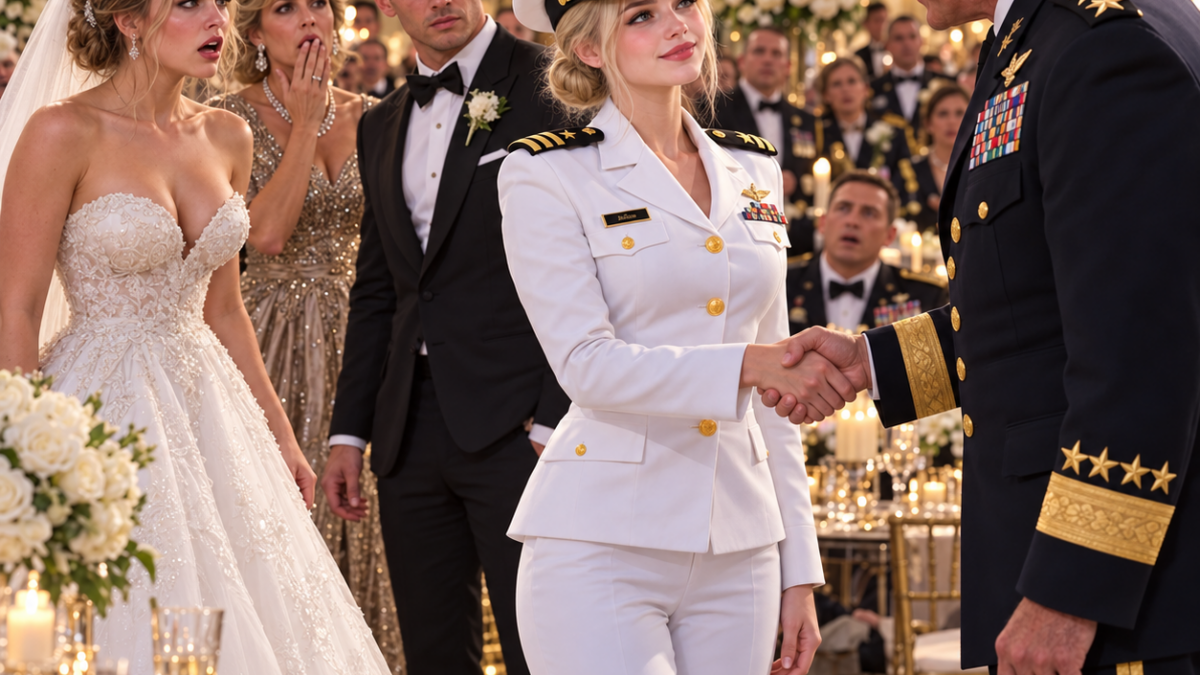
General Douglas Bradley was walking toward us with Austin beside him. On Austin’s other side was a man I had not seen in eighteen months. Nathan Bradley walked with a slight limp. A narrow scar ran from his temple toward his ear. The last time I had heard his voice, it was breaking through static while people were shooting at him and I was trying to move aircraft through a rapidly collapsing situation.
Nathan stopped in front of me.
For several seconds, neither of us spoke.
Then he smiled.
“You sound taller on the radio.”
I laughed before I could stop myself.
“Captain.”
He snapped a salute.
So did his father.
The four-star general standing in the center of my sister’s wedding reception saluted me.
Every nearby conversation stopped.
I returned the salute.
Lydia looked like someone had unplugged her.
Nathan reached out and shook my hand.
“You got twelve of us home.”
His voice changed.
Quieter.
“My wife got her husband back. My daughter got her dad back.”
Then he looked toward Lydia.
“So somebody needs to explain why the person responsible for that was sitting alone in an apartment fifteen minutes away.”
Every face turned toward my sister.
Lydia recovered quickly. She had always been good under social pressure because social pressure was the environment she understood best. “There’s been a misunderstanding,” she said, placing one hand on Austin’s arm. “Emily had work.” Austin moved his arm away. It was a small gesture, but Lydia noticed immediately. “No,” he said. “She didn’t.” Lydia blinked. “Austin—” He interrupted. “You told me she volunteered for duty.” Mom stepped in. “It was simply a family scheduling issue.” Nathan actually laughed once, but there was no humor in it.
“A scheduling issue?”
General Bradley looked toward me. “Commander, were you informed that you were unwelcome at this wedding?” Technically, my rank was Lieutenant Commander, but nobody in that room cared about shortening it. For a moment, I considered protecting Lydia. That instinct annoyed me the instant I recognized it. Years of being the easy child had trained me to reduce conflict even when someone else created it. Then I remembered the restaurant. Mom’s eyes fixed on her coffee while Lydia called my career embarrassing. I remembered the message from that afternoon.
Everything looks perfect. No drama.
I pulled out my phone.
“I was disinvited Thursday.”
Lydia jumped in before I even unlocked the screen. “She’s twisting it.” I handed Austin the messages. He read them slowly. His face hardened. Lydia’s expression changed when she realized I had kept everything. General Bradley did not need to raise his voice. He read one message, then another.
Please don’t make this difficult. Your whole military thing doesn’t fit the weekend.
Another message read:
Austin’s family knows important people. I need everything polished.
Then the photograph of the ballroom.
See? Everything looks perfect. No drama.
Nobody spoke.
A photographer near the cake lowered his camera.
General Bradley handed the phone back.
“You excluded your sister because she serves?”
Lydia’s face flushed. “No. Because she makes everything about the Navy.”
I almost admired the commitment to making the situation worse.
Nathan stared at her.
“She has never once told me she saved my life.”
That finally silenced Lydia.
Nathan reached into his jacket. “I brought something.” He unfolded a photocopy of a commendation citation. My stomach tightened. I recognized it immediately. The language had been sanitized for public use, but the date and basic operation were obvious. Nathan looked around the ballroom. “Eighteen months ago, our team was trapped after an evacuation route collapsed. Communications were bad. Weather was worse. We had wounded men, compromised movement, and almost no time.”
He pointed toward me.
“She coordinated aircraft, naval assets, medical support, and a route nobody thought would hold.”
I shook my head slightly. “Nathan—”
“No.”
He looked directly at me.
“You never got to hear our side.”
Then he faced the guests again.
“Twelve people boarded that extraction aircraft.”
His jaw tightened.
“Twelve came home.”
The room remained silent.
Even the quartet had stopped playing.
I remembered that night differently. I remembered maps, radio calls, fuel windows, conflicting reports, weather data, and the kind of fear that becomes useful only when you turn it into tasks. I had not been thinking about heroism. Nobody competent does during something like that. We were trying to solve the next problem before the next problem killed someone. Nathan and his people did the hardest part. They survived long enough for the route to work. But listening to him speak, I understood something I had refused to think about: the operation continued living in other people’s families after it ended for me.
General Bradley faced Lydia.
“My son told me something else.”
Her face lost color.
Nathan pulled out his phone.
“Last Thanksgiving, you asked me not to mention Emily at dinner.”
I looked at Lydia.
That was new.
Austin looked even more confused.
Nathan continued. “You said she was insecure about her career and might turn the evening into a military story.”
Lydia shook her head. “That was a joke.”
“No.”
Nathan’s voice hardened.
“You were hiding her before the wedding even existed.”
Austin stared at the woman he had married only hours earlier.
“What else have you lied about?”
“Austin, please.”
“No. Answer me.”
The guests were no longer pretending not to listen.
Lydia looked around the room at generals, donors, defense executives, politicians, photographers, and society people she had spent years trying to impress. I could see the panic forming behind her eyes. She had built her entire identity around controlling how rooms perceived her. Now the room had stopped accepting her version.
Then she chose the worst possible defense.
“She has always been jealous of me.”
Someone near the head table actually whispered, “Oh, wow.”
I almost smiled.
I did not need to shout. I did not need to insult her. Lydia was doing enough on her own.
Austin stepped backward.
“You told me Emily hated me.”
I frowned.
That was new too.
Lydia looked panicked.
Austin pulled out his phone. “You said she refused to meet my family because she resented our engagement. You told my mother she mocked military spouses.” That one actually made me laugh once. Not because it was funny. Because it was absurd enough to break through my anger. General Bradley’s wife, Margaret, approached from the head table. She looked Lydia directly in the face.
“Did you say that?”
Lydia opened her mouth.
Nothing came out.
Margaret Bradley turned toward me.
“My son spent three months at Walter Reed after that operation.”
“I know.”
“You sent him a Christmas card.”
I nodded.
“He said you sent cards to three of the other wounded soldiers too.”
“I did.”
Lydia looked around desperately.
Mom grabbed her hand.
“This is supposed to be a wedding. Can everyone stop attacking my daughter?”
I stared at her.
“Which daughter?”
Mom flinched.
That was the first thing I said all evening that truly hurt her.
For once, I was glad.
Austin removed his hand from Lydia’s.
“We’re done for tonight.”
Her head snapped toward him. “What?”
“We’re done.”
“You cannot humiliate me in front of everyone.”
He looked at her for a long moment.
Then said quietly, “You handled that yourself.”
The silence afterward was brutal.
General Bradley stepped away with Nathan. Margaret Bradley followed. The security officers remained discreetly near the entrance. Guests began speaking in low voices, not enough to pretend nothing had happened but enough to allow the reception to breathe again. Lydia stood frozen. Mom whispered urgently into her ear. I suddenly felt very tired.
I turned toward Austin.
“I’m sorry.”
He shook his head.
“You have nothing to apologize for.”
“I mean for today.”
“So do I.”
Neither of us knew what to do with that.
Then Nathan touched my shoulder.
“Can I steal you for five minutes?”
We stepped into a quieter corridor overlooking the water. For several seconds, we simply stood there. He looked stronger than the voice I remembered, though the limp and scar told parts of the story words did not.
“How’s your daughter?” I asked.
“Six now.”
He smiled.
“Bossy.”
“Good.”
“She wants a horse.”
“Less good.”
He laughed.
Then became serious.
“I never thanked you.”
“You didn’t need to.”
“I did.”
“Nathan, I was doing my job.”
“So were the medics. I thanked them too.”
I looked away toward the rain-dark water.
He continued. “You know what I remember most?”
“What?”
“Your voice.”
That surprised me.
“Not what you said. Just that you sounded like somebody had a plan.”
I felt something tighten in my throat.
Most people imagine calm is something you feel.
It is not.
Often calm is what you perform because the people listening cannot afford your fear.
“I did not have much of a plan,” I admitted.
“You had more than we did.”
Fair.
Nathan leaned against the wall.
“Lydia told us you hated these things.”
“What things?”
“Family events. Military receptions. Meeting people.”
“I dislike bad hors d’oeuvres.”
He smiled.
“She made you sound bitter.”
“That was convenient.”
He nodded slowly.
Then asked, “Why didn’t you tell Austin?”
“About being disinvited?”
“Yes.”
I thought about it.
“Because it was his wedding day.”
Nathan frowned. “So?”
“So I didn’t want to blow up his wedding.”
He looked back toward the ballroom.
“Your sister managed that.”
That was difficult to argue with.
I stayed at the reception only because General Bradley asked me to remain for dinner. I almost refused, but he made it clear the request had nothing to do with spectacle. “You were invited,” he said. “Whatever happened with the guest list, you should not be treated as an intruder.” I appreciated that. I sat with Nathan, his wife, several officers, and eventually Austin, who looked like he had aged five years during cocktail hour.
Lydia did not sit with us.
Neither did Mom.
The ceremony had already happened earlier, so there was no question of canceling a wedding before vows. The harder question was what happened afterward.
Lydia tried to regain control before dessert.
She approached Austin near the head table and asked him to speak privately. He agreed. They disappeared into a side room for nearly half an hour. When Austin returned, he looked pale. Lydia did not return with him.
I did not ask.
It was not my marriage.
That distinction mattered.
Later, Mom cornered me near the coat check.
“Are you happy?”
I looked at her.
“About what?”
“You got what you wanted.”
“What exactly did I want?”
“Everyone saw Lydia humiliated.”
I stared at my mother, suddenly more tired than angry.
“Mom, I was sitting at home eating a turkey sandwich.”
“You still came.”
“Military security came to my apartment because General Bradley requested me.”
“You could have refused.”
“And let Lydia keep lying?”
Mom lowered her voice.
“She is your sister.”
“So am I.”
She flinched again.
Good.
I continued before she could change the subject.
“You sat next to her while she told me I was embarrassing. You let her remove me from the wedding. You knew she lied to Austin about why I wasn’t coming.”
Mom looked away.
“You knew?”
Silence.
That was enough.
“You knew.”
“She was stressed.”
I laughed once.
“There it is.”
“What?”
“The excuse.”
“Emily, weddings are emotional.”
“So are deployments.”
She looked offended.
“That is not the same.”
“No. It isn’t.”
I stepped closer.
“On deployment, if I make a bad decision, I own it.”
Mom’s face tightened.
“This family does not.”
I left before she could answer.
The next morning, I woke to forty-seven messages.
Some relatives apologized.
Some wanted details.
Some pretended they had always known Lydia was difficult.
Aunt Denise sent three paragraphs about family unity and ended by asking whether General Bradley was “as intimidating in person as on television.” I deleted that one.
Austin sent a short message.
Thank you for coming. I need space from everything right now.
I replied:
Understood.
Nathan sent a photograph of his daughter wearing an oversized Army cap.
She says Navy is acceptable now.
I laughed for the first time since Thursday.
Then Lydia called.
I let it ring out.
She called again.
Then again.
Finally, a text appeared.
You destroyed everything.
I stared at it.
No apology.
No acknowledgment.
No question about whether I was all right.
Just blame.
I typed a response.
I was home.
Then I blocked her for the day.
By Monday morning, Lydia had already started rewriting the story. According to relatives, I had staged my entrance. She said I had “weaponized military connections” to humiliate her at her own wedding. Somehow, I had apparently convinced a four-star general to send security officers to my apartment for dramatic effect.
That would have been impressive.
Mom repeated a softer version.
“Emily could have handled it privately.”
That sentence spread quickly because it sounded reasonable until anyone asked what “it” meant.
My disinvitation?
Lydia lying to Austin?
Her ordering security to remove me?
The false stories she had told his family for months?
Nobody could give me a version of privacy that did not simply mean Lydia avoiding consequences.
Then she contacted a lifestyle blogger who had planned to publish a feature about the wedding. Lydia described me as unstable, jealous, and obsessed with her military rank. She claimed I had crashed the reception after being removed for “behavioral concerns.”
That was a bad decision.
The officers’ club had security cameras.
The event had professional videographers.
Several military guests had watched Lydia demand that security remove me before General Bradley approached.
Austin also had the messages Lydia sent him.
I had mine.
The blogger quietly dropped the feature.
Two businesses that had provided discounted wedding products in exchange for social media exposure removed Lydia’s photographs from their pages.
Then a more serious problem surfaced.
Lydia’s employer placed her on administrative leave.
That had nothing to do with me.
She worked in event marketing and had used her company email to negotiate complimentary wedding services while implying that the Bradley family officially endorsed certain vendors. Some communications apparently suggested access to military and political guests that she did not have authority to promise.
When I heard that, I almost felt sorry for her.
Almost.
Not because I wanted her career damaged.
Because it showed how far she had taken the same behavior.
Austin had been a relationship.
His father’s name became a brand.
His family became access.
My uniform became ugly only because it did not fit the brand she was building.
Ironically, the thing she tried hardest to hide was the one part of our family with legitimate military credibility.
Austin moved into a hotel before the weekend ended.
Three weeks later, he filed for divorce.
When I heard, I sat at my desk for several minutes staring at nothing.
The marriage had lasted less than a month.
Part of me wondered whether things might have survived if I had stayed home.
Then I rejected that thought.
A marriage that survives only because nobody reveals the truth is not surviving.
It is waiting.
Mom came to my apartment after the divorce filing became public among the family. She stayed in the driveway and called rather than coming upstairs. I could see her through the blinds, sitting inside her car with both hands on the steering wheel.
“Your sister has lost everything,” she said.
“No.”
My answer came easily.
Mom sounded stunned.
I took a sip of gas-station coffee.
“She lost things she thought belonged to her.”
“Emily, she’s your family.”
“So was I.”
Silence.
Then Mom began crying.
I did not enjoy it.
I did not soften either.
“Mom, I spent years being treated like the family mistake because I didn’t live the way you wanted.”
“That isn’t fair.”
“I know.”
She went quiet.
I looked out at the wet parking lot.
“That’s the point.”
For the first time, she had nothing to say.
I did not cut my mother off completely.
I considered it.
Instead, I created distance.
Short calls.
No conversations about Lydia unless Mom could speak without making me responsible for Lydia’s consequences.
The first few attempts went badly.
“She’s depressed.”
“I’m sorry.”
“She needs her sister.”
“She had one.”
“Emily.”
“No.”
Another time:
“You could at least call her.”
“Does she want to apologize?”
“She wants to move forward.”
“That was not my question.”
Mom hated boundaries because boundaries force people to use accurate language.
Eventually, she stopped asking.
A month after the wedding, Nathan and Austin invited me to a diner near Virginia Beach. Nothing fancy. Vinyl booths. Coffee strong enough to remove paint. A waitress who called everyone “hon.” Nathan ordered pancakes at two in the afternoon because, according to him, civilian life meant nobody could stop him.
Austin looked exhausted but calmer.
He apologized again.
I stopped him.
“You didn’t throw me out.”
“No,” he said. “I just believed her.”
“That part is yours.”
He nodded.
“Fair.”
I respected that answer.
He did not ask me to tell him everything Lydia had ever said about him.
He did not need more pain.
Nathan spent most of lunch insulting Austin’s taste in wedding cake.
That helped.
Near the end, Austin looked at me.
“I want to ask one thing.”
“Okay.”
“Did you ever hate me?”
“No.”
“Did you resent the engagement?”
“No.”
“Did you avoid my family?”
“I deployed twice during the time you were dating.”
His mouth tightened.
“Right.”
Then he laughed without humor.
“She made normal things sound intentional.”
“That is how those stories work.”
He nodded.
I did not say anything else.
General Bradley later sent a formal letter through appropriate channels praising the old Red Sea operation and the coordination performed by our team. He also asked whether I would consider applying for a future joint-planning billet.
No magical promotion.
No special favor.
No ridiculous reward handed to me beside a wedding cake.
An opportunity.
That mattered more.
I applied through normal channels.
Six months later, I got the billet based on my record.
When the selection message arrived, I sat alone in my office and read it twice.
Then I smiled.
Not because Lydia would hear about it.
Not because Mom might finally brag.
Because I wanted the job.
That difference mattered.
Lydia’s life changed sharply after the divorce. She moved out of the apartment she could no longer afford after losing her job. Most of the society people she had spent years cultivating vanished almost immediately.
Apparently, connections built on usefulness behave much like usefulness.
They disappear when the transaction ends.
I heard she began freelancing.
Then working for a smaller event company.
Then nothing for several months.
I did not track her.
That was intentional.
For most of my life, Lydia had taken up space in my head without paying rent.
I was done giving her the room.
Mom and I spoke occasionally.
Carefully.
Once, she asked whether I regretted going to the wedding.
I told her the truth.
“I didn’t go to the wedding.”
She looked confused.
“I was brought there.”
There is a difference.
Months later, Mom finally apologized.
Not perfectly.
Not dramatically.
We were sitting in a diner after a medical appointment. She stirred sweetener into coffee and said, “I should have defended you at that restaurant.”
I waited.
She continued.
“I knew Lydia was being cruel.”
“Yes.”
“I thought if I kept her calm, everything would be easier.”
“For who?”
Mom closed her eyes.
“I know.”
That mattered.
For years, her apologies had always included a defense before the apology finished.
This one did not.
“I made you the easier child to disappoint,” she said quietly.
I stared at her.
That sentence was so accurate it hurt.
I had been the reliable daughter.
The one who would survive being overlooked.
The one who did not make scenes.
The one who left and came back and kept functioning.
So when the family needed someone to sacrifice for Lydia’s comfort, they chose me because they assumed I would absorb it.
I looked down at my coffee.
“You did.”
Mom wiped one eye.
“I’m sorry.”
I believed her.
Believing did not restore nine years.
But it was a start.
My relationship with Lydia remained nonexistent for most of the following year.
Then I saw her outside Mom’s church after Thanksgiving service.
I was leaving the next morning for another assignment and had worn my uniform because I came directly from duty. Lydia stood beside a white SUV with her arms folded. She looked thinner. Tired. For the first time I could remember, there was nothing curated about her.
She looked at my uniform.
Then at my ribbons.
No joke.
No insult.
No smile.
“You happy now?” she asked.
I unlocked my Jeep.
“That was never the goal.”
“You ruined my life.”
I turned back.
“No, Lydia.”
A police siren sounded somewhere beyond the shopping center. Wind pushed brown leaves across the parking lot.
“You just finally had an audience when you showed everyone who you were.”
Her face changed.
I expected anger.
Instead, she looked tired.
“You think you’re better than me.”
“No.”
“You always have.”
“I barely thought about you when I was deployed.”
That startled her.
I continued.
“You spent years imagining I was competing with you. I wasn’t.”
She stared at me.
“That is such a cruel thing to say.”
“I’m not trying to be cruel.”
“It sounds cruel.”
“Because you needed me jealous.”
Her eyes narrowed.
“What does that mean?”
“It meant you could explain everything.”
I stepped closer.
“If I didn’t come to something because I was deployed, I was jealous. If I didn’t spend money on something, I was jealous. If I didn’t care about the same people, I was jealous. If I didn’t dress the way you wanted, I was jealous.”
She looked away.
“You needed my life to be smaller so yours felt bigger.”
That landed.
For once, she did not immediately argue.
I opened the driver’s door.
Then Lydia said quietly, “I was ashamed of you.”
I stopped.
There are sentences you expect to hurt because you have already heard versions of them.
That one did.
She continued before I turned.
“I hated explaining you.”
“Why?”
“Because everyone else had normal sisters.”
I faced her.
“What is normal?”
“You disappeared. You missed things. You came home different.”
I said nothing.
Now we were finally talking about something real.
“When you left for Annapolis,” Lydia continued, “Mom talked about you constantly. People asked about you. Teachers remembered you. Then every time you came home, everyone wanted Navy stories.”
I almost laughed from disbelief.
“You thought I stole attention?”
She looked embarrassed.
“Yes.”
“Lydia, I hated talking about deployments.”
“I know that now.”
I studied her face.
“You excluded me from your wedding because you were jealous of me?”
Her eyes filled.
“I don’t know.”
“That’s not an answer.”
“I wanted one thing that was mine.”
I almost softened.
Then I remembered the lies.
“Austin was yours.”
Her face collapsed slightly.
“You did not need to erase me to keep him.”
She wiped under one eye.
“I know.”
The answer surprised me.
I had expected another defense.
None came.
For several seconds, we stood in silence.
Then she said, “I’m sorry.”
I waited.
No but.
No explanation.
No accusation.
Just the sentence.
I nodded.
“Okay.”
Her face tightened.
“That’s it?”
“What do you want?”
“I don’t know.”
“Neither do I.”
That was the truth.
An apology can open a door.
It does not tell you whether walking through is wise.
We did not hug.
I got into my Jeep and drove away.
For the first time in years, I did not check the mirror to see whether my family approved.
My new joint-planning assignment changed the rhythm of my career. More interservice coordination. More meetings. More complicated logistics. More people from different branches using different acronyms for essentially the same problem.
Nathan joked that I had officially become dangerous because I now knew both Navy and Army paperwork.
He and I stayed in touch.
So did Austin, though less frequently.
His divorce became final before what would have been his first anniversary. He eventually transferred to another role and rebuilt his life quietly.
I was glad.
None of us needed the wedding to remain the most important thing that ever happened to us.
That was another lesson Lydia had never understood.
Big events feel permanent only while you are inside them.
Life keeps going.
General Bradley retired the following year.
At his retirement reception, I attended by invitation.
No security escort.
No family crisis.
Just an officer saying goodbye after a long career.
When he saw me, he smiled.
“Commander Carter.”
“General.”
“Still Navy?”
“Unfortunately.”
Nathan groaned from behind him.
General Bradley laughed.
Then he introduced me to his wife as though we had not already met under catastrophic circumstances.
The whole evening was wonderfully boring.
I appreciated that.
At one point, General Bradley said something I remembered later.
“People think rank tells you who matters.”
I looked at him.
“It doesn’t?”
“It tells you responsibility.”
He nodded toward a young enlisted sailor speaking with one of his former aides.
“Character tells you who matters.”
I thought about Lydia.
Mom.
Myself.
He was right.
Years of military service had taught me something similar, but family had complicated it.
I had spent too much time measuring myself against people who had no standard beyond appearances.
Lydia measured worth by rooms entered.
Mom measured peace by conflict avoided.
I had measured strength by how much I could absorb without complaining.
All three measures were flawed.
Real strength was not quietly accepting whatever people did because I knew I could survive.
Sometimes strength was leaving the restaurant.
Saving the message.
Answering honestly when the general asked why I was not invited.
Refusing to protect someone from a truth they created.
That last one had taken me the longest to learn.
A year after the wedding, Lydia called.
I almost did not answer.
Then I did.
“Hi.”
Her voice sounded cautious.
“Hi.”
“I wanted to tell you I got a job.”
“Okay.”
“A real one.”
“That usually helps.”
She laughed nervously.
“Still sarcastic.”
“Occupational stability.”
She told me about a small nonprofit that needed event coordination. Lower salary. No glamorous clients. No national magazines. She sounded embarrassed at first.
Then she said something unexpected.
“I like it.”
“Good.”
“We did a fundraiser for military families last month.”
I went quiet.
“I did not use your name.”
That made me laugh.
“Excellent judgment.”
She laughed too.
Then she asked, “Can I send you something?”
“What?”
“An apology.”
“You already apologized.”
“A better one.”
I looked out my office window.
“Okay.”
The email arrived that evening.
It was long.
I expected excuses.
There were fewer than I feared.
She admitted she had spent years turning my absences into evidence that I did not care. She admitted she had lied to Austin because she was afraid his family would find my career more interesting than hers. She admitted she had wanted to control the wedding so completely that anyone unpredictable became a threat.
Then came the sentence that mattered most.
I knew what you did for a living. I just decided it mattered less than what I wanted.
That was honest.
I replied the next day.
Thank you for saying it clearly.
Nothing more.
We began talking occasionally after that.
Slowly.
No instant sisterhood.
No sentimental montage.
Trust is boring to rebuild.
That is why so few people do it properly.
Birthdays.
Short calls.
Coffee once when I was home.
A Thanksgiving dinner where neither of us discussed the wedding.
The first time she asked about one of my deployments, she stopped herself.
“Can you talk about it?”
That question meant more than curiosity.
It meant respect.
I answered what I could.
Mom improved too.
She stopped calling my assignments “the Navy thing.”
Small victory.
Once, at dinner, she introduced me to someone as “my daughter Emily, a Navy officer.”
No apology attached.
No comparison to Lydia.
Just fact.
I almost looked behind me to see who she meant.
Life settled.
That was the best part.
No dramatic revenge.
No endless collapse.
Lydia rebuilt.
Austin rebuilt.
Mom tried.
I kept serving.
People sometimes imagine justice as the moment someone who hurt you loses everything.
I no longer saw it that way.
Lydia losing the marriage and job did not heal me.
Her finally understanding what she had done mattered more.
My mother crying did not heal me.
Her admitting that she used my resilience as permission to neglect me mattered more.
The Bradleys respecting me did not create my worth.
My career existed before any of them knew my name.
That may have been the biggest lesson.
For years, I thought being overlooked hurt because people failed to recognize what I had accomplished.
Eventually, I realized recognition was not the thing I needed.
Respect was.
The difference is enormous.
Recognition says, I know what you achieved.
Respect says, I do not need proof before treating you like a person.
Lydia had failed that test long before the wedding.
So had Mom.
For a while, so had I.
I allowed people to reduce my life because I believed explaining myself would look defensive.
I let the family call deployments “the Navy thing.”
I let Lydia frame silence as envy.
I let Mom choose convenience because I was certain I could handle the pain.
I could handle it.
That was never the point.
One evening, about eighteen months after the wedding, I returned from work and found an envelope in my mailbox.
No return address.
Inside was a photograph.
Lydia’s wedding ballroom.
Empty.
Taken before guests arrived.
White roses.
Crystal chandeliers.
Perfect tables.
On the back, Lydia had written:
I thought perfection meant removing anything I could not control.
I was wrong.
No signature needed.
I stood in the hallway holding the picture for several minutes.
Then I put it in a drawer.
Not framed.
Not destroyed.
Just kept.
Documentation mattered.
Apparently, it always would.
Years later, the detail I remembered most from that weekend was not the general saluting me.
It was not Lydia’s face when Nathan said twelve people came home.
It was not Austin stepping away.
It was the message on my phone while I stood in my apartment wearing sweatpants.
Please come.
That was the moment the story changed.
Not because someone powerful summoned me.
Because for once, somebody inside Lydia’s perfect world wanted the truth more than the image.
I had spent years believing I did not fit my family because I was too different.
Maybe that was partly true.
I was not good at polished lies.
I did not enjoy social maneuvering.
I had no interest in making my life photograph better than it felt.
I owned a ten-year-old Jeep.
My coffee was usually terrible.
My sea bag was always half-packed.
My hands were rough.
Sometimes I missed birthdays because ships do not care about cake.
I did not look perfect.
Neither did the life I wanted.
That was fine.
The last time Lydia and I had coffee before another assignment, she looked at my uniform and smiled.
“Remember when I told you not to wear that?”
“Frequently.”
“I was an idiot.”
“Yes.”
She stared at me.
“You could at least pretend to think about it.”
“I’m deploying. Time is limited.”
She laughed.
Then she became serious.
“I’m proud of you.”
The sentence surprised me.
I looked down at my coffee.
“Thanks.”
She reached across the table.
“I mean it.”
“I know.”
That was enough.
Later, I loaded my sea bag into the Jeep.
Dress blues hung behind the driver’s seat.
A paper cup sat in the holder.
Nothing glamorous.
Nothing curated.
Nothing a bridal magazine would photograph.
I started the engine.
Years earlier, Lydia had told me my uniform would embarrass her guests.
What she never understood was that I had stopped wearing it for other people a long time ago.
I wore it because of responsibility.
Because people depended on me.
Because somewhere in my memory, twelve voices once came through broken radio traffic while a plan barely held together.
Because all twelve came home.
My family’s opinion had never changed that.
General Bradley’s respect had never created it.
Lydia’s apology did not complete it.
The uniform meant what it meant whether anyone liked the photograph or not.
I pulled out of the parking lot and headed toward base.
For most of my life, I thought peace would come when my family finally understood me.
I was wrong.
Peace came when I stopped needing their understanding before I moved forward.
Their approval could follow if they wanted.
Their apologies could arrive when they were ready.
Their opinions could change slowly.
My life did not have to wait.
And for the first time in years, I drove toward the gate without checking the rearview mirror to see who was watching.
𝗧𝗛𝗘 𝗘𝗡𝗗
My Sister Thought Erasing Me From Her Wedding Would Protect Her Perfect Image
For years, my sister treated my Navy career like something awkward she had to explain away.
At her wedding, she finally decided the easiest solution was to erase me completely.
She never imagined the people she was desperate to impress already knew exactly who I was.
“Don’t wear that uniform around my guests.”
Lydia looked me up and down across the white tablecloth as if I had walked into the restaurant wearing something filthy instead of standard Navy khakis. I had come directly from work, hair pinned back, shoes polished, uniform clean. Nothing dramatic. Nothing ceremonial. But the expression on my sister’s face suggested I had personally sabotaged the atmosphere of the expensive French restaurant she had chosen for lunch. Then she pushed my gold-trimmed wedding invitation toward me with two manicured fingers. “Actually,” she said, “forget it. Don’t come at all.” For a few seconds, I thought she had to be joking. Lydia rarely joked when cameras, money, or appearances were involved, and her wedding involved all three.
My mother, Carol, sat beside her wearing a cream Chanel jacket and stirring a cappuccino she had not touched. She kept her eyes lowered. That told me this conversation had been planned before I arrived. “You invited me six months ago,” I said. Lydia tapped one nail against the envelope. “Things changed.” I asked what had changed. “My guest list.” I almost laughed. She had invited nearly four hundred people. Lydia corrected me automatically. Three hundred eighty-six. Of course she knew the exact number. She had managed this wedding like a military operation designed by people who believed flower walls were strategic assets. Her fiancé, Austin Bradley, was the son of General Douglas Bradley, a four-star Army officer. To Lydia, Austin was not merely a man she loved. He was access.
For months, she had talked about the officers’ club, retired generals, senators, defense executives, donors, photographers, and people with summer houses important enough to have names. She rarely described the wedding as a marriage. It was always an event. A weekend. A guest experience. Now she leaned closer and explained that a national bridal publication might feature photographs from the reception. “You don’t understand,” she said. “I’m starting to,” I answered. Her jaw tightened. “You always do this.” I asked what she meant. “Act sarcastic because you don’t fit in.” That one landed harder than I expected. Lydia saw it and smiled slightly, like someone who had finally found the knife she wanted.
“You disappear for eight months at a time,” she continued. “You show up with rough hands. You barely wear makeup. Whenever anyone asks what you do, you start talking about ships and deployments.” I stared at her. “I answer the question.” “It makes people uncomfortable.” My mother finally joined in. “Emily, sweetheart, Lydia has worked very hard on this weekend.” There it was. The family sentence that always meant I was about to be asked to swallow something awful politely. I looked at Mom. “Worked hard doing what?” “Creating relationships.” “She’s getting married.” Mom gave me a warning look. “You know what I mean.” I did. Lydia had always been the daughter who understood how to turn attention into currency.
I was the daughter who left for Annapolis at eighteen. At my graduation, Mom complained about the heat and the length of the ceremony. At Lydia’s college graduation, she rented a waterfront room and ordered custom cookies printed with Lydia’s face. Her marketing job received speeches at Thanksgiving. My deployments became “Emily’s still doing the Navy thing.” Nine years of service reduced to a hobby I had somehow forgotten to quit. I looked at Lydia. “So this is because I’m active duty?” She sighed. “It’s because you don’t match the tone of the weekend.” I repeated the word. Tone. She rolled her eyes. “Oh my God, Emily. Do I really have to say it?” “Apparently.” The softness disappeared from her face.
“You’re an embarrassment to this family.”
Mom stared into her coffee.
Lydia continued. “I’m not letting your dirty-sailor aesthetic ruin photographs I’ll have forever.” I said nothing. That bothered her more than if I had yelled. She wanted tears or outrage, something dramatic she could later describe as me making a scene. Instead, I slid the invitation back across the table. “Keep it.” Her expression flickered. Mom looked up. “Emily, don’t be childish.” I stood. “I’m not.” “Then understand your sister’s position.” I picked up my cover. “I understand it perfectly.” Outside, rain dotted the windshield of my ten-year-old Jeep. I sat behind the wheel for thirty seconds, allowing myself exactly that long to be hurt before starting the engine.
The wedding was Saturday. I spent that morning at my apartment with burnt coffee, half a turkey sandwich, and logistics folders spread across my kitchen table. Rain swept sideways against the balcony. My phone buzzed repeatedly until I finally checked it. The family group chat was overflowing with photographs. Lydia having her hair done. Champagne. White roses. Mom posing on the club staircase. Aunt Denise had posted, “Our princess finally gets her fairy tale.” I muted the chat. Then another message appeared. Austin. We were not close, but he had always treated me decently. Wish you were here. Lydia said duty came up. Stay safe. I stared at the screen. Duty? Interesting. I typed and deleted three responses before settling on the simplest.
Congratulations. Hope today goes well.
An hour later, Lydia sent me a photograph of the ballroom.
See? Everything looks perfect. No drama.
I saved a screenshot.
Habit.
In my job, documentation mattered.
Apparently, it mattered in families too.
At 4:17 that afternoon, an engine idled outside my building. I ignored it until blue lights flashed across the kitchen wall. I moved to the window. A military security vehicle sat at the curb. Two uniformed officers stepped out. My first thought was casualty notification. That fear becomes automatic after enough years around the military. My stomach dropped. Boots moved through the stairwell. Second floor. Third. Then three hard knocks hit my door. I opened it. The senior officer came to attention.
“Lieutenant Commander Emily Carter?”
“Yes.”
“Ma’am.”
I returned the salute automatically. “What happened?”
“Nothing involving your command, ma’am.”
That only confused me more.
He handed me a sealed message bearing the security marking of the officers’ club where Lydia’s wedding was taking place.
“General Bradley requests your immediate presence.”
I stared at him.
“The groom’s father?”
“Yes, ma’am.”
My phone buzzed.
Austin.
Emily, my father knows. I’m sorry.
Then another message appeared.
Please come.
And suddenly I knew Lydia’s perfect wedding was already beginning to crack.
part2
I closed the apartment door and stood in the middle of my living room holding the sealed message. My gray sweatshirt had OLD NAVY written across the chest, I was wearing sweatpants, and there was a coffee stain near my wrist. If Lydia could have seen me, she probably would have considered it proof that she had made the right decision. The two security officers waited downstairs while I went to the bedroom closet and pulled out my dress blues. Ten minutes later, I was fastening the coat in front of the mirror. Gold stripes. Ribbons. Qualification insignia. The uniform my sister believed would make her wedding photographs look cheap. I stared at myself for a moment longer than necessary, then picked up my cover and left.
The security vehicle moved through Norfolk traffic without lights or sirens. Nobody ran intersections. Nobody shouted into radios. This was not an arrest or a battlefield emergency. Somehow that made the situation feel more serious. Official attention is often quiet. Rain slapped against the windshield while ordinary storefronts moved past us: a tire shop, a coffee shop, a church sign advertising Sunday pancakes. My phone vibrated almost continuously. Aunt Denise. Mom. Lydia. I ignored all of them until Austin called. His voice sounded wrecked when I answered. “Emily?” I asked what happened. He took a breath. “Dad asked where you were.”
“And?”
“I told him you had duty.”
I watched rain streak sideways across the glass. “That’s what Lydia told you?”
“Yes.”
He paused.
“Then Nathan heard your name.”
My grip tightened around the phone.
Nathan Bradley was Austin’s younger brother, an Army captain. I knew the name very well.
Austin continued carefully. “He asked whether you were Lieutenant Commander Carter from the Roosevelt strike group.” Everything inside me became still. “Emily,” he said, “Nathan says you’re the officer who coordinated his extraction in the Red Sea.” I did not answer. Some operations were not family-dinner stories. Austin understood the silence. “My father asked Lydia why you weren’t here.” I closed my eyes. “What did she say?” “That you refused to attend.” Of course she did. Then he added, “I showed Dad your message from this morning.” I opened my eyes again.
“Which message?”
“The congratulations message. Dad asked why someone refusing to attend would send me that.”
The question was simple.
That was the problem.
Simple questions are dangerous when a lie depends on nobody asking them.
The officers’ club looked exactly like something Lydia would design if somebody gave her unlimited flowers and a fear of subtlety. White roses framed the entrance. Crystal chandeliers burned above polished floors. A string quartet played near tall windows overlooking the water. Uniformed officers mixed with civilians in formal wear while waiters moved between them carrying champagne. I stepped through the entrance wearing dress blues, and the first twenty people who noticed me stopped talking. Some recognized the rank. Others recognized the uniform. A few simply sensed that military security escorting an officer into a wedding reception was not normal.
Then Lydia saw me.
Her champagne glass froze halfway to her mouth.
Even across the ballroom, I watched her expression change.
Shock.
Anger.
Calculation.
She shoved the glass toward a bridesmaid and moved toward me quickly, Mom close behind. Lydia kept smiling because photographers were nearby, but the fury in her eyes was unmistakable. “What the hell are you doing here?” she whispered. I glanced back toward the security officers. “I was requested.” She gave a tiny laugh. “By who?” Mom grabbed my elbow before I could answer. I removed her hand. “Emily,” she whispered, “you have made your point. Now leave.”
“I haven’t made any point.”
“You’re wearing the uniform.”
I stared at her.
“Yes, Mom. That’s generally how uniforms work.”
Lydia stepped closer. “Did you actually bring military police to crash my wedding?”
“No.”
“You’re pathetic.”
There it was again. That little superior smile. She turned toward the club’s civilian security manager. “This woman was removed from the guest list. Please escort her out.” The manager looked at my escorts, then at my rank, then back at Lydia. “Ma’am,” he said carefully, “I think we should wait.” Lydia’s smile vanished.
“For what?”
A man answered behind her.
“For me.”
The area around us went silent.
General Douglas Bradley was walking toward us with Austin beside him. On Austin’s other side was a man I had not seen in eighteen months. Nathan Bradley walked with a slight limp. A narrow scar ran from his temple toward his ear. The last time I had heard his voice, it was breaking through static while people were shooting at him and I was trying to move aircraft through a rapidly collapsing situation.
Nathan stopped in front of me.
For several seconds, neither of us spoke.
Then he smiled.
“You sound taller on the radio.”
I laughed before I could stop myself.
“Captain.”
He snapped a salute.
So did his father.
The four-star general standing in the center of my sister’s wedding reception saluted me.
Every nearby conversation stopped.
I returned the salute.
Lydia looked like someone had unplugged her.
Nathan reached out and shook my hand.
“You got twelve of us home.”
His voice changed.
Quieter.
“My wife got her husband back. My daughter got her dad back.”
Then he looked toward Lydia.
“So somebody needs to explain why the person responsible for that was sitting alone in an apartment fifteen minutes away.”
Every face turned toward my sister.
Lydia recovered quickly. She had always been good under social pressure because social pressure was the environment she understood best. “There’s been a misunderstanding,” she said, placing one hand on Austin’s arm. “Emily had work.” Austin moved his arm away. It was a small gesture, but Lydia noticed immediately. “No,” he said. “She didn’t.” Lydia blinked. “Austin—” He interrupted. “You told me she volunteered for duty.” Mom stepped in. “It was simply a family scheduling issue.” Nathan actually laughed once, but there was no humor in it.
“A scheduling issue?”
General Bradley looked toward me. “Commander, were you informed that you were unwelcome at this wedding?” Technically, my rank was Lieutenant Commander, but nobody in that room cared about shortening it. For a moment, I considered protecting Lydia. That instinct annoyed me the instant I recognized it. Years of being the easy child had trained me to reduce conflict even when someone else created it. Then I remembered the restaurant. Mom’s eyes fixed on her coffee while Lydia called my career embarrassing. I remembered the message from that afternoon.
Everything looks perfect. No drama.
I pulled out my phone.
“I was disinvited Thursday.”
Lydia jumped in before I even unlocked the screen. “She’s twisting it.” I handed Austin the messages. He read them slowly. His face hardened. Lydia’s expression changed when she realized I had kept everything. General Bradley did not need to raise his voice. He read one message, then another.
Please don’t make this difficult. Your whole military thing doesn’t fit the weekend.
Another message read:
Austin’s family knows important people. I need everything polished.
Then the photograph of the ballroom.
See? Everything looks perfect. No drama.
Nobody spoke.
A photographer near the cake lowered his camera.
General Bradley handed the phone back.
“You excluded your sister because she serves?”
Lydia’s face flushed. “No. Because she makes everything about the Navy.”
I almost admired the commitment to making the situation worse.
Nathan stared at her.
“She has never once told me she saved my life.”
That finally silenced Lydia.
Nathan reached into his jacket. “I brought something.” He unfolded a photocopy of a commendation citation. My stomach tightened. I recognized it immediately. The language had been sanitized for public use, but the date and basic operation were obvious. Nathan looked around the ballroom. “Eighteen months ago, our team was trapped after an evacuation route collapsed. Communications were bad. Weather was worse. We had wounded men, compromised movement, and almost no time.”
He pointed toward me.
“She coordinated aircraft, naval assets, medical support, and a route nobody thought would hold.”
I shook my head slightly. “Nathan—”
“No.”
He looked directly at me.
“You never got to hear our side.”
Then he faced the guests again.
“Twelve people boarded that extraction aircraft.”
His jaw tightened.
“Twelve came home.”
The room remained silent.
Even the quartet had stopped playing.
I remembered that night differently. I remembered maps, radio calls, fuel windows, conflicting reports, weather data, and the kind of fear that becomes useful only when you turn it into tasks. I had not been thinking about heroism. Nobody competent does during something like that. We were trying to solve the next problem before the next problem killed someone. Nathan and his people did the hardest part. They survived long enough for the route to work. But listening to him speak, I understood something I had refused to think about: the operation continued living in other people’s families after it ended for me.
General Bradley faced Lydia.
“My son told me something else.”
Her face lost color.
Nathan pulled out his phone.
“Last Thanksgiving, you asked me not to mention Emily at dinner.”
I looked at Lydia.
That was new.
Austin looked even more confused.
Nathan continued. “You said she was insecure about her career and might turn the evening into a military story.”
Lydia shook her head. “That was a joke.”
“No.”
Nathan’s voice hardened.
“You were hiding her before the wedding even existed.”
Austin stared at the woman he had married only hours earlier.
“What else have you lied about?”
“Austin, please.”
“No. Answer me.”
The guests were no longer pretending not to listen.
Lydia looked around the room at generals, donors, defense executives, politicians, photographers, and society people she had spent years trying to impress. I could see the panic forming behind her eyes. She had built her entire identity around controlling how rooms perceived her. Now the room had stopped accepting her version.
Then she chose the worst possible defense.
“She has always been jealous of me.”
Someone near the head table actually whispered, “Oh, wow.”
I almost smiled.
I did not need to shout. I did not need to insult her. Lydia was doing enough on her own.
Austin stepped backward.
“You told me Emily hated me.”
I frowned.
That was new too.
Lydia looked panicked.
Austin pulled out his phone. “You said she refused to meet my family because she resented our engagement. You told my mother she mocked military spouses.” That one actually made me laugh once. Not because it was funny. Because it was absurd enough to break through my anger. General Bradley’s wife, Margaret, approached from the head table. She looked Lydia directly in the face.
“Did you say that?”
Lydia opened her mouth.
Nothing came out.
Margaret Bradley turned toward me.
“My son spent three months at Walter Reed after that operation.”
“I know.”
“You sent him a Christmas card.”
I nodded.
“He said you sent cards to three of the other wounded soldiers too.”
“I did.”
Lydia looked around desperately.
Mom grabbed her hand.
“This is supposed to be a wedding. Can everyone stop attacking my daughter?”
I stared at her.
“Which daughter?”
Mom flinched.
That was the first thing I said all evening that truly hurt her.
For once, I was glad.
Austin removed his hand from Lydia’s.
“We’re done for tonight.”
Her head snapped toward him. “What?”
“We’re done.”
“You cannot humiliate me in front of everyone.”
He looked at her for a long moment.
Then said quietly, “You handled that yourself.”
The silence afterward was brutal.
General Bradley stepped away with Nathan. Margaret Bradley followed. The security officers remained discreetly near the entrance. Guests began speaking in low voices, not enough to pretend nothing had happened but enough to allow the reception to breathe again. Lydia stood frozen. Mom whispered urgently into her ear. I suddenly felt very tired.
I turned toward Austin.
“I’m sorry.”
He shook his head.
“You have nothing to apologize for.”
“I mean for today.”
“So do I.”
Neither of us knew what to do with that.
Then Nathan touched my shoulder.
“Can I steal you for five minutes?”
We stepped into a quieter corridor overlooking the water. For several seconds, we simply stood there. He looked stronger than the voice I remembered, though the limp and scar told parts of the story words did not.
“How’s your daughter?” I asked.
“Six now.”
He smiled.
“Bossy.”
“Good.”
“She wants a horse.”
“Less good.”
He laughed.
Then became serious.
“I never thanked you.”
“You didn’t need to.”
“I did.”
“Nathan, I was doing my job.”
“So were the medics. I thanked them too.”
I looked away toward the rain-dark water.
He continued. “You know what I remember most?”
“What?”
“Your voice.”
That surprised me.
“Not what you said. Just that you sounded like somebody had a plan.”
I felt something tighten in my throat.
Most people imagine calm is something you feel.
It is not.
Often calm is what you perform because the people listening cannot afford your fear.
“I did not have much of a plan,” I admitted.
“You had more than we did.”
Fair.
Nathan leaned against the wall.
“Lydia told us you hated these things.”
“What things?”
“Family events. Military receptions. Meeting people.”
“I dislike bad hors d’oeuvres.”
He smiled.
“She made you sound bitter.”
“That was convenient.”
He nodded slowly.
Then asked, “Why didn’t you tell Austin?”
“About being disinvited?”
“Yes.”
I thought about it.
“Because it was his wedding day.”
Nathan frowned. “So?”
“So I didn’t want to blow up his wedding.”
He looked back toward the ballroom.
“Your sister managed that.”
That was difficult to argue with.
I stayed at the reception only because General Bradley asked me to remain for dinner. I almost refused, but he made it clear the request had nothing to do with spectacle. “You were invited,” he said. “Whatever happened with the guest list, you should not be treated as an intruder.” I appreciated that. I sat with Nathan, his wife, several officers, and eventually Austin, who looked like he had aged five years during cocktail hour.
Lydia did not sit with us.
Neither did Mom.
The ceremony had already happened earlier, so there was no question of canceling a wedding before vows. The harder question was what happened afterward.
Lydia tried to regain control before dessert.
She approached Austin near the head table and asked him to speak privately. He agreed. They disappeared into a side room for nearly half an hour. When Austin returned, he looked pale. Lydia did not return with him.
I did not ask.
It was not my marriage.
That distinction mattered.
Later, Mom cornered me near the coat check.
“Are you happy?”
I looked at her.
“About what?”
“You got what you wanted.”
“What exactly did I want?”
“Everyone saw Lydia humiliated.”
I stared at my mother, suddenly more tired than angry.
“Mom, I was sitting at home eating a turkey sandwich.”
“You still came.”
“Military security came to my apartment because General Bradley requested me.”
“You could have refused.”
“And let Lydia keep lying?”
Mom lowered her voice.
“She is your sister.”
“So am I.”
She flinched again.
Good.
I continued before she could change the subject.
“You sat next to her while she told me I was embarrassing. You let her remove me from the wedding. You knew she lied to Austin about why I wasn’t coming.”
Mom looked away.
“You knew?”
Silence.
That was enough.
“You knew.”
“She was stressed.”
I laughed once.
“There it is.”
“What?”
“The excuse.”
“Emily, weddings are emotional.”
“So are deployments.”
She looked offended.
“That is not the same.”
“No. It isn’t.”
I stepped closer.
“On deployment, if I make a bad decision, I own it.”
Mom’s face tightened.
“This family does not.”
I left before she could answer.
The next morning, I woke to forty-seven messages.
Some relatives apologized.
Some wanted details.
Some pretended they had always known Lydia was difficult.
Aunt Denise sent three paragraphs about family unity and ended by asking whether General Bradley was “as intimidating in person as on television.” I deleted that one.
Austin sent a short message.
Thank you for coming. I need space from everything right now.
I replied:
Understood.
Nathan sent a photograph of his daughter wearing an oversized Army cap.
She says Navy is acceptable now.
I laughed for the first time since Thursday.
Then Lydia called.
I let it ring out.
She called again.
Then again.
Finally, a text appeared.
You destroyed everything.
I stared at it.
No apology.
No acknowledgment.
No question about whether I was all right.
Just blame.
I typed a response.
I was home.
Then I blocked her for the day.
By Monday morning, Lydia had already started rewriting the story. According to relatives, I had staged my entrance. She said I had “weaponized military connections” to humiliate her at her own wedding. Somehow, I had apparently convinced a four-star general to send security officers to my apartment for dramatic effect.
That would have been impressive.
Mom repeated a softer version.
“Emily could have handled it privately.”
That sentence spread quickly because it sounded reasonable until anyone asked what “it” meant.
My disinvitation?
Lydia lying to Austin?
Her ordering security to remove me?
The false stories she had told his family for months?
Nobody could give me a version of privacy that did not simply mean Lydia avoiding consequences.
Then she contacted a lifestyle blogger who had planned to publish a feature about the wedding. Lydia described me as unstable, jealous, and obsessed with her military rank. She claimed I had crashed the reception after being removed for “behavioral concerns.”
That was a bad decision.
The officers’ club had security cameras.
The event had professional videographers.
Several military guests had watched Lydia demand that security remove me before General Bradley approached.
Austin also had the messages Lydia sent him.
I had mine.
The blogger quietly dropped the feature.
Two businesses that had provided discounted wedding products in exchange for social media exposure removed Lydia’s photographs from their pages.
Then a more serious problem surfaced.
Lydia’s employer placed her on administrative leave.
That had nothing to do with me.
She worked in event marketing and had used her company email to negotiate complimentary wedding services while implying that the Bradley family officially endorsed certain vendors. Some communications apparently suggested access to military and political guests that she did not have authority to promise.
When I heard that, I almost felt sorry for her.
Almost.
Not because I wanted her career damaged.
Because it showed how far she had taken the same behavior.
Austin had been a relationship.
His father’s name became a brand.
His family became access.
My uniform became ugly only because it did not fit the brand she was building.
Ironically, the thing she tried hardest to hide was the one part of our family with legitimate military credibility.
Austin moved into a hotel before the weekend ended.
Three weeks later, he filed for divorce.
When I heard, I sat at my desk for several minutes staring at nothing.
The marriage had lasted less than a month.
Part of me wondered whether things might have survived if I had stayed home.
Then I rejected that thought.
A marriage that survives only because nobody reveals the truth is not surviving.
It is waiting.
Mom came to my apartment after the divorce filing became public among the family. She stayed in the driveway and called rather than coming upstairs. I could see her through the blinds, sitting inside her car with both hands on the steering wheel.
“Your sister has lost everything,” she said.
“No.”
My answer came easily.
Mom sounded stunned.
I took a sip of gas-station coffee.
“She lost things she thought belonged to her.”
“Emily, she’s your family.”
“So was I.”
Silence.
Then Mom began crying.
I did not enjoy it.
I did not soften either.
“Mom, I spent years being treated like the family mistake because I didn’t live the way you wanted.”
“That isn’t fair.”
“I know.”
She went quiet.
I looked out at the wet parking lot.
“That’s the point.”
For the first time, she had nothing to say.
I did not cut my mother off completely.
I considered it.
Instead, I created distance.
Short calls.
No conversations about Lydia unless Mom could speak without making me responsible for Lydia’s consequences.
The first few attempts went badly.
“She’s depressed.”
“I’m sorry.”
“She needs her sister.”
“She had one.”
“Emily.”
“No.”
Another time:
“You could at least call her.”
“Does she want to apologize?”
“She wants to move forward.”
“That was not my question.”
Mom hated boundaries because boundaries force people to use accurate language.
Eventually, she stopped asking.
A month after the wedding, Nathan and Austin invited me to a diner near Virginia Beach. Nothing fancy. Vinyl booths. Coffee strong enough to remove paint. A waitress who called everyone “hon.” Nathan ordered pancakes at two in the afternoon because, according to him, civilian life meant nobody could stop him.
Austin looked exhausted but calmer.
He apologized again.
I stopped him.
“You didn’t throw me out.”
“No,” he said. “I just believed her.”
“That part is yours.”
He nodded.
“Fair.”
I respected that answer.
He did not ask me to tell him everything Lydia had ever said about him.
He did not need more pain.
Nathan spent most of lunch insulting Austin’s taste in wedding cake.
That helped.
Near the end, Austin looked at me.
“I want to ask one thing.”
“Okay.”
“Did you ever hate me?”
“No.”
“Did you resent the engagement?”
“No.”
“Did you avoid my family?”
“I deployed twice during the time you were dating.”
His mouth tightened.
“Right.”
Then he laughed without humor.
“She made normal things sound intentional.”
“That is how those stories work.”
He nodded.
I did not say anything else.
General Bradley later sent a formal letter through appropriate channels praising the old Red Sea operation and the coordination performed by our team. He also asked whether I would consider applying for a future joint-planning billet.
No magical promotion.
No special favor.
No ridiculous reward handed to me beside a wedding cake.
An opportunity.
That mattered more.
I applied through normal channels.
Six months later, I got the billet based on my record.
When the selection message arrived, I sat alone in my office and read it twice.
Then I smiled.
Not because Lydia would hear about it.
Not because Mom might finally brag.
Because I wanted the job.
That difference mattered.
Lydia’s life changed sharply after the divorce. She moved out of the apartment she could no longer afford after losing her job. Most of the society people she had spent years cultivating vanished almost immediately.
Apparently, connections built on usefulness behave much like usefulness.
They disappear when the transaction ends.
I heard she began freelancing.
Then working for a smaller event company.
Then nothing for several months.
I did not track her.
That was intentional.
For most of my life, Lydia had taken up space in my head without paying rent.
I was done giving her the room.
Mom and I spoke occasionally.
Carefully.
Once, she asked whether I regretted going to the wedding.
I told her the truth.
“I didn’t go to the wedding.”
She looked confused.
“I was brought there.”
There is a difference.
Months later, Mom finally apologized.
Not perfectly.
Not dramatically.
We were sitting in a diner after a medical appointment. She stirred sweetener into coffee and said, “I should have defended you at that restaurant.”
I waited.
She continued.
“I knew Lydia was being cruel.”
“Yes.”
“I thought if I kept her calm, everything would be easier.”
“For who?”
Mom closed her eyes.
“I know.”
That mattered.
For years, her apologies had always included a defense before the apology finished.
This one did not.
“I made you the easier child to disappoint,” she said quietly.
I stared at her.
That sentence was so accurate it hurt.
I had been the reliable daughter.
The one who would survive being overlooked.
The one who did not make scenes.
The one who left and came back and kept functioning.
So when the family needed someone to sacrifice for Lydia’s comfort, they chose me because they assumed I would absorb it.
I looked down at my coffee.
“You did.”
Mom wiped one eye.
“I’m sorry.”
I believed her.
Believing did not restore nine years.
But it was a start.
My relationship with Lydia remained nonexistent for most of the following year.
Then I saw her outside Mom’s church after Thanksgiving service.
I was leaving the next morning for another assignment and had worn my uniform because I came directly from duty. Lydia stood beside a white SUV with her arms folded. She looked thinner. Tired. For the first time I could remember, there was nothing curated about her.
She looked at my uniform.
Then at my ribbons.
No joke.
No insult.
No smile.
“You happy now?” she asked.
I unlocked my Jeep.
“That was never the goal.”
“You ruined my life.”
I turned back.
“No, Lydia.”
A police siren sounded somewhere beyond the shopping center. Wind pushed brown leaves across the parking lot.
“You just finally had an audience when you showed everyone who you were.”
Her face changed.
I expected anger.
Instead, she looked tired.
“You think you’re better than me.”
“No.”
“You always have.”
“I barely thought about you when I was deployed.”
That startled her.
I continued.
“You spent years imagining I was competing with you. I wasn’t.”
She stared at me.
“That is such a cruel thing to say.”
“I’m not trying to be cruel.”
“It sounds cruel.”
“Because you needed me jealous.”
Her eyes narrowed.
“What does that mean?”
“It meant you could explain everything.”
I stepped closer.
“If I didn’t come to something because I was deployed, I was jealous. If I didn’t spend money on something, I was jealous. If I didn’t care about the same people, I was jealous. If I didn’t dress the way you wanted, I was jealous.”
She looked away.
“You needed my life to be smaller so yours felt bigger.”
That landed.
For once, she did not immediately argue.
I opened the driver’s door.
Then Lydia said quietly, “I was ashamed of you.”
I stopped.
There are sentences you expect to hurt because you have already heard versions of them.
That one did.
She continued before I turned.
“I hated explaining you.”
“Why?”
“Because everyone else had normal sisters.”
I faced her.
“What is normal?”
“You disappeared. You missed things. You came home different.”
I said nothing.
Now we were finally talking about something real.
“When you left for Annapolis,” Lydia continued, “Mom talked about you constantly. People asked about you. Teachers remembered you. Then every time you came home, everyone wanted Navy stories.”
I almost laughed from disbelief.
“You thought I stole attention?”
She looked embarrassed.
“Yes.”
“Lydia, I hated talking about deployments.”
“I know that now.”
I studied her face.
“You excluded me from your wedding because you were jealous of me?”
Her eyes filled.
“I don’t know.”
“That’s not an answer.”
“I wanted one thing that was mine.”
I almost softened.
Then I remembered the lies.
“Austin was yours.”
Her face collapsed slightly.
“You did not need to erase me to keep him.”
She wiped under one eye.
“I know.”
The answer surprised me.
I had expected another defense.
None came.
For several seconds, we stood in silence.
Then she said, “I’m sorry.”
I waited.
No but.
No explanation.
No accusation.
Just the sentence.
I nodded.
“Okay.”
Her face tightened.
“That’s it?”
“What do you want?”
“I don’t know.”
“Neither do I.”
That was the truth.
An apology can open a door.
It does not tell you whether walking through is wise.
We did not hug.
I got into my Jeep and drove away.
For the first time in years, I did not check the mirror to see whether my family approved.
My new joint-planning assignment changed the rhythm of my career. More interservice coordination. More meetings. More complicated logistics. More people from different branches using different acronyms for essentially the same problem.
Nathan joked that I had officially become dangerous because I now knew both Navy and Army paperwork.
He and I stayed in touch.
So did Austin, though less frequently.
His divorce became final before what would have been his first anniversary. He eventually transferred to another role and rebuilt his life quietly.
I was glad.
None of us needed the wedding to remain the most important thing that ever happened to us.
That was another lesson Lydia had never understood.
Big events feel permanent only while you are inside them.
Life keeps going.
General Bradley retired the following year.
At his retirement reception, I attended by invitation.
No security escort.
No family crisis.
Just an officer saying goodbye after a long career.
When he saw me, he smiled.
“Commander Carter.”
“General.”
“Still Navy?”
“Unfortunately.”
Nathan groaned from behind him.
General Bradley laughed.
Then he introduced me to his wife as though we had not already met under catastrophic circumstances.
The whole evening was wonderfully boring.
I appreciated that.
At one point, General Bradley said something I remembered later.
“People think rank tells you who matters.”
I looked at him.
“It doesn’t?”
“It tells you responsibility.”
He nodded toward a young enlisted sailor speaking with one of his former aides.
“Character tells you who matters.”
I thought about Lydia.
Mom.
Myself.
He was right.
Years of military service had taught me something similar, but family had complicated it.
I had spent too much time measuring myself against people who had no standard beyond appearances.
Lydia measured worth by rooms entered.
Mom measured peace by conflict avoided.
I had measured strength by how much I could absorb without complaining.
All three measures were flawed.
Real strength was not quietly accepting whatever people did because I knew I could survive.
Sometimes strength was leaving the restaurant.
Saving the message.
Answering honestly when the general asked why I was not invited.
Refusing to protect someone from a truth they created.
That last one had taken me the longest to learn.
A year after the wedding, Lydia called.
I almost did not answer.
Then I did.
“Hi.”
Her voice sounded cautious.
“Hi.”
“I wanted to tell you I got a job.”
“Okay.”
“A real one.”
“That usually helps.”
She laughed nervously.
“Still sarcastic.”
“Occupational stability.”
She told me about a small nonprofit that needed event coordination. Lower salary. No glamorous clients. No national magazines. She sounded embarrassed at first.
Then she said something unexpected.
“I like it.”
“Good.”
“We did a fundraiser for military families last month.”
I went quiet.
“I did not use your name.”
That made me laugh.
“Excellent judgment.”
She laughed too.
Then she asked, “Can I send you something?”
“What?”
“An apology.”
“You already apologized.”
“A better one.”
I looked out my office window.
“Okay.”
The email arrived that evening.
It was long.
I expected excuses.
There were fewer than I feared.
She admitted she had spent years turning my absences into evidence that I did not care. She admitted she had lied to Austin because she was afraid his family would find my career more interesting than hers. She admitted she had wanted to control the wedding so completely that anyone unpredictable became a threat.
Then came the sentence that mattered most.
I knew what you did for a living. I just decided it mattered less than what I wanted.
That was honest.
I replied the next day.
Thank you for saying it clearly.
Nothing more.
We began talking occasionally after that.
Slowly.
No instant sisterhood.
No sentimental montage.
Trust is boring to rebuild.
That is why so few people do it properly.
Birthdays.
Short calls.
Coffee once when I was home.
A Thanksgiving dinner where neither of us discussed the wedding.
The first time she asked about one of my deployments, she stopped herself.
“Can you talk about it?”
That question meant more than curiosity.
It meant respect.
I answered what I could.
Mom improved too.
She stopped calling my assignments “the Navy thing.”
Small victory.
Once, at dinner, she introduced me to someone as “my daughter Emily, a Navy officer.”
No apology attached.
No comparison to Lydia.
Just fact.
I almost looked behind me to see who she meant.
Life settled.
That was the best part.
No dramatic revenge.
No endless collapse.
Lydia rebuilt.
Austin rebuilt.
Mom tried.
I kept serving.
People sometimes imagine justice as the moment someone who hurt you loses everything.
I no longer saw it that way.
Lydia losing the marriage and job did not heal me.
Her finally understanding what she had done mattered more.
My mother crying did not heal me.
Her admitting that she used my resilience as permission to neglect me mattered more.
The Bradleys respecting me did not create my worth.
My career existed before any of them knew my name.
That may have been the biggest lesson.
For years, I thought being overlooked hurt because people failed to recognize what I had accomplished.
Eventually, I realized recognition was not the thing I needed.
Respect was.
The difference is enormous.
Recognition says, I know what you achieved.
Respect says, I do not need proof before treating you like a person.
Lydia had failed that test long before the wedding.
So had Mom.
For a while, so had I.
I allowed people to reduce my life because I believed explaining myself would look defensive.
I let the family call deployments “the Navy thing.”
I let Lydia frame silence as envy.
I let Mom choose convenience because I was certain I could handle the pain.
I could handle it.
That was never the point.
One evening, about eighteen months after the wedding, I returned from work and found an envelope in my mailbox.
No return address.
Inside was a photograph.
Lydia’s wedding ballroom.
Empty.
Taken before guests arrived.
White roses.
Crystal chandeliers.
Perfect tables.
On the back, Lydia had written:
I thought perfection meant removing anything I could not control.
I was wrong.
No signature needed.
I stood in the hallway holding the picture for several minutes.
Then I put it in a drawer.
Not framed.
Not destroyed.
Just kept.
Documentation mattered.
Apparently, it always would.
Years later, the detail I remembered most from that weekend was not the general saluting me.
It was not Lydia’s face when Nathan said twelve people came home.
It was not Austin stepping away.
It was the message on my phone while I stood in my apartment wearing sweatpants.
Please come.
That was the moment the story changed.
Not because someone powerful summoned me.
Because for once, somebody inside Lydia’s perfect world wanted the truth more than the image.
I had spent years believing I did not fit my family because I was too different.
Maybe that was partly true.
I was not good at polished lies.
I did not enjoy social maneuvering.
I had no interest in making my life photograph better than it felt.
I owned a ten-year-old Jeep.
My coffee was usually terrible.
My sea bag was always half-packed.
My hands were rough.
Sometimes I missed birthdays because ships do not care about cake.
I did not look perfect.
Neither did the life I wanted.
That was fine.
The last time Lydia and I had coffee before another assignment, she looked at my uniform and smiled.
“Remember when I told you not to wear that?”
“Frequently.”
“I was an idiot.”
“Yes.”
She stared at me.
“You could at least pretend to think about it.”
“I’m deploying. Time is limited.”
She laughed.
Then she became serious.
“I’m proud of you.”
The sentence surprised me.
I looked down at my coffee.
“Thanks.”
She reached across the table.
“I mean it.”
“I know.”
That was enough.
Later, I loaded my sea bag into the Jeep.
Dress blues hung behind the driver’s seat.
A paper cup sat in the holder.
Nothing glamorous.
Nothing curated.
Nothing a bridal magazine would photograph.
I started the engine.
Years earlier, Lydia had told me my uniform would embarrass her guests.
What she never understood was that I had stopped wearing it for other people a long time ago.
I wore it because of responsibility.
Because people depended on me.
Because somewhere in my memory, twelve voices once came through broken radio traffic while a plan barely held together.
Because all twelve came home.
My family’s opinion had never changed that.
General Bradley’s respect had never created it.
Lydia’s apology did not complete it.
The uniform meant what it meant whether anyone liked the photograph or not.
I pulled out of the parking lot and headed toward base.
For most of my life, I thought peace would come when my family finally understood me.
I was wrong.
Peace came when I stopped needing their understanding before I moved forward.
Their approval could follow if they wanted.
Their apologies could arrive when they were ready.
Their opinions could change slowly.
My life did not have to wait.
And for the first time in years, I drove toward the gate without checking the rearview mirror to see who was watching.