.My Husband’s Family Changed My Locks Before His Grave Was Cold
part2
Three months before Marcus’s diagnosis, we attended his cousin Lauren’s wedding outside Charleston. It was one of those old Southern venues where string lights hung between oak trees and men in pastel jackets pretended humidity was charming. After two hours of smiling through conversations about property values and private schools, I slipped behind the main house to get five quiet minutes. That was when I heard Raymond’s voice. “When Marcus is gone, we move quickly.” I stopped. Gerald answered, “House first. Then the clinic.” My hand went cold around my phone. Timothy asked what would happen to me. Raymond laughed. “She’s military. She moves for a living.” Then Patricia joined them. Her voice was soft, almost pleasant. “She came into this family with a duffel bag. She can leave with one.”
My phone recorded the last forty-seven seconds because my thumb had accidentally hit the video button while I was gripping it. I did not confront them. I walked back through the reception, found Marcus, and waited until we were sitting in our driveway at home before playing the recording. He listened once. Then again. He did not defend them. He did not tell me I had misunderstood. He stared through the windshield for so long I wondered whether he had stopped breathing. Finally he said, “Come inside.” In the kitchen, Marcus went to the hall closet and pulled out a battered leather briefcase I had never seen before. He opened it on the same Formica table where we paid the electric bill.
Inside were deeds, bank records, business documents, insurance papers, and a thick folder marked PEYTON — ESTATE PLAN. Marcus slid the first deed toward me. My name sat beside his. “They think they’re inheriting my life,” he said. He tapped the deed once. “They’re not.” I stared at him. “How long have you had this?” “Years.” He leaned back. “I’ve known who they are longer than you have.” That night I learned my gentle husband, the man who moved turtles out of roads and apologized when he stepped on ants, had spent seven years quietly structuring our finances so his family could never push me out if something happened to him.
It started before our wedding. Raymond invited me to Charleston Country Club and pushed a prenup across a patio table before dessert. “I’m protecting the bloodline.” I slid it back. “I have my own lawyer.” He smiled like I had passed a test. “Smart girl.” When Marcus learned what his father had done, he did not yell. He called Charles Peyton. Over the next seven years, Marcus restructured everything: the house, his veterinary clinic, a waterfront parcel along the Ashley River, investment accounts, and ownership interests. Assets that could pass directly to me were arranged so ownership transferred immediately at his death. Not after Raymond filed something. Not after a family meeting. Immediately.
The will covered everything else. Furniture. Vehicles. Personal accounts. Books. Equipment. Even Marcus’s absurd collection of antique veterinary textbooks that smelled like dust and formaldehyde. Everything came to me. Charles inserted a no-contest clause because Marcus understood his family better than I wanted to. If they challenged the will, they risked losing even the small personal items he left them. I asked why he bothered leaving them anything. Marcus smiled. “Bait.” I stared at him. “You built a legal tripwire for your own relatives?” “I prefer incentive structure.” That was Marcus. The man who could spend twenty minutes comforting an anxious dog had no problem designing consequences for people he believed might attack his wife after his death.
Then he showed me the journal. Dated entries. Every insult. Every pressure campaign. Every comment about my career. Every time Patricia suggested he should have married “someone more settled.” Every conversation Raymond initiated about bringing Gerald into the clinic. Marcus had saved emails, voicemails, and text messages. One message from Gerald asked whether Marcus could “quietly transfer” clinic shares before I found out. I looked up from the phone. “Why didn’t you tell me?” Marcus took a long breath. “Because I wanted you to live here without feeling like you were under siege.” “You knew I was.” His eyes softened. “I knew.” Somehow that hurt worse than discovering the documents. He had seen everything and had been trying to protect me quietly.
Six weeks later, a physician at MUSC said stage-four pancreatic cancer. Marcus looked at me, then at the doctor, then back at me. “Call Charles.” That was how quickly our future collapsed. One moment we were discussing treatment options and timelines. The next, my husband was making sure a dead man could still defend his wife. Cancer reduced Marcus physically with obscene speed. His shoulders disappeared beneath shirts that once fit him. His hands trembled. He stopped finishing meals. Yet every week he made Charles review another document, confirm another beneficiary, update another instruction. I hated watching him use energy on paperwork when he had so little left. He insisted. “They’re going to test every weak spot after I’m gone.”
His family proved him right before he even died. Patricia brought casseroles. Raymond brought opinions. Gerald brought nothing but questions about the clinic. They started visiting twice a week. One afternoon Marcus was asleep in the hospital bed we had installed near the living-room window while I measured liquid medication in the kitchen. Raymond walked around knocking on walls. “Solid construction.” He said it like an appraiser. Patricia sat beside her dying son flipping through a furniture catalog and showed Gerald’s wife a photograph of a white sectional. “This would brighten the room when you move in.” I set the medicine cup down slowly enough not to spill it.
Marcus opened one eye. He had heard her. Neither of us said anything until they left. Later that week, the outdoor camera caught Gerald photographing the garage keypad and side entrance. I downloaded the footage. Two days later another camera recorded Timothy saying, “Dad wants locks done right after the funeral.” I saved that too. Everything went into a cloud folder shared with Charles. Marcus was too weak to sit upright by then, but when I showed him the clip, he squeezed my hand. “Don’t stop them too early.” I leaned closer because his voice had become thin. “What?” “Let them act.” I stared at him. “Marcus, they’re talking about throwing me out of my own house.”
“Exactly.” He took a slow breath. “People like my father talk themselves into believing entitlement is permission. Let them show Charles who they are.” I hated the idea. Every instinct I had from the Army said identify the threat, establish the perimeter, stop the breach before it happens. Marcus understood a different battlefield. He knew his family could explain away private conversations, deny intent, and call recorded jokes misunderstandings. Actual conduct would be harder to hide. “What do you want me to do?” I asked. He looked toward the wedding photograph near the television, then back at me. “Hold long enough for them to make their choices.”
Four days later, Marcus died before sunrise with my hand in his. His breathing slowed gradually until the room became quiet. I remember the clock reading 4:18. I remember thinking the refrigerator sounded impossibly loud. I remember placing my forehead against his hand and telling him I was there, even though I did not know whether he could still hear me. His family arrived three hours later. Raymond’s first serious question was about the deed. Not the funeral. Not whether Marcus suffered. Not whether I had eaten. The deed. That answered every remaining question in me.
So when the moving truck arrived the morning after the funeral, I did not see an ambush. I saw evidence arriving almost exactly on Marcus’s schedule. Charles’s black BMW turned onto the street nine minutes after my call and stopped directly behind the moving truck. Nobody was leaving. He stepped out wearing a charcoal suit despite the Charleston heat. Raymond came down the driveway. “Who the hell are you?” Charles handed him a business card. “Charles Peyton. Counsel for Major Molly Martin.” He emphasized Major just enough to tell me he was angry, though his face never changed.
Raymond’s expression shifted. I had never discussed much of my Army career with the Colemans because every conversation became either a competition or a lecture about how deployments made me an inconvenient wife. Charles looked toward the furniture stacked inside the moving truck, then at my phone. “Still recording?” “Yes.” “Excellent.” He faced Raymond. “You have five minutes to stop removing my client’s property.” Raymond laughed. “Your client has no ownership claim here.” Charles smiled. Not warmly. “Mr. Coleman, I sincerely hope you repeat that when law enforcement arrives.” The laugh disappeared. Gerald stepped forward. “Police?” Charles opened his briefcase on the hood of his BMW.
He removed three certified deeds. “The residence, the clinic property, and the Ashley River parcel were held with survivorship provisions. Marcus’s interest transferred to Molly at the moment of his death.” Raymond snatched the first document and scanned it. “This can be challenged.” “Certainly.” Charles removed another document. “Here is the will containing the no-contest provision your son instructed me to enforce.” Patricia had come outside now. “What is happening?” Charles turned toward her. “Your family is removing property from a home belonging to your daughter-in-law after changing her locks without authorization.” Patricia looked at Raymond. “You said the lawyer handled this.” Charles answered before he could. “Your lawyer appears to have listened to what Raymond wanted instead of verifying what Marcus owned.”
A Charleston police cruiser turned onto the street. I had not called them. Mrs. Dorsey had. She later told me she saw people loading my furniture into a truck and decided somebody in the neighborhood should behave like a neighbor. The officer parked behind Charles’s BMW. A second cruiser arrived moments later. The movers stopped working. Raymond’s expression changed from insulted confidence to calculation. I knew that look. He had finally realized his version of the morning was not controlling the room anymore. Charles closed his briefcase. “Now,” he said quietly, “I suggest nobody removes another object.”
The officers separated everyone and checked identification. Charles showed them the deeds and my recorded statements from Raymond. I showed them the security-system lockout and the video of my furniture being removed. The officers did not make grand declarations about ownership. They simply told the movers to stop until the dispute was clarified. That was enough. We moved into the dining room while the truck remained blocked outside. Charles placed a sealed envelope in the center of the table. Patricia recognized the handwriting before he said anything. Her mouth opened slightly. Raymond leaned forward. “That’s private.” Charles looked at him. “Marcus instructed me to read this if you attempted to remove Molly from her home.”
Nobody spoke.
Charles broke the seal.
Marcus’s letter started years earlier. The first dinner where Raymond spoke to my steelworker father as though he were hired help. The secret prenup meeting. The Christmas Patricia handed the scarf I made her to the housekeeper in front of everyone and said it “suited her better.” The comments about my deployments. The jokes about Marcus being “married to the Army.” The attempts to persuade him to give Gerald control of the clinic. The conversations at Lauren’s wedding. Marcus had written each event plainly, without dramatics. That made it harder to dismiss. Raymond stared at the tabletop. Patricia’s eyes began to fill. Gerald looked like he wanted to leave.
Then Charles reached the final page.
“You confused blood with loyalty,” he read. “Molly never did.”
No one moved.
“You treated my wife like temporary housing in my life. She was my family when I was healthy, my family when I was afraid, and my family when I was dying.”
Patricia covered her mouth.
Gerald stared down.
Raymond kept looking at the legal documents as if somewhere among them must be a loophole capable of resurrecting his authority.
Charles continued.
“If you are hearing this because you tried to take her home, return every item you removed and leave. Do not contact her unless she contacts you first.”
Charles folded the letter.
One of the officers cleared his throat. “Sounds pretty specific.”
I almost smiled.
Raymond turned toward me. “Molly, grief makes people behave irrationally.”
I stared at him.
“You changed my locks before your son’s funeral flowers wilted.”
For the first time since I met Raymond Coleman, he had no superior answer waiting.
He looked away.
Then the officers supervised while Gerald, Timothy, and the movers carried everything back inside. Lamps. Boxes. Books. Kitchen chairs. Marcus’s record player. My medals. Our photographs. Patricia returned my jewelry box without looking at me. Finally Gerald carried my grandmother’s armchair through the doorway. I stood in the living room and pointed toward the exact spot where it had been. “Six inches left.” He glared at me. “Molly.” “Six.” He moved the chair. “Another two.” He did it. Petty? Maybe. Necessary? Absolutely.
Half the street watched while pretending not to. Mrs. Dorsey watered the same azalea bush for nearly forty minutes. A delivery driver slowed down twice. The movers looked embarrassed enough to disappear inside their uniforms. Charles arranged for a locksmith before sunset. New locks. My code. My keys. My house. I stood alone in the living room afterward and looked at everything exactly where Marcus had left it. The silence hit harder once the fight stopped. During conflict, grief waits politely. When the room becomes quiet again, it comes back for everything you owe.
I sat in my grandmother’s chair and cried until I could barely breathe. Not because I had won. Not because Raymond had lost. Because the person who prepared all of this was gone. Marcus had known me well enough to predict I would hold myself together until the danger passed. He also knew what would happen afterward. Charles stayed in the kitchen making coffee I never asked for. When I finally stopped crying, he brought me a mug and sat across from me without speaking. After a while I said, “He planned all of this while he was dying.” Charles looked down at his hands. “He loved you very much.” That almost started me again.
News traveled. Charleston is large enough to call itself a city but certain circles behave like a small town wearing better shoes. Raymond stopped appearing at his country club for a while. Patricia resigned from two charity boards after uncomfortable questions about the incident reached people she could not intimidate. Gerald’s plan to acquire Marcus’s clinic collapsed when Dr. Henderson, the veterinarian he hoped would help finance the transition, withdrew completely. The Colemans had built their identity around being respectable, traditional, family first. That brand became harder to maintain once neighbors watched police supervise them returning a widow’s furniture.
A week later, Raymond mailed me a cashier’s check for one hundred thousand dollars. The accompanying letter contained three paragraphs about emotions running high, misunderstanding Marcus’s intentions, and hoping both sides could “move forward with dignity.” Not one sentence said I am sorry. I called Charles. “Can I send this back?” “Absolutely.” “Any legal reason not to?” “None.” I returned the check uncashed. No note. No speech. Raymond had always believed every problem eventually revealed a purchase price. Marcus had understood something his father never did: there are things money cannot repair because the damage itself was created by treating people like assets.
The harder decision involved the clinic.
Gerald wanted it desperately. Before Marcus became sick, Coleman Veterinary Clinic had grown from a modest neighborhood practice into one of the most trusted animal hospitals in that part of Charleston. Marcus knew every dog by name and forgot half their owners. He kept peanut butter in one drawer for nervous patients and emergency granola bars in another for technicians who forgot lunch. Selling the clinic would have been the easiest financial choice. One investment group offered more money than I expected. Gerald offered less but described it as “keeping Marcus’s legacy in the family.” I almost laughed when I read that phrase.
I did not sell.
Instead, I renamed it the Marcus Coleman Memorial Animal Hospital.
I remained active duty, so I hired an experienced medical director and kept the staff Marcus trusted. The senior technician, Nancy, cried when I told her no one was losing a job. “Marcus thought you might sell,” she admitted. “Marcus thought I might do a lot of sensible things,” I said. On Saturdays when duty allowed, I volunteered. Not medicine. I was not a veterinarian. I answered phones, carried files, made coffee, cleaned kennels if we were short, and sat with frightened owners while clinicians handled emergencies. Nothing heroic. I loved it more than I expected.
The waiting room had scratched tile, old magazines, a coffee machine that produced something legally questionable, and usually at least one Labrador shedding enough hair to create another dog. Military families started coming because several technicians knew I served. Then veterans. Then we created a fund to help service members who could not afford emergency veterinary care. I used some of Marcus’s estate to seed it. The first dog we helped belonged to a young Army specialist whose shepherd had swallowed part of a tennis ball. He kept apologizing for needing assistance. I told him Marcus would have charged him in homemade cookies if he could have gotten away with it.
Six months after Marcus died, we held a small dedication outside the clinic. Folding chairs. Costco sandwiches. A local high-school color guard. An American flag beside the new sign. Charles attended. Mrs. Dorsey came and somehow brought three trays of brownies. Marcus’s nurses and technicians came. Several former patients arrived with their owners. The Coleman family did not attend. I had not invited them. That felt less like punishment than clarity. Marcus’s letter told them not to contact me unless I chose first. I had not chosen. For once, no one in that family was deciding when I should be ready.
After everyone left, I sat alone in Marcus’s old office. His desk still had scratches from the metal carrier of a cat that once escaped during an exam. I opened drawers, sorting old pens and expired business cards. When I pulled the bottom drawer out completely, I found an envelope taped underneath. My name was written across it.
Molly, my soldier.
I sat down before opening it.
Inside was one page.
Marcus wrote that he knew I would win the legal fight. He knew Charles would make certain of it. Then he wrote the sentence that hurt most because it sounded exactly like him.
Hold the line when you have to. Then live.
I read it five times.
Below that, he had added: Do not spend the rest of your life fighting people who no longer matter.
I laughed through tears.
Even dead, my husband was giving me orders he knew I needed.
For months, I had imagined surviving grief as a series of defensive positions. Protect the house. Protect the clinic. Protect the documents. Protect the memory. Protect myself from Raymond. Marcus was reminding me defense was supposed to end eventually. A life built only around resisting enemies still belongs partly to those enemies. He wanted better for me. The realization scared me because fighting was easier than living. Fighting gave each day a target. Living required choosing something when no emergency told me what mattered.
I folded the letter and placed it inside my jacket.
The next morning, I stood on my front porch before sunrise. Charleston smelled like wet grass, salt, and warm pavement from the previous day. My Jeep sat in the driveway. Through the living-room window, I could see my grandmother’s chair. Marcus’s funeral flag rested inside a walnut display case near the fireplace. The house was legally mine. The clinic was protected. The Colemans had no keys, no ownership claim, and no place in my decisions unless I gave them one.
For the first time since the hospital, I did not need to go to a lawyer, funeral home, courthouse, or meeting.
I started my running watch.
Then I ran.
The first mile hurt because I had barely trained during Marcus’s final months. The second hurt for different reasons. By the third, my breathing settled. I passed houses, dogs, sprinklers, delivery trucks. Ordinary life. People leaving for work. Children waiting for buses. Nobody knew I had buried my husband. Nobody knew his family tried to remove me from my home. Nobody cared. Strangely, that helped. The world had continued while mine stopped, and maybe I was allowed to rejoin it without asking permission.
I ran four miles.
Then five.
When I returned, Mrs. Dorsey stood on her porch holding coffee.
“You look terrible,” she called.
“Thank you.”
“Means you ran enough.”
I laughed.
It was the first laugh since Marcus died that did not feel borrowed.
Weeks became months. Grief changed texture. At first, every object in the house felt loaded. Marcus’s shoes by the back door. His coffee mug. A grocery list written in his handwriting. Eventually those things became less like traps and more like evidence that he had existed outside the hospital bed. I started remembering healthy Marcus again. The man who sang badly while cooking. The veterinarian who once brought home an injured box turtle and converted our guest bathroom into a rehabilitation center. The husband who could never find his keys even though he insisted on buying tracking tags.
I began sleeping in our bedroom again.
That took longer than I expected.
For weeks, I slept on the couch because lying on his side of the bed made the absence too physical. One night after a long shift, I went upstairs without planning to. I changed clothes, climbed into bed, and woke six hours later with sunlight across the blanket. I cried when I realized where I was. Then I made coffee.
That became grief for me.
Cry.
Coffee.
Work.
Repeat.
Not heroic.
Real.
Raymond tried twice more to communicate through lawyers. One letter proposed a “family reconciliation meeting.” Charles forwarded it with one sentence: You are under no obligation to respond. I did not. Patricia sent a birthday card nine months after Marcus’s death. No apology. Inside she wrote, We all lost someone. I stared at it for a long time. Technically true. Emotionally dishonest. We had all lost Marcus, but they had tried to use his death as a transfer of control. I placed the card in a drawer rather than answering. Silence was no longer something they were doing to me. It had become a boundary I chose.
Gerald made the biggest mistake later that year. He contacted one of Marcus’s old clinic partners and implied ownership disputes were still unresolved. The partner called me immediately. Charles sent Gerald a formal notice the same afternoon. Gerald backed away. No court case followed because the documents were too clear. That was the beauty of what Marcus built. He did not leave me a battle plan requiring constant warfare. He left me paperwork strong enough to make most battles pointless.
The Colemans slowly disappeared from my daily life.
Their absence felt strange at first. For years every holiday came with Patricia criticizing something subtle and Raymond explaining finances nobody asked about. I had spent so much time bracing for them that peace felt suspicious. The first Thanksgiving after Marcus died, I expected grief to destroy me. Instead, Nancy from the clinic invited me to her house. There were seventeen people, two dogs under the table, a child playing trumpet badly in another room, and a turkey that almost caught fire.
Nobody criticized my cooking.
Nobody asked about property.
Nobody told me where I belonged.
I went home with leftover pie and cried in the driveway because I had enjoyed myself.
Guilt is strange after loss.
Happiness can feel disloyal.
I heard Marcus’s voice in my head.
Then live.
So I went inside and ate the pie.
The clinic fund grew. A retired Marine donated after we helped his bulldog through emergency surgery. A local business matched contributions. We added a quiet room for families saying goodbye to pets. Marcus had always wanted one but kept postponing it because there was never enough money. I named it simply The Marcus Room. No plaque listing donors. No dramatic portrait. Just a photograph of him sitting on the floor with a nervous golden retriever leaning against his chest.
That was the Marcus I wanted people to know.
Not the estate.
Not the family name.
Not the fight.
The man on the floor with a frightened dog.
Two years after his death, Charles asked whether I wanted to update my own estate documents. I laughed. “Marcus turned you into a monster.” “Marcus paid his bills on time.” “So that’s love now?” Charles smiled. “In my profession, absolutely.” I updated everything. Not because I expected anyone to attack my property when I died, but because uncertainty invites other people to make decisions for you. Marcus had taught me that. I created instructions for the clinic, the assistance fund, the house, and my military benefits.
Then Charles asked the question I had been avoiding.
“Any personal bequests to the Colemans?”
I looked out his office window.
“No.”
He waited.
“None?”
“None.”
He nodded and kept typing.
No judgment.
That was another kind of freedom.
I did not need to leave bait.
I was not Marcus.
My boundary could simply be a closed door.
Another year passed before I saw Patricia again. It happened accidentally at a grocery store in Charleston. I was reaching for coffee when I heard my name. She stood at the end of the aisle holding a basket with two bottles of wine and a loaf of bread. She looked older. Smaller. For a moment, neither of us moved.
“Molly.”
“Patricia.”
Her eyes dropped toward my left hand.
I still wore my wedding ring.
She noticed.
“I heard the clinic is doing well.”
“It is.”
“Marcus would be proud.”
That sentence almost angered me.
Almost.
Instead, I asked, “Did you need something?”
She looked wounded, but not surprised.
“I wanted to say I think about that morning.”
“So do I.”
“We were grieving.”
There it was again.
The excuse.
I picked up the coffee.
“Grief didn’t hire movers.”
Her face changed.
“No.”
“Grief didn’t change my locks.”
She looked down.
“No.”
“Grief didn’t photograph my keypad before Marcus died.”
Silence.
People moved around us with carts.
Finally Patricia whispered, “I’m sorry.”
It was the first actual apology any Coleman had given me.
I studied her.
“You’re sorry for what?”
Her eyes filled.
“For treating you like you were temporary.”
Marcus’s words.
That mattered.
I nodded.
“Thank you.”
She waited, perhaps expecting forgiveness to arrive immediately because apology had finally appeared.
It did not.
I did not hug her.
I did not invite her for coffee.
I simply said, “Take care of yourself.”
Then I walked away.
I felt lighter afterward.
Not because everything was fixed.
Because I discovered I could hear an apology without reopening the door.
Forgiveness, if it came, did not have to equal access.
Marcus would have understood.
Raymond never apologized.
Not really.
He died several years later after a stroke. Gerald notified Charles, who forwarded the message because I had requested all communication remain indirect. I felt less than I expected. No satisfaction. No grief. Just the strange recognition that a man who once seemed capable of controlling every room eventually became another name attached to a date.
Patricia did not ask me to attend the funeral.
I would not have.
Gerald inherited most of Raymond’s remaining business interests. Timothy moved to Florida. Their family continued. Mine did too.
That distinction had taken me years to accept.
Marcus’s death had not left me family-less.
It had revealed which relationships were real.
The people at the clinic became part of my life. Charles became the irritating friend who reminded me to update insurance beneficiaries. Mrs. Dorsey continued monitoring the street with the dedication of an unpaid intelligence service. My Army friends rotated through deployments and assignments but kept showing up when it mattered. Some visited Marcus’s grave with me. Others never mentioned him unless I did.
They learned what I needed.
Years later, on the anniversary of Marcus’s death, I went to the cemetery alone. I brought no flowers because he hated cut flowers. Instead, I brought coffee and sat beside the marker like an idiot while drinking both cups.
“You were right,” I told him.
The cemetery did not answer.
“You’d be unbearable about it.”
Still nothing.
I laughed.
Then I told him about the clinic, the fund, Patricia’s apology, and a Labrador named Moose who had eaten half a couch cushion and somehow survived.
I told him I was considering retirement from the Army.
That one was harder.
For most of my adult life, the uniform had given structure to everything. Marcus understood that. He never asked me to choose between service and marriage. Now, without him, staying had become partly habit.
“Hold the line when you have to,” I whispered.
Then live.
I knew what he would say.
I retired eighteen months later.
No dramatic reason.
No breakdown.
No scandal.
I was simply ready.
The ceremony was small. A few friends. People from the clinic. Charles. Mrs. Dorsey wore a dress that looked older than I was and cried louder than anyone. My commander handed me the flag. I thought about the morning Patricia removed my Bronze Star shadow box from the wall as though my service were clutter.
Afterward, I went home.
My home.
Same porch.
Same living room.
My grandmother’s chair had been reupholstered but remained exactly where Gerald had been forced to return it years earlier.
Marcus’s flag rested beside mine.
I stood there for a long time.
No one was waiting to remove anything.
No deadline.
No clipboard.
No moving truck.
Just silence.
The good kind.
Retirement gave me more time at the clinic. I started working there four days a week in administration and community outreach. I still cleaned kennels when necessary because job titles mean very little when a sick animal has exploded across a floor. The veterans assistance fund expanded to cover working dogs and service animals. We partnered with a rescue organization. Every year on Marcus’s birthday, we paid emergency veterinary bills until that year’s fund ran out.
I never put my name on it.
It did not need my name.
Some things can honor you better by continuing without advertising you.
One afternoon, a young military spouse came into the clinic carrying an injured terrier wrapped in a towel. Her husband was deployed. Her credit card had been declined at another emergency hospital. She was crying before she reached the desk. We treated the dog. The fund covered most of the cost. When she asked who created it, Nancy pointed toward the photograph of Marcus with the golden retriever.
“His wife,” she said.
The woman looked at me.
“You?”
I nodded.
“Why?”
I thought about Marcus dying beside the window.
Raymond measuring walls.
Patricia selecting furniture before her son was gone.
The moving truck.
Charles’s deeds.
Marcus’s hidden letter.
Hold the line. Then live.
“Because sometimes people need somebody to make a bad week smaller.”
That was enough.
A decade after Marcus died, I finally renovated the house.
Not because Patricia had wanted to.
Because the roof leaked.
I replaced the kitchen cabinets Marcus hated, refinished the floors, and painted the living room. The contractor asked whether I wanted to move my grandmother’s chair somewhere else.
“No.”
“Not even temporarily?”
“Temporary is fine.”
I pointed.
“But it goes back there.”
He looked confused.
“Sentimental?”
“Extremely.”
When the work finished, I stood in the new kitchen and realized something important.
For years, I preserved the house almost exactly as Marcus left it because changing anything felt like another kind of loss.
But Marcus had not protected the house so I could turn it into a museum.
He protected it so I could have a life inside it.
That night, I donated some of his old clothes.
Kept a few shirts.
Cried over one ridiculous veterinary conference T-shirt.
Then kept going.
Living did not erase him.
It proved he had been loved enough that life could continue without pretending death had not happened.
I never forgot the morning the Colemans changed my locks.
For years, people who heard the story focused on the legal victory.
The deeds.
The police.
The letter.
Gerald carrying furniture back while neighbors watched.
They liked that part because consequences make clean stories.
But that was not the part that changed me.
The part that changed me happened months earlier in the hospital bed when Marcus whispered, “Let them act.”
He was not telling me to seek revenge.
He was telling me to stop preventing people from revealing themselves.
I had spent too much of my life trying to manage everyone else’s behavior.
Stay polite so Patricia stayed calm.
Ignore Raymond so Marcus did not have to fight with his father.
Let Gerald make comments because confronting him would ruin dinner.
Absorb disrespect for the sake of peace.
Marcus saw what I did.
And while he was dying, he gave me permission to stop.
That was the inheritance that mattered most.
Not the house.
Not the clinic.
Not the investments.
Permission to stop carrying relationships other people refused to carry honestly.
Years later, I received a Christmas card from Patricia.
One sentence.
I hope your life is peaceful.
I stared at it.
Then smiled.
It was.
Not perfect.
Peaceful.
There is a difference.
I sent nothing back.
Not out of cruelty.
Because some relationships end without needing to become wars.
The clinic continued thriving. The assistance fund outgrew the small account we created and became a nonprofit program. Charles eventually retired and complained constantly that his replacement lacked personality, which was remarkable coming from Charles. Mrs. Dorsey died at ninety-two, leaving me a ceramic dog so ugly I displayed it proudly in the clinic lobby.
Life kept taking people.
Life kept giving others.
That is what it does.
On the twentieth anniversary of the day Marcus and I bought the house, I ordered pizza from the same place we used when we moved in.
I sat on the floor.
Not because furniture had been stolen.
Because I wanted to.
Cold pizza.
Cardboard box.
Living room lights low.
I looked at the wall where my shadow box still hung.
At Marcus’s flag.
At my grandmother’s chair.
At the window beside which my husband died.
For once, none of those objects felt like evidence.
They were simply pieces of a life.
Mine.
Ours.
Then mine again.
I opened one of Marcus’s old letters and reread the line I had practically memorized.
Hold the line when you have to. Then live.
“I did,” I said aloud.
Nobody answered.
I did not need an answer.
The house was quiet.
The locks were mine.
The keys were mine.
The life beyond the door was mine.
And after all those years, that was enough.
𝗧𝗛𝗘 𝗘𝗡𝗗
My Husband’s Family Changed My Locks Before His Grave Was Cold
Six days after I buried my husband, his family walked into my house and began dividing my life as if I had already disappeared. They believed grief had made me too weak to fight them and that blood gave them rights my marriage never could. What none of them knew was that Marcus had heard them planning this exact morning months earlier, and my quiet husband had prepared for every single move they were about to make.
“Two hours, Molly. Take your clothes and leave the family property.”
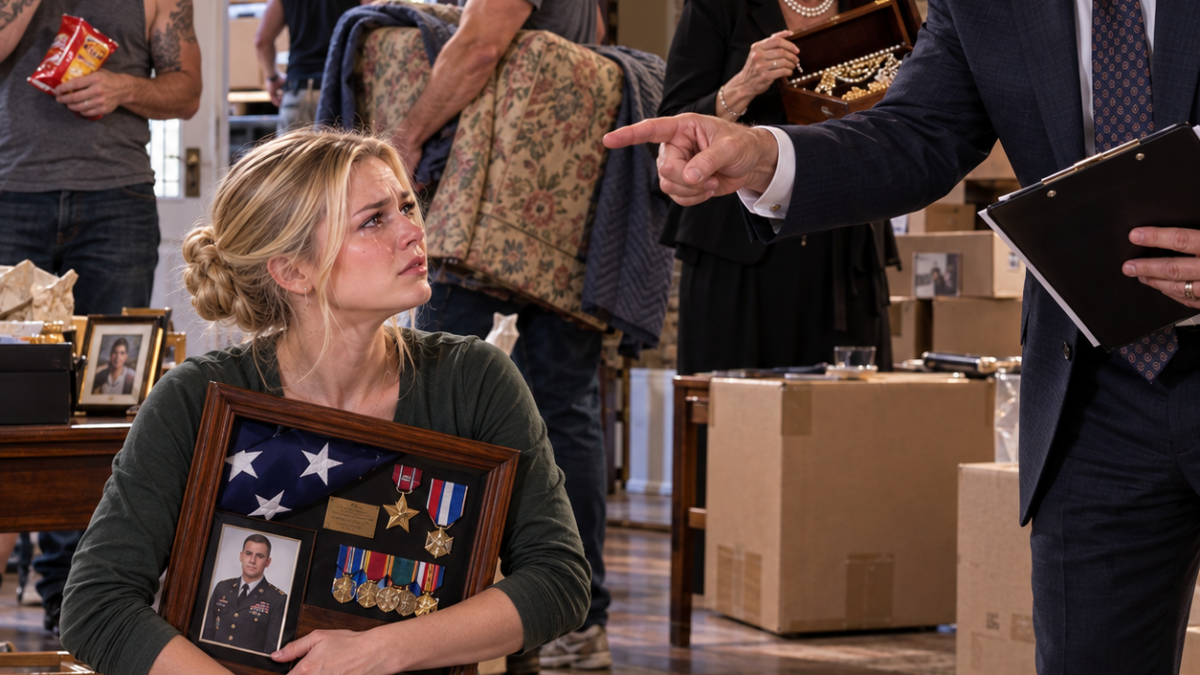
Raymond Coleman stood in the middle of my living room holding a clipboard in one hand and an unlit cigar in the other. My living room. My house. The room where Marcus and I had eaten cold pizza on moving boxes because our refrigerator had not arrived yet. The room where he had spent an entire Saturday trying to center my military shadow box above the fireplace, drilling the first hole crooked and blaming the wall. Six days earlier, Marcus had died in that same room while I held his hand. One day earlier, I had watched soldiers fold an American flag above his grave. Now his father was giving me a deadline to leave the life Marcus and I had built together.
I looked past Raymond and counted. Gerald, my oldest brother-in-law, was wrapping framed photographs in newspaper. Timothy stood beside the fireplace eating barbecue chips directly from the bag as though helping remove a dead man’s possessions had made him hungry. Patricia, my mother-in-law, held my jewelry box open in both hands and inspected the contents with the detached concentration of a woman checking merchandise at an estate sale. She lifted one necklace, frowned, and put it back. “These are yours, I assume?” I stared at her. “My wedding ring is in there.” Patricia shrugged. “Obviously we don’t want that.” I almost laughed. Almost. Sometimes grief makes cruelty sound so absurd that your body cannot decide whether to cry or smile.
Marcus had been buried at a military cemetery outside Charleston beneath a low gray sky. Wet grass soaked through the heels I should never have worn, and taps cut through the humid morning while I stood straighter than my spine wanted to allow. Raymond waited until cemetery workers were lowering his son’s casket before telling me Gerald would “take over the house.” I told him the house belonged to me too. Raymond gave me the same expression he used when a waiter poured the wrong bourbon. “You married into the Coleman family,” he said. “You didn’t become one.” Patricia touched my elbow, not tenderly, but possessively. “You’ll be happier near your base anyway.” I said nothing because silence can be more useful than anger when somebody believes they have already won.
I slept barely three hours that night. Not in the house. In my Jeep two blocks away, because I wanted space between myself and the place where Marcus had taken his final breath. At 7:43 the next morning, the security app on my phone sent an alert, then immediately logged me out. Password changed. At 8:02, a white moving truck backed into our driveway. At 8:17, Gerald walked out carrying two kitchen chairs. I drove over. My key no longer worked. They had changed the locks exactly the way Marcus predicted they would. Timothy opened the front door shirtless. “Oh,” he said when he saw me. “You.” Not I’m sorry. Not how are you holding up. Just you.
That was how I ended up standing in my own living room while four people treated my marriage like a storage unit that had gone delinquent. Raymond pointed upstairs. “Get personal items only. Clothes. Toiletries. Military property. Everything else stays until ownership is sorted.” I asked who would be doing the sorting. “Family counsel.” “Your lawyer?” He corrected me. “Our lawyer.” That mattered. So did the fact that Gerald and one of the movers were carrying my grandmother’s floral armchair toward the front door. “Put that down.” Gerald smirked. “Mom thinks it’ll work upstairs.” I told him my grandmother bought it in Ohio in 1978 and left it to me. “And?” he asked, continuing toward the door.
I could have screamed. I could have blocked them. I could have made the scene Raymond already planned to use against me. Instead, I pulled out my phone. It was already recording. Gerald’s smirk disappeared. “What are you doing?” “Documenting.” Raymond stepped toward me. “You do not have permission to record inside this residence.” I slowly looked around the room, then back at him. “My residence?” His jaw tightened. Good. He had said exactly what I needed. Patricia came downstairs carrying my Bronze Star shadow box. She handed it to Timothy. “Put this with her things.” Then she looked at the empty wall above the fireplace and said, “That already looks better.” That one hurt because Marcus had hung it there himself.
I waited for the wave to pass, then asked Raymond three questions. “Who hired the movers?” “I did.” “Who authorized the lock change?” “I did.” “Who accessed the security system?” Gerald shifted beside the doorway before anyone answered. That told me enough. I nodded. “Thank you.” Raymond frowned. “For what?” “Clarifying.” Then I walked outside. Patricia called after me that I had less than two hours. I did not turn around. I crossed the porch Marcus rebuilt during COVID, passed the flag still flying at half-staff beside the garage, and stopped at the edge of the driveway. Then I dialed the number Marcus had forced me to memorize months earlier.
Charles Peyton answered on the second ring. “Peyton.” I looked at the moving truck. “It started.” His voice changed immediately. “What exactly?” “Locks changed. Movers present. Raymond admits he authorized it. Gerald accessed the cameras. Furniture is being removed.” Charles asked whether I was recording. “Yes.” “Good. Do not argue. Do not touch anyone. Do not block the truck yet.” I stared at Gerald guiding my grandmother’s chair toward the ramp. “Yet?” “I’m ten minutes away.” I watched Raymond come onto the porch with the confidence of a man inspecting property he believed belonged to him. “Make it eight,” I said.
Raymond called across the yard. “You’re embarrassing yourself.” The neighbors had started watching. Mrs. Dorsey stood behind her curtains across the street. A landscaper two houses down had stopped his mower. The movers were pretending not to notice the tension. I turned toward Raymond and smiled for the first time that morning. “No,” I said. “You just don’t know which part is embarrassing yet.” His face tightened because confidence works best when the other person accepts the rules. I no longer did. Three months before Marcus died, he and I had already heard his family planning this exact takeover. My husband knew what they would do. And before cancer took his strength, he built a legal wall around me they had not even bothered to look for.
part2
Three months before Marcus’s diagnosis, we attended his cousin Lauren’s wedding outside Charleston. It was one of those old Southern venues where string lights hung between oak trees and men in pastel jackets pretended humidity was charming. After two hours of smiling through conversations about property values and private schools, I slipped behind the main house to get five quiet minutes. That was when I heard Raymond’s voice. “When Marcus is gone, we move quickly.” I stopped. Gerald answered, “House first. Then the clinic.” My hand went cold around my phone. Timothy asked what would happen to me. Raymond laughed. “She’s military. She moves for a living.” Then Patricia joined them. Her voice was soft, almost pleasant. “She came into this family with a duffel bag. She can leave with one.”
My phone recorded the last forty-seven seconds because my thumb had accidentally hit the video button while I was gripping it. I did not confront them. I walked back through the reception, found Marcus, and waited until we were sitting in our driveway at home before playing the recording. He listened once. Then again. He did not defend them. He did not tell me I had misunderstood. He stared through the windshield for so long I wondered whether he had stopped breathing. Finally he said, “Come inside.” In the kitchen, Marcus went to the hall closet and pulled out a battered leather briefcase I had never seen before. He opened it on the same Formica table where we paid the electric bill.
Inside were deeds, bank records, business documents, insurance papers, and a thick folder marked PEYTON — ESTATE PLAN. Marcus slid the first deed toward me. My name sat beside his. “They think they’re inheriting my life,” he said. He tapped the deed once. “They’re not.” I stared at him. “How long have you had this?” “Years.” He leaned back. “I’ve known who they are longer than you have.” That night I learned my gentle husband, the man who moved turtles out of roads and apologized when he stepped on ants, had spent seven years quietly structuring our finances so his family could never push me out if something happened to him.
It started before our wedding. Raymond invited me to Charleston Country Club and pushed a prenup across a patio table before dessert. “I’m protecting the bloodline.” I slid it back. “I have my own lawyer.” He smiled like I had passed a test. “Smart girl.” When Marcus learned what his father had done, he did not yell. He called Charles Peyton. Over the next seven years, Marcus restructured everything: the house, his veterinary clinic, a waterfront parcel along the Ashley River, investment accounts, and ownership interests. Assets that could pass directly to me were arranged so ownership transferred immediately at his death. Not after Raymond filed something. Not after a family meeting. Immediately.
The will covered everything else. Furniture. Vehicles. Personal accounts. Books. Equipment. Even Marcus’s absurd collection of antique veterinary textbooks that smelled like dust and formaldehyde. Everything came to me. Charles inserted a no-contest clause because Marcus understood his family better than I wanted to. If they challenged the will, they risked losing even the small personal items he left them. I asked why he bothered leaving them anything. Marcus smiled. “Bait.” I stared at him. “You built a legal tripwire for your own relatives?” “I prefer incentive structure.” That was Marcus. The man who could spend twenty minutes comforting an anxious dog had no problem designing consequences for people he believed might attack his wife after his death.
Then he showed me the journal. Dated entries. Every insult. Every pressure campaign. Every comment about my career. Every time Patricia suggested he should have married “someone more settled.” Every conversation Raymond initiated about bringing Gerald into the clinic. Marcus had saved emails, voicemails, and text messages. One message from Gerald asked whether Marcus could “quietly transfer” clinic shares before I found out. I looked up from the phone. “Why didn’t you tell me?” Marcus took a long breath. “Because I wanted you to live here without feeling like you were under siege.” “You knew I was.” His eyes softened. “I knew.” Somehow that hurt worse than discovering the documents. He had seen everything and had been trying to protect me quietly.
Six weeks later, a physician at MUSC said stage-four pancreatic cancer. Marcus looked at me, then at the doctor, then back at me. “Call Charles.” That was how quickly our future collapsed. One moment we were discussing treatment options and timelines. The next, my husband was making sure a dead man could still defend his wife. Cancer reduced Marcus physically with obscene speed. His shoulders disappeared beneath shirts that once fit him. His hands trembled. He stopped finishing meals. Yet every week he made Charles review another document, confirm another beneficiary, update another instruction. I hated watching him use energy on paperwork when he had so little left. He insisted. “They’re going to test every weak spot after I’m gone.”
His family proved him right before he even died. Patricia brought casseroles. Raymond brought opinions. Gerald brought nothing but questions about the clinic. They started visiting twice a week. One afternoon Marcus was asleep in the hospital bed we had installed near the living-room window while I measured liquid medication in the kitchen. Raymond walked around knocking on walls. “Solid construction.” He said it like an appraiser. Patricia sat beside her dying son flipping through a furniture catalog and showed Gerald’s wife a photograph of a white sectional. “This would brighten the room when you move in.” I set the medicine cup down slowly enough not to spill it.
Marcus opened one eye. He had heard her. Neither of us said anything until they left. Later that week, the outdoor camera caught Gerald photographing the garage keypad and side entrance. I downloaded the footage. Two days later another camera recorded Timothy saying, “Dad wants locks done right after the funeral.” I saved that too. Everything went into a cloud folder shared with Charles. Marcus was too weak to sit upright by then, but when I showed him the clip, he squeezed my hand. “Don’t stop them too early.” I leaned closer because his voice had become thin. “What?” “Let them act.” I stared at him. “Marcus, they’re talking about throwing me out of my own house.”
“Exactly.” He took a slow breath. “People like my father talk themselves into believing entitlement is permission. Let them show Charles who they are.” I hated the idea. Every instinct I had from the Army said identify the threat, establish the perimeter, stop the breach before it happens. Marcus understood a different battlefield. He knew his family could explain away private conversations, deny intent, and call recorded jokes misunderstandings. Actual conduct would be harder to hide. “What do you want me to do?” I asked. He looked toward the wedding photograph near the television, then back at me. “Hold long enough for them to make their choices.”
Four days later, Marcus died before sunrise with my hand in his. His breathing slowed gradually until the room became quiet. I remember the clock reading 4:18. I remember thinking the refrigerator sounded impossibly loud. I remember placing my forehead against his hand and telling him I was there, even though I did not know whether he could still hear me. His family arrived three hours later. Raymond’s first serious question was about the deed. Not the funeral. Not whether Marcus suffered. Not whether I had eaten. The deed. That answered every remaining question in me.
So when the moving truck arrived the morning after the funeral, I did not see an ambush. I saw evidence arriving almost exactly on Marcus’s schedule. Charles’s black BMW turned onto the street nine minutes after my call and stopped directly behind the moving truck. Nobody was leaving. He stepped out wearing a charcoal suit despite the Charleston heat. Raymond came down the driveway. “Who the hell are you?” Charles handed him a business card. “Charles Peyton. Counsel for Major Molly Martin.” He emphasized Major just enough to tell me he was angry, though his face never changed.
Raymond’s expression shifted. I had never discussed much of my Army career with the Colemans because every conversation became either a competition or a lecture about how deployments made me an inconvenient wife. Charles looked toward the furniture stacked inside the moving truck, then at my phone. “Still recording?” “Yes.” “Excellent.” He faced Raymond. “You have five minutes to stop removing my client’s property.” Raymond laughed. “Your client has no ownership claim here.” Charles smiled. Not warmly. “Mr. Coleman, I sincerely hope you repeat that when law enforcement arrives.” The laugh disappeared. Gerald stepped forward. “Police?” Charles opened his briefcase on the hood of his BMW.
He removed three certified deeds. “The residence, the clinic property, and the Ashley River parcel were held with survivorship provisions. Marcus’s interest transferred to Molly at the moment of his death.” Raymond snatched the first document and scanned it. “This can be challenged.” “Certainly.” Charles removed another document. “Here is the will containing the no-contest provision your son instructed me to enforce.” Patricia had come outside now. “What is happening?” Charles turned toward her. “Your family is removing property from a home belonging to your daughter-in-law after changing her locks without authorization.” Patricia looked at Raymond. “You said the lawyer handled this.” Charles answered before he could. “Your lawyer appears to have listened to what Raymond wanted instead of verifying what Marcus owned.”
A Charleston police cruiser turned onto the street. I had not called them. Mrs. Dorsey had. She later told me she saw people loading my furniture into a truck and decided somebody in the neighborhood should behave like a neighbor. The officer parked behind Charles’s BMW. A second cruiser arrived moments later. The movers stopped working. Raymond’s expression changed from insulted confidence to calculation. I knew that look. He had finally realized his version of the morning was not controlling the room anymore. Charles closed his briefcase. “Now,” he said quietly, “I suggest nobody removes another object.”
The officers separated everyone and checked identification. Charles showed them the deeds and my recorded statements from Raymond. I showed them the security-system lockout and the video of my furniture being removed. The officers did not make grand declarations about ownership. They simply told the movers to stop until the dispute was clarified. That was enough. We moved into the dining room while the truck remained blocked outside. Charles placed a sealed envelope in the center of the table. Patricia recognized the handwriting before he said anything. Her mouth opened slightly. Raymond leaned forward. “That’s private.” Charles looked at him. “Marcus instructed me to read this if you attempted to remove Molly from her home.”
Nobody spoke.
Charles broke the seal.
Marcus’s letter started years earlier. The first dinner where Raymond spoke to my steelworker father as though he were hired help. The secret prenup meeting. The Christmas Patricia handed the scarf I made her to the housekeeper in front of everyone and said it “suited her better.” The comments about my deployments. The jokes about Marcus being “married to the Army.” The attempts to persuade him to give Gerald control of the clinic. The conversations at Lauren’s wedding. Marcus had written each event plainly, without dramatics. That made it harder to dismiss. Raymond stared at the tabletop. Patricia’s eyes began to fill. Gerald looked like he wanted to leave.
Then Charles reached the final page.
“You confused blood with loyalty,” he read. “Molly never did.”
No one moved.
“You treated my wife like temporary housing in my life. She was my family when I was healthy, my family when I was afraid, and my family when I was dying.”
Patricia covered her mouth.
Gerald stared down.
Raymond kept looking at the legal documents as if somewhere among them must be a loophole capable of resurrecting his authority.
Charles continued.
“If you are hearing this because you tried to take her home, return every item you removed and leave. Do not contact her unless she contacts you first.”
Charles folded the letter.
One of the officers cleared his throat. “Sounds pretty specific.”
I almost smiled.
Raymond turned toward me. “Molly, grief makes people behave irrationally.”
I stared at him.
“You changed my locks before your son’s funeral flowers wilted.”
For the first time since I met Raymond Coleman, he had no superior answer waiting.
He looked away.
Then the officers supervised while Gerald, Timothy, and the movers carried everything back inside. Lamps. Boxes. Books. Kitchen chairs. Marcus’s record player. My medals. Our photographs. Patricia returned my jewelry box without looking at me. Finally Gerald carried my grandmother’s armchair through the doorway. I stood in the living room and pointed toward the exact spot where it had been. “Six inches left.” He glared at me. “Molly.” “Six.” He moved the chair. “Another two.” He did it. Petty? Maybe. Necessary? Absolutely.
Half the street watched while pretending not to. Mrs. Dorsey watered the same azalea bush for nearly forty minutes. A delivery driver slowed down twice. The movers looked embarrassed enough to disappear inside their uniforms. Charles arranged for a locksmith before sunset. New locks. My code. My keys. My house. I stood alone in the living room afterward and looked at everything exactly where Marcus had left it. The silence hit harder once the fight stopped. During conflict, grief waits politely. When the room becomes quiet again, it comes back for everything you owe.
I sat in my grandmother’s chair and cried until I could barely breathe. Not because I had won. Not because Raymond had lost. Because the person who prepared all of this was gone. Marcus had known me well enough to predict I would hold myself together until the danger passed. He also knew what would happen afterward. Charles stayed in the kitchen making coffee I never asked for. When I finally stopped crying, he brought me a mug and sat across from me without speaking. After a while I said, “He planned all of this while he was dying.” Charles looked down at his hands. “He loved you very much.” That almost started me again.
News traveled. Charleston is large enough to call itself a city but certain circles behave like a small town wearing better shoes. Raymond stopped appearing at his country club for a while. Patricia resigned from two charity boards after uncomfortable questions about the incident reached people she could not intimidate. Gerald’s plan to acquire Marcus’s clinic collapsed when Dr. Henderson, the veterinarian he hoped would help finance the transition, withdrew completely. The Colemans had built their identity around being respectable, traditional, family first. That brand became harder to maintain once neighbors watched police supervise them returning a widow’s furniture.
A week later, Raymond mailed me a cashier’s check for one hundred thousand dollars. The accompanying letter contained three paragraphs about emotions running high, misunderstanding Marcus’s intentions, and hoping both sides could “move forward with dignity.” Not one sentence said I am sorry. I called Charles. “Can I send this back?” “Absolutely.” “Any legal reason not to?” “None.” I returned the check uncashed. No note. No speech. Raymond had always believed every problem eventually revealed a purchase price. Marcus had understood something his father never did: there are things money cannot repair because the damage itself was created by treating people like assets.
The harder decision involved the clinic.
Gerald wanted it desperately. Before Marcus became sick, Coleman Veterinary Clinic had grown from a modest neighborhood practice into one of the most trusted animal hospitals in that part of Charleston. Marcus knew every dog by name and forgot half their owners. He kept peanut butter in one drawer for nervous patients and emergency granola bars in another for technicians who forgot lunch. Selling the clinic would have been the easiest financial choice. One investment group offered more money than I expected. Gerald offered less but described it as “keeping Marcus’s legacy in the family.” I almost laughed when I read that phrase.
I did not sell.
Instead, I renamed it the Marcus Coleman Memorial Animal Hospital.
I remained active duty, so I hired an experienced medical director and kept the staff Marcus trusted. The senior technician, Nancy, cried when I told her no one was losing a job. “Marcus thought you might sell,” she admitted. “Marcus thought I might do a lot of sensible things,” I said. On Saturdays when duty allowed, I volunteered. Not medicine. I was not a veterinarian. I answered phones, carried files, made coffee, cleaned kennels if we were short, and sat with frightened owners while clinicians handled emergencies. Nothing heroic. I loved it more than I expected.
The waiting room had scratched tile, old magazines, a coffee machine that produced something legally questionable, and usually at least one Labrador shedding enough hair to create another dog. Military families started coming because several technicians knew I served. Then veterans. Then we created a fund to help service members who could not afford emergency veterinary care. I used some of Marcus’s estate to seed it. The first dog we helped belonged to a young Army specialist whose shepherd had swallowed part of a tennis ball. He kept apologizing for needing assistance. I told him Marcus would have charged him in homemade cookies if he could have gotten away with it.
Six months after Marcus died, we held a small dedication outside the clinic. Folding chairs. Costco sandwiches. A local high-school color guard. An American flag beside the new sign. Charles attended. Mrs. Dorsey came and somehow brought three trays of brownies. Marcus’s nurses and technicians came. Several former patients arrived with their owners. The Coleman family did not attend. I had not invited them. That felt less like punishment than clarity. Marcus’s letter told them not to contact me unless I chose first. I had not chosen. For once, no one in that family was deciding when I should be ready.
After everyone left, I sat alone in Marcus’s old office. His desk still had scratches from the metal carrier of a cat that once escaped during an exam. I opened drawers, sorting old pens and expired business cards. When I pulled the bottom drawer out completely, I found an envelope taped underneath. My name was written across it.
Molly, my soldier.
I sat down before opening it.
Inside was one page.
Marcus wrote that he knew I would win the legal fight. He knew Charles would make certain of it. Then he wrote the sentence that hurt most because it sounded exactly like him.
Hold the line when you have to. Then live.
I read it five times.
Below that, he had added: Do not spend the rest of your life fighting people who no longer matter.
I laughed through tears.
Even dead, my husband was giving me orders he knew I needed.
For months, I had imagined surviving grief as a series of defensive positions. Protect the house. Protect the clinic. Protect the documents. Protect the memory. Protect myself from Raymond. Marcus was reminding me defense was supposed to end eventually. A life built only around resisting enemies still belongs partly to those enemies. He wanted better for me. The realization scared me because fighting was easier than living. Fighting gave each day a target. Living required choosing something when no emergency told me what mattered.
I folded the letter and placed it inside my jacket.
The next morning, I stood on my front porch before sunrise. Charleston smelled like wet grass, salt, and warm pavement from the previous day. My Jeep sat in the driveway. Through the living-room window, I could see my grandmother’s chair. Marcus’s funeral flag rested inside a walnut display case near the fireplace. The house was legally mine. The clinic was protected. The Colemans had no keys, no ownership claim, and no place in my decisions unless I gave them one.
For the first time since the hospital, I did not need to go to a lawyer, funeral home, courthouse, or meeting.
I started my running watch.
Then I ran.
The first mile hurt because I had barely trained during Marcus’s final months. The second hurt for different reasons. By the third, my breathing settled. I passed houses, dogs, sprinklers, delivery trucks. Ordinary life. People leaving for work. Children waiting for buses. Nobody knew I had buried my husband. Nobody knew his family tried to remove me from my home. Nobody cared. Strangely, that helped. The world had continued while mine stopped, and maybe I was allowed to rejoin it without asking permission.
I ran four miles.
Then five.
When I returned, Mrs. Dorsey stood on her porch holding coffee.
“You look terrible,” she called.
“Thank you.”
“Means you ran enough.”
I laughed.
It was the first laugh since Marcus died that did not feel borrowed.
Weeks became months. Grief changed texture. At first, every object in the house felt loaded. Marcus’s shoes by the back door. His coffee mug. A grocery list written in his handwriting. Eventually those things became less like traps and more like evidence that he had existed outside the hospital bed. I started remembering healthy Marcus again. The man who sang badly while cooking. The veterinarian who once brought home an injured box turtle and converted our guest bathroom into a rehabilitation center. The husband who could never find his keys even though he insisted on buying tracking tags.
I began sleeping in our bedroom again.
That took longer than I expected.
For weeks, I slept on the couch because lying on his side of the bed made the absence too physical. One night after a long shift, I went upstairs without planning to. I changed clothes, climbed into bed, and woke six hours later with sunlight across the blanket. I cried when I realized where I was. Then I made coffee.
That became grief for me.
Cry.
Coffee.
Work.
Repeat.
Not heroic.
Real.
Raymond tried twice more to communicate through lawyers. One letter proposed a “family reconciliation meeting.” Charles forwarded it with one sentence: You are under no obligation to respond. I did not. Patricia sent a birthday card nine months after Marcus’s death. No apology. Inside she wrote, We all lost someone. I stared at it for a long time. Technically true. Emotionally dishonest. We had all lost Marcus, but they had tried to use his death as a transfer of control. I placed the card in a drawer rather than answering. Silence was no longer something they were doing to me. It had become a boundary I chose.
Gerald made the biggest mistake later that year. He contacted one of Marcus’s old clinic partners and implied ownership disputes were still unresolved. The partner called me immediately. Charles sent Gerald a formal notice the same afternoon. Gerald backed away. No court case followed because the documents were too clear. That was the beauty of what Marcus built. He did not leave me a battle plan requiring constant warfare. He left me paperwork strong enough to make most battles pointless.
The Colemans slowly disappeared from my daily life.
Their absence felt strange at first. For years every holiday came with Patricia criticizing something subtle and Raymond explaining finances nobody asked about. I had spent so much time bracing for them that peace felt suspicious. The first Thanksgiving after Marcus died, I expected grief to destroy me. Instead, Nancy from the clinic invited me to her house. There were seventeen people, two dogs under the table, a child playing trumpet badly in another room, and a turkey that almost caught fire.
Nobody criticized my cooking.
Nobody asked about property.
Nobody told me where I belonged.
I went home with leftover pie and cried in the driveway because I had enjoyed myself.
Guilt is strange after loss.
Happiness can feel disloyal.
I heard Marcus’s voice in my head.
Then live.
So I went inside and ate the pie.
The clinic fund grew. A retired Marine donated after we helped his bulldog through emergency surgery. A local business matched contributions. We added a quiet room for families saying goodbye to pets. Marcus had always wanted one but kept postponing it because there was never enough money. I named it simply The Marcus Room. No plaque listing donors. No dramatic portrait. Just a photograph of him sitting on the floor with a nervous golden retriever leaning against his chest.
That was the Marcus I wanted people to know.
Not the estate.
Not the family name.
Not the fight.
The man on the floor with a frightened dog.
Two years after his death, Charles asked whether I wanted to update my own estate documents. I laughed. “Marcus turned you into a monster.” “Marcus paid his bills on time.” “So that’s love now?” Charles smiled. “In my profession, absolutely.” I updated everything. Not because I expected anyone to attack my property when I died, but because uncertainty invites other people to make decisions for you. Marcus had taught me that. I created instructions for the clinic, the assistance fund, the house, and my military benefits.
Then Charles asked the question I had been avoiding.
“Any personal bequests to the Colemans?”
I looked out his office window.
“No.”
He waited.
“None?”
“None.”
He nodded and kept typing.
No judgment.
That was another kind of freedom.
I did not need to leave bait.
I was not Marcus.
My boundary could simply be a closed door.
Another year passed before I saw Patricia again. It happened accidentally at a grocery store in Charleston. I was reaching for coffee when I heard my name. She stood at the end of the aisle holding a basket with two bottles of wine and a loaf of bread. She looked older. Smaller. For a moment, neither of us moved.
“Molly.”
“Patricia.”
Her eyes dropped toward my left hand.
I still wore my wedding ring.
She noticed.
“I heard the clinic is doing well.”
“It is.”
“Marcus would be proud.”
That sentence almost angered me.
Almost.
Instead, I asked, “Did you need something?”
She looked wounded, but not surprised.
“I wanted to say I think about that morning.”
“So do I.”
“We were grieving.”
There it was again.
The excuse.
I picked up the coffee.
“Grief didn’t hire movers.”
Her face changed.
“No.”
“Grief didn’t change my locks.”
She looked down.
“No.”
“Grief didn’t photograph my keypad before Marcus died.”
Silence.
People moved around us with carts.
Finally Patricia whispered, “I’m sorry.”
It was the first actual apology any Coleman had given me.
I studied her.
“You’re sorry for what?”
Her eyes filled.
“For treating you like you were temporary.”
Marcus’s words.
That mattered.
I nodded.
“Thank you.”
She waited, perhaps expecting forgiveness to arrive immediately because apology had finally appeared.
It did not.
I did not hug her.
I did not invite her for coffee.
I simply said, “Take care of yourself.”
Then I walked away.
I felt lighter afterward.
Not because everything was fixed.
Because I discovered I could hear an apology without reopening the door.
Forgiveness, if it came, did not have to equal access.
Marcus would have understood.
Raymond never apologized.
Not really.
He died several years later after a stroke. Gerald notified Charles, who forwarded the message because I had requested all communication remain indirect. I felt less than I expected. No satisfaction. No grief. Just the strange recognition that a man who once seemed capable of controlling every room eventually became another name attached to a date.
Patricia did not ask me to attend the funeral.
I would not have.
Gerald inherited most of Raymond’s remaining business interests. Timothy moved to Florida. Their family continued. Mine did too.
That distinction had taken me years to accept.
Marcus’s death had not left me family-less.
It had revealed which relationships were real.
The people at the clinic became part of my life. Charles became the irritating friend who reminded me to update insurance beneficiaries. Mrs. Dorsey continued monitoring the street with the dedication of an unpaid intelligence service. My Army friends rotated through deployments and assignments but kept showing up when it mattered. Some visited Marcus’s grave with me. Others never mentioned him unless I did.
They learned what I needed.
Years later, on the anniversary of Marcus’s death, I went to the cemetery alone. I brought no flowers because he hated cut flowers. Instead, I brought coffee and sat beside the marker like an idiot while drinking both cups.
“You were right,” I told him.
The cemetery did not answer.
“You’d be unbearable about it.”
Still nothing.
I laughed.
Then I told him about the clinic, the fund, Patricia’s apology, and a Labrador named Moose who had eaten half a couch cushion and somehow survived.
I told him I was considering retirement from the Army.
That one was harder.
For most of my adult life, the uniform had given structure to everything. Marcus understood that. He never asked me to choose between service and marriage. Now, without him, staying had become partly habit.
“Hold the line when you have to,” I whispered.
Then live.
I knew what he would say.
I retired eighteen months later.
No dramatic reason.
No breakdown.
No scandal.
I was simply ready.
The ceremony was small. A few friends. People from the clinic. Charles. Mrs. Dorsey wore a dress that looked older than I was and cried louder than anyone. My commander handed me the flag. I thought about the morning Patricia removed my Bronze Star shadow box from the wall as though my service were clutter.
Afterward, I went home.
My home.
Same porch.
Same living room.
My grandmother’s chair had been reupholstered but remained exactly where Gerald had been forced to return it years earlier.
Marcus’s flag rested beside mine.
I stood there for a long time.
No one was waiting to remove anything.
No deadline.
No clipboard.
No moving truck.
Just silence.
The good kind.
Retirement gave me more time at the clinic. I started working there four days a week in administration and community outreach. I still cleaned kennels when necessary because job titles mean very little when a sick animal has exploded across a floor. The veterans assistance fund expanded to cover working dogs and service animals. We partnered with a rescue organization. Every year on Marcus’s birthday, we paid emergency veterinary bills until that year’s fund ran out.
I never put my name on it.
It did not need my name.
Some things can honor you better by continuing without advertising you.
One afternoon, a young military spouse came into the clinic carrying an injured terrier wrapped in a towel. Her husband was deployed. Her credit card had been declined at another emergency hospital. She was crying before she reached the desk. We treated the dog. The fund covered most of the cost. When she asked who created it, Nancy pointed toward the photograph of Marcus with the golden retriever.
“His wife,” she said.
The woman looked at me.
“You?”
I nodded.
“Why?”
I thought about Marcus dying beside the window.
Raymond measuring walls.
Patricia selecting furniture before her son was gone.
The moving truck.
Charles’s deeds.
Marcus’s hidden letter.
Hold the line. Then live.
“Because sometimes people need somebody to make a bad week smaller.”
That was enough.
A decade after Marcus died, I finally renovated the house.
Not because Patricia had wanted to.
Because the roof leaked.
I replaced the kitchen cabinets Marcus hated, refinished the floors, and painted the living room. The contractor asked whether I wanted to move my grandmother’s chair somewhere else.
“No.”
“Not even temporarily?”
“Temporary is fine.”
I pointed.
“But it goes back there.”
He looked confused.
“Sentimental?”
“Extremely.”
When the work finished, I stood in the new kitchen and realized something important.
For years, I preserved the house almost exactly as Marcus left it because changing anything felt like another kind of loss.
But Marcus had not protected the house so I could turn it into a museum.
He protected it so I could have a life inside it.
That night, I donated some of his old clothes.
Kept a few shirts.
Cried over one ridiculous veterinary conference T-shirt.
Then kept going.
Living did not erase him.
It proved he had been loved enough that life could continue without pretending death had not happened.
I never forgot the morning the Colemans changed my locks.
For years, people who heard the story focused on the legal victory.
The deeds.
The police.
The letter.
Gerald carrying furniture back while neighbors watched.
They liked that part because consequences make clean stories.
But that was not the part that changed me.
The part that changed me happened months earlier in the hospital bed when Marcus whispered, “Let them act.”
He was not telling me to seek revenge.
He was telling me to stop preventing people from revealing themselves.
I had spent too much of my life trying to manage everyone else’s behavior.
Stay polite so Patricia stayed calm.
Ignore Raymond so Marcus did not have to fight with his father.
Let Gerald make comments because confronting him would ruin dinner.
Absorb disrespect for the sake of peace.
Marcus saw what I did.
And while he was dying, he gave me permission to stop.
That was the inheritance that mattered most.
Not the house.
Not the clinic.
Not the investments.
Permission to stop carrying relationships other people refused to carry honestly.
Years later, I received a Christmas card from Patricia.
One sentence.
I hope your life is peaceful.
I stared at it.
Then smiled.
It was.
Not perfect.
Peaceful.
There is a difference.
I sent nothing back.
Not out of cruelty.
Because some relationships end without needing to become wars.
The clinic continued thriving. The assistance fund outgrew the small account we created and became a nonprofit program. Charles eventually retired and complained constantly that his replacement lacked personality, which was remarkable coming from Charles. Mrs. Dorsey died at ninety-two, leaving me a ceramic dog so ugly I displayed it proudly in the clinic lobby.
Life kept taking people.
Life kept giving others.
That is what it does.
On the twentieth anniversary of the day Marcus and I bought the house, I ordered pizza from the same place we used when we moved in.
I sat on the floor.
Not because furniture had been stolen.
Because I wanted to.
Cold pizza.
Cardboard box.
Living room lights low.
I looked at the wall where my shadow box still hung.
At Marcus’s flag.
At my grandmother’s chair.
At the window beside which my husband died.
For once, none of those objects felt like evidence.
They were simply pieces of a life.
Mine.
Ours.
Then mine again.
I opened one of Marcus’s old letters and reread the line I had practically memorized.
Hold the line when you have to. Then live.
“I did,” I said aloud.
Nobody answered.
I did not need an answer.
The house was quiet.
The locks were mine.
The keys were mine.
The life beyond the door was mine.
And after all those years, that was enough.