𝗙𝗨𝗟𝗟 𝗦𝗧𝗢𝗥𝗬 My Father Hid Me From His Guests Until One Salute Forced Him to Face What He Had Done
part2
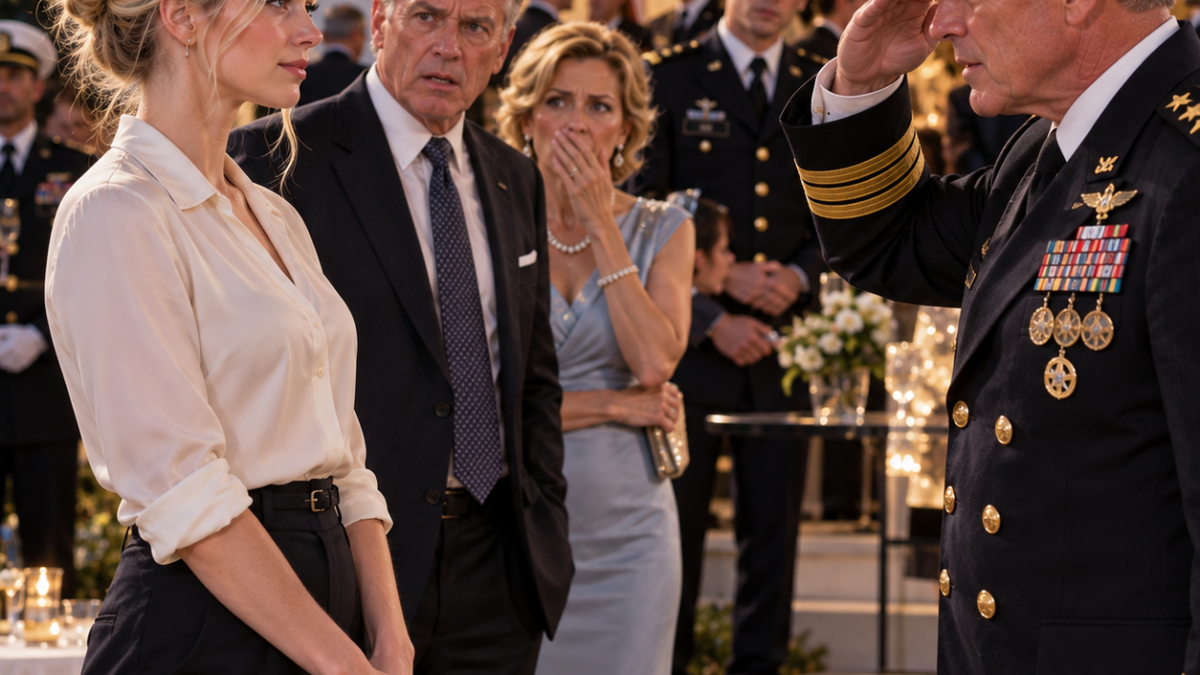
For several seconds, nobody moved.
Dad’s eyes stayed on Keene’s hand as though the salute itself had violated some rule of physics. Commander Keene seemed completely unaware that he had just dropped a match into a room full of gasoline. He smiled at me, extended his hand, and shook mine warmly.
“Mara, I heard your team finally got approval for the revised inspection protocols.”
“We did.”
“Congratulations.”
“The engineers did the hard part.”
Keene laughed.
“That’s what you always say.”
Then he turned toward Dad.
“Russ, why didn’t you mention your daughter was the Ellison who headed the Ridgeway reconstruction panel?”
Dad blinked.
“You worked with Mara?”
“Six months.”
Keene sounded surprised Dad needed to ask.
“Fourteen aircraft, contradictory maintenance records, a contractor insisting everything was pilot handling. Your daughter found the common failure pattern buried in the inspection history.”
I wished he would stop.
Not because anything he said was wrong.
Because every sentence made me more embarrassed.
Dad was being invited to feel proud of work he had never cared enough to ask about.
The Ridgeway review had consumed almost a year of my life. A modified aircraft fleet began showing structural irregularities that people initially treated as unrelated maintenance problems. My team rebuilt inspection histories, compared tolerances, and identified a quality-control failure that had been disguised by inconsistent reporting. The contract pause was expensive, unpopular, and necessary.
Keene had been one of the retired aviation specialists assigned to challenge our technical conclusions.
He had challenged nearly everything.
That was why I respected him.
Now he looked at my father.
“I’ve sat through enough review boards to know the difference between someone protecting a program and someone trying to find the truth.”
His smile softened.
“Mara never let us settle for the convenient answer.”
Dad said nothing.
Keene added, “You raised a remarkable woman, Russ.”
The sentence landed strangely.
Dad’s mouth opened.
Closed.
Through the kitchen window, we could hear Graham telling someone about his new assignment.
Finally Dad said, “Mara has always been good with technical matters.”
Keene tilted his head.
“That’s one way of putting it.”
Someone inside called for him. Keene excused himself and disappeared through the screen door, apparently still unaware that he had completely changed the evening.
Dad waited until the door clicked shut.
“Why didn’t you tell us?”
I nearly laughed.
“Tell you what?”
“About Ridgeway. About your responsibilities.”
“Did you want to know?”
His jaw tightened.
“That isn’t fair.”
“I think it’s the fairest question we’ve had in seven years.”
He shifted his weight.
“You’re implying I’ve taken no interest in your life.”
“Last Thanksgiving you asked if I still worked for that computer company in Bethesda.”
“You knew what I meant.”
“I’ve never worked for a computer company.”
“Mara.”
“You didn’t know because you never asked.”
His face hardened.
“Commander Keene served under me. He wouldn’t salute some civilian analyst lightly.”
“He wasn’t saluting a rank.”
I folded my arms.
“I don’t have one.”
“Then why?”
“He was acknowledging professional responsibility. He knows my work.”
Dad looked away.
“Apparently better than I do.”
“Apparently.”
The admission escaped before he could soften it.
For a moment I thought we might finally talk about Pensacola.
Instead, he asked, “Did Ridgeway involve Atlantic Systems Engineering?”
I stared.
Atlantic Systems Engineering was a defense contractor connected to several avionics and maintenance-data programs. The name had appeared in my old Pensacola paperwork.
“Why?”
“Just curious.”
“You’ve never been curious before.”
“Mara, this isn’t the place.”
“You brought the past into the kitchen.”
He rubbed one hand over his mouth.
Then said, “I spoke to Grant Voss last month.”
The name hit harder than I expected.
Grant had been my training partner.
He had watched me file at least one of the equipment discrepancy reports that supposedly never existed.
Then, during the inquiry, he signed a statement claiming I ignored his advice to report the problem.
“What does Grant have to do with tonight?”
“I saw him at a conference.”
“That must have been nice.”
“Mara.”
“Did he tell you his career is going well?”
Dad ignored that.
“He mentioned the database migration.”
I stopped breathing for half a second.
“What?”
“He said the timing was unfortunate. Certain records may have been difficult to retrieve because of a system change.”
“That’s what I told you.”
“I know.”
“No. You told me the investigation had already determined that wasn’t true.”
Dad lowered his eyes.
“I started asking questions.”
“When?”
“After the conference.”
“You have been looking into my separation for weeks?”
“Quietly.”
“And you didn’t tell me?”
“I wanted facts before reopening something painful.”
There was something surreal about hearing that from a man who had just told me to stay hidden in the kitchen.
“What did you find?”
“Not here.”
“When?”
“Give me a few days.”
Seven years earlier, that answer would have worked.
Wait.
Trust me.
Let the adults handle it.
I picked up my purse.
“I’m leaving.”
“Graham will be disappointed.”
“Graham can call.”
Dad hesitated, then said, “Commander Martin Sloane retired last year.”
Sloane had chaired the original investigation.
He was the man who told me the electronic reports could not be recovered.
The man who suggested voluntary separation would be the “cleanest” option.
“What does his retirement have to do with anything?”
Dad looked away.
“I haven’t finished looking into it.”
For the first time, I saw something beneath his control.
Fear.
I couldn’t tell whether he was afraid I had been wronged or afraid of what his response to that wrong might reveal.
Graham found me near the front door.
“You’re leaving?”
“Early morning.”
He knew it was an excuse.
He hugged me anyway.
“I really did want you here.”
That made me hold him a little longer.
Then I walked outside.
At my car, my phone showed a message from an unfamiliar Virginia number.
Mara, this is Leah Benton. I worked on the maintenance database at Pensacola in 2019. Has anyone told you why your reports disappeared?
I sat behind the wheel for ten minutes.
Then I called.
A woman answered on the third ring.
“Mara?”
“Yes.”
She exhaled.
“I should’ve contacted you years ago.”
Leah had been a technical records specialist at Pensacola during my inquiry. I recognized her name, but we had never met.
“Why now?”
“Someone started asking about archived reports.”
“My father?”
“His questions reached a contractor compliance officer. That person used to work with me.”
“What do you know?”
Silence.
Then:
“Your reports weren’t lost during migration.”
My fingers tightened around the phone.
“They were specifically removed from the active review system.”
I closed my eyes.
For seven years I had known the official explanation made no technical sense.
Knowing privately is not the same as hearing confirmation.
“Who removed them?”
“I don’t know the entire authorization chain.”
“Tell me what you do know.”
Leah said there had been a scheduled system conversion around the time of my inquiry. Some records genuinely required reindexing.
Mine were different.
They were flagged before the migration.
Moved through a directed administrative archive action.
I asked why she never spoke.
“My supervisor told me to stay out of personnel matters.”
Her voice broke slightly.
“I was twenty-six. My father was sick. I needed the health insurance.”
I understood.
That didn’t erase the cost.
I drove home thinking about the first discrepancy.
Clear weather over Pensacola.
Steady Gulf wind.
Grant beside me.
The heading display began drifting from independent reference data.
Small at first.
Persistent.
We recalibrated.
It returned.
After landing, I filed a discrepancy report.
Maintenance supposedly corrected the issue.
Two days later, same aircraft.
Same problem.
More pronounced.
Second report.
Reference to the first.
Third occurrence, I requested the aircraft be removed from the rotation until independent verification.
Grant stood beside me.
He called me overly cautious.
Two weeks later, I was summoned to an inquiry asking why I had failed to formally report the problem.
Sloane said the electronic system contained no submissions under my candidate ID.
Grant said he had urged me to file them.
I had a notebook with timestamps.
An unsigned printout.
Not enough.
Dad could have helped me find independent counsel.
Instead, after speaking privately with Sloane, he told me:
Professional integrity means accepting consequences.
I left the Navy in June 2019.
My first civilian job was nights at a distribution center near Jacksonville.
Package scanner.
Fluorescent lights.
Concrete floors.
A studio apartment with failing air-conditioning.
Nobody there cared whose daughter I was.
Nobody cared that I had once expected to fly.
That life might have swallowed me if a former instructor hadn’t recommended a technical employment program.
That was where I met Dr. Naomi Sato.
She led an aviation safety research group doing defense work.
During my interview, she asked me how I would reconstruct a flight incident from incomplete telemetry.
I spent forty minutes covering a whiteboard.
At the end, she looked at the adverse investigation note in my background file.
“Would you allow an independent reviewer to examine this?”
I almost said no.
I was tired of strangers deciding whether my memory deserved to exist.
But Naomi did something different.
She separated verified facts from allegations.
She did not assume the Navy was wrong.
She did not assume I was wrong.
She looked.
That became the foundation of my second career.
I learned incident reconstruction.
Maintenance histories.
Recorded parameters.
Engineering specifications.
Data anomalies.
By 2023, I was leading a small team.
Then came Ridgeway.
The review Commander Keene had just praised.
Naomi once told me, “The people who hurt your first career didn’t give you this one. You built it after they damaged the future you wanted.”
I thought about that the morning after Graham’s party.
I told Naomi about Leah’s call.
She told me not to touch another record without legal guidance.
By noon, I had retained Julia Price, a former military attorney who now handled administrative-record cases.
Four days after the party, Julia sent me an authorized copy of an administrative transaction summary.
Three submissions associated with my candidate identification.
Transferred out of the active system.
Not migration loss.
Directed archive action.
Approval required.
The approving senior account belonged to Commander Martin Sloane.
Then I saw the notification field.
RADM R. ELLISON — COMMAND LIAISON.
My father.
I stared at the screen until the letters blurred.
Dad had told me he only recently started asking questions.
The document suggested his office had been connected to the disappearance of my records seven years earlier.
Julia came to my apartment that evening.
I had printed everything and spread it across the dining table beside my old training notebook.
Three handwritten report entries.
Three archive actions.
Dates matched.
Numbers matched.
My hands shook.
Julia pointed at Dad’s designation.
“This is not proof he ordered anything.”
“I know.”
“It proves his office was identified.”
“I know.”
“We need underlying records.”
“I know.”
I resented her caution.
That was why I needed her.
My entire professional career depended on refusing to confuse a compelling pattern with a completed investigation.
I could not abandon that standard simply because the pattern involved my family.
Two days later, we met Leah.
She brought contemporaneous notes and a signed statement.
According to her, the reporting system genuinely had been preparing for conversion.
But my reports—and reports from several other candidates—were selected separately before that process began.
“Why?”
Julia asked.
Leah explained that the training program was being evaluated for an expanded maintenance-data contract.
Atlantic Systems Engineering supported part of the infrastructure.
Repeated unresolved technical discrepancies created problems for the evaluation.
My reports suggested deficiencies might have been closed without proper verification.
“Your reports weren’t the only ones.”
She placed a handwritten list on the table.
Four candidate identifiers.
Multiple maintenance references.
Weeks of dates.
One ID belonged to someone who had transferred after arguing with an instructor.
Another belonged to a candidate who repeatedly complained about electronics failures.
I stared at the list.
For seven years, I thought someone had destroyed evidence specifically to protect Grant’s story about me.
Now something worse became possible.
Maybe I had simply been useful.
A candidate blamed for not reporting a problem was easier than a reporting system that failed to preserve repeated warnings.
“Who initiated the action?” Julia asked.
“Sloane authorized it. A contractor systems liaison prepared the batch. Two command offices were notified.”
Leah looked at me.
“I remember the Ellison designation because everyone knew who your father was.”
“Did you ever see his signature?”
“No.”
That mattered.
Julia wrote it down.
After the meeting, I drove toward the water instead of Maryland.
My mother called.
“Your father says you left upset.”
“I was.”
“He feels terrible.”
“Which part?”
She sighed.
“Mara, please don’t make everything difficult.”
I closed my eyes.
That sentence had followed me through childhood.
Difficulty was what my family called any truth that required somebody powerful to feel uncomfortable.
“Do you remember correspondence about Pensacola in 2019?”
“There was a lot of paperwork.”
“Did you read it?”
“That was your father’s professional business.”
“It was my life.”
Silence.
Later that week, Graham asked to meet.
We chose a diner halfway between our homes.
He arrived in jeans and looked exhausted.
“Dad was the one who suggested I invite you.”
That surprised me.
“Why?”
“He said it might be a chance for the family to be together.”
“Did he tell you he was reviewing my separation?”
“No.”
I showed him the archive summary.
He read slowly.
“This doesn’t look accidental.”
“It wasn’t.”
“Dad knew?”
“I don’t know what he knew.”
Graham rubbed his thumb against his coffee mug.
Then admitted something else.
He had met Grant Voss at a professional gathering two years earlier.
Grant asked about me.
Made a comment about people who could not accept responsibility.
Graham repeated Dad’s version.
I looked at my brother.
“Did you defend me?”
He lowered his eyes.
“No.”
I let him sit with that.
“I’m sorry.”
“An apology isn’t understanding.”
“I know.”
“Do you?”
He didn’t answer.
The next morning, Julia called.
A retired flight instructor named Iris Doyle had agreed to speak.
She still had calendar entries from the weeks around my investigation.
One entry described a technical meeting Grant later claimed had influenced his recollection.
There was only one problem.
Grant’s signed statement had been received before that meeting occurred.
His testimony contained details from a conversation that had not happened yet.
Julia’s voice was tight.
“Mara, this may not be bad memory.”
I leaned against the kitchen counter.
“We may be looking at a statement built to support a conclusion before the inquiry finished.”
Captain Iris Doyle appeared on video from her house outside Savannah.
White hair.
Orchids behind her.
Same calm voice I remembered.
“Mara, I owe you an explanation.”
She had questioned the aircraft being returned to service.
She remembered my reports.
Saw a maintenance supervisor acknowledge at least one.
When the investigation began, she was told the records were invalidated during migration.
“Did you challenge it?”
“Yes.”
“What happened?”
“Sloane told me the issue had already been reviewed above my level.”
Iris swallowed.
“He said continuing to raise it would create confusion while the program was under evaluation.”
She looked directly at me.
“I believed the equipment was unreliable.”
Her voice broke.
“I should have understood they were using your investigation to make the technical problem disappear.”
The emerging picture became uglier because nobody needed to be a cartoon villain.
Some people wanted the schedule protected.
Some wanted the contract.
Some wanted careers.
Some wanted reputations.
Some were scared.
Some stayed quiet.
And one twenty-four-year-old candidate became the easiest thing to sacrifice.
The Naval Inspector General accepted our complaint for preliminary assessment.
Julia reminded me that acceptance was not vindication.
“We have questions worth investigating. That’s all.”
Then I discovered another complication.
Atlantic Systems Engineering had a subsidiary connected to Ridgeway.
No evidence of wrongdoing in my current work.
Still, the appearance mattered.
I disclosed everything to Naomi and removed myself from remaining contractor-related follow-up.
She approved immediately.
“You can’t control what they did to your record.”
She looked at me.
“You can control whether anyone can legitimately question your judgment now.”
Then an engineering safety bulletin surfaced.
A 2020 training event.
Different aircraft.
Related equipment.
Recurring heading-data disagreement during a practice approach.
The instructor aborted the exercise.
Later inspection found earlier corrective measures had been insufficient.
Nobody was hurt.
The bulletin did not prove my reports would have prevented it.
But it proved the underlying technical concern had not disappeared when I left.
The system blamed me.
The problem stayed.
That night, Grant called.
I recognized his voice immediately.
Smooth.
Friendly.
“Mara. I hear people are asking old questions.”
“I’m represented.”
“I just thought maybe we could clear up a misunderstanding.”
“I won’t discuss an ongoing matter without counsel.”
He laughed.
“Still keeping records of everything?”
“Yes.”
“Some things never change.”
Then his tone shifted.
“You’ve built a good career. It would be unfortunate if digging around your past created questions about your judgment.”
I opened a notebook.
“Is that a threat?”
“No.”
“Then put it in writing.”
He hung up.
I documented every word.
Two days later, Graham arrived at my apartment carrying a cardboard box.
Inside were old family papers from Dad’s home office.
One envelope carried my name and the year of my separation.
Correspondence between Dad and Commander Sloane.
Administrative language.
Fairness.
Leadership concerns.
Avoiding unnecessary external scrutiny.
Then I found the memorandum.
Dad’s handwritten initials appeared beside a paragraph recommending that the personnel matter be closed without additional examination.
The date was after my reports had been archived but before I signed the separation.
At the bottom:
Additional review is not recommended, given the reputational considerations for senior leadership and the Ellison family.
Graham read over my shoulder.
“Did Dad know you were innocent?”
I stared at the handwriting.
“I don’t know what he believed.”
My voice sounded distant.
“But he knew his reputation was part of the decision.”
Graham sat down.
Then my brother started crying.
For seven years, he thought he had watched our parents deal with my failure.
Now he understood that they had helped transform my future into a reputation-management problem.
I wanted to comfort him.
I didn’t.
Some grief belonged to him.
Julia asked whether I understood what happened next.
“If this becomes relevant, your father’s role will be examined.”
“Yes.”
“You’re sure?”
I thought about the kitchen.
Stay out of sight.
It’s simpler.
“Yes.”
Dad called four times the next morning.
I ignored the first three.
The fourth came through my office reception.
He asked to meet.
We chose a restaurant near Annapolis.
He arrived early in a charcoal sweater instead of one of his usual blazers.
He looked older.
“Your brother shouldn’t have gone through those files.”
That was his first sentence.
I stared.
“Is that what concerns you?”
“They weren’t intended for general circulation.”
“They were about my separation.”
“There were sensitive considerations.”
“What context makes this better?”
Dad looked out the window.
“I was told the recordkeeping problem had been resolved internally.”
“By Sloane?”
“Yes.”
“Did you know my reports existed?”
“Not when the initial inquiry began.”
The qualification was immediate.
I caught it.
“When did you know?”
Silence.
“Dad.”
He finally looked at me.
“Shortly before you signed the separation.”
Everything inside me went still.
“Sloane called. He said there were some entries in an administrative archive, but they were incomplete and wouldn’t necessarily prove proper submission.”
“You knew records existed.”
“I knew there might be entries.”
“You told me the system could not have produced a false result.”
“I was trying to keep you from a long public proceeding.”
“No.”
My voice became quiet.
“You were protecting yourself.”
His face hardened.
But he did not deny it.
He had been under consideration for a post-retirement advisory position.
A public fight involving his daughter, an active training program, and Navy leadership could create questions.
He convinced himself I could separate quietly.
Rebuild elsewhere.
Eventually see the incident as a setback.
I stared at him.
“Did you believe Grant?”
“I believed the panel had grounds.”
“Even after you knew records existed?”
Silence.
There it was.
“You knew I might be telling the truth.”
“Yes.”
I had imagined that sentence for years.
I thought hearing it would make me feel powerful.
Instead, I felt twenty-four again.
“And you let me think you believed I was lying.”
Dad’s expression changed.
“I handled it badly.”
“You helped make it happen.”
He lowered his eyes.
I told him about the 2020 training incident.
The unresolved technical pattern.
The possibility that hiding the reports had consequences beyond me.
He whispered, “I didn’t know.”
“You didn’t want to know.”
Before we left, he asked me not to submit his memorandum to investigators.
Not directly.
He framed it carefully.
Retired people.
Old decisions.
Institutional confidence.
Damage to reputations.
I listened until he stopped.
Then said, “Julia will provide whatever is relevant.”
His face changed.
“Mara, would you really put your own father through an investigation?”
I looked at him.
“You let me go through one alone.”
That ended the conversation.
In the parking lot, Mom was waiting beside my car.
Dad had told her where we were meeting.
She twisted the strap of her handbag around both hands.
“Please don’t make a permanent decision while you’re angry.”
“Did you know about the memorandum?”
Her face answered first.
“Yes.”
“When?”
“That summer.”
The air felt thin.
I remembered sitting at our kitchen table after I came home from Pensacola.
Mom telling me Dad always had good reasons.
Mom saying we had to move forward.
She had known there was correspondence about protecting the family’s reputation.
“Why didn’t you tell me?”
“I was afraid of what would happen to the family if it came out.”
I unlocked my car.
“It came out anyway, Mom.”
She started crying.
“It just took seven years.”
I did not comfort her.
That night Julia called.
The Inspector General had found enough concern to open a formal examination.
Records preservation notices were going out.
Atlantic Systems Engineering.
The 2019 training evaluation.
Archived submissions.
Grant’s original testimony.
Sloane had retained counsel.
Grant was formally notified.
For the first time, the investigation was no longer happening to me.
The people who had built my downfall were being asked to explain themselves.
The inquiry began with documents.
That mattered.
Not assumptions.
Not rank.
Not reputation.
Records.
Investigators reconstructed the archive process backward.
They interviewed Leah.
Iris.
Maintenance personnel.
Contractor representatives.
They found a surviving backup.
Three reports.
My candidate credentials.
Three different dates.
Receipt acknowledgments.
Timestamps matching my notebook.
The contents described the recurring navigation discrepancy exactly as I had said.
Julia called me at work.
“They authenticated them.”
I sat behind my desk.
“Existence?”
“More than existence.”
Her voice softened.
“The submissions themselves.”
I thanked her.
Hung up.
Then stared at my monitor.
Outside my office, two analysts argued about a graph.
Someone reheated lunch.
A printer jammed.
Ordinary life continued.
I had imagined this moment for seven years.
I thought I would smile.
Instead, I started crying.
Naomi closed my office door.
I handed her the notice.
She read it.
“You have what you should have had seven years ago.”
I tried to speak.
Couldn’t.
She sat across from me.
I cried for the twenty-four-year-old woman who had waited in a hallway while older people decided her documented words could be removed from reality.
I cried because I had built a life without knowing if the official record would ever agree with me.
Naomi waited.
Then said, “The years after were real too.”
She was right.
The investigation continued.
Grant’s statement contained language that had appeared in a draft circulated before his formal interview.
Investigators refused to guess motive.
They did establish that he had reviewed suggested language before signing.
His testimony had redirected attention away from a faulty reporting process and toward me.
The training program’s reporting weaknesses were confirmed.
Atlantic Systems Engineering faced compliance scrutiny.
Corrective procedures changed.
No one claimed the later 2020 incident was directly caused by one person.
That restraint mattered.
Truth did not need exaggeration.
Dad was interviewed in January.
He admitted knowing records existed before I separated.
He admitted supporting closure without independent verification.
He admitted family reputation influenced his recommendation.
The man who taught me integrity meant answering hard questions finally had to answer his own.
He later resigned from a voluntary Navy advisory position.
He publicly said it was time for younger leadership.
I didn’t speculate beyond the facts.
Graham was interviewed too.
He had no role in Pensacola.
But he described how Dad framed my separation to the family.
Where he found the documents.
What he had believed for seven years.
Afterward, Graham told me, “That was the first time I felt like I was serving what I always said I believed in.”
“Truth?”
He nodded.
“Even when it makes the family look bad.”
By spring, the Inspector General findings supported formal review of my separation.
The maintenance records had been improperly excluded.
The original personnel inquiry had relied on incomplete evidence.
Possible misconduct involving archival actions and inaccurate statements was referred for further review.
Grant lost certain personnel-related responsibilities while integrity concerns remained unresolved.
Sloane’s retirement did not erase scrutiny.
The contractor faced corrective actions.
Nothing happened like television.
No dramatic arrests.
No cameras waiting outside.
Just documented consequences.
Those mattered more.
Then, in August, the Board for Correction of Naval Records approved changes to my file.
The adverse narrative stating that I failed to report known equipment deficiencies would be removed.
The corrected file would reflect that my submissions existed.
That they had been improperly excluded.
That the investigation used to justify my departure had not fairly considered the available record.
The Navy could not give me back a flight career I never completed.
I did not ask it to invent one.
I wanted one thing.
Accuracy.
Julia emailed the certified decision on a Friday afternoon.
I printed it.
Placed it beside my original training notebook.
Seven years separated those pages.
Seven years.
Distribution center nights.
Studio apartment.
Naomi.
Ridgeway.
Commander Keene.
My father telling me to stay in the kitchen.
I read the correction again.
Then closed the notebook.
I called Naomi.
“It’s official.”
She was quiet.
Then:
“How do you feel?”
I looked at the papers.
“I don’t know yet.”
“That’s allowed.”
Dad wrote three letters.
The first sounded like an admiral.
Formal.
Controlled.
Acknowledging serious errors.
The second sounded like a father trying to explain regret.
The third finally sounded like Russell Ellison.
No defense.
No explanation of good intentions.
He admitted he had valued the appearance of a respectable family over treating his daughter fairly.
He admitted believing me would have forced him to question an officer he respected and an institution he loved.
He admitted telling me to stay in the kitchen because part of him still saw my presence as a threat to the image he preferred.
At the end:
I do not expect forgiveness because I finally found the courage to name what I did. If there is ever a way to build something different between us, I would be grateful for the chance.
I read it twice.
Then put it in a drawer.
The apology mattered.
So did the damage.
One did not erase the other.
A week later, I replied.
I thanked him for cooperating honestly with investigators.
I told him I needed distance.
I would decide what future contact looked like.
I asked him not to use Graham or Mom to carry messages.
Dad answered with two sentences.
I understand.
I will respect that.
I did not reply.
For the first time, silence between us belonged to me.
Mom struggled more.
She wanted dinner.
A family photograph.
A celebration of my corrected record.
Something public enough to prove the chapter had ended.
When I declined, she said, “Your father is getting older. We don’t have unlimited time.”
“Neither did I.”
She went quiet.
I told her if she wanted a relationship with me, it had to exist separately from forcing me to repair Dad’s feelings.
She said she needed time.
I told her to take it.
Graham surprised me most.
He stopped pushing.
No requests to call Dad.
No surprise holiday reconciliation.
He asked me to breakfast once when work brought him through Maryland.
Then again a few weeks later.
We started rebuilding in boring places.
Diners.
Coffee shops.
Parking lots.
He still defended Dad sometimes out of habit.
I still reacted too sharply sometimes.
But Graham learned something our family had never been good at.
He learned to stop.
Listen.
Correct himself.
One rainy afternoon, almost exactly a year after his promotion party, we sat beside an interstate eating sandwiches.
“I used to think being a good officer meant protecting the people above me,” he said.
I waited.
“And protecting the organization.”
He looked at me.
“The investigation made me realize loyalty can become an excuse not to ask necessary questions.”
“That’s true.”
“I thought you left because you couldn’t handle what happened.”
He stared into his coffee.
“Now I think I couldn’t handle knowing what happened, so I accepted Dad’s story.”
I nodded.
“That’s closer.”
He did not ask me to tell him he had been a good brother.
That helped.
At work, Naomi asked me to lead a new initiative focused on data integrity during incident investigations.
We built procedures to flag missing records before analysts drew conclusions from absence.
I insisted every new analyst learn one distinction:
No record found is not the same as proof nothing happened.
We studied data synchronization.
Archive errors.
Incomplete histories.
Reporting pressure.
The kind of bureaucratic shortcuts that rarely begin with someone announcing an intention to hide the truth.
Often, the dangerous sentence is simpler.
Can we just close this?
One of our younger analysts, Rachel Moreno, brought me a maintenance timeline that did not quite fit.
Several senior reviewers thought the inconsistency was trivial.
“Should I let it go?”
“Show me.”
We traced it together.
A synchronization problem.
It did not change the final safety finding.
But we documented it.
Rachel thanked me.
I thought of Iris Doyle.
Leah Benton.
My father.
People who once saw something wrong and convinced themselves silence was safer.
“Never be embarrassed to raise a technical concern supported by evidence,” I told her.
“Even if it turns out to be nothing?”
“Especially then. That’s how you learn the system can be trusted.”
In November, Commander Keene invited me to speak at a small professional aviation safety gathering.
I agreed on one condition.
My family investigation stayed out of the presentation.
He respected that.
Afterward, he found me near the refreshments.
“I heard eventually what happened at Graham’s party.”
“So did half of Virginia, apparently.”
He smiled.
Then his face became serious.
“I’m sorry about the salute.”
I shook my head.
“That was never the problem.”
“I meant it.”
“I know.”
“You did good work, Mara.”
He paused.
“That’s all I wanted to say.”
For the first time, I accepted the compliment without measuring it against whether my father knew.
“Thank you.”
Thanksgiving came.
Graham invited me to his apartment.
He specifically said Mom and Dad would not be there.
I made him swear.
He did.
His apartment was small.
Mismatched chairs.
Tiny kitchen.
A few Navy friends.
Spouses.
No formal photographs.
No performance.
I brought cornbread dressing.
We spent an hour arguing about whether his turkey was cooked.
One of his friends asked what I did.
Graham answered before I could.
“Mara runs technical reviews for an aviation safety research group.”
He smiled.
“She’s very good at it.”
Simple.
No apology attached.
No careful wording.
No comparison.
Just pride.
Later, while washing dishes, I noticed a photograph on his refrigerator.
The two of us as children at the beach.
I was thirteen.
He was eight.
Wet hair.
Crooked smiles.
“Where did you find that?”
“Old box from home.”
“You kept it?”
“I wanted a picture of us.”
He dried a plate.
“Not a promotion picture. Just us.”
I looked at it for a long time.
That night, Dad sent one text.
I hope you have a peaceful Thanksgiving.
I read it.
Put the phone away.
Returned to the living room.
No dramatic response.
No punishment.
I simply was not ready.
That was enough.
In December, the final administrative correction arrived.
Certified.
Complete.
I filed one copy at home.
One professionally.
The original beside my notebook.
I did not frame it.
Did not post it.
Did not send it to my parents.
The document mattered because it was accurate.
Not because it could become another family trophy.
Christmas was at my apartment.
Naomi brought dumplings.
Friends brought wine.
Somebody chose a terrible holiday movie.
We played cards until almost midnight.
After everyone left, I stood alone washing glasses.
I remembered Dad’s kitchen.
The glass of water in his hand.
Stay here.
It’s simpler.
At the time, some part of me still wanted to walk into that living room and prove I belonged.
Prove I was worthy of those officers.
Prove my life had not ended at Pensacola.
I didn’t feel that need anymore.
Being recognized by people who refused to know you is not the same thing as being valued by people who do.
Dad’s approval had once felt like a door.
Now I understood something.
I had built an entire life outside the room.
The corrected record did not give me back flight training.
It did not erase the distribution center.
It did not transform Mom.
It did not repair Dad.
It did not make every memory harmless.
It corrected the truth.
That was enough.
Months later, Dad and I eventually met for coffee.
My choice.
Neutral place.
No uniform.
No audience.
He looked older than the last time.
Less like an admiral.
More like my father.
“I don’t know how to begin.”
“Don’t begin with an explanation.”
He nodded.
We sat quietly.
Then he said, “I was ashamed.”
I looked at him.
“Of me?”
“Of what your case implied.”
He swallowed.
“If you were right, then people I trusted had behaved badly. An institution I built my identity around had failed. And I had no control over the consequences.”
“So you chose the easier story.”
“Yes.”
“You chose me as the easier loss.”
His eyes filled.
“Yes.”
There are admissions you wait years to hear.
When they finally arrive, they rarely feel satisfying.
They feel heavy.
Dad wiped his face.
“I don’t know whether I deserve another chance.”
“That’s not the question.”
“What is?”
“Whether I want to give one.”
He nodded.
That distinction mattered.
We did not reconcile that morning.
We started something smaller.
Occasional coffee.
Short calls.
No using Graham.
No talking around what happened.
When Dad slipped into old language, I corrected him.
When I reacted to something he did not mean, I tried to say so.
Sometimes he apologized.
Sometimes I left.
That was the relationship.
Not healed.
Not destroyed.
Real.
Mom took longer.
Her instinct remained to make pain disappear by gathering everyone around food.
She invited me to birthdays.
Anniversaries.
Family dinners.
Sometimes I declined.
Sometimes I went.
The first time I returned to their house after the investigation, I stopped in the hallway.
The Christmas photograph was gone.
In its place hung two smaller frames.
One showed Graham in uniform.
The other showed me at a civilian aviation safety symposium.
I looked at Mom.
She seemed embarrassed.
“Your father chose that one.”
I stared at the picture.
“You didn’t need to fix the wall.”
“I know.”
“Do you?”
She nodded.
“I think I’m learning.”
That was all.
I walked into the kitchen.
Nobody told me to stay there.
Years passed.
My work grew.
Rachel became one of our strongest analysts.
Graham made another promotion.
Dad became less active in Navy circles.
Mom eventually stopped trying to schedule forgiveness.
The old investigation became something I could discuss without feeling my entire body tighten.
That surprised me most.
Healing was not forgetting.
It was being able to remember without needing the past to change before I moved.
One afternoon, Naomi found me reviewing a complicated incident reconstruction.
“You’re doing the thing.”
“What thing?”
“Staring at one line like you can intimidate it.”
“It works sometimes.”
She laughed.
Then looked at the old notebook on the corner of my desk.
“You still keep that?”
“Yes.”
“Why?”
I thought about it.
“For a while, it was the only proof I had that I wasn’t imagining things.”
“And now?”
“Now it reminds me that memory deserves evidence, but evidence deserves patience.”
Naomi nodded.
“Annoyingly wise.”
“I learned from an annoying mentor.”
Fair.
Eventually I was invited to teach a short seminar on investigative data integrity.
At the end, a young analyst asked a question.
“What do you do when everyone senior to you thinks the issue is too small to matter?”
I looked around the room.
Seven years earlier, I would have answered from anger.
Now I answered from experience.
“You make the concern specific.”
I said.
“You document it. You separate what you know from what you suspect. You ask the next defensible question.”
The analyst nodded.
“And if they still ignore you?”
“Then make sure the record shows you asked.”
That sentence settled over me after the session.
The record shows you asked.
That was what I had wanted from Pensacola.
Not victory.
A fair record.
One Sunday, Dad called.
“Your mother found something.”
“That sounds dangerous.”
He laughed.
“She found the swing.”
I stopped.
“What swing?”
“The oak-tree swing.”
Apparently, when they removed it, Dad had put the old wooden seat in the garage instead of throwing it away.
The ropes were gone.
The wood was cracked.
“Why are you telling me?”
“I thought maybe we could fix it.”
I stared out my apartment window.
For years, I had been using that missing swing as a symbol for everything my family replaced when it no longer fit the image.
Now Dad wanted to restore it.
Part of me wanted to laugh at the obvious metaphor.
Instead, I drove down that Saturday.
Dad had the seat on his workbench.
We sanded it.
Reinforced the wood.
Replaced the hardware.
His hands shook more than they used to.
I did most of the measuring.
He pretended not to notice.
When we were ready to hang it, Mom came outside carrying lemonade.
Graham arrived with his children.
Nobody made a speech.
We tied new ropes over the same old branch.
The swing hung slightly crooked.
Dad frowned.
“We can adjust it.”
I sat down.
“No.”
He looked at me.
“It’s fine.”
I pushed off lightly.
The oak leaves moved above me.
For the first time in a long time, that house did not feel like a museum of the version of us Dad wanted people to see.
It felt like a place where imperfect things could remain.
Later, Graham stood beside me.
“You know, when I called you for the promotion party, Dad told me he wanted everyone together.”
“I remember.”
“I thought maybe he already knew something.”
“He knew enough to be afraid.”
Graham nodded.
“I’m glad you came anyway.”
“So am I.”
That surprised me.
If I had skipped the party, Keene would not have saluted me.
Maybe Dad’s inquiry would still have continued.
Maybe Leah still would have spoken.
Maybe not.
But I had stopped believing life needed one dramatic moment to justify what came after.
The salute was not magic.
It did not prove me innocent.
It did not repair my record.
It did one thing.
It broke the family story open long enough for questions to enter.
The evidence did the rest.
Years after the promotion party, Commander Keene and I met again at another professional conference.
He smiled when he saw me.
“No salute this time?”
“Please don’t.”
He laughed.
Then asked, “How’s your father?”
“Learning.”
“That sounds difficult.”
“It is.”
“And you?”
I thought about the question.
Work.
Family.
The corrected record.
The old flight career that would never exist.
The second career that did.
“I’m good.”
He studied me.
“You mean that?”
“Yes.”
That mattered.
On my thirty-fifth birthday, Graham gave me a framed photograph.
Not of my corrected record.
Not of the Ridgeway panel.
Not of Dad in uniform.
It was the old beach picture from his refrigerator.
Thirteen-year-old Mara.
Eight-year-old Graham.
Wet hair.
Crooked smiles.
On the back, he had written:
Before we learned to make everything complicated.
I laughed.
Then cried.
Then told him it was sentimental garbage.
He hugged me.
“Happy birthday.”
“Thanks.”
Family became smaller after all of this.
Not fewer people.
Fewer performances.
Dad stopped introducing Graham by rank.
Mom stopped explaining my job before I could answer.
Graham stopped turning every professional event into evidence of worth.
And I stopped using achievement as a silent argument against the version of me they once believed.
That may have been the hardest change.
For years, every successful review, every promotion, every professional compliment carried a hidden message.
See?
I was worth believing.
Eventually I understood that I had been worth believing before Ridgeway.
Before Keene.
Before Naomi.
Before the corrected record.
Even if my second career had failed, the original investigation still deserved truth.
Competence was not what made injustice wrong.
That lesson became central to how I led.
Whenever somebody junior brought me a concern, I did not ask whether they had enough status to be right.
I asked what the evidence showed.
Sometimes they were wrong.
That was fine.
Being wrong after honest examination is not failure.
Building a system where people are afraid to speak is.
The last time I opened my original Pensacola notebook, the ink looked faded.
Three entries.
Dates.
Times.
Reference numbers.
Ordinary handwriting.
Those notes had outlived the investigation that tried to erase them.
I placed the corrected record beside the notebook.
Then I closed both.
Not forever.
Just for the day.
Outside my office, Rachel was waiting.
“We have a problem.”
“Of course we do.”
She handed me a tablet.
“Maintenance timeline doesn’t match the inspection summary.”
I looked at it.
Small discrepancy.
Possibly meaningless.
Possibly not.
I smiled.
“Let’s see.”
That was my life now.
Not proving the past.
Doing the work.
Following the data.
Asking the next question.
And when I visited my parents, I no longer entered through the side door or drifted toward the kitchen automatically.
I walked into the room.
Dad looked up.
Mom smiled.
Sometimes someone new asked what I did.
I answered for myself.
One evening, an old Navy acquaintance of Dad’s said, “Russ tells me you work in aviation safety.”
Before I could answer, Dad said, “She leads technical investigations.”
I looked at him.
He caught himself.
Then smiled.
“But Mara can explain it better than I can.”
That was progress.
Small.
Real.
I told the man about my work.
No family mythology.
No shame.
No need for applause.
Later, Dad followed me onto the porch.
The same porch where Keene saluted me years earlier.
We stood under the warm lights.
“You know,” Dad said, “I still think about that night.”
“So do I.”
“When Keene saluted you…”
He shook his head.
“I was embarrassed.”
“I know.”
“Not by you.”
I waited.
“By how little I knew.”
That was the closest he had ever come to describing the real wound.
“You could have asked.”
“I know.”
We stood quietly.
Then he said, “I’m sorry I needed someone else’s respect before I questioned my lack of it.”
That sentence nearly broke me more than the apology letter had.
I looked at him.
“Thank you.”
Nothing else.
No hug.
No dramatic absolution.
Just truth.
Sometimes that is enough.
When I drove home that night, I passed the oak tree.
The swing moved slightly in the wind.
Old wood.
New rope.
Still crooked.
I smiled.
Seven years earlier, Dad had helped preserve a story because it was easier than challenging people he respected.
Later, he hid me in the kitchen because he still believed my presence might complicate his perfect room.
Then a retired commander saluted me.
For a while, I thought that was the moment everything changed.
It wasn’t.
The real change came afterward.
Leah speaking despite fear.
Iris admitting silence had consequences.
Julia refusing to let anger replace evidence.
Naomi believing facts before reputation.
Graham choosing honesty over family comfort.
Dad eventually answering investigators truthfully.
Mom admitting she knew more than she said.
Me learning that I could demand accuracy without demanding revenge.
The salute opened the door.
Truth walked through slowly.
Document by document.
Question by question.
Year by year.
And the life I built afterward did not belong to the Navy that failed me, the father who doubted me, the brother who accepted an easier story, or the investigation that once defined my name.
It belonged to me.
The first career was gone.
I stopped mourning the exact life I thought I should have had.
That woman at twenty-four deserved better.
She also deserved more than to remain the center of my identity forever.
So I let her rest.
Not erased.
Not forgotten.
Rested.
The final certified correction stayed in my records drawer.
My medals were never involved because I had none from that unfinished path.
My proof became different things.
The notebook.
The people who believed me.
The analysts I trained.
The reviews that held up under scrutiny.
A brother learning to listen.
A father who finally asked questions.
A restored wooden swing beneath an old oak tree.
And a life that no longer depended on anybody else agreeing that I deserved to occupy the room.
Years earlier, my father told me to stay in the kitchen because he believed my past would embarrass the family.
He was wrong.
But the most important thing I learned was not how wrong he had been.
It was that I did not need to spend the rest of my life proving it.
I had work to do.
People I trusted.
Questions worth asking.
A future that belonged entirely to me.
And the next time I walked into my parents’ house, I did not wait for permission to leave the kitchen.
I never needed it.