.My Family Thought My Sacrifice Belonged to Them Until I Came Home Wounded
part2
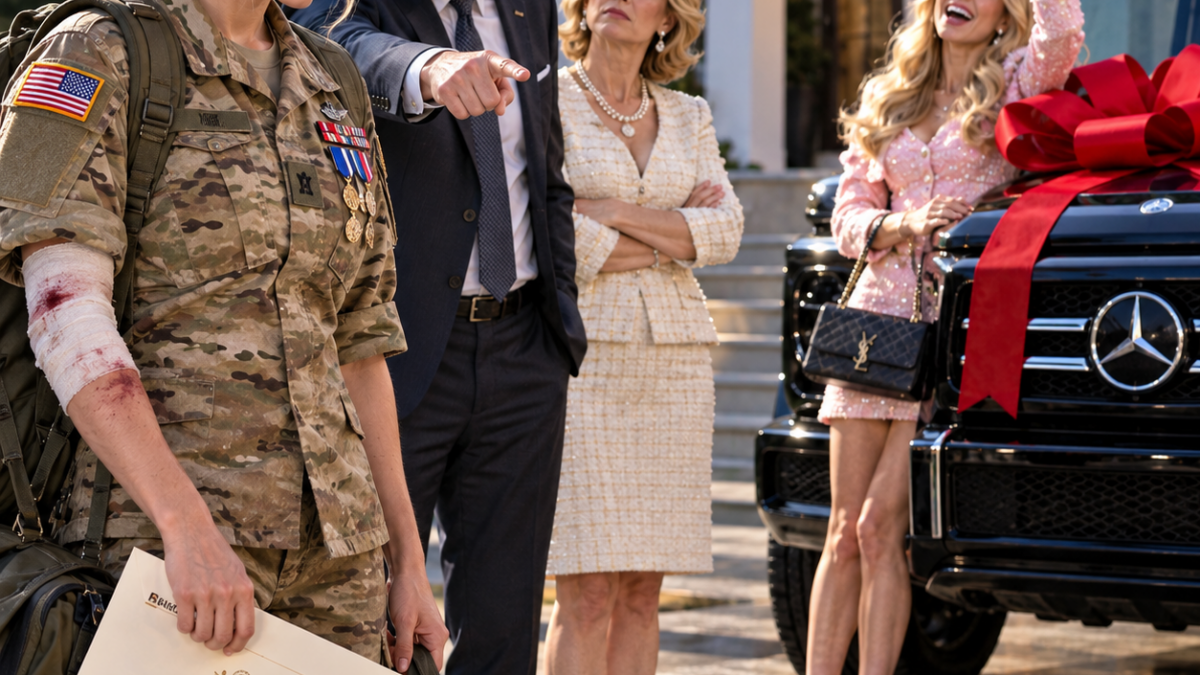
A month after that phone call, Chloe posted a photograph from our parents’ driveway.
New G-Wagon.
Huge red bow.
Mom and Dad standing beside her.
The caption read:
Hard work always pays off when you have family who believes in you.
I stared at the picture from a cot thousands of miles away.
For a moment, I almost admired the nerve.
Then I started pulling public records.
The county property database showed my parents had taken out a second mortgage against the house.
The interest rate was ugly.
Adjustable.
Aggressive.
They had stripped most of the remaining equity to finance Chloe’s SUV, apartment, and lifestyle.
Then I found the part that changed everything.
Buried in loan paperwork Dad had emailed me months earlier was a cash-flow projection.
My military allotment was listed as recurring household income.
Not temporary help.
Not gifts.
Income.
Dad had effectively bet the family home on the assumption that I would keep sending money indefinitely.
He had never asked.
At 1:14 in the morning, sitting inside a bunker while generators hummed outside, I logged into my military pay account.
I canceled the family allotment.
Then Chloe’s rent transfer.
Then the card payment I had been covering.
Then the automatic savings transfer.
Everything.
I opened a separate account at a bank my parents had never used.
Changed passwords.
Changed security questions.
Removed them from my emergency financial authorizations.
Then I updated my beneficiary forms.
Robert and Evelyn disappeared from every page.
Ten minutes later, my phone started vibrating.
Dad.
Mom.
Chloe.
Dad again.
Then a text.
WHAT THE HELL DID YOU DO?
I turned the phone facedown.
Twenty minutes later, our unit rolled into the mission that eventually placed a Silver Star on my chest.
Machine-gun fire started before sunrise.
Rounds chewed dirt from the wall beside us.
A mortar landed close enough to throw debris down the back of my collar.
One soldier went down.
Then another.
Everything became movement.
I crawled.
Dragged.
Packed wounds.
Applied tourniquets.
Pulled one kid backward by his vest while he screamed that he couldn’t feel his fingers.
Another soldier kept asking whether his brother knew where he was.
For four hours, my family disappeared from my mind completely.
There was no Chloe.
No handbag.
No bank account.
No Robert Watts demanding money.
There were only the people in front of me and the next useful decision.
Twelve men came out alive.
That was enough for me.
Four days later, command told me I had been recommended for the Silver Star.
I almost laughed.
The ceremony felt unreal compared with the actual event.
Bright lights.
Formal uniforms.
Citations written in language clean enough to make chaos sound organized.
But when I returned to Virginia and placed the invitation in Dad’s hand, some small part of me still hoped my parents would see it as proof that my life mattered.
Instead, they chose Chloe’s handbag dinner.
So I left.
I drove until I reached a twenty-four-hour diner where Sergeant First Class Myra Reyes was already sitting in a booth with coffee that looked capable of removing paint.
Myra had deployed with me twice.
She took one look at my face.
“Who died?”
“Nobody.”
“Then who disappointed you?”
I slid the second VIP ticket toward her.
“My parents passed.”
She looked at the ticket.
Then at me.
“Idiots.”
“Pretty much.”
She picked it up.
“Who gets the other seat?”
I already knew.
Aunt Martha.
Mom’s older sister.
Thirty years as a trauma nurse.
Every month I was deployed, Martha mailed something.
Wool socks.
Protein bars.
Coffee.
Bandages.
Homemade cookies wrapped badly in foil.
Once she mailed a paperback murder mystery with a note that said, You need fictional problems for a change.
She never asked me for money.
Never asked for favors.
Never treated my service like a family investment.
I called her.
She answered on the third ring.
“Katie?”
Only Martha still called me that.
“I’m getting the Silver Star Friday.”
Silence.
Then I heard her breathe in sharply.
“Where?”
“Pentagon ceremony.”
“What time do I need to be there?”
That was it.
No scheduling problem.
No restaurant reservation.
No purse.
“What if you’re working?”
“I’ll call in dead.”
I laughed for the first time that week.
Friday evening, I stood beneath bright white lights while rows of officers, families, reporters, and invited guests filled the room.
I looked toward the VIP section.
Martha was there.
So was Myra.
No empty seats.
General Thomas Vance stepped to the podium and began reading the citation.
The ambush.
My injury.
The twelve soldiers.
Details I had never told my parents because they had never bothered to ask.
Then I walked forward.
General Vance pinned the medal to my uniform.
The room stood.
Martha covered her mouth.
Myra saluted.
For several seconds, I felt disconnected from my own body.
The medal felt heavy.
Not physically.
Emotionally.
I could still hear one of the wounded men asking whether his fingers were still attached.
Awards are strange things.
They clean up the worst moments of your life and put them in velvet boxes.
Then General Vance returned to the microphone.
“We have one more recognition tonight.”
I turned.
That was not on my schedule.
Martha looked equally confused.
The general explained that a privately funded military-family foundation had created a new program honoring civilians who spent decades supporting wounded service members and deployed troops.
The first honoree had been selected from nominations submitted by active-duty personnel.
“Martha Sullivan.”
My aunt stopped breathing.
I smiled.
Months earlier, Myra had told me about the program.
I submitted Martha without telling her.
General Vance announced the recognition package.
A mortgage-free lake house donated through the foundation.
Property taxes supported for life through an endowment.
A medical supplemental fund.
And a fully paid European trip Martha had talked about taking since she was twenty-five.
She stared at me.
“You did this?”
“Technically, a board did.”
“You nominated me.”
“Maybe.”
“You little—”
The cameras cut to us as I helped her stand.
She hugged me.
Hard.
Live television carried the moment nationwide.
Somewhere across Washington, my parents were apparently sitting inside an expensive restaurant celebrating Chloe’s handbag sponsorship.
My phone was locked away.
By the time I reached my truck an hour later, I had forty-nine missed calls.
Mostly from people who had called me an embarrassment.
The first message was Dad.
YOU HAD NO RIGHT TO GIVE THAT HOUSE TO MARTHA. CALL ME NOW.
Mom:
After everything we’ve done for you, you humiliate us on national television?
Then Chloe:
You destroyed my dinner. Everyone was watching the TV at the bar.
I stared at the screen.
Then turned it off.
They believed the medal ceremony was the night I rejected them.
It wasn’t.
I had rejected the arrangement weeks earlier.
Their financial clock was already running.
I reached my apartment at 11:47 p.m.
All three of them were waiting outside.
Of course they were.
Chloe still wore a red cocktail dress from the dinner. Mom’s mascara had streaked under her eyes. Dad had sweated through the collar of a shirt that looked more expensive than my first issued rifle.
Nobody said congratulations.
Dad pointed at me.
“You call that general.”
“No.”
“You tell him there’s been a mistake.”
“There hasn’t.”
Chloe stepped closer.
“That house should have gone to us.”
I unlocked my door.
“Martha received it because Martha was nominated.”
“By you!”
“Correct.”
Mom grabbed my wounded arm.
Pain ripped through the healing stitches.
I jerked free.
“Touch me again and I’m calling the police.”
Her expression transformed instantly.
“You’d call police on your mother?”
“Try me.”
Dad slammed his fist into the drywall beside my door.
The hallway became silent.
Fortunately for me, my apartment complex had cameras.
So did my doorbell.
I looked at the tiny blue recording light.
Then at Dad.
“Do that again.”
He finally noticed the camera.
His hand dropped.
That may have been my favorite moment of the night.
Chloe began crying about her reputation.
Apparently several people at the restaurant had recognized my name during the broadcast. Someone searched her social media and found years of captions about sacrifice, hard work, and family support.
Screenshots were already circulating.
“I lost two brand calls because of you!”
I stepped into my apartment.
“You lost them because somebody compared your captions to reality.”
Dad shoved one foot against the threshold.
“You owe us.”
There it was.
Not love.
Not concern.
An invoice.
I looked at all three of them.
“The automatic payments are permanently canceled.”
Mom went pale.
“Nobody gets another dollar.”
Dad stopped breathing normally.
Chloe whispered, “What?”
“Good night.”
I began closing the door.
Dad said one last thing.
“If you stop those transfers, the house is gone.”
I looked at him.
Then shut the door.
Click.
Deadbolt.
And suddenly I knew exactly where to look next.
The following morning, Myra met me at a diner near Fort Myer.
I ordered eggs.
She ordered enough bacon to alarm a cardiologist.
I opened my laptop.
County property records told part of the story.
The rest came from financial documents Dad had casually emailed me over the years, probably because he never imagined I would examine them together.
Loan disclosures.
Second-mortgage documents.
Bank statements.
A spreadsheet titled FAMILY CASH FLOW.
There it was.
MIL ALLOTMENT — $4,850 MONTHLY.
Not Caitlyn.
Not daughter.
Income.
Myra stared at the screen.
“That’s disgusting.”
“It gets better.”
Dad had projected future reenlistment bonuses.
Money I had not earned yet.
He had signed a personal guarantee on Chloe’s G-Wagon financing.
Her monthly payment was absurd.
He had also used expected continuing transfers from me to justify household affordability.
My parents had built a lifestyle in which my deployment pay was not assistance.
It was infrastructure.
I contacted an attorney recommended through military legal assistance.
Dana Mercer worked out of a small office that smelled like printer toner and stale coffee. She spent forty minutes examining everything.
“You’re not on the mortgage?”
“No.”
“Not on the vehicle loan?”
“No.”
“Not on Chloe’s lease?”
“No.”
She leaned back.
“Then their financial stupidity is not legally your emergency.”
I stared at her.
“That may be the most beautiful sentence anyone has ever said to me.”
“Don’t put it on a greeting card.”
She tapped Dad’s spreadsheet.
“Keep this.”
“Why?”
“If they claim your transfers were voluntary gifts and try to distort the arrangement, this demonstrates that your father treated the money as recurring household income.”
I saved three copies.
Cloud.
External drive.
One with Myra.
Then my phone buzzed.
Chloe had posted a crying video online.
According to her, I had abandoned my “struggling elderly parents” after manipulating the military into giving Aunt Martha a mansion.
She described herself as a hardworking entrepreneur whose family had suddenly been “financially attacked.”
I almost replied.
Dana stopped me.
“Wait.”
“I have screenshots.”
“Good.”
“She’s lying.”
“Then let her create the record.”
That sounded familiar.
When someone is showing you who they are, stop interrupting.
For two days, I collected everything.
Texts from Mom demanding money during deployment.
Dad threatening to “teach me loyalty” after I canceled the allotment.
Chloe asking for rent.
Security deposits.
Airfare.
Clothes.
Vegas.
My favorite remained Christmas Eve.
Can you hurry? I’m literally at dinner and my card isn’t working.
Timestamp: 8:43 p.m.
That same night, my unit had been under rocket alert.
Dana sent one formal cease-and-desist letter.
No threats.
No drama.
Dates.
Screenshots.
Financial records.
A warning that knowingly false statements damaging my professional reputation could have legal consequences.
Chloe deleted the video within thirty minutes.
Too late.
Someone had already screen-recorded it.
Worse for her, one of the handbag company’s marketing employees had watched my medal ceremony.
Then she watched Chloe’s rant.
The sponsorship disappeared.
Another brand followed.
Mom called Martha.
She begged her to “fix the misunderstanding.”
Martha recorded the conversation.
For eleven minutes, Mom insulted me.
Then she asked Martha to transfer the lake house to Chloe.
Martha’s response was six words.
“Evelyn, you need professional financial advice.”
Then she hung up.
The recording eventually reached Dana.
But Dad still had farther to fall.
Four weeks later, Myra sent me a video.
I watched it in a break room between training sessions.
A tow truck was hauling Chloe’s black G-Wagon out of her apartment parking lot.
Chloe ran outside wearing a bathrobe and slippers.
Three neighbors were filming.
One guy stood beside his car eating a breakfast sandwich.
Peak America.
The lender had repossessed the vehicle.
Her apartment followed soon afterward.
Without my transfers, the family’s cash flow collapsed almost immediately.
Dad raided his retirement account.
Paid penalties.
Tried refinancing the house.
Denied.
Then the adjustable second mortgage reset.
The payment jumped.
Mom began calling relatives.
Unfortunately for them, the relatives had seen the ceremony.
Then Chloe’s video.
Then pieces of the financial record after Dad started telling people I had “stolen family money.”
My cousin Ben called.
“I had no idea they were taking your combat pay.”
“I didn’t understand it that way either. I thought I was helping.”
He was quiet.
Then he said, “Your dad told us you barely spent anything because the Army paid for your life.”
I laughed once.
“Apparently bullets are complimentary.”
“That’s not funny.”
“No.”
Dad eventually left a voicemail.
His voice had changed.
No anger.
Fear.
“The bank is threatening foreclosure. Caitlyn, call me. Please.”
I listened once.
Then deleted it.
Two months later, the foreclosure notice entered the public record.
Dad had one final move.
He showed up at my job.
He reached the visitor checkpoint and demanded to see me.
He told security there was a “family financial emergency.”
I was teaching trauma response when my supervisor found me.
“Captain Watts, you expecting a Robert Watts?”
“No, sir.”
“He’s making noise at the gate.”
Of course he was.
Base police handled it.
I never left the training building.
According to the report, Dad demanded that someone order me to restart the monthly payments.
A military police officer apparently explained, with admirable patience, that the United States Army did not manage adult daughters’ family allowances.
Dad called me selfish.
He called the Silver Star a publicity stunt.
Then he raised his voice at the wrong person.
Security escorted him off the installation.
The incident report gave Dana exactly what she needed.
Do not visit my home.
Do not visit my workplace.
Do not contact my command.
Everything goes through counsel.
Mom texted:
Look what you’ve done to your father.
I was washing dry-erase marker from my fingers when I read it.
Then I blocked her.
Two weeks later, the house sold under pressure for far less than Dad once claimed it was worth.
My parents moved into a two-bedroom rental outside Woodbridge.
Chloe moved in with them.
Three adults.
One bathroom.
No G-Wagon.
No downtown apartment.
No automatic military paycheck.
For the first time in years, their lifestyle matched their actual income.
I expected to feel guilty.
Sometimes I did.
That surprised me.
Guilt is strange when you’ve spent years being trained to treat someone else’s comfort as your responsibility.
I would wake in the middle of the night thinking about Dad’s foreclosure.
Then I would remember the spreadsheet.
MIL ALLOTMENT — $4,850 MONTHLY.
Not help.
Not gratitude.
Expectation.
Myra called that emotional muscle memory.
Dana called it conditioning.
Martha called it nonsense.
“Stop paying imaginary bills,” she told me.
“I’m not paying anything.”
“In your head.”
That woman had been a nurse too long.
She could diagnose guilt through walls.
The first time I visited her lake house, I understood why the foundation had selected it.
It was not a mansion.
Two bedrooms.
Cedar deck.
Old dock.
Big kitchen windows overlooking water.
That made me love it more.
Roast chicken was in the oven when I arrived. Myra brought beer. A Labrador from next door wandered onto the deck as if he had signed closing documents.
Nobody asked me for money.
Nobody asked whether the medal could open doors for them.
The Silver Star stayed inside its case most days.
I did not need to stare at it.
The soldiers I had pulled out were alive.
That was enough.
My assignment changed too.
I became a senior instructor at Fort Bragg, working with combat medics headed toward the same kinds of places that had consumed most of my twenties.
I loved the work.
Not because it was easier than deployment.
Because experience finally felt useful instead of merely painful.
One afternoon, a nineteen-year-old trainee froze during a simulated mass-casualty event.
Afterward, she found me outside.
“I’m sorry, ma’am.”
“For what?”
“I froze.”
“So?”
Her eyes widened.
“I don’t think I’m as tough as everybody else.”
I knew that sentence.
I had lived inside versions of it for years.
I pulled up my sleeve enough to show the scar on my arm.
“Tough people freeze sometimes.”
She stared.
“Then what?”
“Then they learn what to do next.”
She nodded.
That evening, Martha sent me a photograph from her deck.
Sunset.
Coffee mug.
No caption.
That was our relationship.
No invoice attached.
Chloe tried rebuilding her online presence.
The internet remembered.
Screenshots do that.
Every attempt to tell the story as “military sister gets jealous of influencer” attracted comments linking to footage from the ceremony or archived versions of her crying video.
Eventually, she stopped talking about me publicly.
That helped.
Four months after the medal ceremony, I saw my parents one final time.
Not intentionally.
I had stopped at a diner off Route 1 after work.
Through the window, I noticed them in a booth.
Dad looked older.
Mom wore an expensive coat I remembered from better days, but the cuffs were worn.
Chloe sat across from them scrolling her phone.
Nobody looked happy.
For a moment, Dad saw me through the glass.
He stood.
I considered getting into my truck.
Instead, I waited.
He came outside.
“Caitlyn.”
Traffic hissed over wet pavement behind us.
He shoved his hands into his pockets.
“We lost the house.”
“I know.”
“Your mother thinks maybe, with some time—”
“No.”
He stared at me.
I wasn’t angry anymore.
That may have bothered him most.
“You were my daughter.”
I tilted my head.
“Was?”
He flinched.
Good catch, Dad.
I looked through the diner window.
Mom watched us.
Chloe did not.
“I spent five years trying to earn one sentence from you.”
He looked down.
“I sent money from combat zones. I paid Chloe’s rent while sleeping behind razor wire. I transferred money during rocket alerts. I came home wounded and invited you to the biggest ceremony of my career.”
His jaw tightened.
“You chose a handbag.”
“It wasn’t that simple.”
“It was exactly that simple.”
“Your sister had an opportunity.”
“So did you.”
He looked up.
“What?”
“You had an opportunity to show up.”
Silence.
“You didn’t.”
He began to say my name.
I stopped him.
“You didn’t lose me because I got a medal.”
I touched the truck door handle.
“You lost me because the medal proved I never needed your permission to know what my life was worth.”
I got in.
He didn’t follow.
That Sunday, I drove to Martha’s house.
Myra was already there destroying hamburgers on the grill.
Martha yelled through the screen door that she had warned her about the heat.
A football game played quietly inside.
The lake was flat.
My phone stayed silent on the table.
No alerts.
No demands.
No guilt-inducing messages.
Just Myra swearing because another burger had become carbon.
I sat on the deck with my boots on the railing.
The scar in my arm still hurt whenever the weather shifted.
Some nights, sleep still came in fragments.
But the money in my bank account was mine.
My apartment was mine.
My career was mine.
My peace was beginning to feel like mine too.
Martha walked outside and handed me a plate.
“You good, Katie?”
I looked around.
Lake.
Dock.
Myra arguing with a grill.
The woman who had mailed wool socks halfway across the world because she worried my feet were cold.
“Yeah.”
For once, I didn’t need to lie.
I had spent years believing blood automatically made people family.
Blood made Robert, Evelyn, and Chloe my relatives.
The people on that deck had earned something different.
I took a bite of Myra’s hamburger.
“It’s terrible.”
She pointed the spatula at me.
“You have a Silver Star, not culinary authority.”
Martha laughed so hard she nearly spilled her tea.
For a while, I thought that would be the end of everything.
It wasn’t.
Healing rarely ends on the most cinematic day.
The financial chaos eventually settled.
My parents’ rental became permanent.
Dad found consulting work.
Mom sold several expensive pieces she had once treated like proof of success.
Chloe took a regular marketing job after her influencer income collapsed.
I heard those things through extended family.
I did not ask.
That was important.
For years, I had monitored their emergencies automatically.
Was Dad okay?
Did Mom need help?
Was Chloe short on rent?
Had somebody paid the card?
The moment I stopped sending money, I discovered how much mental space had been occupied by anticipating their next demand.
Silence felt strange at first.
Then luxurious.
I started saving aggressively.
Not because I feared being broke.
Because for the first time, saving felt like building something that belonged to me.
Emergency fund.
Retirement account.
A small travel account.
I bought a used motorcycle and scared Martha half to death.
“You survived Syria to die on Interstate 95?”
“That’s dramatic.”
“I’m a trauma nurse. Dramatic is evidence-based.”
I sold it eight months later.
Not because Martha won.
That is the official record.
My relationship with Dad changed only once after the diner.
He wrote a letter.
Paper.
Stamped envelope.
No demand for money.
No request for reconciliation.
He admitted the allotment had started as temporary help and slowly became something he counted on.
Then something he believed he deserved.
He wrote that Chloe’s lifestyle had become proof to him that he was a successful father.
My career frightened him because he could not control it.
He understood her world.
Cars.
Apartments.
Followers.
Brands.
Money.
My world was deployment orders, places he could not picture, and dangers he could not fix.
So he minimized it.
The explanation did not excuse anything.
But for the first time, it sounded honest.
At the end, he wrote:
I should have gone to your ceremony.
Not because it was televised.
Because you asked me.
I read that sentence several times.
Then put the letter away.
I did not call.
Not yet.
Some apologies deserve acknowledgment without immediate access.
A year later, I sent him a card on his birthday.
Happy birthday. I hope you’re well.
He replied with one line.
Thank you for writing.
That was all.
It was enough.
Mom never apologized clearly.
Her messages, when they occasionally reached me through new numbers, always bent toward justification.
We were under pressure.
We made sacrifices too.
You don’t understand what parents go through.
You embarrassed us publicly.
Eventually, I stopped reading beyond the first sentence.
Chloe surprised me.
Nearly two years after the ceremony, she sent an email.
No influencer language.
No dramatic formatting.
I expected blame.
Instead, she wrote:
I thought the money came from Mom and Dad.
I knew you helped sometimes, but I didn’t understand how much.
When I found Dad’s spreadsheet, I understood.
I still should have asked.
I also knew you were overseas when I asked for things, and I chose not to think about what that meant.
I’m sorry.
That last line stayed with me.
Not I’m sorry you felt hurt.
Not I’m sorry things got out of control.
I’m sorry.
I waited a week before replying.
Thank you for saying it.
She responded:
I don’t expect anything.
That helped.
We did not become sisters again overnight.
We started with birthdays.
Then occasional messages.
Eventually coffee.
The first time we met, she drove a used Honda.
I did not mention it.
She caught me looking anyway.
“Go ahead.”
“I didn’t say anything.”
“You’re thinking it.”
“I’m thinking Hondas are reliable.”
She laughed.
That was the first normal moment we had shared in years.
Then she became serious.
“The G-Wagon was stupid.”
“Yes.”
“You could pretend to hesitate.”
“I’m military. Efficiency.”
She smiled.
Then looked down at her coffee.
“Did you hate me?”
“No.”
“Why?”
I thought about it.
“Because hating you would still make my life revolve around you.”
Her eyes filled.
“That’s worse.”
“Probably.”
She nodded.
Then she said, “I’m glad you stopped paying.”
That surprised me.
“What?”
“I needed to find out whether any of it was actually mine.”
That was the first time I saw my sister as something other than the person my parents had chosen over me.
She had been used too.
Not in the same way.
Not equally.
But she had been taught that love arrived as luxury and disappeared when the luxury stopped.
That kind of lesson damages people differently.
I did not rescue her from it.
She had to learn for herself.
My career continued.
The Silver Star became something I rarely discussed.
Once, a trainee recognized my name from the ceremony.
“Ma’am, are you the Captain Watts from the video?”
I sighed.
“Unfortunately.”
He looked horrified.
“I meant the medal, ma’am.”
“I know.”
The class laughed.
Then I made them run the scenario again.
That became my favorite response to admiration.
Back to work.
The medal never mattered as much as what came afterward.
Teaching younger medics not to panic when blood changed the shape of a room.
Teaching them that courage does not feel like courage while it is happening.
Teaching them that the person screaming loudest may not be the person most at risk.
Teaching them to look.
Listen.
Decide.
Move.
Those were the skills that saved people.
Not ceremonies.
Not ribbons.
Not television.
Years later, Martha finally took the Europe trip.
She sent me photographs from Italy.
Most were terrible.
Thumb over the lens.
Crooked buildings.
One entire photograph of what appeared to be a sidewalk.
I called her.
“Do you understand cameras?”
“I’m a nurse.”
“That does not answer the question.”
“I’ve kept people alive with less technology.”
Fair.
When she returned, we sat on her deck.
The lake was calm.
Myra joined us with hamburgers.
She had improved.
Slightly.
Martha looked at me over her tea.
“Would you do it again?”
“Nominate you?”
“No. Cut them off.”
I looked toward the water.
“Yes.”
“No hesitation?”
“Plenty.”
“But yes.”
“Yes.”
She nodded.
“Good.”
I smiled.
“You knew that.”
“I wanted to hear you say it.”
Trauma nurses.
Always collecting baseline data.
Eventually, the night of the medal ceremony became less sharp in my memory.
I remembered the medal.
Martha’s face.
The missed calls.
But I stopped hearing Dad’s words every time I saw my uniform.
You’re an embarrassment.
For a long time, that sentence had stuck to me.
Then one morning I was getting dressed for a formal event and realized I had not thought about it in months.
I looked at myself in the mirror.
Same uniform.
More ribbons.
Older face.
Scar still visible if I raised my sleeve.
Nothing about me needed correction.
The realization was quiet.
Most important realizations are.
My family had spent years teaching me that usefulness was the price of belonging.
When I sent money, I mattered.
When I solved emergencies, I mattered.
When I paid bills, I mattered.
When I became expensive emotionally instead of profitable financially, I became embarrassing.
Martha never did that.
Myra never did that.
The people I served beside never did that.
Even the young soldiers I pulled from the kill zone never owed me anything because I helped them.
Service was not a loan.
Love shouldn’t have been either.
That distinction changed everything.
Five years after the Silver Star ceremony, Dad and I spoke in person again.
Martha arranged nothing.
Chloe arranged nothing.
We happened to be at the same family funeral.
He looked much older.
So did I.
We stood beneath gray Virginia skies after most people had left.
Dad approached slowly.
“Caitlyn.”
“Dad.”
No accusation.
No money.
No dramatic reconciliation.
He looked at my uniform.
“I saw your promotion announcement.”
“Okay.”
“I was proud.”
I waited.
Then he corrected himself.
“I am proud.”
That mattered more.
“Thank you.”
He looked toward the cemetery.
“I was a terrible father to you.”
I didn’t rush to rescue him from the sentence.
“Yes.”
His eyes closed briefly.
“You always were direct.”
“Occupational hazard.”
He almost smiled.
Then he asked the question I had once desperately wanted him to ask.
“Are you happy?”
I thought about Martha’s lake.
Myra.
The trainees.
My apartment.
My own bank account.
Chloe slowly rebuilding a relationship with me.
The nights I still woke too early.
The scar.
The work.
The peace.
“Mostly.”
He nodded.
“That sounds real.”
“It is.”
We did not hug.
Not that day.
But I gave him my number.
A new one.
He called two weeks later.
We talked for nine minutes.
No money.
That became our rule without ever saying it.
He asked about work.
I asked about his health.
Nothing was fixed.
But something was different.
Sometimes forward is enough.
Mom and I never rebuilt the same way.
She remained tied to the belief that family conflict should be forgotten rather than understood.
I stopped trying to change her.
That was another form of peace.
You cannot argue somebody into accountability.
They either arrive there or they don’t.
The last time I visited Martha’s lake house before another long assignment, the three of us sat on the cedar deck.
Myra was grilling again.
Martha had banned her from hamburgers and assigned hot dogs instead.
“Lower skill requirement,” Martha said.
“I’ve treated arterial bleeds under fire,” Myra protested.
“You burn ground beef.”
“Unrelated competency.”
I laughed.
The lake reflected late-afternoon light.
My phone sat facedown on the table.
No missed calls.
No bank alerts.
No family emergency waiting to become my responsibility.
Martha handed me tea.
“You good, Katie?”
I looked around.
Years earlier, I had answered that question automatically.
Fine.
Always fine.
Strong daughter.
Useful soldier.
Reliable bank account.
Now I actually considered it.
My arm still ached when storms moved in.
Some nights I still woke hearing gunfire that wasn’t there.
Dad and I had a fragile relationship instead of the one I once wanted.
Mom remained distant.
Chloe and I were learning how to be sisters without money between us.
My career was demanding.
My coffee was still terrible.
Nothing was perfect.
But everything important belonged to me.
My paycheck.
My decisions.
My home.
My work.
My relationships.
My peace.
“Yeah,” I said.
Martha smiled.
For once, I didn’t have to lie.
Myra handed me a burned hot dog.
I stared at it.
“This is charcoal.”
“You have a Silver Star, not culinary authority.”
“Apparently that joke still works.”
“It’s a classic.”
Martha laughed.
I took a bite anyway.
It was awful.
The biggest victory of my life did not happen beneath Pentagon lights.
It did not happen when a general pinned a medal to my uniform.
It did not happen when my phone showed forty-nine missed calls.
It did not happen when Chloe’s G-Wagon disappeared on a tow truck or when my parents lost the house they had financed with money they never should have counted on.
It happened much later.
On a cedar deck beside a quiet lake.
Bad food.
Good people.
No invoices.
No guilt.
Nobody asking what my sacrifice could buy them.
For years, I thought being family meant bleeding for people until they finally noticed the wound.
I know better now.
Family is not the person who asks how much you can give.
It is the person who notices you are cold and mails you socks halfway around the world without expecting anything back.
It is the friend who sits beside you at a ceremony because there should not be an empty chair.
It is the father who, years too late, finally learns to ask how you are instead of what you can provide.
It is even the sister who eventually admits that she benefited from something wrong and stops demanding that forgiveness arrive on her schedule.
Blood made Robert, Evelyn, and Chloe my relatives.
Choice determined what came after.
I looked across the lake as the sun dropped lower behind the trees.
Myra and Martha were arguing about mustard.
The Silver Star was back in its case.
Exactly where I liked it.
Twelve men were still alive.
Aunt Martha had a home she owned outright.
My paycheck went into my account.
And nobody at that table had ever asked me to bleed for their comfort.
That was enough.
𝗧𝗛𝗘 𝗘𝗡𝗗
My Family Thought My Sacrifice Belonged to Them Until I Came Home Wounded
For years, every deployment check became another piece of their perfect life.
When I finally came home carrying a medal invitation and a healing wound, they still chose my sister.
That was when I stopped arguing and started looking at the numbers.
“You’re an embarrassment to this family.”
My father said it while holding an invitation embossed with the seal of the Department of Defense.
I had been home from the Middle East for thirty-six hours. Beneath the left sleeve of my uniform, a shrapnel wound was still healing badly enough that certain movements pulled the stitches. My duffel sat beside the front door of my parents’ house outside Alexandria, Virginia. My boots were dusty. I smelled faintly of antiseptic, jet fuel, sweat, and the kind of exhaustion that clings to you after too many nights sleeping wherever somebody tells you to lie down.
Dad looked at none of that.
Robert Watts studied the gold invitation in his hand, snorted, and tossed it onto the coffee table.
It slid halfway beneath a copy of Architectural Digest.
My mother, Evelyn, sat on the couch scrolling through her phone.
“We already have plans Friday.”
I laughed once.
Nothing was funny.
“What plans?”
Mom finally looked up.
“Chloe got a sponsorship.”
My little sister was twenty-four, beautiful, ambitious, and professionally photographed from almost every angle. Instagram. TikTok. Beauty reels. Coffee-shop selfies. Luxury hotel bathrooms that never seemed to cost her anything.
Mom smiled.
“A leather company is sending her a handbag.”
I stared at her.
“A handbag.”
“It’s not just a handbag, Caitlyn. It’s a networking dinner.”
I looked at Dad.
He shrugged.
Neither of them had asked why I had returned earlier than expected.
Neither had asked about my arm.
Neither knew that twelve soldiers were alive because four weeks earlier I had crawled through machine-gun fire, packed wounds with blood-slick gloves, dragged men by their body armor, and refused to stop until everybody who could still breathe was behind cover.
But Chloe was getting a purse.
“The ceremony is televised,” I said. “I have two family seats.”
Dad picked the invitation back up.
For three seconds, stupidly, I thought he might change his mind.
Instead, he said, “I’m not spending Friday night watching people congratulate themselves for doing their jobs.”
That hurt more cleanly than the shrapnel had.
Mom’s eyes moved over my uniform.
“You should shower before you go anywhere. You smell like sweat.”
“I came directly from processing.”
“And blood.”
Her nose wrinkled slightly.
Dad stood.
“We are not standing beside you on television looking like some military propaganda family. Chloe has fashion people coming to dinner. We have appearances to think about.”
Then he said it.
“You’re an embarrassment to us.”
I didn’t yell.
Five years of deployments teach you useful things. One of them is that when people are finally showing you exactly who they are, interrupting them only delays the lesson.
I picked up the invitation.
“Okay.”
Dad frowned.
That bothered him more than anger.
“Okay?”
“Enjoy the handbag.”
I walked outside.
No one followed.
No dramatic music played.
Somebody two houses down ran a leaf blower while my boots hit the concrete driveway.
My truck sat beside Chloe’s black Mercedes G-Wagon.
The SUV cost around one hundred forty thousand dollars.
I knew because, technically, I had helped pay for it.
Not because I wanted to.
For years, my parents had treated my military income like family property. It started before my first deployment, when Dad convinced me to establish an automatic allotment into their joint bank account.
“For emergencies,” he had said.
I was twenty-two and still naive enough to believe parental approval worked like a rewards program.
Send enough money.
Be useful enough.
Eventually somebody says they’re proud of you.
Instead, my hazard pay became Chloe’s rent.
Then her “branding expenses.”
Then a club membership.
Then a downtown apartment.
Once, on Christmas Eve, I sat inside a concrete shelter entering a verification code because Chloe’s landlord wanted twelve hundred dollars before midnight.
Outside, our position was under rocket alert.
Inside, Chloe needed rent because she had spent hers on Miami.
Nobody asked how my Christmas was going.
That had become normal.
Until eight weeks before the medal ceremony.
Our convoy had been hit outside the wire. Shrapnel tore through my left arm. I was sitting in a medical tent while a medic cleaned blood from my skin when someone called my name.
“Watts. Satellite phone. Your dad.”
I took it with my good hand.
Dad skipped hello.
“Chloe needs two grand today.”
I looked down at blood dripping toward my boot.
“For what?”
“Fashion Week networking.”
“I just got hit.”
Silence.
Then:
“So?”
The medic stopped working for half a second.
Mom took the phone.
“How can you be this selfish? Chloe is building a real career. Your job is rolling around in dirt. It’s not like you have anything to spend money on.”
Something inside me disconnected.
I hung up.
That night, I began reviewing every transfer I had made in five years.
And what I found made one thing very clear.
My family had not built their lifestyle around loving me.
They had built it around my paycheck.
part2
A month after that phone call, Chloe posted a photograph from our parents’ driveway.
New G-Wagon.
Huge red bow.
Mom and Dad standing beside her.
The caption read:
Hard work always pays off when you have family who believes in you.
I stared at the picture from a cot thousands of miles away.
For a moment, I almost admired the nerve.
Then I started pulling public records.
The county property database showed my parents had taken out a second mortgage against the house.
The interest rate was ugly.
Adjustable.
Aggressive.
They had stripped most of the remaining equity to finance Chloe’s SUV, apartment, and lifestyle.
Then I found the part that changed everything.
Buried in loan paperwork Dad had emailed me months earlier was a cash-flow projection.
My military allotment was listed as recurring household income.
Not temporary help.
Not gifts.
Income.
Dad had effectively bet the family home on the assumption that I would keep sending money indefinitely.
He had never asked.
At 1:14 in the morning, sitting inside a bunker while generators hummed outside, I logged into my military pay account.
I canceled the family allotment.
Then Chloe’s rent transfer.
Then the card payment I had been covering.
Then the automatic savings transfer.
Everything.
I opened a separate account at a bank my parents had never used.
Changed passwords.
Changed security questions.
Removed them from my emergency financial authorizations.
Then I updated my beneficiary forms.
Robert and Evelyn disappeared from every page.
Ten minutes later, my phone started vibrating.
Dad.
Mom.
Chloe.
Dad again.
Then a text.
WHAT THE HELL DID YOU DO?
I turned the phone facedown.
Twenty minutes later, our unit rolled into the mission that eventually placed a Silver Star on my chest.
Machine-gun fire started before sunrise.
Rounds chewed dirt from the wall beside us.
A mortar landed close enough to throw debris down the back of my collar.
One soldier went down.
Then another.
Everything became movement.
I crawled.
Dragged.
Packed wounds.
Applied tourniquets.
Pulled one kid backward by his vest while he screamed that he couldn’t feel his fingers.
Another soldier kept asking whether his brother knew where he was.
For four hours, my family disappeared from my mind completely.
There was no Chloe.
No handbag.
No bank account.
No Robert Watts demanding money.
There were only the people in front of me and the next useful decision.
Twelve men came out alive.
That was enough for me.
Four days later, command told me I had been recommended for the Silver Star.
I almost laughed.
The ceremony felt unreal compared with the actual event.
Bright lights.
Formal uniforms.
Citations written in language clean enough to make chaos sound organized.
But when I returned to Virginia and placed the invitation in Dad’s hand, some small part of me still hoped my parents would see it as proof that my life mattered.
Instead, they chose Chloe’s handbag dinner.
So I left.
I drove until I reached a twenty-four-hour diner where Sergeant First Class Myra Reyes was already sitting in a booth with coffee that looked capable of removing paint.
Myra had deployed with me twice.
She took one look at my face.
“Who died?”
“Nobody.”
“Then who disappointed you?”
I slid the second VIP ticket toward her.
“My parents passed.”
She looked at the ticket.
Then at me.
“Idiots.”
“Pretty much.”
She picked it up.
“Who gets the other seat?”
I already knew.
Aunt Martha.
Mom’s older sister.
Thirty years as a trauma nurse.
Every month I was deployed, Martha mailed something.
Wool socks.
Protein bars.
Coffee.
Bandages.
Homemade cookies wrapped badly in foil.
Once she mailed a paperback murder mystery with a note that said, You need fictional problems for a change.
She never asked me for money.
Never asked for favors.
Never treated my service like a family investment.
I called her.
She answered on the third ring.
“Katie?”
Only Martha still called me that.
“I’m getting the Silver Star Friday.”
Silence.
Then I heard her breathe in sharply.
“Where?”
“Pentagon ceremony.”
“What time do I need to be there?”
That was it.
No scheduling problem.
No restaurant reservation.
No purse.
“What if you’re working?”
“I’ll call in dead.”
I laughed for the first time that week.
Friday evening, I stood beneath bright white lights while rows of officers, families, reporters, and invited guests filled the room.
I looked toward the VIP section.
Martha was there.
So was Myra.
No empty seats.
General Thomas Vance stepped to the podium and began reading the citation.
The ambush.
My injury.
The twelve soldiers.
Details I had never told my parents because they had never bothered to ask.
Then I walked forward.
General Vance pinned the medal to my uniform.
The room stood.
Martha covered her mouth.
Myra saluted.
For several seconds, I felt disconnected from my own body.
The medal felt heavy.
Not physically.
Emotionally.
I could still hear one of the wounded men asking whether his fingers were still attached.
Awards are strange things.
They clean up the worst moments of your life and put them in velvet boxes.
Then General Vance returned to the microphone.
“We have one more recognition tonight.”
I turned.
That was not on my schedule.
Martha looked equally confused.
The general explained that a privately funded military-family foundation had created a new program honoring civilians who spent decades supporting wounded service members and deployed troops.
The first honoree had been selected from nominations submitted by active-duty personnel.
“Martha Sullivan.”
My aunt stopped breathing.
I smiled.
Months earlier, Myra had told me about the program.
I submitted Martha without telling her.
General Vance announced the recognition package.
A mortgage-free lake house donated through the foundation.
Property taxes supported for life through an endowment.
A medical supplemental fund.
And a fully paid European trip Martha had talked about taking since she was twenty-five.
She stared at me.
“You did this?”
“Technically, a board did.”
“You nominated me.”
“Maybe.”
“You little—”
The cameras cut to us as I helped her stand.
She hugged me.
Hard.
Live television carried the moment nationwide.
Somewhere across Washington, my parents were apparently sitting inside an expensive restaurant celebrating Chloe’s handbag sponsorship.
My phone was locked away.
By the time I reached my truck an hour later, I had forty-nine missed calls.
Mostly from people who had called me an embarrassment.
The first message was Dad.
YOU HAD NO RIGHT TO GIVE THAT HOUSE TO MARTHA. CALL ME NOW.
Mom:
After everything we’ve done for you, you humiliate us on national television?
Then Chloe:
You destroyed my dinner. Everyone was watching the TV at the bar.
I stared at the screen.
Then turned it off.
They believed the medal ceremony was the night I rejected them.
It wasn’t.
I had rejected the arrangement weeks earlier.
Their financial clock was already running.
I reached my apartment at 11:47 p.m.
All three of them were waiting outside.
Of course they were.
Chloe still wore a red cocktail dress from the dinner. Mom’s mascara had streaked under her eyes. Dad had sweated through the collar of a shirt that looked more expensive than my first issued rifle.
Nobody said congratulations.
Dad pointed at me.
“You call that general.”
“No.”
“You tell him there’s been a mistake.”
“There hasn’t.”
Chloe stepped closer.
“That house should have gone to us.”
I unlocked my door.
“Martha received it because Martha was nominated.”
“By you!”
“Correct.”
Mom grabbed my wounded arm.
Pain ripped through the healing stitches.
I jerked free.
“Touch me again and I’m calling the police.”
Her expression transformed instantly.
“You’d call police on your mother?”
“Try me.”
Dad slammed his fist into the drywall beside my door.
The hallway became silent.
Fortunately for me, my apartment complex had cameras.
So did my doorbell.
I looked at the tiny blue recording light.
Then at Dad.
“Do that again.”
He finally noticed the camera.
His hand dropped.
That may have been my favorite moment of the night.
Chloe began crying about her reputation.
Apparently several people at the restaurant had recognized my name during the broadcast. Someone searched her social media and found years of captions about sacrifice, hard work, and family support.
Screenshots were already circulating.
“I lost two brand calls because of you!”
I stepped into my apartment.
“You lost them because somebody compared your captions to reality.”
Dad shoved one foot against the threshold.
“You owe us.”
There it was.
Not love.
Not concern.
An invoice.
I looked at all three of them.
“The automatic payments are permanently canceled.”
Mom went pale.
“Nobody gets another dollar.”
Dad stopped breathing normally.
Chloe whispered, “What?”
“Good night.”
I began closing the door.
Dad said one last thing.
“If you stop those transfers, the house is gone.”
I looked at him.
Then shut the door.
Click.
Deadbolt.
And suddenly I knew exactly where to look next.
The following morning, Myra met me at a diner near Fort Myer.
I ordered eggs.
She ordered enough bacon to alarm a cardiologist.
I opened my laptop.
County property records told part of the story.
The rest came from financial documents Dad had casually emailed me over the years, probably because he never imagined I would examine them together.
Loan disclosures.
Second-mortgage documents.
Bank statements.
A spreadsheet titled FAMILY CASH FLOW.
There it was.
MIL ALLOTMENT — $4,850 MONTHLY.
Not Caitlyn.
Not daughter.
Income.
Myra stared at the screen.
“That’s disgusting.”
“It gets better.”
Dad had projected future reenlistment bonuses.
Money I had not earned yet.
He had signed a personal guarantee on Chloe’s G-Wagon financing.
Her monthly payment was absurd.
He had also used expected continuing transfers from me to justify household affordability.
My parents had built a lifestyle in which my deployment pay was not assistance.
It was infrastructure.
I contacted an attorney recommended through military legal assistance.
Dana Mercer worked out of a small office that smelled like printer toner and stale coffee. She spent forty minutes examining everything.
“You’re not on the mortgage?”
“No.”
“Not on the vehicle loan?”
“No.”
“Not on Chloe’s lease?”
“No.”
She leaned back.
“Then their financial stupidity is not legally your emergency.”
I stared at her.
“That may be the most beautiful sentence anyone has ever said to me.”
“Don’t put it on a greeting card.”
She tapped Dad’s spreadsheet.
“Keep this.”
“Why?”
“If they claim your transfers were voluntary gifts and try to distort the arrangement, this demonstrates that your father treated the money as recurring household income.”
I saved three copies.
Cloud.
External drive.
One with Myra.
Then my phone buzzed.
Chloe had posted a crying video online.
According to her, I had abandoned my “struggling elderly parents” after manipulating the military into giving Aunt Martha a mansion.
She described herself as a hardworking entrepreneur whose family had suddenly been “financially attacked.”
I almost replied.
Dana stopped me.
“Wait.”
“I have screenshots.”
“Good.”
“She’s lying.”
“Then let her create the record.”
That sounded familiar.
When someone is showing you who they are, stop interrupting.
For two days, I collected everything.
Texts from Mom demanding money during deployment.
Dad threatening to “teach me loyalty” after I canceled the allotment.
Chloe asking for rent.
Security deposits.
Airfare.
Clothes.
Vegas.
My favorite remained Christmas Eve.
Can you hurry? I’m literally at dinner and my card isn’t working.
Timestamp: 8:43 p.m.
That same night, my unit had been under rocket alert.
Dana sent one formal cease-and-desist letter.
No threats.
No drama.
Dates.
Screenshots.
Financial records.
A warning that knowingly false statements damaging my professional reputation could have legal consequences.
Chloe deleted the video within thirty minutes.
Too late.
Someone had already screen-recorded it.
Worse for her, one of the handbag company’s marketing employees had watched my medal ceremony.
Then she watched Chloe’s rant.
The sponsorship disappeared.
Another brand followed.
Mom called Martha.
She begged her to “fix the misunderstanding.”
Martha recorded the conversation.
For eleven minutes, Mom insulted me.
Then she asked Martha to transfer the lake house to Chloe.
Martha’s response was six words.
“Evelyn, you need professional financial advice.”
Then she hung up.
The recording eventually reached Dana.
But Dad still had farther to fall.
Four weeks later, Myra sent me a video.
I watched it in a break room between training sessions.
A tow truck was hauling Chloe’s black G-Wagon out of her apartment parking lot.
Chloe ran outside wearing a bathrobe and slippers.
Three neighbors were filming.
One guy stood beside his car eating a breakfast sandwich.
Peak America.
The lender had repossessed the vehicle.
Her apartment followed soon afterward.
Without my transfers, the family’s cash flow collapsed almost immediately.
Dad raided his retirement account.
Paid penalties.
Tried refinancing the house.
Denied.
Then the adjustable second mortgage reset.
The payment jumped.
Mom began calling relatives.
Unfortunately for them, the relatives had seen the ceremony.
Then Chloe’s video.
Then pieces of the financial record after Dad started telling people I had “stolen family money.”
My cousin Ben called.
“I had no idea they were taking your combat pay.”
“I didn’t understand it that way either. I thought I was helping.”
He was quiet.
Then he said, “Your dad told us you barely spent anything because the Army paid for your life.”
I laughed once.
“Apparently bullets are complimentary.”
“That’s not funny.”
“No.”
Dad eventually left a voicemail.
His voice had changed.
No anger.
Fear.
“The bank is threatening foreclosure. Caitlyn, call me. Please.”
I listened once.
Then deleted it.
Two months later, the foreclosure notice entered the public record.
Dad had one final move.
He showed up at my job.
He reached the visitor checkpoint and demanded to see me.
He told security there was a “family financial emergency.”
I was teaching trauma response when my supervisor found me.
“Captain Watts, you expecting a Robert Watts?”
“No, sir.”
“He’s making noise at the gate.”
Of course he was.
Base police handled it.
I never left the training building.
According to the report, Dad demanded that someone order me to restart the monthly payments.
A military police officer apparently explained, with admirable patience, that the United States Army did not manage adult daughters’ family allowances.
Dad called me selfish.
He called the Silver Star a publicity stunt.
Then he raised his voice at the wrong person.
Security escorted him off the installation.
The incident report gave Dana exactly what she needed.
Do not visit my home.
Do not visit my workplace.
Do not contact my command.
Everything goes through counsel.
Mom texted:
Look what you’ve done to your father.
I was washing dry-erase marker from my fingers when I read it.
Then I blocked her.
Two weeks later, the house sold under pressure for far less than Dad once claimed it was worth.
My parents moved into a two-bedroom rental outside Woodbridge.
Chloe moved in with them.
Three adults.
One bathroom.
No G-Wagon.
No downtown apartment.
No automatic military paycheck.
For the first time in years, their lifestyle matched their actual income.
I expected to feel guilty.
Sometimes I did.
That surprised me.
Guilt is strange when you’ve spent years being trained to treat someone else’s comfort as your responsibility.
I would wake in the middle of the night thinking about Dad’s foreclosure.
Then I would remember the spreadsheet.
MIL ALLOTMENT — $4,850 MONTHLY.
Not help.
Not gratitude.
Expectation.
Myra called that emotional muscle memory.
Dana called it conditioning.
Martha called it nonsense.
“Stop paying imaginary bills,” she told me.
“I’m not paying anything.”
“In your head.”
That woman had been a nurse too long.
She could diagnose guilt through walls.
The first time I visited her lake house, I understood why the foundation had selected it.
It was not a mansion.
Two bedrooms.
Cedar deck.
Old dock.
Big kitchen windows overlooking water.
That made me love it more.
Roast chicken was in the oven when I arrived. Myra brought beer. A Labrador from next door wandered onto the deck as if he had signed closing documents.
Nobody asked me for money.
Nobody asked whether the medal could open doors for them.
The Silver Star stayed inside its case most days.
I did not need to stare at it.
The soldiers I had pulled out were alive.
That was enough.
My assignment changed too.
I became a senior instructor at Fort Bragg, working with combat medics headed toward the same kinds of places that had consumed most of my twenties.
I loved the work.
Not because it was easier than deployment.
Because experience finally felt useful instead of merely painful.
One afternoon, a nineteen-year-old trainee froze during a simulated mass-casualty event.
Afterward, she found me outside.
“I’m sorry, ma’am.”
“For what?”
“I froze.”
“So?”
Her eyes widened.
“I don’t think I’m as tough as everybody else.”
I knew that sentence.
I had lived inside versions of it for years.
I pulled up my sleeve enough to show the scar on my arm.
“Tough people freeze sometimes.”
She stared.
“Then what?”
“Then they learn what to do next.”
She nodded.
That evening, Martha sent me a photograph from her deck.
Sunset.
Coffee mug.
No caption.
That was our relationship.
No invoice attached.
Chloe tried rebuilding her online presence.
The internet remembered.
Screenshots do that.
Every attempt to tell the story as “military sister gets jealous of influencer” attracted comments linking to footage from the ceremony or archived versions of her crying video.
Eventually, she stopped talking about me publicly.
That helped.
Four months after the medal ceremony, I saw my parents one final time.
Not intentionally.
I had stopped at a diner off Route 1 after work.
Through the window, I noticed them in a booth.
Dad looked older.
Mom wore an expensive coat I remembered from better days, but the cuffs were worn.
Chloe sat across from them scrolling her phone.
Nobody looked happy.
For a moment, Dad saw me through the glass.
He stood.
I considered getting into my truck.
Instead, I waited.
He came outside.
“Caitlyn.”
Traffic hissed over wet pavement behind us.
He shoved his hands into his pockets.
“We lost the house.”
“I know.”
“Your mother thinks maybe, with some time—”
“No.”
He stared at me.
I wasn’t angry anymore.
That may have bothered him most.
“You were my daughter.”
I tilted my head.
“Was?”
He flinched.
Good catch, Dad.
I looked through the diner window.
Mom watched us.
Chloe did not.
“I spent five years trying to earn one sentence from you.”
He looked down.
“I sent money from combat zones. I paid Chloe’s rent while sleeping behind razor wire. I transferred money during rocket alerts. I came home wounded and invited you to the biggest ceremony of my career.”
His jaw tightened.
“You chose a handbag.”
“It wasn’t that simple.”
“It was exactly that simple.”
“Your sister had an opportunity.”
“So did you.”
He looked up.
“What?”
“You had an opportunity to show up.”
Silence.
“You didn’t.”
He began to say my name.
I stopped him.
“You didn’t lose me because I got a medal.”
I touched the truck door handle.
“You lost me because the medal proved I never needed your permission to know what my life was worth.”
I got in.
He didn’t follow.
That Sunday, I drove to Martha’s house.
Myra was already there destroying hamburgers on the grill.
Martha yelled through the screen door that she had warned her about the heat.
A football game played quietly inside.
The lake was flat.
My phone stayed silent on the table.
No alerts.
No demands.
No guilt-inducing messages.
Just Myra swearing because another burger had become carbon.
I sat on the deck with my boots on the railing.
The scar in my arm still hurt whenever the weather shifted.
Some nights, sleep still came in fragments.
But the money in my bank account was mine.
My apartment was mine.
My career was mine.
My peace was beginning to feel like mine too.
Martha walked outside and handed me a plate.
“You good, Katie?”
I looked around.
Lake.
Dock.
Myra arguing with a grill.
The woman who had mailed wool socks halfway across the world because she worried my feet were cold.
“Yeah.”
For once, I didn’t need to lie.
I had spent years believing blood automatically made people family.
Blood made Robert, Evelyn, and Chloe my relatives.
The people on that deck had earned something different.
I took a bite of Myra’s hamburger.
“It’s terrible.”
She pointed the spatula at me.
“You have a Silver Star, not culinary authority.”
Martha laughed so hard she nearly spilled her tea.
For a while, I thought that would be the end of everything.
It wasn’t.
Healing rarely ends on the most cinematic day.
The financial chaos eventually settled.
My parents’ rental became permanent.
Dad found consulting work.
Mom sold several expensive pieces she had once treated like proof of success.
Chloe took a regular marketing job after her influencer income collapsed.
I heard those things through extended family.
I did not ask.
That was important.
For years, I had monitored their emergencies automatically.
Was Dad okay?
Did Mom need help?
Was Chloe short on rent?
Had somebody paid the card?
The moment I stopped sending money, I discovered how much mental space had been occupied by anticipating their next demand.
Silence felt strange at first.
Then luxurious.
I started saving aggressively.
Not because I feared being broke.
Because for the first time, saving felt like building something that belonged to me.
Emergency fund.
Retirement account.
A small travel account.
I bought a used motorcycle and scared Martha half to death.
“You survived Syria to die on Interstate 95?”
“That’s dramatic.”
“I’m a trauma nurse. Dramatic is evidence-based.”
I sold it eight months later.
Not because Martha won.
That is the official record.
My relationship with Dad changed only once after the diner.
He wrote a letter.
Paper.
Stamped envelope.
No demand for money.
No request for reconciliation.
He admitted the allotment had started as temporary help and slowly became something he counted on.
Then something he believed he deserved.
He wrote that Chloe’s lifestyle had become proof to him that he was a successful father.
My career frightened him because he could not control it.
He understood her world.
Cars.
Apartments.
Followers.
Brands.
Money.
My world was deployment orders, places he could not picture, and dangers he could not fix.
So he minimized it.
The explanation did not excuse anything.
But for the first time, it sounded honest.
At the end, he wrote:
I should have gone to your ceremony.
Not because it was televised.
Because you asked me.
I read that sentence several times.
Then put the letter away.
I did not call.
Not yet.
Some apologies deserve acknowledgment without immediate access.
A year later, I sent him a card on his birthday.
Happy birthday. I hope you’re well.
He replied with one line.
Thank you for writing.
That was all.
It was enough.
Mom never apologized clearly.
Her messages, when they occasionally reached me through new numbers, always bent toward justification.
We were under pressure.
We made sacrifices too.
You don’t understand what parents go through.
You embarrassed us publicly.
Eventually, I stopped reading beyond the first sentence.
Chloe surprised me.
Nearly two years after the ceremony, she sent an email.
No influencer language.
No dramatic formatting.
I expected blame.
Instead, she wrote:
I thought the money came from Mom and Dad.
I knew you helped sometimes, but I didn’t understand how much.
When I found Dad’s spreadsheet, I understood.
I still should have asked.
I also knew you were overseas when I asked for things, and I chose not to think about what that meant.
I’m sorry.
That last line stayed with me.
Not I’m sorry you felt hurt.
Not I’m sorry things got out of control.
I’m sorry.
I waited a week before replying.
Thank you for saying it.
She responded:
I don’t expect anything.
That helped.
We did not become sisters again overnight.
We started with birthdays.
Then occasional messages.
Eventually coffee.
The first time we met, she drove a used Honda.
I did not mention it.
She caught me looking anyway.
“Go ahead.”
“I didn’t say anything.”
“You’re thinking it.”
“I’m thinking Hondas are reliable.”
She laughed.
That was the first normal moment we had shared in years.
Then she became serious.
“The G-Wagon was stupid.”
“Yes.”
“You could pretend to hesitate.”
“I’m military. Efficiency.”
She smiled.
Then looked down at her coffee.
“Did you hate me?”
“No.”
“Why?”
I thought about it.
“Because hating you would still make my life revolve around you.”
Her eyes filled.
“That’s worse.”
“Probably.”
She nodded.
Then she said, “I’m glad you stopped paying.”
That surprised me.
“What?”
“I needed to find out whether any of it was actually mine.”
That was the first time I saw my sister as something other than the person my parents had chosen over me.
She had been used too.
Not in the same way.
Not equally.
But she had been taught that love arrived as luxury and disappeared when the luxury stopped.
That kind of lesson damages people differently.
I did not rescue her from it.
She had to learn for herself.
My career continued.
The Silver Star became something I rarely discussed.
Once, a trainee recognized my name from the ceremony.
“Ma’am, are you the Captain Watts from the video?”
I sighed.
“Unfortunately.”
He looked horrified.
“I meant the medal, ma’am.”
“I know.”
The class laughed.
Then I made them run the scenario again.
That became my favorite response to admiration.
Back to work.
The medal never mattered as much as what came afterward.
Teaching younger medics not to panic when blood changed the shape of a room.
Teaching them that courage does not feel like courage while it is happening.
Teaching them that the person screaming loudest may not be the person most at risk.
Teaching them to look.
Listen.
Decide.
Move.
Those were the skills that saved people.
Not ceremonies.
Not ribbons.
Not television.
Years later, Martha finally took the Europe trip.
She sent me photographs from Italy.
Most were terrible.
Thumb over the lens.
Crooked buildings.
One entire photograph of what appeared to be a sidewalk.
I called her.
“Do you understand cameras?”
“I’m a nurse.”
“That does not answer the question.”
“I’ve kept people alive with less technology.”
Fair.
When she returned, we sat on her deck.
The lake was calm.
Myra joined us with hamburgers.
She had improved.
Slightly.
Martha looked at me over her tea.
“Would you do it again?”
“Nominate you?”
“No. Cut them off.”
I looked toward the water.
“Yes.”
“No hesitation?”
“Plenty.”
“But yes.”
“Yes.”
She nodded.
“Good.”
I smiled.
“You knew that.”
“I wanted to hear you say it.”
Trauma nurses.
Always collecting baseline data.
Eventually, the night of the medal ceremony became less sharp in my memory.
I remembered the medal.
Martha’s face.
The missed calls.
But I stopped hearing Dad’s words every time I saw my uniform.
You’re an embarrassment.
For a long time, that sentence had stuck to me.
Then one morning I was getting dressed for a formal event and realized I had not thought about it in months.
I looked at myself in the mirror.
Same uniform.
More ribbons.
Older face.
Scar still visible if I raised my sleeve.
Nothing about me needed correction.
The realization was quiet.
Most important realizations are.
My family had spent years teaching me that usefulness was the price of belonging.
When I sent money, I mattered.
When I solved emergencies, I mattered.
When I paid bills, I mattered.
When I became expensive emotionally instead of profitable financially, I became embarrassing.
Martha never did that.
Myra never did that.
The people I served beside never did that.
Even the young soldiers I pulled from the kill zone never owed me anything because I helped them.
Service was not a loan.
Love shouldn’t have been either.
That distinction changed everything.
Five years after the Silver Star ceremony, Dad and I spoke in person again.
Martha arranged nothing.
Chloe arranged nothing.
We happened to be at the same family funeral.
He looked much older.
So did I.
We stood beneath gray Virginia skies after most people had left.
Dad approached slowly.
“Caitlyn.”
“Dad.”
No accusation.
No money.
No dramatic reconciliation.
He looked at my uniform.
“I saw your promotion announcement.”
“Okay.”
“I was proud.”
I waited.
Then he corrected himself.
“I am proud.”
That mattered more.
“Thank you.”
He looked toward the cemetery.
“I was a terrible father to you.”
I didn’t rush to rescue him from the sentence.
“Yes.”
His eyes closed briefly.
“You always were direct.”
“Occupational hazard.”
He almost smiled.
Then he asked the question I had once desperately wanted him to ask.
“Are you happy?”
I thought about Martha’s lake.
Myra.
The trainees.
My apartment.
My own bank account.
Chloe slowly rebuilding a relationship with me.
The nights I still woke too early.
The scar.
The work.
The peace.
“Mostly.”
He nodded.
“That sounds real.”
“It is.”
We did not hug.
Not that day.
But I gave him my number.
A new one.
He called two weeks later.
We talked for nine minutes.
No money.
That became our rule without ever saying it.
He asked about work.
I asked about his health.
Nothing was fixed.
But something was different.
Sometimes forward is enough.
Mom and I never rebuilt the same way.
She remained tied to the belief that family conflict should be forgotten rather than understood.
I stopped trying to change her.
That was another form of peace.
You cannot argue somebody into accountability.
They either arrive there or they don’t.
The last time I visited Martha’s lake house before another long assignment, the three of us sat on the cedar deck.
Myra was grilling again.
Martha had banned her from hamburgers and assigned hot dogs instead.
“Lower skill requirement,” Martha said.
“I’ve treated arterial bleeds under fire,” Myra protested.
“You burn ground beef.”
“Unrelated competency.”
I laughed.
The lake reflected late-afternoon light.
My phone sat facedown on the table.
No missed calls.
No bank alerts.
No family emergency waiting to become my responsibility.
Martha handed me tea.
“You good, Katie?”
I looked around.
Years earlier, I had answered that question automatically.
Fine.
Always fine.
Strong daughter.
Useful soldier.
Reliable bank account.
Now I actually considered it.
My arm still ached when storms moved in.
Some nights I still woke hearing gunfire that wasn’t there.
Dad and I had a fragile relationship instead of the one I once wanted.
Mom remained distant.
Chloe and I were learning how to be sisters without money between us.
My career was demanding.
My coffee was still terrible.
Nothing was perfect.
But everything important belonged to me.
My paycheck.
My decisions.
My home.
My work.
My relationships.
My peace.
“Yeah,” I said.
Martha smiled.
For once, I didn’t have to lie.
Myra handed me a burned hot dog.
I stared at it.
“This is charcoal.”
“You have a Silver Star, not culinary authority.”
“Apparently that joke still works.”
“It’s a classic.”
Martha laughed.
I took a bite anyway.
It was awful.
The biggest victory of my life did not happen beneath Pentagon lights.
It did not happen when a general pinned a medal to my uniform.
It did not happen when my phone showed forty-nine missed calls.
It did not happen when Chloe’s G-Wagon disappeared on a tow truck or when my parents lost the house they had financed with money they never should have counted on.
It happened much later.
On a cedar deck beside a quiet lake.
Bad food.
Good people.
No invoices.
No guilt.
Nobody asking what my sacrifice could buy them.
For years, I thought being family meant bleeding for people until they finally noticed the wound.
I know better now.
Family is not the person who asks how much you can give.
It is the person who notices you are cold and mails you socks halfway around the world without expecting anything back.
It is the friend who sits beside you at a ceremony because there should not be an empty chair.
It is the father who, years too late, finally learns to ask how you are instead of what you can provide.
It is even the sister who eventually admits that she benefited from something wrong and stops demanding that forgiveness arrive on her schedule.
Blood made Robert, Evelyn, and Chloe my relatives.
Choice determined what came after.
I looked across the lake as the sun dropped lower behind the trees.
Myra and Martha were arguing about mustard.
The Silver Star was back in its case.
Exactly where I liked it.
Twelve men were still alive.
Aunt Martha had a home she owned outright.
My paycheck went into my account.
And nobody at that table had ever asked me to bleed for their comfort.
That was enough.