.My Brother Hid Me Beside the Kitchen Because He Thought I Made Him Look Small, Until the Most Powerful Man in the Room Crossed the Ballroom for Me
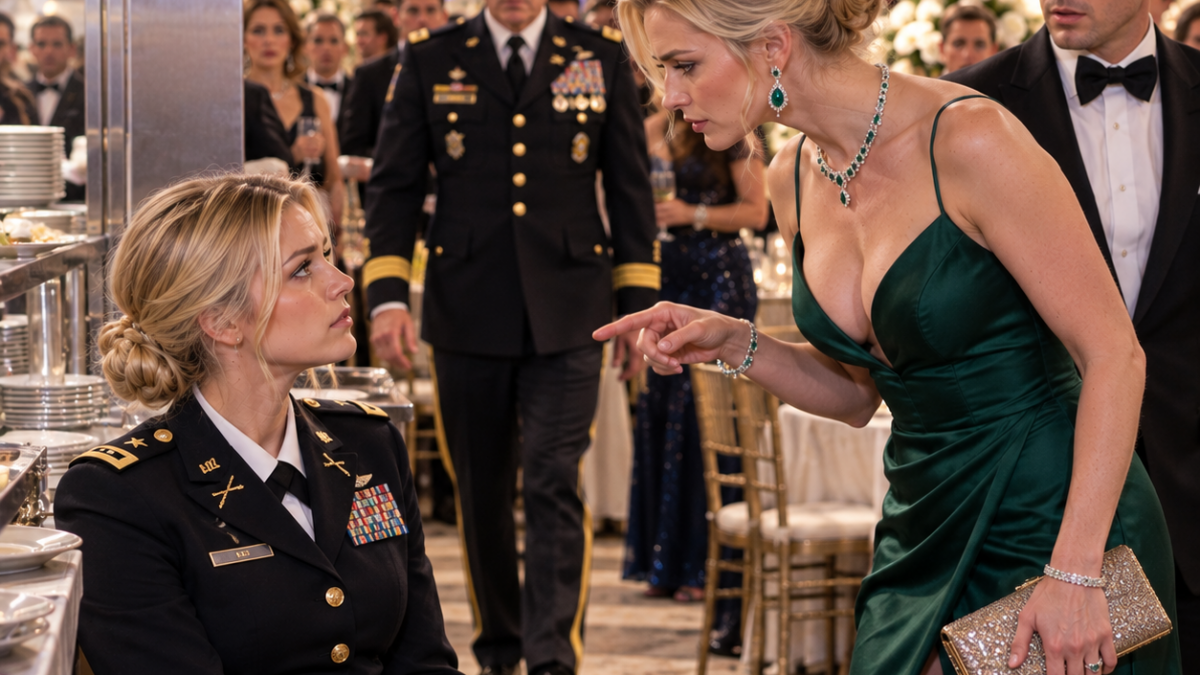
part2
General Harrison was seventy-four, silver-haired, wearing a black tuxedo with miniature medals aligned over his chest. He moved slowly, but command followed him into the room like weather. Mark practically launched himself across the ballroom. “General Harrison.” He reached him before Victoria did and extended his hand. “Sir, what an incredible honor.” Harrison gave him a polite nod. Victoria joined them. “Granddad, this is Mark.” My brother smiled like his entire future depended on the next five seconds. Maybe it did. “I’ve heard so much about your legacy, sir.” Harrison nodded again.
Then his eyes moved past Mark.
Past Victoria.
Across the ballroom.
It was the environmental scan of a man who had spent decades entering rooms without assuming anything.
His gaze reached my corner.
Stopped.
His expression changed.
Not dramatically.
That was never his style.
But I saw recognition.
A waiter passed with champagne. Harrison absently lifted a flute from the tray without taking his eyes off me.
Then his fingers opened.
The glass shattered across the marble.
The quartet stopped.
Every conversation died.
Mark stared at the broken crystal.
Victoria stared at her grandfather.
General Harrison started walking toward me.
Mark hurried after him. “General, sir, the head table is this way.”
No response.
“Sir?”
Harrison kept walking.
Mark looked toward me.
Panic entered his face.
“Those are just overflow seats,” he said quickly. “Staff, vendors, distant acquaintances.”
General Harrison stopped.
He turned toward my brother.
“Staff?”
Mark swallowed. “Yes, sir. Nothing you need to concern yourself with.”
The general’s voice became very quiet.
“Son, I suggest you stop talking.”
Then he crossed the final distance.
I stood.
We looked at each other for one second.
His heels came together.
His right hand rose.
A retired four-star general saluted me in the middle of my brother’s engagement dinner.
“Major Stratton.”
Nobody breathed.
“It is very good to see you again.”
I returned the salute.
“General.”
Behind him, Mark had gone completely white.
Harrison lowered his hand and looked at the folding chair, the water pitcher, the spare napkins, and the kitchen doors. Then he looked at Mark.
“Why is Major Stratton sitting here?”
Mark opened his mouth.
Nothing useful came out.
Victoria stepped forward. “Major?”
Her eyes moved from me to Mark.
“You told me she worked some small government job.”
Mark rubbed the back of his neck. “It’s complicated.”
General Harrison looked at him the way senior officers look at a catastrophically stupid report.
“No,” he said. “It is not.”
Then he faced the room.
“Four years ago, my youngest grandson Lucas was serving as a lieutenant during a joint operation overseas.”
Victoria went still.
Everyone in their family knew that story.
They just didn’t know my part.
“A reconnaissance element was cut off after an ambush,” Harrison continued. “Nine Americans were trapped beyond their planned extraction route.”
I remembered the radio traffic.
Dust.
Coordinates.
Drone feed dropping in and out.
A young lieutenant working very hard not to sound afraid.
“We had aircraft available,” Harrison said, “but authorization stalled between commands.”
He looked at me.
“Major Stratton refused to let procedure become an obituary.”
I hated when people described it that way.
I had done my job.
Nothing more.
The general apparently disagreed.
“She coordinated surveillance, redirected assets, and stayed on the network for fourteen hours until every soldier came home.”
Victoria covered her mouth.
Mark stared at me as if I had secretly learned another language.
Harrison’s voice carried across the ballroom.
“My grandson is alive because Major Stratton knew exactly when rules mattered and when lives mattered more.”
Then he looked at my table.
“And somebody seated her beside a kitchen door.”
That was when Mark’s evening truly started burning.
“Who is she?” Victoria asked.
Not me.
Mark.
He tried smiling.
Bad move.
“Victoria, babe, can we discuss this privately?”
Her expression changed at babe.
“Who. Is. She?”
Mark glanced around.
Every person who mattered to him was watching.
The photographer had lowered his camera.
Even the bartenders had stopped pretending not to listen.
For one second, Mark looked twelve again.
Then pride won.
“She’s my sister.”
Victoria stepped backward.
“Your sister.”
“My older sister.”
Her father, Robert Caldwell, slowly put his whiskey down. “You told us your immediate family was deceased.”
“My parents are.”
“That is not what I said.”
Mark’s voice rose. “I didn’t lie. I simplified.”
I almost admired the sentence.
Terrible.
Efficient.
Victoria stared at him. “You made me send wedding paperwork listing you as having no living siblings.”
Mark’s eyes flicked toward me.
“Because it was easier.”
“Easier for who?”
He had no answer.
Robert stepped closer. The warmth he had shown Mark earlier had disappeared.
“My firm was preparing a three-million-dollar investment in your company.”
Mark stiffened. “Robert, that’s business. This has nothing to do with—”
“It has everything to do with business.”
Robert pulled out his phone.
“You represented yourself to my partners as entirely self-funded.”
Mark swallowed.
I stayed silent.
Robert looked at me.
“Major, did you ever financially support his company?”
Mark moved quickly.
“Isabelle, don’t.”
Wrong choice of words.
Every eye returned to me.
I could have humiliated him.
I didn’t need to.
“I lent him forty thousand dollars.”
Robert’s expression hardened.
Mark whispered my name like a warning.
I continued.
“And I paid most of his living expenses through college.”
Victoria stared. “You told me you worked three jobs.”
“He did.”
Mark relaxed slightly.
I added, “For about six weeks.”
Someone near the bar coughed into a napkin.
It sounded suspiciously like laughter.
Mark looked ready to explode.
Victoria pulled out her phone.
“I want to show you something.”
She opened a text thread.
His messages.
About me.
One sat clearly on the screen.
My sister’s technically Army, but nothing impressive. Mostly administrative. She gets weird about family attention.
General Harrison read it.
His jaw shifted.
That tiny movement frightened Mark more than shouting would have.
Mark immediately said, “That’s out of context.”
Victoria laughed once.
No humor.
“You told the planner Isabelle should be seated with staff.”
“I was trying to avoid awkwardness.”
The coordinator near the wall suddenly looked interested in disappearing.
General Harrison noticed.
“You.”
The man stopped.
“Yes, sir?”
“Did Mr. Stratton instruct you to place Major Stratton at this table?”
The coordinator glanced at Mark.
Mark gave him a look that screamed Don’t you dare.
Unfortunately for Mark, the coordinator worked for Victoria’s family.
“Yes.”
Mark’s shoulders dropped.
“He specifically requested the auxiliary table beside the service corridor.”
Victoria closed her eyes.
Mark stepped forward.
“Okay. Fine. I didn’t want military talk dominating my engagement.”
I looked at him.
“You could have asked me not to discuss work.”
“You wouldn’t understand.”
That actually surprised me.
“Try me.”
His face reddened.
“You walk into a room and people respect you immediately.”
There it was.
The real problem.
Not my uniform.
Not the Army.
Not Victoria’s family.
Me.
“You have medals. Rank. Stories. People listen when you speak.”
He gestured toward General Harrison.
“Look at this. One look at you and suddenly I’m invisible.”
I let the sentence sit.
Mark had spent years believing my accomplishments reduced his.
I had spent years making myself smaller so he wouldn’t feel that way.
No more.
Victoria removed her engagement ring.
Mark saw it.
“Victoria.”
She placed it carefully on the nearest table.
That calm movement made it worse.
“You didn’t hide her because she embarrassed you.”
She looked at me.
“You hid her because she exposed you.”
Then she walked toward the exit.
Mark followed.
Robert stepped between them.
“Don’t.”
One word.
Mark stopped.
Suddenly he had no fiancée, no future father-in-law standing beside him, no audience willing to admire him, and nowhere left to hide.
He turned toward Robert.
“Please don’t mix personal issues with the investment.”
Robert stared at him.
“Character becomes a business issue the moment I’m writing checks.”
“That money was already approved.”
“Preliminary approval.”
“We shook hands.”
“We did.”
Robert picked up his whiskey.
“And now I regret using mine.”
Mark looked physically ill.
The investment had been his lifeline.
His logistics software company had decent technology and terrible cash flow. I knew because fourteen months earlier, Mark had asked me for another loan.
I said no.
He didn’t speak to me for three months.
Now Robert took out his phone.
“Tomorrow morning, my legal team will formally withdraw.”
Mark stepped forward.
“You can’t do that.”
Robert almost smiled.
“Watch me.”
My brother turned toward me.
“This is what you wanted.”
I blinked.
Some accusations become funny because they are so detached from reality.
“I sat exactly where you told me to sit.”
“You knew Harrison.”
“I served under one of his joint commands years ago.”
“You should have warned me.”
That one landed differently.
Not because it hurt.
Because Mark genuinely believed it.
He thought I had an obligation to warn him that humiliating his sister might have consequences.
I pulled out my phone and opened our texts.
His instructions sat on the screen.
NO UNIFORM.
NO SERVICE TALK.
DO NOT TELL THEM YOU’RE MY SISTER.
I turned it toward him.
“You gave me instructions.”
His lips tightened.
“I followed every one.”
Nobody spoke.
A distant police siren passed somewhere beyond the country-club grounds.
Inside, the only sound came from the kitchen doors swinging behind me.
People who had congratulated Mark all evening now avoided his eyes.
Victoria had removed the ring.
Robert had withdrawn the investment.
General Harrison looked disgusted.
I hadn’t raised my voice once.
That bothered Mark more than anything.
Harrison stepped beside me. “Major Stratton, you’re joining us at the head table.”
I shook my head.
“Thank you, sir.”
“You’re declining?”
“Yes.”
He studied me.
I looked at Mark.
“My reason for coming tonight was family.”
Mark flinched.
“That situation has been clarified.”
I picked up my purse.
I almost made it to the lobby before Robert caught up.
“Major.”
I stopped.
General Harrison was beside him.
Robert looked uncomfortable. “May I ask one business question?”
“Sure.”
He opened Mark’s investment presentation on his phone.
A page appeared labeled FOUNDER ASSETS.
My stomach tightened.
There was our childhood home in Ohio.
White siding.
Green shutters.
The cracked driveway Dad always promised to replace.
Below it:
FOUNDER-OWNED REAL ESTATE — ESTIMATED EQUITY $310,000.
I stared at Robert.
“That house belongs to me.”
His eyebrows lifted.
“Entirely?”
“Yes.”
After probate, Mark had sold his share to me when I refinanced the mortgage. I paid him cash for his interest. My name was the only one on the deed.
Mark had followed us.
He heard everything.
“Seriously?”
He looked at me as if I had betrayed him again.
“That slide is just collateral presentation.”
“It says founder-owned.”
“It’s basically family property.”
“No.”
I held his gaze.
“It’s my property.”
He scoffed. “I grew up there.”
“So did I.”
General Harrison folded his arms.
Mark looked at Robert.
“This is ridiculous.”
Robert said nothing.
I did.
“You sold your interest eight years ago.”
Mark lowered his voice.
“I was twenty-three.”
“And you accepted the check.”
He stared at me.
“That money paid for my MBA.”
“I know.”
Because I wrote it.
Robert closed the presentation.
“This moves beyond family drama.”
Mark’s anger vanished.
“Robert.”
“If your investor materials knowingly contain false ownership representations, my counsel will review everything.”
“It was a mistake.”
“Then hope it’s the only one.”
For the first time that evening, Mark wasn’t arrogant.
He was scared.
My phone buzzed.
A message from my lawyer in Ohio.
Funny timing.
The bank had contacted her that afternoon.
Someone had recently requested verification of the home’s equity.
Someone named Mark Stratton.
I turned the screen off.
He didn’t need to know yet.
But he would.
I left the country club alone.
No escort.
No dramatic exit.
Just rain, wet pavement, and the valet looking deeply uncomfortable when he handed me my keys.
I sat in my car for almost a minute without starting it.
That surprised me.
I had spent years operating in environments where people made decisions under fire. I could usually compartmentalize emotion until later.
But Mark was different.
Enemy fire is simple.
Family betrayal is not.
I remembered him at seven years old following me through the woods behind our parents’ house.
At twelve asking me to help build a model rocket.
At seventeen calling after his first breakup.
At twenty-one crying at Mom’s funeral.
I had spent years treating him partly like a brother and partly like someone I was still responsible for.
Maybe that was the mistake.
After Mom and Dad died, I had stepped into the gap so quickly that neither of us noticed when support became expectation.
Pay the tax.
Cover the mortgage.
Send groceries.
Fix the car.
Fund the bridge loan.
Say nothing.
Ask for nothing back.
I thought that was love.
Maybe part of it was.
Maybe part of it was fear that if I stopped being useful, there would be nothing left connecting us.
That thought sat with me all the way home.
Sunday morning, Mark showed up at my townhouse outside Alexandria.
He parked crooked across the driveway and pounded on the door hard enough to wake the neighbors.
I was drinking black coffee in the kitchen beside a half-eaten breakfast sandwich and a stack of briefing papers.
I checked the camera.
Mark.
Of course.
I opened the door but kept the storm door locked.
“You’re going to call Robert.”
No hello.
Consistent.
“No.”
“Isabelle, my board is panicking.”
“I’m sorry to hear that.”
“The Caldwells pulled the investment.”
“I heard.”
“Two other investors followed them.”
I took another sip.
Mark stared at me.
“You could fix this.”
“How?”
“Tell Harrison everything was a misunderstanding.”
“It wasn’t.”
“Tell Robert the house slide was an administrative error.”
“Was it?”
He looked away.
There was my answer.
I leaned against the frame.
“The bank contacted my lawyer.”
His eyes snapped back.
“What?”
“You requested an equity statement on my house.”
“I was exploring options.”
“With property you don’t own.”
“I wasn’t going to actually do anything.”
“That sentence has never improved a legal situation.”
His face twisted.
“After everything I’ve been through, you’re threatening me?”
I almost smiled.
“Mark, I spent ten years cleaning up after you.”
He stepped closer to the glass.
“You think because you wore a uniform and got medals you’re better than me?”
“No.”
“Bullshit.”
“I think your choices belong to you.”
He laughed bitterly.
“Victoria won’t answer my calls.”
I said nothing.
“My board suspended me.”
Still nothing.
“Robert told people I misrepresented financial assets.”
“He told the board?”
“My partner did.”
That made sense.
Robert’s counsel had probably contacted the company during due diligence.
Mark dragged both hands through his hair.
“You’re my sister.”
Finally.
The word he had been ashamed to use three nights earlier.
“You didn’t want a sister Friday.”
His face collapsed for half a second.
Then anger returned.
“You owe me.”
That was when I unlocked the storm door.
Not to let him in.
To hand him an envelope.
He stared at it.
“What’s this?”
“My attorney’s letter.”
His face drained.
It stated clearly that he had no ownership interest in the Ohio property and no authority to use it in financing materials. It demanded that all references be corrected immediately.
Mark read it twice.
“You got a lawyer involved?”
“No.”
I picked up my coffee.
“You did.”
Then I closed the door.
The camera recorded him standing there for forty-seven seconds.
For once, he had nothing to say.
His board suspended him from daily management pending an internal review. I knew only because his business partner contacted my attorney to confirm ownership records. I answered exactly what was asked and nothing more. No revenge narrative. No warnings about Mark’s character. Documents were enough.
The house belonged to me.
Mark had represented it otherwise.
The board could decide what that meant.
That was a lesson I had learned in the Army.
Good investigations require clean lanes.
Personal anger muddies evidence.
I was angry.
So I stayed out.
Victoria sent me one message two weeks later.
I’m sorry for how I treated you that night.
I read it twice.
Then another appeared.
I believed what Mark told me. But I still chose to speak to you like you were beneath me.
That was better.
I replied:
Thank you.
Nothing else.
We did not become friends.
We didn’t need to.
Apologies do not require immediate intimacy.
General Harrison called once.
“Major.”
“General.”
“You okay?”
The question almost made me laugh because it sounded so unlike him.
“Yes, sir.”
“Good.”
Pause.
Then: “You know you should’ve told me you were related to that fool.”
I smiled.
“My brother instructed me not to discuss family.”
Harrison grunted.
“Following orders suddenly?”
“Selective growth.”
That earned a laugh.
Then he became serious.
“Lucas would like to see you.”
My chest tightened slightly.
“I don’t need thanks.”
“I know.”
“He doesn’t owe me anything.”
“I know.”
“Then why?”
“Because sometimes the living need to see the people attached to their memories.”
That sentence stayed with me.
I agreed.
Months later, General Harrison’s military family foundation held a small ceremony honoring people involved in battlefield intelligence and medical evacuation work.
I tried to decline.
He ignored me.
“Major, I’m retired. I finally have enough free time to annoy people properly.”
So I went.
Dress uniform this time.
Not for Mark.
For myself.
The event took place in a modest Army museum auditorium. Folding chairs. Paper cups of coffee. Veterans arguing beside a display case. American flags behind the podium.
No champagne tower.
No country club.
No people measuring one another through cuff links.
Lucas Harrison found me before the ceremony.
Twenty-six.
Captain now.
Still the same voice I remembered over a terrible radio frequency.
“Ma’am.”
Then he hugged me.
Military protocol suffered briefly.
I allowed it.
When he stepped back, his eyes were wet.
“I remember your voice.”
I swallowed.
“Sorry about that.”
He laughed.
“No. I mean—I remember everything going wrong, then somebody coming on the net who sounded like nothing could go wrong anymore.”
That wasn’t how I remembered it.
I remembered being terrified of getting nine people killed.
“Sounded better than I felt.”
Lucas nodded.
“Good to know.”
We stood quietly for a moment.
Then he said, “Thank you.”
I had received awards before.
Medals.
Commendations.
Letters.
Nothing felt like those two words from him.
“Glad you made it home.”
That was all I could say.
Victoria attended too.
She approached during the reception afterward.
No emerald gown.
No diamonds.
Just a dark blue dress and an expression that looked genuinely uncomfortable.
“I owe you an apology in person.”
“You already sent one.”
“I know.”
She looked down.
“I still want to say it.”
So I let her.
“I treated you badly because I believed Mark’s story, but the truth is I also liked believing it. It made me feel superior.”
That was honest.
Rare.
“I appreciate you saying that.”
She exhaled.
“Granddad says I inherited the family talent for judging rooms too fast.”
“Harrison says things politely now?”
“No.”
We both laughed.
That was probably as close to friendship as we would ever get.
It was enough.
Mark’s company survived.
Mark did not survive as CEO.
His board negotiated his departure after investors discovered several exaggerated claims in fundraising materials. Nothing dramatic enough for criminal court. Nothing cinematic. Just enough misrepresentation for people to stop trusting him with money.
The Caldwell investment vanished.
Two other investors withdrew.
His partner restructured the company.
Mark moved to Dallas and took a sales position.
For several months, we didn’t speak.
Relatives occasionally asked whether I regretted that.
Usually people who believed blood relationships required endless access no matter the behavior.
I never gave them the answer they wanted.
Blood means history.
It does not mean immunity.
Six months after the engagement dinner, I stopped at a roadside diner off I-95 after the Harrison foundation ceremony.
Traffic had been miserable.
Naturally.
I sat at the counter in civilian clothes because my uniform hung in a garment bag in the back seat. The waitress poured coffee into a chipped white mug. Baseball highlights played silently on the television. A teenager in a graduation hoodie argued with his father about college applications two booths away.
Normal life.
Beautifully normal.
My phone buzzed.
Mark.
I hadn’t blocked him.
Maybe some part of me still wanted proof he would understand eventually.
His message read:
I know you probably hate me. I’m sorry for what I did.
I stared at it.
Then another arrived.
I was jealous of you for years. Every time someone asked about my family, I felt like your life made mine look smaller.
There it was.
Not perfect.
But true.
I typed three words.
I don’t hate you.
Then I stopped.
Deleted them.
Not because they were false.
Because his apology did not require immediate access to me.
Forgiveness and permission are different things.
I set the phone facedown.
The waitress slid a slice of apple pie toward me.
“Kitchen’s closing. This one’s on me.”
I smiled.
“Thanks.”
Outside, trucks moved through the dark highway.
A police cruiser passed beneath the diner’s neon sign.
My uniform hung in the car.
My medals were inside.
Not displayed.
Not hidden.
Just mine.
For years, I had confused love with making myself smaller.
Pay the bill.
Send the money.
Skip recognition.
Change the subject.
Let Mark feel important.
That night at Belmont ended the habit.
Not because General Harrison saluted me.
Not because Victoria left.
Not because Robert pulled the investment.
Because Mark finally said the thing underneath everything.
One look at you and suddenly I’m invisible.
I had spent years solving that problem for him.
I stopped.
That changed everything.
Several weeks after his apology, Mark mailed me a letter.
Actual paper.
That alone told me he had thought about it.
The first line read:
You were more of a parent to me after Mom and Dad died than I ever admitted.
I put the letter down.
Read it again later.
He wrote about college. The mortgage. The transmission. The forty-thousand-dollar loan. The house.
Then:
I turned every thing you gave me into proof that I didn’t need you.
That was harder to read.
Because it was true.
He said he had built his company around the story that he was entirely self-made because investors loved it, Victoria admired it, and eventually he believed it too.
Then:
Every time you showed up, the story felt weaker.
So I made you smaller.
I sat at my kitchen table for a long time after reading that.
No anger.
No satisfaction.
Mostly grief.
Not just for what Mark had done.
For the years we had both lost.
I did not answer immediately.
Three months later, Dad’s old house developed a roof leak.
My house.
Technically.
But still Dad’s in my head.
I drove to Ohio for the weekend and spent Saturday meeting contractors. The kitchen smelled the same. The old oak table still carried knife marks from our childhood. On one wall hung a pencil mark showing Mark’s height at age nine.
I stood there looking at it.
He had always been my little brother before he became the man who hid me beside a kitchen.
That did not excuse him.
It complicated him.
I called him that evening.
He answered on the second ring.
“Isabelle?”
“You wrote me.”
Silence.
“Yeah.”
“I read it.”
“I figured.”
Another silence.
“I don’t hate you.”
He exhaled.
I could hear traffic through his phone.
“That’s more than I deserve.”
“Don’t do that.”
“What?”
“Turn shame into another performance.”
He went quiet.
Then: “Okay.”
“I’m still angry.”
“I know.”
“I don’t trust you.”
“I know.”
“You don’t get access to my finances, property, or professional life.”
“Understood.”
I looked around the old kitchen.
“But I’m willing to talk.”
The silence on his end lasted long enough that I wondered whether the call had dropped.
Then he said, “Thank you.”
We spoke for twenty-two minutes.
Nothing dramatic.
Dallas weather.
His new job.
The roof.
Mom’s old recipe drawer.
Ordinary things.
That was the beginning.
Not reconciliation.
A beginning.
Trust rebuilt the way buildings do.
Slowly.
Visible structure first.
Mark sent monthly payments toward the forty-thousand-dollar loan.
I had stopped expecting that money years earlier.
He insisted.
The first payment was small.
Five hundred dollars.
I almost returned it.
Then I realized returning it would protect him again.
So I kept it.
Accountability sometimes looks like allowing someone to repay what they owe.
He corrected every reference to the Ohio property in old presentations, even after leaving the company. His attorney sent mine confirmation.
He stopped telling people he was self-made.
The first time I saw evidence of that came indirectly. An old college friend of his called me.
“Mark told me you basically kept him afloat after your parents died.”
I didn’t know what to say.
“So?”
“Nothing. I just thought you’d want to know.”
I did.
More than I expected.
Not because I needed credit.
Because truth was beginning to cost Mark less than pretending.
That mattered.
Victoria moved on.
I saw her once a year later at another Harrison foundation event. She was dating nobody, according to her grandfather, which he announced with absolutely no respect for her privacy.
“Granddad.”
“What?”
She looked mortified.
I laughed.
Harrison looked pleased with himself.
Lucas had promoted again.
Robert Caldwell never invested in Mark’s former company, but he did ask me once whether I thought Mark had changed.
“That’s not my decision to make.”
Robert nodded.
“Fair.”
Then he surprised me.
“I almost liked him.”
“I know.”
“I was angry because I thought he fooled me.”
“He fooled himself first.”
Robert considered that.
“Maybe.”
People rarely think of lies that way.
But the most durable ones are often built inward first.
Mark needed to believe he had built everything alone before he could sell that story convincingly.
He needed to believe my help did not count.
My career did not count.
My ownership of the house was “family property.”
My service was “administrative.”
I was not exactly a sister.
Each lie made the next one easier.
By the time Victoria met him, he was not merely deceiving her.
He was living inside an identity that required constant maintenance.
I threatened it simply by existing.
That was why the kitchen table mattered.
That was why the seat beside the service corridor mattered.
He needed me physically present enough to satisfy whatever guilt brought me there, but socially invisible enough not to challenge the story.
I understood that months later.
Understanding did not erase the harm.
It made it comprehensible.
There is relief in comprehension.
One spring morning, General Harrison called unexpectedly.
“Major.”
“Sir.”
“You busy?”
“Yes.”
“Good. I need a favor.”
“That is not how favors work.”
“It is when you outrank people for forty years.”
“You’re retired.”
“I reject your technicality.”
I laughed.
He wanted me to speak to a group of junior officers about operational judgment.
I almost declined.
Then I thought about Lucas.
I went.
During questions, a lieutenant asked how to know when procedure should bend.
That was a dangerous question.
I answered carefully.
“Procedure exists because people before you already discovered many ways things can go wrong. Do not treat rules as obstacles just because you want to feel decisive.”
Pens moved.
“But judgment exists because no procedure can predict every situation.”
More pens.
“The key is whether you are willing to accept responsibility afterward. If your plan only works if someone else takes the blame, you’re not exercising judgment. You’re exercising ego.”
That sentence made me think of Mark.
It also made me think of myself.
I had spent years assuming that helping him was automatically virtuous.
It wasn’t.
Sometimes helping people avoid consequences teaches them that consequences belong to somebody else.
I had done that too often.
Mark needed money.
I solved it.
Mark needed property taxes covered.
I solved it.
Mark needed an investor bridge.
I solved it.
Then I resented him for acting as though he had solved everything alone.
My generosity had been real.
So had my failure to establish boundaries.
Both truths could coexist.
That realization made our rebuilding healthier.
When Mark asked for advice about a new job offer, I answered.
When he asked for money to move apartments, I said no.
He accepted it.
No guilt.
No silence afterward.
That was growth.
A year after Belmont, Mark visited Ohio while I was working on the house. He pulled into the cracked driveway in a rental car and stood beside it looking nervous.
“You said I could come.”
“I did.”
“Just checking.”
He had learned caution.
Good.
We spent the afternoon clearing old boxes from the attic.
Mom’s Christmas decorations.
Dad’s fishing gear.
Mark’s high-school trophies.
My old military scholarship letter.
He found a stack of canceled checks in a box from probate.
One had my name on it.
Property tax payment.
Another.
Mortgage.
Another.
Transmission transfer.
Mark sat on the attic floor holding them.
“I really erased you.”
I kept sorting.
“Yes.”
“I don’t remember thinking of it that way.”
“Most people don’t think of themselves as villains.”
He looked at me.
“Do you?”
“Sometimes.”
That surprised him.
“When?”
“When I helped you because it made me feel necessary.”
He frowned.
“I’m serious.”
“I know.”
“I think after Mom and Dad died, I was afraid if I stopped fixing things, we’d stop being family.”
Mark looked down at the checks.
“So we both used each other.”
“Different ways.”
He nodded.
That was the kind of conversation we never could have had before Belmont.
No winner.
No loser.
Just two adults looking honestly at a bad system.
We sold Dad’s old pickup that weekend.
Neither of us needed it.
Mark wanted to keep the cracked basketball hoop.
I told him he could have it if he figured out how to transport it to Dallas.
He did.
Of course he did.
Three weeks later, he sent me a photo.
The rusty hoop stood behind his apartment building.
Caption:
FOUNDING ASSET. ESTIMATED VALUE $37.
I laughed hard enough to scare the woman sitting near me at the airport.
Humor was returning.
Not the cruel kind.
The useful kind.
Two years after the engagement dinner, Mark was still in Dallas. Sales turned out to suit him. He was good with people when he wasn’t trying so hard to impress them. He paid back almost half the old company loan.
Victoria married someone else eventually.
Mark called me the evening he found out.
“I’m okay.”
“That usually means you aren’t.”
“I’m mostly okay.”
“Better.”
He sighed.
“I deserved to lose her.”
“Maybe.”
“You don’t sound convinced.”
“I don’t think relationships are court sentences. You lost her because she decided she couldn’t trust you. That’s different.”
He went quiet.
“You always talk like this?”
“Occupational hazard.”
He laughed.
Then said, “I’m happy for her.”
I believed him.
That mattered.
My career moved too.
Promotions came.
New assignments.
I became more visible whether I wanted to or not.
The strange thing was that after Belmont, I became less uncomfortable with visibility.
Not hungry for it.
Just less afraid.
For years, I had hidden accomplishments because I associated recognition with hurting Mark.
That was unhealthy.
His insecurity was not my responsibility.
At a family foundation event, Harrison once introduced me to someone as “the officer who saved my grandson.”
I corrected him.
“One of the officers.”
Harrison sighed.
“You are exhausting.”
“So I’ve heard.”
But I stopped minimizing everything else.
If someone asked my rank, I answered.
If someone asked what I had done, I gave a truthful version appropriate to the room.
No shrinking.
No performance.
Just fact.
That lesson reached beyond family.
At work, I noticed younger women doing the same thing I had.
Softening titles.
Saying “we got lucky” after doing exceptional work.
Letting louder people summarize their contributions.
One captain presented a brilliant logistics plan, then ended with, “It was really just common sense.”
I stopped her.
“No.”
She looked startled.
“Don’t insult your work to make the room comfortable.”
Silence.
Then I realized I sounded like someone I wished I had met twenty years earlier.
She nodded.
“Yes, ma’am.”
Afterward, she thanked me.
That moment meant more than I expected.
Maybe we teach best from the scars we finally understand.
Mark’s lie had exposed one of mine.
I had told myself disappearing was humility.
Sometimes it was fear.
Fear that competence would cost me family.
Eventually I understood that any relationship requiring me to shrink was already costing too much.
Three years after Belmont, Mark invited me to Dallas.
No event.
No investor dinner.
No wealthy girlfriend.
Just dinner.
He cooked.
Badly.
His apartment was smaller than the condo he used to brag about. The furniture was normal. One wall held a photograph of Mom and Dad.
Another held the cracked basketball hoop outside his window.
“You really kept that thing.”
“Founder-owned asset.”
“Shut up.”
We laughed.
After dinner, he handed me an envelope.
Last payment.
Forty thousand dollars, repaid in installments over years.
I looked at the check.
“You didn’t have to finish this now.”
“Yes, I did.”
“Why?”
“Because I spent years pretending help wasn’t help if I could eventually claim the result.”
He sat across from me.
“I needed to finish owing you money before I could figure out what I actually owe you.”
That was a dangerous sentence.
“Mark.”
“I know. Not payable.”
Good.
He had learned.
“I owe you acknowledgment,” he continued. “And I owe you not using guilt to make you stay close.”
I set the check down.
“That’s better.”
He smiled.
“Still grading me?”
“Always.”
He raised his glass.
“To administrative work.”
I raised mine.
“To self-funded entrepreneurs.”
We both laughed.
That night, I slept in his guest room.
The first time we had been under the same roof voluntarily in years.
No great healing moment.
No tears.
Just ordinary trust returning.
Slowly.
General Harrison died the following year.
Seventy-eight.
Peacefully.
Lucas called me.
The funeral was enormous.
Generals.
Politicians.
Soldiers.
Family.
At the reception, Victoria hugged me.
Robert shook my hand.
Lucas spoke about his grandfather’s obsession with responsibility.
Then he told the Belmont story.
Not all of it.
Just the champagne glass.
He said, “Granddad spent his entire life meeting important people. The night he dropped a glass because he saw Major Stratton sitting beside a kitchen door taught me that he never confused seating charts with worth.”
People laughed softly.
I looked down.
That sentence stayed with me.
Seating charts with worth.
Maybe that had been the entire problem.
Mark spent years measuring worth through proximity.
Who sat at the head table.
Who owned the company.
Who knew generals.
Who funded deals.
Who wore expensive clothes.
Who could open doors.
I spent years reacting by pretending none of those symbols mattered at all.
That was another extreme.
Some symbols do matter.
Rank carries responsibility.
Money creates options.
Reputation affects trust.
The mistake is treating symbols as identity.
General Harrison understood that.
Mark learned it.
So did I.
After the funeral, Lucas handed me a small envelope.
“Granddad left this for you.”
Inside was a handwritten note.
Stratton—
You were right to decline my head table.
Still annoyed me.
Keep choosing your own seat.
—Harrison
I laughed in the middle of the parking lot.
That note sits in my desk now.
Not framed.
Just kept.
Mark visited a few months later.
I showed it to him.
He read it twice.
“Keep choosing your own seat.”
“Yep.”
He looked at me.
“I really put you next to the kitchen.”
“You did.”
“I was a complete ass.”
“Yes.”
He nodded.
“Good talk.”
We laughed.
That was forgiveness in its healthiest form for us.
Not pretending the thing never happened.
Being able to name it without letting it control the room.
I never forgot Belmont.
I stopped reliving it.
That distinction took years.
People sometimes ask whether I regret going that night.
No.
Not because Mark got exposed.
Because if I had stayed home, I might have continued making myself smaller indefinitely.
Mark’s humiliation was temporary.
My habit was older.
The salute shattered both.
For him, it exposed the lie.
For me, it exposed how much I had cooperated with being erased.
That was uncomfortable.
Useful.
Pain can be both.
The country club eventually renovated the ballroom.
I know because Victoria sent me a photograph as a joke years later.
The service table beside the kitchen was gone.
Her caption:
Your throne has been removed.
I replied:
Historic site destroyed.
She sent a laughing emoji.
Life is strange.
The woman who once warned me not to wander toward family tables became someone who occasionally sent me sarcastic photos.
Mark became a brother again instead of a liability I managed.
Robert eventually invested in an entirely different company.
Lucas stayed in the Army.
I kept serving.
Not every broken thing needs to return to its original shape.
Sometimes repair creates something better because everyone finally sees the cracks.
One evening, years after the engagement dinner, I sat alone in the Ohio house before finally selling it.
The rooms were nearly empty.
The scratched oak table remained because the buyer didn’t want it and I couldn’t bring myself to throw it away.
Mark had flown in to help close the house.
He stood in the doorway.
“You taking the table?”
“Apparently.”
“Why?”
“History.”
He smiled.
“Bad history?”
“Mixed.”
He ran one hand over the scratches.
“Remember Dad yelling when we carved our initials underneath?”
“I remember you blaming me.”
“I was nine.”
“You were a liar early.”
“Gifted child.”
We laughed.
Then Mark became serious.
“Do you ever wish Mom and Dad had seen us now?”
“Yes.”
“Think they’d be proud?”
I thought about it.
“Probably confused.”
He smiled.
“Accurate.”
We loaded the table into a rental trailer.
The house sold a week later.
The money was mine.
I gave Mark nothing.
He asked for nothing.
That mattered more than the check he eventually repaid.
At my next promotion ceremony, Mark came.
He sat in the second row.
Not hidden.
Not at the head table.
Just family.
When my name was called, he stood with everyone else.
Afterward, he waited until the crowd thinned.
“Congratulations.”
“Thank you.”
“No speech?”
“No.”
“Good.”
Then he handed me a small box.
Inside were the gold cuff links he wore at Belmont.
I stared at him.
“What am I supposed to do with these?”
“Throw them away.”
“You throw them away.”
“I tried.”
“And?”
“They felt cursed.”
I laughed.
“So you gave them to me?”
“Leadership.”
I shook my head.
I eventually mailed them back.
He kept them in a drawer.
Some artifacts deserve witnesses.
Years later, I still think about one detail from Belmont more than the salute.
Mark’s hand on my arm outside.
Whatever happens tonight, do not tell them you’re my sister.
At the time, I heard shame.
Now I hear fear.
He was terrified that if powerful people saw the person who helped build him, they would understand he had not built himself alone.
That fear made him cruel.
Understanding it does not excuse it.
But it taught me something I carried into command.
People often behave worst around truths they think will make them smaller.
Good leadership does not exploit that fear.
Good families should not either.
You create room where truth does not reduce anyone’s worth.
Mark eventually learned that my accomplishments did not erase his.
I learned his success did not become less legitimate because he had received help.
Everyone receives help.
Some people are simply more honest about it.
That may be the difference between gratitude and entitlement.
On the anniversary of Harrison’s death, Lucas sent me a photograph.
General Harrison in his tuxedo at Belmont.
Someone had captured the moment right before he saw me.
Mark stood in front of him, smiling, hand extended.
I was a blur in the background beside the kitchen.
Lucas wrote:
Granddad always said this picture contained two completely different stories depending on where you looked.
He was right.
Foreground:
Mark becoming somebody.
Background:
The person he had hidden to make the story work.
I saved the photograph.
Not because I needed proof anymore.
Because perspective interests me.
Move your eyes six feet and the whole narrative changes.
Mark had spent years controlling where people looked.
I spent years staying in the background.
General Harrison simply noticed the whole room.
Maybe that is what experience gives you.
A wider field of view.
These days, when young officers ask me what leadership means, I rarely talk first about missions.
I tell them to notice who is seated near the kitchen.
Who gets interrupted.
Who gets described instead of asked.
Who is carrying the work while someone else narrates success.
Power has patterns.
So does insecurity.
If you learn to see both, you make fewer stupid decisions.
Sometimes I tell the Belmont story.
Not Mark’s name.
Not Victoria’s.
Just the lesson.
A man hid someone important because her existence threatened the story he was selling.
A senior leader recognized her.
The lie collapsed.
Then I ask:
“What actually caused the collapse?”
Most students say the salute.
Wrong.
The lie caused it.
The salute only introduced reality.
That distinction matters.
Reality is not revenge.
Consequences are not ambushes when they come from facts you already knew.
Mark learned that painfully.
I did too.
My brother once believed he had to become bigger by hiding the people who helped him stand.
I once believed loving him meant letting him.
Both ideas were wrong.
We got better.
Not perfectly.
Not quickly.
But honestly.
That is more than many families manage.
The last time Mark visited, we sat at Dad’s old oak table in my Virginia townhouse.
Yes, I kept it.
There were new scratches now.
My coffee mug sat near one edge.
Mark’s laptop near the other.
He was helping me compare roof estimates.
At one point he looked around.
“Your place is nicer than I remember.”
“You’ve been here four times.”
“I was emotionally unavailable.”
“Apparently.”
He laughed.
Then he looked at the old table.
“You know, if I ever start another company—”
“No.”
“I wasn’t going to ask for money.”
“No.”
“I was going to say I’ll put this table in the founder story.”
“No.”
He grinned.
I did too.
Normal sibling nonsense.
For years, I thought reconciliation would require some grand moment where Mark fully understood my pain.
It didn’t.
He understood enough.
Then he behaved differently.
That mattered more.
Words establish awareness.
Behavior establishes change.
I trusted behavior.
When Mark left that evening, he hugged me at the door.
No awkwardness.
No shame.
No attempt to explain me to anyone.
Just: “Love you.”
“Love you too.”
He drove away.
I went back inside.
The old oak table stood in the kitchen.
Harrison’s note sat in my desk.
My medals hung in a closet.
Nothing displayed for proof.
Nothing hidden from shame.
Just mine.
That balance took me most of my adult life.
The engagement dinner once felt like the night Mark’s perfect life collapsed.
Now I think of it differently.
It was the night both of us lost stories we needed to lose.
Mark lost the story that he built himself from nothing.
I lost the story that loving family required becoming invisible.
His loss cost him a fiancée, investors, a title, and years of repair.
Mine cost me a habit.
I got the better deal.
But both of us came out more honest.
And whenever I remember General Harrison crossing that ballroom, I no longer focus on the four stars, the salute, or Mark’s face.
I remember what Harrison saw before anyone else did.
A woman seated beside the kitchen.
A room arranged to communicate status.
A story that didn’t make sense.
He simply looked closer.
That was all truth needed.
Mark spent years trying to become somebody important.
I spent years pretending importance meant nothing.
We were both wrong.
Worth is not the head table.
It is not the kitchen table either.
It is what remains when nobody needs a seating chart to know who you are.
And these days, wherever I walk into a room, I choose my own seat.