The Five Bikers Who Cornered My Mother Thought Fear Would Make Her Sell, but They Had No Idea Who Had Been Watching the Shoreline With Them
part2
Deputy Lena Carver walked through the front door less than a minute later with two additional units pulling in behind her.
Ray Danner’s expression changed from anger to calculation.
That was another useful thing about men who believed fear should solve everything. Once fear stopped working, they started calculating exits.
Lena removed a folded warrant from her uniform pocket.
“Raymond Danner.”
He stared at her.
“You’re under arrest on an outstanding warrant issued this morning in connection with two extortion complaints in Etowah County.”
Two riders shifted immediately.
Wrong move.
The deputies positioned themselves.
The youngest man raised both hands.
“I don’t want trouble.”
Ray looked at him.
The kid swallowed.
“My name’s Jesse Cole. I don’t want trouble.”
Lena glanced at one deputy.
“Keep your hands where we can see them.”
Two riders had unrelated warrants.
The fifth had no active warrant but suddenly developed a powerful interest in saying nothing.
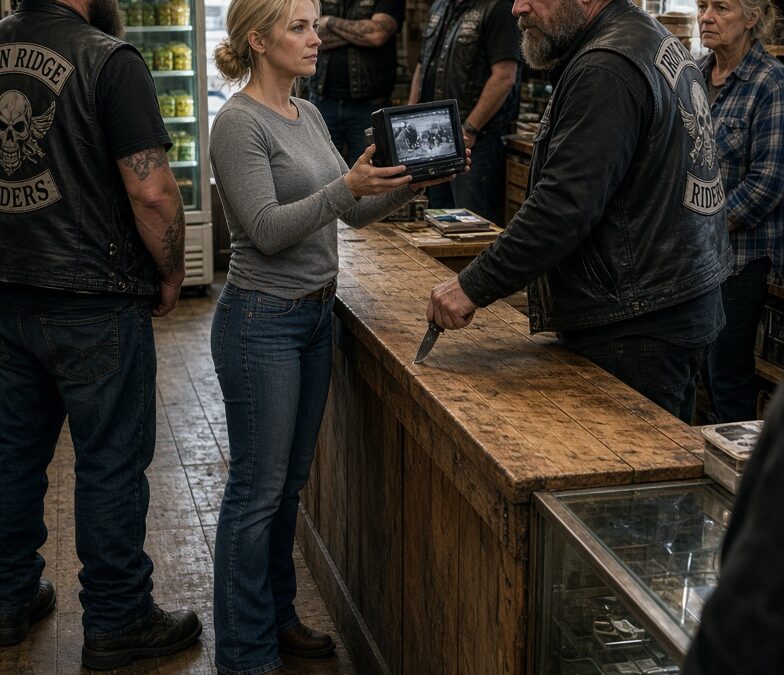
Ray barely spoke after Lena took the knife, demand note, and their identifying information.
By five o’clock, the parking lot was quiet again.
Mom made coffee.
Of course she did.
Some people process danger by shaking.
My mother made coffee strong enough to dissolve metal.
I helped Lena document the camera files.
We created duplicate copies.
Logged times.
Photographed the handwritten demand.
Photographed the knife in place before moving it.
Mom kept wiping the counter around us.
“You know,” Lena said, “you can stop cleaning the crime scene now.”
Mom looked at her.
“The fingerprints are already photographed.”
“Elaine.”
“I’m not living with dried biker sweat on my counter.”
Lena gave up.
I almost laughed.
For a little while, the entire event felt absurdly finished.
Five men walked in.
Made a criminal demand.
Got caught.
Simple.
I should have known better.
Simple rarely stays simple once people start comparing records.
I crouched near a spinner-bait display where one rider had been standing.
Something white showed beneath the metal base.
I reached toward it.
Lena stopped me.
“Don’t touch.”
I froze.
She photographed the object where it lay.
Then pulled on gloves and slid it free.
Folded paper.
County parcel map.
North shoreline.
Our property had been circled in red.
Whitaker Lake Supply.
The adjacent rear strip.
The road.
Three neighboring parcels.
Beside our lot someone had written:
ACQUIRE BEFORE OCTOBER 15.
I looked at Mom.
The courage she had shown while Ray Danner pointed a knife at her disappeared.
Not into fear.
Into recognition.
That bothered me more.
“You’ve seen something like this.”
She stared at the map.
Long breath.
Set her coffee down.
“Your cousin Wade brought me one in June.”
I straightened.
“What?”
“Not that exact one.”
“Wade Mercer?”
She gave me a tired look.
“You don’t have another cousin Wade.”
Wade was Dad’s sister Susan’s son.
Forty-two.
Polished.
The kind of man who could wear work boots to a planning meeting and a linen jacket to a marina opening without looking uncomfortable in either.
He owned Red Pine Development.
For three years, Red Pine had been buying lakefront property around Marshall County.
Mom had never told me how often he approached her.
First offer:
Nine months after Dad died.
Framed as kindness.
Elaine was a widow.
The shop was old.
Maintenance was difficult.
Why not sell while prices were strong?
Second offer:
Glossy renderings.
Townhomes.
Marina.
Restaurants.
Landscaped boardwalk.
North Shore Landing.
Mom refused.
Then Aunt Susan started calling.
Every few weeks.
“You’re holding everyone back over sentiment.”
“You should think about your future.”
“Daniel would have wanted you comfortable.”
Dad’s name became leverage after death.
I felt anger climb.
Mom saw it.
“That is why I didn’t tell you.”
“Because I’d be angry?”
“Because your father was gone a year. Susan was still family. Wade was family. I didn’t want every disagreement becoming war.”
I looked at the red circle.
“Somebody else already turned it into one.”
Monday morning, I met Lena at the sheriff’s investigative office.
Fluorescent lights.
Bad coffee.
Too many beige walls.
Jesse Cole had decided to cooperate.
Lena warned me his information was incomplete.
Good warning.
Cooperators are not automatically reliable because their story helps you.
Jesse said Ray’s crew had been visiting businesses around the lake for months.
Some paid.
Some refused.
Some got threatened.
Ray did not describe himself as the boss.
Twice a month, cash went to somebody Jesse knew only as Hale.
“First name?”
“Didn’t know.”
“Vehicle?”
Dark SUV.
Jesse had seen a Red Pine Development sign in the cargo area once.
That mattered.
Not proof.
A connection.
Then Jesse said something worse.
Owners who refused payments sometimes received purchase offers afterward.
Ray joked scared people became “realistic” about property values.
He used another phrase.
Problem parcels.
Jesse had asked once what that meant.
Ray told him:
“Properties that don’t understand they’re already sold.”
Lena did not look at me when Jesse repeated it.
Good.
This was her interview.
Not my case.
I went home.
Stayed instead of returning to Huntsville.
Mom and I spent the afternoon in Dad’s old office above the shop.
It still smelled faintly of pipe tobacco despite him quitting years before his death.
Mom had avoided some drawers.
Dad’s handwriting on labels made opening them feel like disturbing him.
We pulled files.
Taxes.
Property correspondence.
Insurance.
Survey records.
At 4:40, I found a folder.
NORTH SHORE ACCESS.
Inside:
Three letters from Red Pine Development.
All requested an easement across the rear of Mom’s parcel.
Twenty-two feet wide.
Looked minor.
It would connect the county highway to parcels Wade owned closer to the water.
Dad rejected every request.
The final letter had a pencil note in his handwriting.
Wade won’t take no for an answer. Check family trust documents before signing anything.
“Family trust?”
Mom frowned.
Dad’s parents once owned a much larger shoreline tract.
Most divided among their children.
Old arrangements nobody discussed anymore.
I called Harold Benson.
Dad’s estate attorney.
Quiet man.
Old-fashioned office.
When I mentioned the trust, Harold stopped talking.
Long enough that I checked my phone.
“Harold?”
“I’m here.”
“What is it?”
“I wondered when this would come back.”
That was not comforting.
He asked us to meet him in the morning.
Then added:
“Do not sign anything Wade brings you.”
“I wasn’t planning to.”
“Good.”
“He sent bikers.”
Silence again.
“Not directly. At least not that we can prove.”
Harold exhaled.
“Then perhaps we should have had this conversation earlier.”
That evening, Aunt Susan called.
Mom answered.
Susan was loud enough I heard from across the kitchen.
“I heard about that ridiculous motorcycle incident.”
Mom looked at me.
Susan continued.
“It isn’t safe for you out there anymore.”
Mom said nothing.
“You’re seventy, Elaine.”
Still nothing.
“Nobody wants you hurt.”
Mom’s face changed.
Susan kept going.
“Maybe this is God’s way of telling you it’s time to sell.”
Mom looked directly at me.
Then said:
“Interesting timing.”
Hung up.
Harold Benson’s office sat above a dentist near the courthouse.
He spread an old plat map across the conference table.
My grandparents created a family land trust in 1978.
Purpose:
Protect access between several lake parcels intended for their children.
Most of the trust dissolved over time as property was sold.
One provision remained.
A narrow strip behind Mom’s shop.
It controlled permanent road access to almost forty acres east of us.
Dad’s refusal to grant Red Pine an easement had not simply irritated Wade.
It blocked North Shore Landing’s cheapest road connection.
Without our access, Wade needed:
A longer road.
Steeper terrain.
Additional environmental review.
Two more property purchases.
Harold estimated millions in additional development cost.
Mom leaned back.
“Daniel knew?”
Harold almost smiled.
“Daniel knew every inch of that shoreline.”
Dad sold bait.
Boat batteries.
Rain gear.
Coffee nobody should have consumed voluntarily.
People confused ordinary work with ordinary intelligence.
Dad knew property lines the way other men knew football statistics.
Apparently Wade underestimated him first.
Lena spent the same week interviewing owners.
The arrest had changed the psychology.
Fear isolates.
Arrests compare stories.
Pete Lawson, a marina mechanic, finally made a statement.
Ray’s crew demanded $400 in August.
Pete refused.
Six days later:
Two customer-trailer tires slashed.
Then Wade appeared personally.
Purchase offer.
Comment:
“Running an isolated business gets stressful.”
Another owner:
Kay Monroe.
Paid riders twice.
Her husband undergoing cancer treatment.
She could not risk damage to the store.
She had withdrawal slips hidden in a drawer.
Dates matched Ray’s notebook.
Seven targeted properties fell inside or beside North Shore Landing.
Four owners got Red Pine offers within two weeks of refusing or delaying extortion payments.
One man sold after his storage building was vandalized.
Buyer:
LLC with mailing address at Red Pine’s accounting office.
Pattern.
Dates.
Records.
Wade called Thursday afternoon.
“You’ve been gone a long time, Mara.”
“So?”
“You’re looking at local business through whatever lens the Army gave you.”
“I’m looking at deeds, dates, offers, and criminal complaints.”
He laughed softly.
“You always were dramatic.”
“Those are civilian documents.”
He invited Mom and me to Aunt Susan’s for dinner.
“Adults should settle misunderstandings before lawyers make everything ugly.”
I told Mom no.
She surprised me.
“We’re going.”
“Why?”
“I spent four years avoiding fights because I thought peace was decent.”
She grabbed her purse.
“I’d like to see what peace bought.”
Susan served roast chicken on her best china.
Talked twenty minutes about church, weather, property taxes, cousins.
Anything except bikers.
I waited.
Then:
“Does Red Pine employ somebody named Hale?”
Wade’s fork stopped halfway to his mouth.
Barely.
Then continued.
“We have dozens of consultants.”
“What kind?”
“Property. Planning. Acquisition.”
“Martin Hale?”
He looked at me.
“That name familiar?”
“Should it be?”
“Ray Danner’s crew gave cash to someone called Hale.”
Susan put down her fork.
“Enough.”
I looked at her.
“This is dinner, not an interrogation.”
Wade smiled.
“Aunt Susan is right.”
Mom said:
“My store is apparently part of a criminal investigation. I’m comfortable asking questions.”
Susan turned toward her.
“This is exactly what I was afraid of when Mara came back.”
Mom’s expression did not move.
“When my daughter came back, five men demanding money from me went to jail.”
She took a sip of water.
“So far, I’m pleased with the timing.”
Susan’s face hardened.
She started talking about North Shore Landing.
Jobs.
Tax revenue.
Restaurants.
Housing.
Investment.
Revitalization.
Then:
“You cling to that little shop like it’s a cathedral.”
Mom looked at her.
“I never asked your son to save me from working.”
Wade leaned back.
Friendly mask gone.
“North Shore Landing is happening.”
His voice stayed calm.
“With your property or around it.”
He looked at Mom.
“You could walk away with enough money to never work again.”
Mom answered:
“I like my work.”
Nothing left.
We left before dessert.
At home, I found a voicemail from Lena.
Call me immediately.
I called.
“Martin Hale,” she said. “Freelance property consultant. Worked acquisition projects for Red Pine almost two years.”
I leaned against the counter.
“Anything else?”
“Ray’s phone.”
My stomach tightened.
Message from Hale.
Three days before the visit.
Our address.
Then:
Old lady won’t listen. Encourage reconsideration.
The words were vague.
Wade’s lawyers would later live inside that vagueness.
Encourage.
Reconsideration.
Nobody typed:
Threaten her.
Still, the message linked two systems.
Property acquisition.
Ray Danner.
Mom was not selected because she was old and alone by coincidence.
Somebody involved in acquisition pointed pressure toward her after negotiation failed.
Lena called state investigators.
Cross-county allegations.
Multiple businesses.
Financial links.
Then she told me something I respected.
“Mara, stop investigating.”
“I know.”
“No, you know intellectually. I’m telling you operationally.”
I smiled despite myself.
“Understood.”
“This is my case.”
“Yes.”
“You can preserve your own property. You can give records. You can support Elaine.”
“Yes.”
“You do not interview people. You do not follow Wade. You do not start acting like you’re back in uniform.”
“I’m retired from active command, Lena. Not brain-dead.”
“That is exactly the sentence someone says before doing something stupid.”
She was right.
Experience can become dangerous when it convinces you rules apply less because you know how to handle risk.
I agreed.
Trouble came anyway.
Friday:
Three county code complaints.
Signage.
Drainage.
Old propane cage.
Monday:
Distributor suspended our account for “credit concern.”
Tuesday:
County inspector arrived over alleged illegal building expansion into a protected setback.
Each problem looked petty.
Together:
Pressure.
Mom wanted to call Wade.
I stopped her.
“Save every envelope.”
“I’m seventy, Mara. I know how mail works.”
“Apparently criminals don’t.”
She gave me a look.
We let inspectors do their jobs.
By Wednesday:
All three complaints traced to the same online account.
One included a photograph taken from a parking area owned by Red Pine.
Distributor problem:
Regional manager personally called to apologize.
Somebody emailed a document claiming Whitaker Lake Supply’s business license had been suspended.
False.
County letterhead.
Wrong phone number.
Licensing director’s name misspelled.
I printed it.
Studied the signature block.
Something familiar.
Not the signature itself.
Typed annotation.
Unusual lowercase g.
Mom went upstairs.
Returned with Wade’s July paperwork.
Same formatting.
Same strange g in an annotation.
Not proof.
Potential template connection.
I gave both to Lena.
Then Harold found something worse.
Easement agreement.
Filed eighteen months earlier.
Granted Red Pine access across part of Mom’s land.
Dad’s name.
Dad’s signature.
Notarization.
Mom stared.
Date:
March 8.
Dad had died the previous November.
My entire career taught me to separate shock from information.
That one still hit.
Mom sat at the kitchen table.
Both palms flat.
“They used his name after we buried him.”
Her voice sounded smaller than when Ray had a knife on the counter.
Harold filed a formal dispute.
Contacted Lena.
The named notary had retired to Florida.
Investigators reached her.
She denied witnessing Dad’s signature.
She had notarized other documents for Wade years earlier.
Someone could have copied stamp information.
Red Pine’s attorney called it administrative error.
Wade called Mom.
Blamed outside title service.
Then made the mistake that changed Mom completely.
“Elaine, Daniel would have wanted you taken care of.”
Mom gripped the phone.
“Do not tell me what my dead husband would want while your company files papers pretending he was alive.”
She hung up.
That night, she opened the fireproof box under her bed for the first time since Dad’s funeral.
Insurance policies.
Birth certificates.
Old deed.
At the bottom:
Sealed envelope.
Harold Benson’s name.
Inside:
Key.
Bank safe-deposit box.
No secret fortune waited there.
No dramatic confession.
What Dad left was more useful.
Records.
Red Pine offers.
Handwritten conversation notes.
Planning-board agendas.
Survey invoices.
Yellow legal pad tracking property sales.
I thought he was studying Wade’s project.
Then I noticed symbols beside addresses.
Small red checks.
Properties later targeted by Ray’s crew.
Dad made those marks nearly a year before the bikers came to Mom.
He had seen something.
One folder held correspondence from Charles Vick.
Retired civil engineer.
Worked on early infrastructure planning for North Shore Landing.
Charles discovered Red Pine’s advertised road design depended on access rights the company did not own.
When he raised it, Wade reacted badly.
A note from Charles quoted him:
Holdouts always become sellers when ownership stops being comfortable.
At the time, Charles assumed Wade meant higher offers.
Zoning pressure.
Lawsuits.
After hearing about Ray?
He was less certain.
He agreed to speak with investigators.
Produced emails.
Martin Hale was added to acquisition meetings shortly after Charles challenged access assumptions.
Then came the county planning hearing.
Wade filled the room.
Consultants.
Maps.
Economic projections.
North Shore Landing stickers.
He spoke smoothly.
Jobs.
Tourism.
Housing.
Revitalization.
Never bikers.
Never forged easement.
Mom sat beside me.
Navy cardigan.
Pearl earrings Dad gave her at thirty years.
Public comment opened.
Wade’s supporters described opponents as:
Emotional.
Anti-growth.
Selfish.
Afraid of change.
Aunt Susan stood.
“My son has sacrificed years for a project that will help this county.”
Then she looked directly at Mom.
“Sometimes grief prevents people from seeing the future.”
I felt Mom stiffen.
Before I could speak, she stood.
Walked to microphone.
No notes.
“My name is Elaine Whitaker.”
Room quieted.
“I’ve operated Whitaker Lake Supply thirty-six years.”
Taxes.
Teenage employees.
Fuel during storms.
Credit to families who needed boat repairs before payday.
“I am not asking this board to preserve my memories.”
She looked toward Wade.
“I’m asking you not to approve a development plan dependent on an easement carrying my husband’s signature four months after he died.”
Room changed.
Wade’s attorney stood.
Objection.
Issue under review.
Reporters typed.
Mom returned to her chair.
Folded hands.
As if she had asked someone to pass biscuits.
Board postponed the vote.
Three more owners contacted Lena within forty-eight hours.
Gloria Emmett.
Retired school principal.
Property Red Pine needed for drainage access.
No biker visit.
Instead:
Repeated code complaints.
Tax challenge.
Martin Hale purchase offer.
Timing aligned.
Gloria kept everything.
Her explanation:
“I taught middle-school mathematics thirty-four years. I don’t throw away evidence when numbers behave strangely.”
I liked her immediately.
State investigators compared complaint metadata.
Red Pine acquisition records.
Hale bank activity.
Hale-owned company received monthly field-consulting payments.
Within days of several payments:
Large cash withdrawals.
Same periods Ray’s crew collected.
Documents.
Timestamps.
Bank records.
Witnesses.
No need for anyone to believe my instincts.
Evidence did the work.
Harold called late Friday.
Another problem.
Family trust received payment from Red Pine eighteen months earlier.
Described as temporary survey-access reimbursement.
Mom never approved it.
Neither did I.
Authorization:
Aunt Susan.
Trustee.
Susan became trustee after Dad died.
Mom had refused responsibility while grieving.
Susan’s authority covered routine management.
Not permanent property rights without beneficiary approval.
The Red Pine payment was small enough not to look alarming.
Attached memorandum described much broader access.
Mom stared at Susan’s signature.
“She washed casserole dishes in my kitchen after Daniel died.”
I said nothing.
“She sat there while I cried.”
Her voice broke.
“Then she signed papers for Wade.”
Some betrayals arrive with engines.
Others arrive labeled administrative convenience.
Susan came to the shop Saturday morning.
No call.
Looked ten years older.
Asked to speak with Mom alone.
Mom shook her head.
“Anything you need to explain can survive Mara hearing it.”
Susan admitted signing.
Wade told her it was temporary.
Harmless.
North Shore Landing had consumed his savings.
Investor money.
Loans against his house.
When access problems grew, Wade became desperate.
“I thought if the project succeeded, none of this would matter.”
Mom looked at her.
“Things still matter when nobody catches you.”
Susan cried.
Said she knew nothing about bikers.
Never met Ray.
But Wade once said Hale was “making stubborn owners more cooperative.”
“Did you ask what that meant?”
“No.”
“Why?”
Susan wiped her face.
“Because he’s my son.”
Mom nodded slowly.
“And Daniel was my husband.”
She asked Susan to leave.
In the stockroom afterward, Mom sat on a case of boat oil.
Then told me something she had held four years.
During Dad’s final months, he fought with Wade repeatedly.
Dad suspected Wade was using family relationships to gather information about owners.
Who had debt.
Who had sick spouses.
Whose children moved away.
Who might sell.
Mom begged Dad to stop fighting.
His blood pressure was bad.
Arguments exhausted him.
Then Dad died of a heart attack.
Mom blamed herself.
Convinced herself the conflict should die too.
“I thought silence was kindness.”
She rubbed both hands together.
“Maybe it was just fear wearing church clothes.”
I sat beside her.
Did not say she should have told me.
She knew.
Grief changes judgment.
The important thing was now.
Two days later, Wade asked to meet.
Diner in Guntersville.
I informed Lena.
Public place.
No private arrangements.
Wade arrived in a sport coat.
No tie.
Looked genuinely tired.
He said Red Pine made mistakes.
Hale used criminals.
Title service mishandled easement.
Susan signed something she didn’t understand.
Everyone else.
Then he pushed an envelope across the table.
Offer for Mom’s property.
Nearly three times his earlier price.
“If she sells, this all stops hurting everyone.”
I left the envelope untouched.
“You’re still trying to buy the result.”
He leaned closer.
“You commanded soldiers. You think you know pressure.”
Finally.
Acknowledgment of what I had been.
Not respect.
Weapon.
“Try forty employees whose mortgages depend on you. Investors calling every hour. Banks ready to pull credit. One strip of dirt destroying ten years of work.”
There it was.
Wade’s worldview.
His stakes were real.
Everybody else’s choices were obstacles.
“You had choices before the bikers.”
His jaw tightened.
“Before the forged signature.”
No answer.
“Before false complaints.”
He looked down at the envelope.
Then:
“Be careful what you make impossible to undo.”
I stood.
“That sounds like a threat.”
“It’s advice.”
“Then you should have used it earlier.”
Back at the shop, Lena’s unmarked car waited.
She stepped out holding a folder.
State investigators executed warrants at Hale’s office and house.
“They found a spreadsheet.”
Properties.
Pressure methods.
Whitaker Lake Supply row:
FAMILY LEVERAGE AVAILABLE.
Other rows:
CODE.
CREDIT.
RIDERS.
TAX REVIEW.
Notes about illnesses.
Divorces.
Debt.
Aging owners.
Children out of state.
Our row included:
Elaine’s age.
Dad’s death.
My deployment history.
Susan’s trust position.
Wade’s belief Mom would eventually sell rather than split the family.
I read it once.
Handed it back.
The worst part was not being studied.
It was how ordinary our vulnerabilities looked in spreadsheet cells.
Hale began cooperating after prosecutors confronted him with Ray’s messages and bank records.
His story changed.
Eventually:
He paid Ray for “field persuasion.”
Properties Wade identified as acquisition priorities.
Hale insisted Wade never explicitly ordered violence.
Investigators recovered emails.
Wade demanding faster results.
Complaining Hale was “too gentle with sentimental owners.”
Pete Lawson’s marina:
He’ll sell when staying gets expensive enough.
Mom:
Use family channels first.
Grand jury returned indictments in December.
Ray:
Extortion-related charges.
Conspiracy.
Hale:
Payments.
Pressure campaign.
Wade:
Conspiracy.
Fraud.
Document-related charges.
Separate investigation into title filings and forged easement.
Susan was not charged with the biker operation.
She resigned as trustee.
Cooperated regarding unauthorized trust access.
Harold helped appoint independent trustee.
Court froze further changes involving family property until disputes resolved.
Aunt Susan called after Wade’s arrest.
No apology.
Request.
“Tell prosecutors Wade was under unbearable pressure.”
“No.”
“Hale manipulated him.”
“Evidence will determine that.”
“You know people in law enforcement.”
“I know how evidence works.”
“He’s family.”
“You already used that argument.”
Her breathing shook.
“You’re going to let your cousin go to prison?”
I looked through the shop window.
Mom was helping a boy pick a lure with his grandfather.
“Wade decided how much risk he was willing to put on everybody else.”
I paused.
“I’m not taking responsibility for the bill.”
Susan called me cruel.
I did not argue.
By January, more owners came forward.
Two had paid Ray and stayed silent.
Jesse’s cooperation helped reconstruct collections.
Cash withdrawals.
Hale records.
Acquisition targets.
What began as five bikers threatening one widow became evidence of systematic pressure to make specific properties financially or psychologically painful to keep.
North Shore Landing collapsed.
Investors withdrew.
Lenders froze credit.
Planning board rejected development application pending easement and fraud disputes.
Employees lost work.
That mattered.
I did not celebrate.
But I rejected Wade’s argument that employees made his choices excusable.
If anything, risking their livelihoods made what he did worse.
Mom got another offer in spring.
Legitimate marina company.
Fair price.
She declined.
Instead:
New roof.
Fuel dock repaint.
Pete Lawson got a corner inside the store to advertise mobile boat repair.
Kay Monroe sold homemade sandwiches from a refrigerator on weekends.
Gloria Emmett created a local property-owner group.
Shared information.
Suspicious complaints.
Unknown buyers.
Acquisition companies.
I helped install cameras.
That was victory.
Not cheering.
Not revenge.
People becoming harder to isolate.
Ray took a plea after two riders agreed to testify.
Jesse received a lighter sentence for early cooperation and limited record.
Hale pleaded guilty and produced Red Pine records.
Wade held out longer.
His attorney painted him as a developer trapped by a rogue consultant.
Then prosecutors introduced:
His messages.
Forged easement evidence.
False business-license document.
Financial links.
Red Pine reimbursements to Hale during periods owners were pressured.
The morning Wade entered his plea, Mom asked whether I wanted to attend.
“Only if you want company.”
She shook her head.
“I don’t need to watch him lose.”
She put on her flannel shirt.
“I already watched him choose.”
We opened the shop at six.
By eight:
Three bass boats stopped.
Ice.
Fuel.
Coffee.
Weather complaints.
Pete came in looking for a socket wrench he swore he left behind the counter.
Someone tracked red mud across the floor ten minutes after I mopped.
Most ordinary morning imaginable.
I loved it.
Wade eventually admitted participation in a scheme using improper pressure to influence property owners and admitted his role in fraudulent documents tied to development.
Prison time.
Restitution.
Restrictions on future development activities.
Civil claims followed.
Red Pine’s remaining assets sold.
Susan mailed Mom six pages a month later.
I did not read them.
Mom did.
Folded once.
Put them in a drawer.
“You answering?”
“No.”
“Forgive her?”
Mom thought while pouring coffee.
“I don’t spend much time deciding whether I forgive people anymore.”
She looked at me.
“I decide whether I trust them.”
Closed the drawer.
“That answer is no.”
I understood.
People talk about forgiveness as if refusing reconciliation means daily rage.
Most mornings Mom did not think about Susan.
Most mornings I did not think about Wade.
That was the point.
Anger still gives somebody space.
Indifference charges rent somewhere else.
I stayed in a government advisory position another year.
Then left.
No dramatic incident.
I had reached the point where I wanted my experience to belong more to me than to a schedule I could never fully explain to people I loved.
Lena encouraged me to start a small risk-consulting company.
Rural businesses.
Marinas.
Clinics.
Family stores.
Places too small for corporate security departments.
Most work was wonderfully boring.
Lighting.
Camera placement.
Cash procedures.
Emergency contacts.
Staff training.
Document preservation.
Helping owners notice patterns before patterns became emergencies.
I never advertised myself as a former Ranger commander.
Did not need to.
Mom kept my old Ranger tab stitched to a duffel behind the counter.
She claimed it reminded her I occasionally knew what I was doing.
I claimed she kept it there because she enjoyed telling fishermen stories about me at eight.
Both probably true.
County eventually approved smaller redevelopment elsewhere along the shoreline.
Different company.
Legitimate access.
Negotiated purchases.
Reasonable environmental plan.
Nobody objected because development itself had never been the problem.
Choice was the problem.
Wade believed the future entitled him to remove other people’s choices.
Ray believed fear could remove them.
Hale believed paperwork could hide the method.
Susan believed family loyalty excused looking away.
All wrong.
Different reasons.
On the first anniversary of the biker visit, Mom found Ray’s handwritten demand inside an evidence-return envelope from prosecutors.
Cheap notebook paper.
Three hundred today.
Two hundred monthly.
She held it by two corners.
Laughed.
“Three hundred dollars.”
I smiled.
“All of that because he wanted three hundred dollars.”
“It wasn’t about three hundred.”
“No.”
She looked toward the lake.
“I suppose it wasn’t.”
Outside, water lay silver between pines.
A Tennessee family pulled in towing a boat.
Two boys jumped out arguing over who caught the bigger bass.
Their father entered.
Bell rang.
Mom folded Ray’s paper.
Dropped it into shredder.
Picked up her dish towel.
A minute later she was wiping fingerprints off the same counter Ray used to frighten her.
They believed isolation meant weakness.
Elderly widow.
Businesses separated by roads and trees.
Families protecting appearances.
Owners too embarrassed to admit fear.
Enough little lies that nobody would ever assemble the larger one.
What destroyed them was not my rank.
Not Ranger training.
Not any classified operation I had worked overseas.
It was their confidence nobody would compare notes.
Once we did, everything separated became one story.
That should have been the end.
It wasn’t.
Not for Mom.
Courtrooms resolve charges.
They do not automatically repair the mental habit of listening for motorcycles.
For months after the case, Mom glanced toward the window whenever multiple engines approached.
She hated that.
“I’m not scared.”
“You can be scared.”
“I’m not.”
“Then why are you watching the parking lot?”
“I own a parking lot.”
That was Mom.
One afternoon, three touring motorcycles pulled in.
Older couple.
Their adult son.
Mom froze for half a second.
Then went right back to pricing lures.
The riders bought coffee.
Asked about a boat ramp.
Left.
Afterward, Mom stood behind the counter.
Breathed out.
I pretended not to notice.
She pretended not to need me to.
Healing sometimes means allowing people dignity while they relearn ordinary.
My consulting work grew faster than I expected.
Apparently there were plenty of businesses that did not need elite security.
They needed somebody to ask simple questions.
Does that camera actually record faces?
Who has keys?
Who can alter invoices?
Where do complaints go?
What happens if a supplier suddenly claims your license is suspended?
Who verifies?
Who preserves records?
One bait shop owner told me:
“I can’t afford a system like Elaine’s.”
I looked at his register.
“You can afford a notebook.”
He frowned.
“What?”
“Write dates.”
I told him about Gloria.
Numbers behaving strangely.
He laughed.
Started a log.
Six months later, that log helped him discover an employee was voiding cash sales.
Not dramatic.
No bikers.
No police raid.
Just records.
I found that deeply satisfying.
People often imagine security as force.
Locks.
Guns.
Guards.
Sometimes security is simply remembering exactly what happened yesterday.
Lena sent me a client eventually.
Small rural medical clinic.
Anonymous complaints appearing whenever it negotiated expansion.
Nothing criminal.
Turned out to be a neighbor worried about traffic.
We met.
Resolved it.
No conspiracy.
That mattered too.
Once you survive a conspiracy, there is a danger of seeing one everywhere.
Professional discipline means testing the boring explanation first.
Dad understood that instinctively.
His safe-deposit box became something I taught from.
Not literally.
I did not carry his papers around.
But the principle.
Patient documentation.
No drama.
Dates.
Names.
Copies.
He had seen pressure before he could prove why it mattered.
Instead of confronting Wade every week, he wrote things down.
I used to imagine what might have happened if Dad lived another year.
Would he have uncovered it?
Would Wade have backed off?
Would Ray’s crew have targeted him?
No useful answer.
Grief loves alternate timelines.
They never pay rent either.
Eventually I stopped asking.
One Sunday morning, Mom and I replaced the cracked varnish on the counter Ray damaged with his knife.
For years she had left the puncture mark.
Evidence.
Then memory.
Then habit.
I sanded.
She watched.
“You’re taking too much.”
“I know how to sand wood.”
“You sand like the federal government.”
“What does that mean?”
“Slow and expensive.”
I laughed.
She smiled.
Then became quiet.
“Your father would’ve fixed this the same week.”
“Probably.”
“I couldn’t.”
I stopped sanding.
“Why?”
She looked at the knife mark.
“Felt like if I covered it, I’d be pretending.”
I understood.
“So why now?”
She shrugged.
“I’m tired of Ray Danner owning part of my counter.”
We filled the gouge.
Sanded.
New varnish.
The mark disappeared unless you knew where to look.
That was not erasure.
It was reclamation.
A few months later, Wade wrote me.
Not Mom.
Me.
Prison mail.
I considered returning it unopened.
Then read.
He wrote about pressure.
Failure.
North Shore Landing.
Investors.
Debt.
He wrote that he never asked Hale to threaten anybody.
Then:
I knew what he was doing in general. I kept myself from knowing specifics because I thought that made me less responsible.
That sentence stopped me.
At least he understood something.
He wrote that he believed the project would become successful enough to justify everything.
Jobs.
Tax base.
Marina.
Property values.
Future good erasing present harm.
Then:
I thought your mother was being irrational. I never considered that she simply valued something differently than I did.
Closer.
Then:
I am sorry Daniel’s name was used on that easement.
Not:
I’m sorry my company filed it.
Careful language remained.
I put the letter away.
No reply.
Months later, second letter.
Shorter.
I was wrong to think consequences become somebody else’s fault because I felt trapped.
Better.
I still did not answer.
My silence was not punishment.
I simply had nothing to give him.
Mom asked once.
“You ever hear from Wade?”
“Yes.”
“What’d he say?”
“He’s thinking.”
“Good.”
She kept pricing hooks.
“That can be uncomfortable.”
Aunt Susan remained absent.
Then one Christmas, a card arrived.
No long letter.
Just:
Elaine, I am sorry I chose my fear for my son over my duty to you and Daniel.
Mom read it.
Placed it beside the coffee maker.
I saw it there two weeks.
Then it disappeared.
“Throw it away?”
“No.”
“Answer?”
“No.”
“Then?”
“Put it with Daniel’s papers.”
“Why?”
Mom shrugged.
“Because it’s true.”
Some apologies deserve only to become part of the accurate record.
Years passed.
Whitaker Lake Supply changed.
New roof.
Better coolers.
Card reader that actually worked.
Mom complained technology was ruining commerce while using it enthusiastically.
Pete’s repair business expanded.
Kay’s sandwiches became so popular Mom started charging her refrigerator rent.
Gloria’s property-owner group turned into a legitimate association.
Shared alerts.
Planning-board updates.
Scam warnings.
New development proposals.
People stopped assuming every buyer was corrupt.
They also stopped assuming every complaint was isolated.
That balance mattered.
The lake changed too.
More homes.
More tourists.
Different boats.
Higher prices.
Some development.
Some preservation.
Choice.
Negotiation.
Nothing glamorous.
Exactly how it should have been.
Mom worked until seventy-four.
Then announced retirement.
I did not believe her.
Neither did anyone.
She sold Whitaker Lake Supply.
That surprised me.
Buyer:
Pete Lawson and his wife.
Contract included conditions.
Store name stays.
Public boat-ramp information remains free.
Old coffee recipe prohibited on humanitarian grounds.
Mom objected to the last provision.
Pete insisted.
Mom moved into a smaller house ten minutes away.
First week of retirement, she went to the shop every day.
By week three, Pete gave her a stool behind the counter.
By month two, customers assumed she still owned it.
Retirement was mostly theoretical.
I asked why she sold after fighting so hard.
Her answer was immediate.
“Because I chose to.”
That was everything.
Wade wanted her sale.
Fear wanted her sale.
Family pressure wanted it.
She said no.
Years later, when she wanted to sell, she said yes.
Same transaction.
Completely different meaning.
Choice.
At seventy-eight, Mom’s health began slipping.
Nothing dramatic at first.
Heart rhythm.
Fatigue.
Then more appointments.
I spent more time in Alabama.
My consulting company could operate remotely.
One afternoon we sat on her porch overlooking a stand of pines.
No lake view.
She had deliberately bought somewhere away from water.
“You miss the shop?”
“Sometimes.”
“Dad?”
“Every day.”
We sat quietly.
Then she said:
“I’m glad you were there that Saturday.”
I smiled.
“Because of the cameras?”
“No.”
“Because of Lena?”
“No.”
“Because I’m charming?”
“God, no.”
She looked at me.
“Because I think I would’ve paid them.”
That surprised me.
“You?”
“I was tired.”
She looked down at her hands.
“Everybody thought I was strong because I argued with Ray.”
She shook her head.
“I was thinking, maybe three hundred dollars is easier.”
I let that settle.
“I’m glad you didn’t.”
“So am I.”
She smiled.
“But don’t turn it into some speech about courage.”
“I wasn’t going to.”
“You were.”
Probably.
“Sometimes people don’t need courage,” she said. “They need somebody beside them long enough to remember they have choices.”
I carried that into work.
Changed how I trained clients.
Security was not only deterrence.
It was reducing isolation.
A clerk knowing whom to call.
Neighbor sharing information.
Owner keeping copies.
Employees understanding they could report concerns without facing them alone.
Most coercion works by narrowing perceived options.
Good security expands them.
The irony was that Army service had taught me the same lesson in harsher environments.
The best teams were rarely the strongest because one person could do everything.
They were strongest because nobody had to face uncertainty alone.
I had spent years thinking command meant making decisions under pressure.
Mom reminded me it also meant preserving choices for people whose fear was trying to erase them.
After she died, I inherited very little.
She had spent most of the sale money carefully.
Gave some away.
Lived comfortably.
Left me Dad’s yellow legal pad.
The one from the safe-deposit box.
Property addresses.
Notes.
Dates.
Red checks.
On the last page, Dad had written:
Ask why everybody is suddenly in a hurry.
I stared at that line a long time.
That was him.
No conspiracy language.
No accusation.
Just a question.
Pressure creates urgency.
Sign now.
Sell now.
Pay now.
Do not involve lawyers.
Do not compare notes.
Act before October 15.
Urgency is useful.
Sometimes necessary.
It can also be a weapon.
I framed that page in my office.
Not the Ranger tab.
Not medals.
Dad’s handwriting.
ASK WHY EVERYBODY IS SUDDENLY IN A HURRY.
Clients noticed.
Asked.
I told them:
“If someone benefits from you deciding before you can verify, slow down.”
That became almost a company motto.
Years after North Shore Landing, a young business owner called me about a purchaser pressing him to sign before a supposed zoning deadline.
Nothing criminal.
But the deadline was exaggerated.
He negotiated another thirty days.
Got an appraisal.
Found the property worth significantly more.
Sold anyway.
Good decision.
His decision.
That was success.
Once, at a conference, an organizer introduced me as:
“Former Army Ranger commander who dismantled an extortion ring threatening her mother.”
I corrected him.
“I installed cameras.”
He laughed.
I didn’t.
“Law enforcement dismantled the ring.”
He adjusted the introduction next session.
That mattered.
Stories compress complexity into heroes.
One soldier.
Five bikers.
Handcuffs.
Great title.
Incomplete truth.
Lena built the case.
Jesse cooperated.
Owners spoke.
Harold found records.
Dad documented.
Gloria saved letters.
Pete remembered timing.
Kay kept withdrawals.
Mom stood at the microphone.
Susan eventually told the truth.
Even Hale’s cooperation mattered.
No single person “took down” Wade.
Their own actions created evidence.
People compared it.
That was the story.
I stopped letting audiences turn me into the myth because myths teach the wrong lesson.
You do not need a Ranger daughter to resist coercion.
You need systems.
Witnesses.
Documentation.
Neighbors.
Lawyers.
Officials willing to listen.
Time.
Choices.
One summer, a motorcycle club organized a charity ride around Lake Guntersville.
Pete called me.
“You’re gonna love this.”
“What?”
“Thirty bikes stopping at the shop.”
I laughed.
“How’s Mom handling it?”
“She’s dead, Mara.”
“I know.”
He was quiet.
Then laughed too.
“Habit.”
Whitaker Lake Supply sponsored water and coffee.
I went.
Thirty motorcycles filled the gravel lot.
Leather vests.
Engines.
Noise.
For half a second, memory pulled me backward.
Ray.
Knife.
Monitor.
Then the riders started unloading donation boxes for a local children’s hospital.
One older man walked inside.
Looked at the repaired counter.
“Place got history?”
Pete smiled.
“You have no idea.”
I stood near the bait refrigerator.
Said nothing.
Not every leather vest is a threat.
Not every developer is corrupt.
Not every family conflict is conspiracy.
Healing includes learning not to turn one danger into a worldview.
The charity ride raised eleven thousand dollars.
Mom would have charged them for coffee.
Pete gave it free.
I told him she was haunting him.
He said:
“Worth it.”
Sometimes I think about Ray Danner’s note.
Three hundred today.
Two hundred monthly.
The absurdly small amount that opened everything.
But Mom was right.
It was never really about three hundred dollars.
The money was obedience.
Proof she could be pressured.
Once somebody demonstrates they can make you pay, selling becomes easier.
That was the architecture of the scheme.
Not violence first.
Isolation.
Discomfort.
Small costs.
Code complaints.
Credit concerns.
Tires.
Rumors.
Family calls.
Then an offer.
The offer was supposed to feel like relief.
Wade’s genius, if I can call it that, was understanding people do not need to be physically forced if you can make ownership emotionally exhausting.
His failure was the same as every bully’s.
He assumed everyone experienced exhaustion alone.
Once owners compared stories, the pressure stopped looking personal.
That was the crack.
Pete thought his tires were his problem.
Kay thought her payments were hers.
Gloria thought the code complaints were hers.
Mom thought Susan’s calls were family drama.
Dad thought Wade’s easement pressure was a property dispute.
Separate, each incident was survivable.
Together, they were a system.
That lesson shaped the rest of my career more than any high-risk operation I had led.
Patterns are rarely hidden because evidence does not exist.
They stay hidden because evidence belongs to different people who never talk.
Every time my company takes a new client, I ask:
“Who else has experienced something similar?”
Not:
“Who is behind this?”
Start with comparison.
Do not force a theory.
Let records meet.
Sometimes nothing connects.
Good.
Sometimes everything does.
One afternoon, years after Mom died, I opened the old evidence folder Pete returned from storage.
Inside was a photocopy of the parcel map.
Our property circled red.
ACQUIRE BEFORE OCTOBER 15.
I traced the circle with one finger.
That piece of paper once felt like a threat.
Now it looked childish.
Someone believed drawing a red circle made ownership inevitable.
That was Wade’s entire mistake.
He confused intention with entitlement.
Wanting a property does not make it yours.
Needing access does not make refusal unfair.
Risking investors’ money does not transfer the risk to neighbors.
Building a future does not give you permission to bulldoze other people’s present.
I put the map back.
Closed the folder.
Did not frame it.
Dad’s legal pad deserved the wall.
Not Wade’s circle.
A few months later, I received a notice that Wade had completed his sentence.
I felt nothing dramatic.
No fear.
No anger.
No satisfaction.
His attorney sent no message.
Susan did not call.
Life continued.
That was fine.
Consequences are not supposed to become entertainment.
He had served time.
Paid restitution he could.
Lost Red Pine.
Lost years.
What he did remained true.
What he did next belonged to him.
I did not need to monitor it.
Then, unexpectedly, Wade emailed me.
One paragraph.
I am working for a contractor now. Nothing involving acquisitions. I know you do not owe me an answer. I wanted you to know I understand why Elaine never trusted me again.
I read it.
No apology request.
No explanation.
Just acknowledgment.
I replied with two words.
I understand.
That was more than I expected to give.
It was enough.
The older I got, the less interested I became in humiliating people who once deserved consequences.
Humiliation is unstable fuel.
Accountability lasts longer.
I wanted Wade to understand.
I did not need him suffering every morning.
Maybe that is forgiveness.
Maybe not.
Mom would say trust is the better question.
I never trusted him again.
I did stop carrying him.
Those are different.
I still visit Whitaker Lake Supply.
Pete runs it now.
His daughter handles online orders.
Kay’s sandwiches have become an actual refrigerated display.
Gloria’s property group meets quarterly in the back room.
The birdhouse camera is newer.
Same location.
The counter looks good.
If you know where Ray stabbed it, you can find a faint change in the grain.
Most people don’t.
I always do.
Sometimes Pete catches me looking.
“You gonna stare at that all day?”
“Yes.”
“Want coffee?”
“No.”
“Smart.”
I stand behind the counter where Mom used to stand.
Hear boats on trailers.
Ice machine humming.
Bell over the door.
Ordinary noises.
That shop survived not because a retired Ranger commander happened to be home.
It survived because ordinary people stopped accepting isolation as the price of keeping what belonged to them.
That is the version I tell now.
The five bikers are dramatic.
The handcuffs make a clean ending.
But they were never the real danger.
The real danger was a system built on the idea that fear, paperwork, family pressure, and financial exhaustion could quietly remove choice.
The real victory came when people began returning those choices to one another.
A witness.
A saved receipt.
A phone call.
A bank record.
A public statement.
A camera.
A lawyer.
A mother finally deciding that keeping peace had cost enough.
The men behind North Shore Landing thought everybody around the lake was separate.
One widow.
One mechanic.
One teacher.
One sick husband.
One dead father.
One daughter who lived away.
They thought separate meant weak.
They were wrong.
Separate only meant nobody had compared notes yet.
Once we did, the story changed.
And after that, no amount of intimidation, family loyalty, or red ink on a parcel map could put it back the way Wade wanted.