FULL ENDING My Brother Spent Years Telling Everyone I Was Afraid of Airplanes Until One Announcement Exposed the Career He Had Quietly Been Using Behind My Back
part2
I returned to the pavilion only long enough to retrieve my watch case and phone.
Garrett was complaining about three civilian demonstration aircraft that had just been instructed to shut down near Runway Two-Seven.
“Federal bureaucracy,” he said. “Somebody in an office gets nervous and suddenly people who actually fly have to wait.”
The overhead speaker cracked with static.
Conversation across the pavilion stopped.
“Attention all air wings, demonstration teams, and civilian flight directors. Runway Two-Seven is now restricted under Air Combat Command operational protocol. All nonessential personnel remain clear of the hot line.”
Garrett froze with coffee halfway to his mouth.
The controller continued.
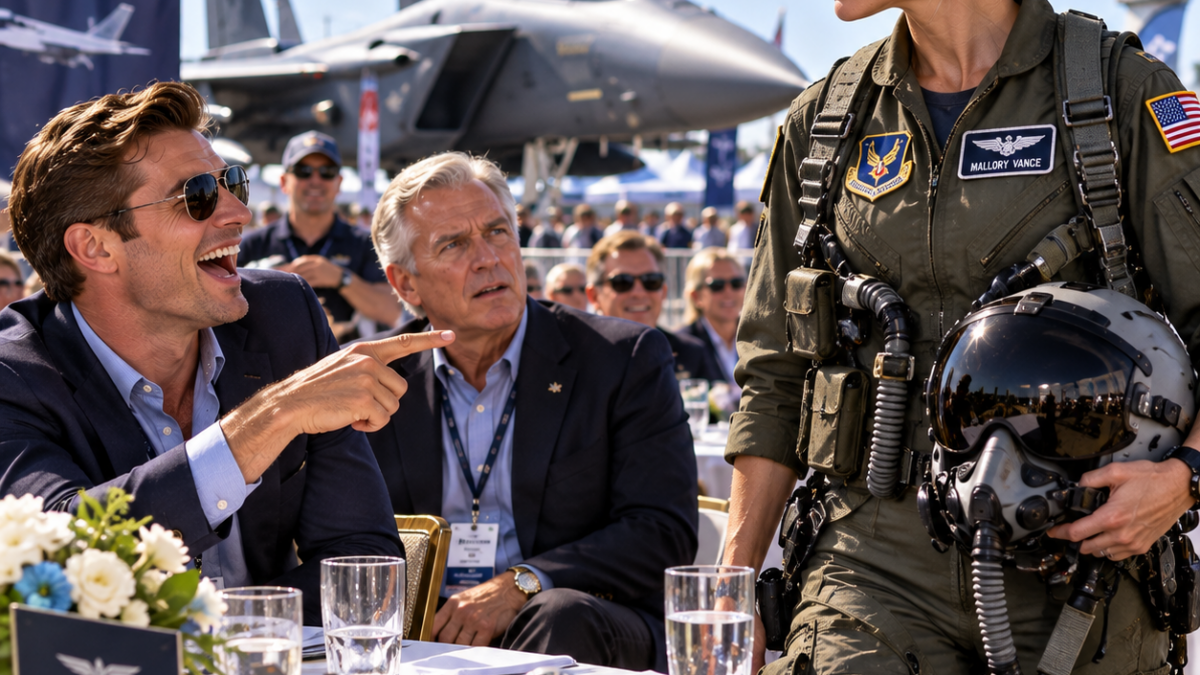
“Priority movement and evaluation clearance for lead flight evaluation officer, Major Mallory Vance.”
Nobody moved.
Tom Brennan slowly turned toward me.
A man near the end of the table looked at my face, then at the military credential that had shifted partly out of my jacket pocket.
“Mallory Vance?” he said. “The test pilot?”
Garrett’s hand jerked.
Coffee spilled down the front of his shirt.
I put on my sunglasses and picked up my phone.
“Excuse me.”
I looked at Garrett.
“They’re waiting for me.”
The walk from the sponsor pavilion to the military cordon took less than two minutes.
It felt longer.
I could sense people watching through the pavilion windows, but by the time two Air Force security personnel checked my credentials and moved the barrier, that world no longer mattered.
Inside the cordon, people were working.
Ground equipment.
Fuel carts.
Maintenance crews.
Telemetry specialists.
Engineers.
Nobody cared about family mythology.
That was one of the reasons I loved aviation.
Airflow does not know who your father favors.
Software does not become safer because someone tells a good story.
Gravity has never once been impressed by confidence.
Inside the temporary dressing bay, I changed into my flight gear while Miller reviewed maintenance notes.
The anger from lunch narrowed into something useful.
Focus.
By the time I walked toward the F-15EX, Garrett might as well have existed on another planet.
The jet sat beneath a hard white sky, heat shimmering around the landing gear.
I completed the external inspection without rushing.
Fasteners.
Control surfaces.
Hydraulic areas.
Tires.
Intakes.
Sensors.
Each check existed because somebody, somewhere, had once learned what happened when people stopped checking.
The crew chief handed me the digital release.
“Aircraft is yours, ma’am.”
I signed.
“Let’s bring it back the same way.”
He grinned.
“Our favorite plan.”
When the engines came alive, vibration traveled through the seat and into my spine.
I waited for the indications to stabilize.
Checked the data.
Checked again.
Tower cleared me to taxi.
From the cockpit I could see the sponsor pavilion far away beside the public crowd line.
I did not look for Garrett.
“Viper Zero-One, Runway Two-Seven, cleared for departure.”
“Viper Zero-One, cleared Two-Seven.”
I advanced the throttles.
Acceleration erased everything else.
The runway markings arrived faster.
Then faster again.
Rotation.
Weight leaving the wheels.
Gear coming up.
Climb.
For twenty-six minutes, Garrett Vance did not exist.
The flight profile was technical rather than spectacular.
Handling qualities.
Response characteristics.
Sensor behavior.
Control-law transitions.
Telemetry captured everything.
To spectators below, some passes probably looked like an air-show routine.
They were not.
Every maneuver corresponded to a line of data.
Every limit existed for a reason.
“Viper Zero-One, telemetry reports clean capture.”
“Copy.”
I rolled into the next point.
By the time I landed, shut down, and climbed from the cockpit, my brother had become nothing more than an irritating memory from lunch.
I spent almost forty minutes with engineers before Miller finally nodded toward the perimeter fence.
“You have a visitor.”
Garrett stood alone near the gate.
No sponsor crowd.
No audience.
The coffee stain had dried across his shirt.
He looked at my flight suit like it was evidence from a crime scene.
“You fly that?”
“Yes.”
“Since when?”
“Years.”
“Jets like that?”
“Among other aircraft.”
He stared.
“You never told me.”
“I did.”
His eyebrows tightened.
“I sent everybody an invitation when I graduated from Test Pilot School. You were copied.”
“I thought it was engineering school.”
“You assumed.”
“Well, you never corrected me.”
“Today I tried.”
He looked away.
“You could’ve said something before humiliating me.”
I almost laughed.
“You told strangers I was afraid of airplanes.”
“I was joking.”
“You invented a career for me, mocked that career, then used it to make yourself look better.”
He rubbed the back of his neck.
“So you sat there knowing tower was going to announce you?”
“I sat there waiting for you to stop talking.”
That landed harder than I expected.
Dad arrived several minutes later.
“Mallory.”
He looked half amazed, half angry.
“Why didn’t you tell us you were doing that today?”
“It wasn’t public information.”
“I’m your father.”
“That does not change operational restrictions.”
He lowered his voice.
“Everybody in that pavilion thinks we had no idea what you do.”
“You didn’t.”
“Of course we knew you were successful.”
“At what?”
Dad opened his mouth.
Nothing came.
Garrett stepped in.
“This is what she wanted. Make everybody look stupid, then pretend she’s above it.”
I suddenly felt tired.
“I have a debrief.”
Dad sighed.
“Mallory, don’t make this into a family crisis.”
“I didn’t.”
I left.
My work continued.
Engineers discussed thermal load, sensor tracking, control behavior, and a telemetry anomaly that turned out to be timing rather than aircraft performance.
The air show resumed.
I flew home commercially the following evening.
Dad called twice before I landed.
Garrett sent a message.
We need to clear the air before this gets weird.
I ignored both.
Three days later, an overnight envelope appeared outside my apartment.
No return address.
Inside were four photocopied pages and one yellow sticky note.
The first document carried the logo of Vance Aviation Services.
Dad had started the company after leaving corporate flying.
Garrett joined as director of flight operations two years earlier.
They managed several privately owned turboprops.
I had deliberately stayed out of the business.
The document title read:
FLIGHT RISK ASSESSMENT AND TECHNICAL REVIEW.
Halfway down was a paragraph referencing Air Force flight-test methodology.
Then:
Consultation with Major Mallory Vance, USAF.
At the bottom sat my name.
Underneath:
A signature.
Supposedly mine.
I stared at it.
The shape was close.
Good enough to fool someone unfamiliar with how I currently signed.
But whoever copied it used an older version.
The finishing stroke on the V was wrong.
The sticky note said:
Ask Garrett why they needed your name.
I did not call him.
Flight test teaches you something useful.
When unexpected behavior appears, you do not immediately start moving controls.
First establish what is happening.
I photographed every page.
Placed the originals in a sleeve.
Read them again.
The risk assessment concerned a Beechcraft King Air managed by Vance Aviation for a manufacturing company in Wisconsin.
Crew scheduling.
Maintenance coordination.
Pilot qualification.
The document had apparently been created eight months earlier after an unspecified operational event.
Garrett was listed as chief pilot.
I was listed as independent technical consultant.
I had never seen the aircraft.
Never spoken to the owner.
Never performed consulting work for Dad’s business.
At 0630 the next morning, I called base legal.
By eight, I sat across from Lieutenant Colonel Hannah Pike.
She read the documents twice.
“Did you authorize use of your rank?”
“No.”
“Military affiliation?”
“No.”
“Signature?”
“No.”
“Did you provide verbal advice somebody could reasonably have interpreted as technical review?”
“No.”
She tapped the paragraph.
“This is written to create the impression an active-duty Air Force test pilot reviewed their safety program.”
“That is how it reads.”
“Do you know who sent this?”
“No.”
Pike nodded.
“Do not confront anyone until evidence is preserved.”
That part was easy.
The difficult part was admitting I was not entirely surprised.
My family had always contained small dishonesties everyone agreed not to inspect too closely.
Garrett borrowed money and called it investment.
Dad covered mistakes because your brother means well.
Stories got better every year.
A difficult winter landing became heroic.
A scheduling problem became an emergency only Garrett could solve.
I treated those exaggerations as personality.
Forging my signature changed the category.
Pike helped notify the appropriate military ethics and legal offices because my rank and service affiliation had been used in private business documents.
Civilian issues went to a separate attorney.
My phone vibrated all day.
Dad.
Dad again.
Garrett.
Mom.
Mom had not attended Oshkosh because of a knee injury.
Her text read:
Your father says there was some misunderstanding at the air show. Please call me before this gets blown out of proportion.
I stared at the last line.
Before this gets blown out of proportion.
Nobody in my family knew I had the document.
At least I had told none of them.
Then Garrett texted.
Dad says you’re ignoring everyone. Grow up, Mal.
I put the phone facedown.
That evening, I received an email from Eric Dalton.
Subject:
You received the papers?
He said he worked maintenance coordination for Vance Aviation.
Please don’t use my work email. There is more. I sent what I could prove without accessing anything I’m not authorized to access. Your signature wasn’t the first problem.
Minutes later, my phone rang from a Wisconsin number.
“Major Vance?”
“Who is this?”
“Eric Dalton.”
“You sent the envelope.”
“Yes.”
“Why?”
His breathing sounded tight.
“Because after Oshkosh, I realized you didn’t know.”
“Didn’t know what?”
Pause.
“Your brother has been telling clients for almost a year that you’re an unofficial safety adviser to Vance Aviation.”
I leaned back.
“He said what?”
“He never put you on payroll. He was careful. More like family access. Said you reviewed procedures, talked through test standards, helped design their risk matrix.”
“I did none of that.”
“I figured that out Saturday.”
“How?”
“I was at Oshkosh.”
That surprised me.
“I heard what Garrett said afterward. Somebody showed me video from the sponsor tent. He told everybody you worked logistics.”
“Yes.”
“That’s when I knew something was wrong.”
I stayed silent.
Eric continued.
“If you were actually advising him, Garrett would’ve bragged about it to everybody in that pavilion.”
Simple.
Obvious.
“What was the operational event mentioned in the risk assessment?”
Eric went quiet.
“A runway excursion last February.”
My grip tightened.
“Injury?”
“No. Barely.”
“What happened?”
“Rejected takeoff. Aircraft went off the end onto frozen ground.”
“Who was flying?”
Longer pause.
“Garrett.”
I stood.
“What caused the reject?”
“That’s where it gets complicated.”
“How?”
“Official report says engine indication fluctuation. Maintenance data doesn’t support the version presented to the owner.”
“What does it support?”
Eric lowered his voice.
“That Garrett began the takeoff with an unresolved warning already present.”
I walked toward the window.
Cars moved below.
People carrying groceries.
Normal lives.
I thought about Garrett in the sponsor pavilion bragging that some pilots trusted instinct more than caution.
“Why wasn’t it reported properly?”
“The owner didn’t want publicity. Your dad convinced him it was faulty indication plus poor runway condition. Then the insurer started asking questions.”
“And that’s when my name appeared.”
“Yes.”
The forged signature was not about vanity.
It was protection.
“Why tell me now?”
His answer came immediately.
“Because Garrett is scheduled to fly the aircraft again Friday.”
The King Air did not fly Friday.
I made certain nobody could claim I used military authority in a civilian matter.
My attorney informed the aircraft owner that documents attributed to me were unauthorized.
The owner contacted the insurer.
The insurer contacted Vance Aviation.
By Thursday, dispatch was suspended while records were reviewed.
Dad called at 4:17.
I answered.
“What did you do?”
No hello.
“I corrected a false representation involving my name.”
“You contacted our client.”
“My attorney did.”
“Do you understand what you started?”
“Do you understand someone forged my signature?”
Silence.
The first answer.
I sat slowly.
“You knew.”
“Mallory, listen.”
“You knew.”
“It wasn’t supposed to be presented as a legal certification.”
“It has my signature.”
“It was internal assurance material.”
“It was sent to an insurer.”
“As supporting documentation.”
I laughed once.
“Do you hear yourself?”
His voice shifted into the instructive tone he used when I was a teenager.
“Your brother made a mistake. The business was under enormous pressure. One client was threatening to pull three aircraft. Insurance renewal was already difficult.”
“So you forged my signature.”
“I didn’t.”
“Who did?”
Hesitation.
That told me plenty.
“I don’t know exactly how Garrett prepared the packet.”
“But you knew he referenced me.”
“I knew he referenced your background.”
“Without permission.”
“You’re family.”
There it was.
One sentence clarifying thirty years.
“That is not permission.”
“You would have helped if we asked.”
“No.”
The answer came instantly.
Dad stopped.
“If you showed me a safety document hiding an unresolved warning and asked me to attach my name to it, I would have refused.”
“That’s because you don’t understand private aviation pressure.”
“I understand what happens when people normalize risk because fixing it costs money.”
“Garrett has thousands of hours.”
“Hours don’t erase bad judgment.”
Dad’s voice hardened.
“You sound like you want him to fail.”
“I want everyone to stop using my name to protect him from consequences.”
He hung up.
Mom called eleven minutes later.
I answered because I knew what would happen otherwise.
Dad would tell his version.
Garrett would add emotion.
By Sunday, I would become the daughter who destroyed the family company because of sibling resentment.
“Mom.”
“What is happening?”
“Did Dad tell you somebody signed my name to a safety document?”
She sighed.
Not gasped.
Sighed.
“I knew they mentioned you in something.”
I stood.
“How much?”
“Very little. Your father said they needed to show the insurance people that the family had strong safety expertise.”
“And you didn’t think I should know?”
“I assumed they had talked to you.”
“Did Dad say that?”
“No.”
“Garrett?”
“No.”
Silence.
Then:
“Can you please not make this bigger than it has to be?”
I looked at the framed photograph on my wall from Test Pilot School.
Twenty-one officers under a desert sky.
Exhausted.
Smiling.
A friend had framed it because nobody from my family attended.
“Mom, Garrett operated an aircraft with an unresolved warning, ran it off a runway, then my forged signature appeared on a document reassuring the insurer.”
“But nobody was hurt.”
I let silence answer.
“I’m not saying it was right.”
“You are saying the outcome determines whether it matters.”
“That isn’t fair.”
“No.”
My voice stayed calm.
“What happened isn’t fair.”
She began crying softly.
Years earlier, that would have ended the conversation.
I would have comforted her.
Softened everything.
Apologized for my tone.
The issue would disappear beneath the emergency of Mom being upset.
This time I did not rescue her from the emotion.
“I love you.”
I paused.
“But I’m not fixing this for them.”
The next morning, Eric sent three dates.
Runway excursion.
Autopilot fault deferred.
Fuel discrepancy.
I called.
“What is this?”
“Three events that disappeared into amended paperwork.”
“Amended legally?”
“I can’t claim something I can’t prove.”
“Tell me what you can prove.”
“Original maintenance notes existed.”
“And?”
“Later versions were different.”
“Who changed them?”
“I don’t know.”
Careful.
Not evasive.
“Why didn’t you report it?”
“I tried.”
“To who?”
“Your father.”
I rubbed my forehead.
“What did he say?”
“That I was confusing administrative cleanup with safety decisions.”
There it was.
Language soft enough to make danger sound clerical.
“Why stay?”
“I’ve been asking myself that.”
Before ending the call, Eric told me Vance Aviation had spent the year pursuing a major fleet-management contract for six business aircraft.
Nearly triple annual revenue.
The prospective client wanted enhanced safety documentation.
Garrett provided it.
My name appeared twice.
I forwarded everything to my attorney.
At noon, base security called.
“You have a civilian visitor.”
“Name?”
“Garrett Vance.”
I met him in a conference room outside the secure area.
No sponsor badge.
No sunglasses.
No audience.
Just my brother beneath fluorescent lights with a visitor sticker stuck crookedly to his shirt.
He started before I sat.
“You need to stop.”
“Stop what?”
“You know.”
“I know several investigations may involve your company. I didn’t start them.”
“You contacted Halberg.”
“My attorney informed an aircraft owner that a document with my name was false.”
“Same thing.”
“No.”
His jaw tightened.
“Dad could lose everything.”
“Did he forge my signature?”
Garrett looked toward the wall.
“Did you?”
He stood.
“This is unbelievable.”
“Sit down.”
Something in my voice worked.
He sat.
I slid the safety assessment across the table.
“Is that your document?”
“It was part of a packet.”
“Did you prepare it?”
“Mostly.”
“Who signed my name?”
“It wasn’t supposed to matter.”
My heartbeat changed.
Not surprise.
Recognition.
“Who signed it?”
“We had a deadline. Dad already told the insurer we had outside safety review. You were deployed or TDY or wherever you disappear to, and we couldn’t reach you.”
“My phone works.”
“You don’t answer half the time.”
“You never called.”
He looked away.
“Garrett.”
His face reddened.
“I signed it.”
The room became perfectly silent.
Then he rushed.
“But I used things you said over the years. Risk matrices. Cockpit judgment. I didn’t invent your opinions.”
“You presented them as a technical review of an aircraft I had never seen.”
“We needed credibility.”
“So you stole mine.”
“It wasn’t like that.”
“What was it like?”
“You don’t understand what Dad has invested.”
Necessity.
Not innocence.
“We had loans. Hangar commitments. Payroll. That runway thing happened at the worst possible time. If insurance walked, we were finished.”
“Why did you take off?”
He stopped.
“What?”
“The unresolved warning.”
His eyes narrowed.
“Who have you been talking to?”
“Answer.”
“It was intermittent.”
“Resolved?”
“We had maintenance look at it.”
“Resolved?”
Silence.
“No.”
“Why go?”
“The client had executives who needed Minneapolis before noon.”
“So schedule pressure over unresolved indication.”
“You weren’t there.”
“That is why I am asking.”
“It was thirty below. The system had been temperamental. Everything else was normal.”
“And then?”
“It flickered during takeoff.”
“You rejected.”
“Yes.”
“Late.”
“Later than ideal.”
“You overran.”
“The runway was contaminated.”
I stared.
Garrett slapped his palm lightly against the table.
“Nobody got hurt.”
Mom’s exact words.
“Do all of you practice that sentence?”
He glared.
“And altered maintenance records?”
His face changed.
Tiny.
But I spent years studying human behavior under pressure.
He expected questions about the runway.
Not that.
“What altered notes?”
“Eric has originals.”
Color left his face.
Enough.
“You need to leave.”
“Eric is doing this?”
“You need a lawyer.”
“Dalton has a grudge against Dad.”
“I do not care why he preserved documents if they are authentic.”
“They’re out of context.”
“Then explain context to investigators.”
He stood.
“You’re my sister.”
“Yes.”
“Does that mean nothing?”
“It meant enough to you that you used my name without permission.”
“You’re going to destroy Dad over paperwork.”
“No, Garrett.”
I looked directly at him.
“If something gets destroyed, it will be because of decisions you made before I knew they existed.”
He left.
Two days later, Dad came to my apartment.
I almost did not open the door.
Part of me still wanted to hear which version he would choose.
Deny.
Blame Garrett.
Minimize.
He looked older.
“Can I come in?”
I stepped aside.
“Garrett said he spoke with you.”
“He admitted signing my name.”
Dad closed his eyes briefly.
“You knew.”
“I knew afterward.”
“How long?”
“A few days.”
“And kept using it.”
“We couldn’t unring the bell.”
“You could have corrected the record.”
“We would have lost the account.”
I nodded.
Dad mistook it for understanding.
He stepped forward.
“I know it looks bad.”
“It is bad.”
“We made decisions under pressure.”
“You keep saying pressure like it changes the facts.”
“You think the Air Force never cuts corners?”
I looked at him.
“Not with my signature.”
Dad hardened.
“Your brother has always been reckless. You know that.”
The admission surprised me.
“You spent thirty years defending him.”
“Somebody had to keep him moving.”
“No. Somebody had to teach him consequences.”
His anger flared.
“You think raising him was easy? He screwed up, your mother panicked, he promised he would change, and I tried to keep the family together.”
“And what did you do when I needed something?”
The anger stopped.
“You didn’t attend my graduation.”
He lowered his eyes.
“You didn’t ask what I flew.”
Silence.
“You didn’t know what my job was.”
I continued.
“But the minute Garrett needed credibility after running an airplane off the runway, suddenly my career became family property.”
Dad had no answer.
Then he said something unexpected.
“The company was supposed to be yours too.”
I stared.
“What?”
“When I started Vance Aviation, I planned for both of you to inherit it.”
“Nobody told me.”
“No.”
“Why?”
He hesitated.
“Garrett asked us not to.”
Dad sat in my living room and told me a story about my own future I had never been allowed to know.
Seven years earlier, preliminary succession plans named both Garrett and me as eventual beneficiaries.
Garrett objected.
I had chosen the military.
I had no interest in the family company.
I would interfere with operational decisions I did not understand.
The irony was almost elegant.
“And you agreed.”
“Eventually.”
“Did you ask me?”
“You were busy.”
Busy.
The most powerful word in my family.
Busy meant nobody needed to invite me.
Busy meant they could decide what I wanted.
Busy meant the daughter accumulating advanced aviation qualifications could be ignored in every meaningful business conversation until her credentials became useful.
“Why tell me now?”
“Because this has gone too far.”
“No.”
I shook my head.
“This went too far when you let Garrett use my name.”
“I mean the investigations.”
“So you tell me about an inheritance because you want me to stop cooperating.”
“That’s not what I said.”
“It is what you’re doing.”
He stood.
“I’m explaining history.”
“You’re protecting the company.”
“Our company could’ve been yours.”
“No.”
I opened the door.
“It was Garrett’s.”
“You made sure of that.”
The following weeks moved with the slow violence of bureaucracy.
Emails.
Interviews.
Insurers.
Owners.
Attorneys.
The Federal Aviation Administration became involved after maintenance and operational records reached appropriate channels.
I answered questions only about matters involving my name.
That boundary mattered.
I did not want revenge.
I did not want to become an amateur investigator of Garrett’s entire career.
I gave evidence.
Answered truthfully.
Let people with jurisdiction do their jobs.
Eric resigned from Vance Aviation.
He called me on his final day.
“I should’ve left sooner.”
“Probably.”
He laughed weakly.
“Appreciate the honesty.”
“Why did you really send me everything?”
Silence.
Then:
“Because I signed off a maintenance coordination sheet before the runway excursion.”
My stomach tightened.
“What does that mean?”
“The warning Garrett saw was connected to an issue we had been tracking. I documented it for inspection. The note changed after the event.”
“By you?”
“No.”
“Did you know?”
“Not until weeks later.”
“Why stay silent?”
“I had a mortgage. Daughter starting college.”
No self-pity.
That made it harder.
“I told myself nobody got hurt.”
He exhaled.
“Then I realized I was using the same excuse everybody else used.”
“What changed at Oshkosh?”
“You.”
“Me?”
“When Garrett stood there telling everybody you were scared of airplanes, I realized something.”
“What?”
“He needed you to be small.”
I said nothing.
“If people knew who you actually were, somebody might wonder why Vance Aviation wasn’t publicly using you.”
He paused.
“Then somebody might ask whether you really approved the things he said you approved.”
The thought stayed with me.
I had assumed Garrett underestimated me because he did not care enough to learn.
The truth was uglier.
Ignorance became useful.
He could tell clients his accomplished military test-pilot sister quietly advised him.
Then tell friends and family the same sister shuffled paperwork.
Each audience received the Mallory that served him best.
The contradiction survived because those audiences never met.
Until Oshkosh.
In November, the medical-device company withdrew its fleet-management proposal.
Two existing aircraft owners moved their airplanes elsewhere pending review.
Vance Aviation did not collapse.
It shrank.
Quickly.
Garrett sent me a six-paragraph email.
Paragraph one apologized that I felt betrayed.
Paragraph two described his pressure.
Paragraph three explained Dad’s financial exposure.
Paragraph four blamed Eric.
Paragraph five said families should solve problems privately.
Paragraph six asked me to provide a written statement confirming Garrett had discussed general safety principles with me in the past.
That, he argued, would show the forged review had been based on real conversations.
I read the email twice.
Forwarded it to my attorney.
Never answered.
Before Thanksgiving, Mom called.
“Come home. Just dinner.”
“Will Garrett be there?”
“Of course.”
“Then no.”
Her voice tightened.
“How long are you going to punish everyone?”
“I am not punishing anyone.”
“Your father barely sleeps.”
“I did not make his decisions.”
“Garrett’s career could be over.”
“I did not make his decisions either.”
“Mallory—”
I interrupted gently.
“I spent years hearing that Garrett’s words didn’t matter because he was joking. His mistakes didn’t matter because nobody got hurt. My feelings didn’t matter because keeping peace mattered more.”
I paused.
“I am not doing that anymore.”
“He is your brother.”
“That is not a waiver.”
I spent Thanksgiving with two flight-test friends, their children, and a seventy-pound Labrador named Moose who stole half a dinner roll from my plate.
It was one of the most peaceful holidays I remembered.
In December, investigators requested one final interview concerning forged documents.
Attached was a list of materials.
The last item stopped me.
Email correspondence between Douglas Vance and Garrett Vance regarding Major Mallory Vance’s credentials.
The earliest email was fourteen months before the runway excursion.
That changed the timeline.
Until then, Dad portrayed my name as something used during panic after Garrett’s accident.
Still wrong.
But reactive.
The emails proved planning.
More than a year before the runway event, Garrett suggested using my background in marketing material for a corporate client.
Dad responded that they should avoid listing me formally because I might ask too many operational questions and my active-duty status could complicate things.
Then one line.
Better to reference family access informally. Gives us credibility without putting Mallory in the kitchen.
I read it three times.
An investigator asked, “Have you heard that expression?”
“No.”
“What did he mean?”
“I can infer it.”
“Please do.”
“My father did not want me participating in company decisions.”
“Why?”
“You would need to ask him.”
For years I believed my family excluded me because they underestimated me.
Now I understood at least some exclusion was deliberate.
They wanted the value of my credentials without the inconvenience of my judgment.
Another email.
Garrett:
Clients love the military test-pilot connection. No reason to complicate the story by explaining exactly what she does.
Dad replied with a thumbs-up emoji.
That ridiculous symbol hurt more than the signature.
The signature was clear.
A violation.
The emoji was casual.
Familiar.
Family.
My father had watched Garrett construct two versions of me and helped preserve them.
Official consequences arrived gradually.
I learned only what was appropriate.
I stopped chasing aviation gossip.
Garrett lost his management role at Vance Aviation.
His flying privileges came under regulatory review based on operational and recordkeeping issues.
The company accepted outside compliance oversight.
Dad stepped away from daily management.
Vance Aviation survived.
Barely.
Early that spring, Dad asked me to meet at a coffee shop halfway between Dayton and their home.
I almost refused.
Then I realized I wanted to hear what he would say when there was nothing left I could save for him.
He arrived first.
Both hands around a paper cup.
For the first time, my father looked less like Dad and more like an old pilot.
Gray hair.
Smaller shoulders.
Tired eyes.
“I owe you an apology.”
I waited.
No but.
No immediate explanation.
So I let him continue.
“I knew Garrett used your career to impress clients.”
Silence.
“I knew he described your involvement in ways that weren’t accurate. I told myself it was harmless because he wasn’t putting you on contracts.”
I said nothing.
“When he signed your name, I learned afterward.”
He looked down.
“I should’ve corrected it immediately.”
“Why didn’t you?”
“I thought I could control the damage.”
“To the company.”
“Yes.”
Not to me.
He understood.
“Garrett needed more from us growing up.”
I almost laughed.
“That’s still your explanation?”
“He was impulsive. He struggled in school. He needed encouragement.”
“And I didn’t?”
“You always handled yourself.”
The sentence landed softly.
That made it worse.
“Do you know what that meant from my side?”
He looked at me.
“It meant every time Garrett needed attention, he got it.”
I continued.
“Every time I succeeded without demanding attention, you treated that as evidence I did not need you.”
His eyes filled.
I did not stop.
“You missed Test Pilot School graduation because Garrett had a banquet.”
“I know.”
“You never visited Edwards.”
“I know.”
“You could not describe my job at Oshkosh even while your company used my job to impress clients.”
“I know.”
We sat quietly.
Finally he said, “I was proud of you.”
“I would’ve preferred interested.”
Dad nodded.
That sentence hurt him.
It needed to.
I believed his apology.
That did not mean I wanted the old relationship restored.
People confuse forgiveness with restoration because restoration makes everybody comfortable.
But once you understand someone clearly, sometimes the correct response is simply less access.
“I don’t hate you.”
Dad looked up.
“But I’m not going back to pretending this was one bad decision.”
His expression tightened.
“Will you ever trust me?”
“I don’t know.”
It was the most generous truthful answer I had.
Garrett called later that week.
I did not answer.
His voicemail lasted more than four minutes.
He said he admired me.
My career intimidated him.
Dad compared us more than I realized.
He always felt I was waiting for him to fail.
Signing my name had been stupid.
He was sorry.
Then near the end:
“I just wish you’d given me a chance to fix this before outsiders got involved.”
There it was.
Even inside apology, his real complaint remained exposure.
I deleted the message.
Almost exactly one year after Oshkosh, the organizers invited me back.
Aviation safety panel.
My first reaction was no.
Then I saw the topic.
DECISION-MAKING UNDER PRESSURE.
I laughed out loud.
For the first time in months, Oshkosh no longer felt like the place where my family humiliated me.
It was simply a place.
I could return if I wanted.
I accepted.
The following August smelled exactly the same.
Hot pavement.
Jet fuel.
Concession food.
This time I wore civilian clothes and a plain event badge with my name but no rank.
No one carried my bag.
Nobody saluted.
No loudspeaker announced me.
I preferred it.
The forum tent was packed.
Student pilots.
Corporate pilots.
Airline captains.
Instructors.
Retirees.
I spoke about schedule pressure.
Confirmation bias.
Ego.
The dangerous human habit of treating yesterday’s successful shortcut as proof that the shortcut was safe.
I never mentioned Garrett.
Did not need to.
“One of the most dangerous lessons in aviation,” I told the audience, “is getting away with something.”
People looked up.
“Nothing bad happening does not prove the decision was good.”
Several people wrote that down.
Afterward, Tom Brennan approached me.
The silver-haired instructor from the sponsor pavilion.
He looked embarrassed before speaking.
“Major Vance.”
“Mallory is fine.”
He smiled.
“I wanted to apologize for last year.”
“You didn’t say anything.”
“Exactly.”
I understood.
“I teach pilots to speak when something sounds wrong, then I sat at that table while your brother made a fool of himself at your expense.”
“You didn’t know me.”
“Didn’t need to.”
Fair.
We talked about safety culture.
Before leaving, he said, “For what it’s worth, I don’t remember the jet as much as I remember one thing.”
“What?”
“You never tried to win the argument.”
I smiled.
“I had somewhere else to be.”
Later, I walked through the exhibition grounds alone.
I passed the old sponsor pavilion.
Different logos.
Different guests.
For one second I could see Garrett in the previous summer.
Leaning back.
Dad smiling.
Coffee sweating inside plastic cups.
My hands around iced tea while somebody who knew almost nothing about my life confidently explained it.
I once thought the satisfying ending was tower saying my name.
It was not.
That announcement only embarrassed Garrett.
Embarrassment fades.
What followed mattered because his own boasting connected audiences he had kept separate.
People compared stories.
Those comparisons exposed unauthorized use of my credentials.
That exposed the runway event.
The runway event exposed altered records.
Those records exposed a culture built around one dangerous belief:
Consequences can always be managed later.
The real problem had never been that my brother failed to understand how accomplished I was.
The problem was that he believed other people’s identities, reputations, and trust were resources he could spend when convenient.
Dad helped teach him that.
Mom helped by calling every consequence family conflict.
And I had contributed too, though unintentionally.
I removed myself from arguments so completely that silence became something everyone else could define for me.
That changed.
I did not begin explaining myself to people committed to misunderstanding me.
But I stopped allowing silence to become permission.
If somebody used my name, I corrected it.
If somebody crossed a boundary, I named it.
When family asked me to absorb harm so everyone else could feel comfortable, I said no.
No hearing.
No closing argument.
Just no.
Mom and I eventually built a polite, limited relationship.
Calls every few weeks.
Neighbors.
Garden projects.
Distant cousins.
Sometimes she tried to mention Garrett.
I changed the subject.
Dad and I rebuilt something smaller.
He started asking about my work.
Real questions.
Most of what I could tell him was boring.
That was useful.
Genuine interest survives boring details.
Pride usually wants highlights.
Once, he visited me near Dayton.
We spent a Saturday at a small aviation museum.
Under the wing of an old experimental aircraft, Dad read every placard.
“You work with systems descended from this kind of testing?”
“More or less.”
He nodded.
Then asked another question.
Not a statement disguised as a question.
Not an invitation to tell me about Garrett.
A real question.
I answered.
Enough for one day.
I did not reconcile with my brother.
Eventually, Garrett met the requirements necessary to return to flying work.
Not management.
Not the status he once enjoyed.
Dad said he became quieter.
Maybe.
I hoped he became safer.
Those are different wishes from wanting him back inside my life.
About eighteen months after Oshkosh, Garrett sent one final email.
No excuses.
No request.
He wrote that losing his position forced him to admit he spent years measuring himself against people who never knew they were competing with him.
Then:
I lied about you because your real career made me feel ordinary, and I used that same career privately because it made the company look extraordinary.
He admitted something else.
Dad compared us.
Garrett always felt I represented some version of competence he could never match.
Instead of dealing with that, he needed me smaller.
His final paragraph was short.
I understand why you don’t trust me. You don’t owe me a relationship because we’re related. I’m sorry for what I did with your name, and I’m sorry for all the years before that when I needed you to be less so I could feel like more.
I read it twice.
Then closed my laptop.
I did not reply.
Maybe someday.
Maybe never.
Forgiveness, if it comes, does not require reopening every door.
A week later, I reported before sunrise for another evaluation flight.
The base was almost silent.
Eastern sky barely gray.
Portable maintenance lights created long shadows across cold concrete.
I crossed the ramp carrying my helmet.
The crew chief met me beside the aircraft.
“Morning, Major.”
“Morning.”
“Ready?”
I looked up at the jet.
People occasionally ask whether flying scares me.
Yes.
Any pilot claiming nothing about aviation scares them anymore is either trying to sell something or has stopped paying attention.
I respect engines because they can fail.
Weather because it changes.
Speed because it reduces the time available to correct mistakes.
Fear is not the opposite of competence.
Used correctly, fear is information.
That was what Garrett never understood when he called me afraid of airplanes.
My quietness around aircraft was never fear of them.
It was attention.
The best pilots I know become quieter when the stakes rise.
They listen harder.
Check twice.
Leave pride on the ground because the aircraft has no use for it.
I climbed the ladder.
Settled into the cockpit.
Began the checklist.
Years earlier, I might have wanted Dad standing outside the fence.
Might have wanted Garrett watching.
Might have imagined their expressions proving something.
I no longer needed witnesses.
Tower cleared me to taxi.
Morning light spread across the runway.
I lowered my visor.
Moved the throttles.
“Viper Zero-One ready.”
The answer came through my headset.
“Viper Zero-One, cleared for departure.”
The engines rose.
I rolled forward.
Acceleration pressed me into the seat.
Runway markings moved faster beneath the nose.
I rotated.
The wheels left the ground.
And this time, there was nobody left I needed to prove wrong.
the end
My Brother Spent Years Telling Everyone I Was Afraid of Airplanes Until One Announcement Exposed the Career He Had Quietly Been Using Behind My Back
Garrett built his entire identity around being the pilot in our family while my father happily let him reduce my career to paperwork and fluorescent lights. At the biggest air show of the summer, he humiliated me in front of pilots, vendors, and old family friends because he assumed I would do what I had always done—stay quiet. Three days later, an overnight envelope arrived at my apartment with my forged signature on a flight-safety document, and suddenly the joke at Oshkosh was the least important lie he had told.
The tarmac at Oshkosh smelled like hot asphalt, sunscreen, fried food, and jet fuel.
It was the kind of smell aviation people either loved or pretended to hate while secretly loving it. Vintage fighters rolled behind barriers. Families crowded the flight line in folding chairs. Children wore foam pilot wings and oversized hearing protection while parents pointed toward aircraft they could not name. Somewhere beyond the civilian displays, turbine engines wound up and down in the summer heat.
My older brother Garrett walked beside our father like the entire show had been arranged for him personally.
Sponsor badge.
Aviator sunglasses.
Confident stride.
Dad kept turning toward him whenever another aircraft taxied past.
“That sounds like a Pratt,” Garrett said once.
Dad smiled.
“Good ear.”
I walked several steps behind them carrying the canvas tote Dad had handed me in the parking lot.
At the security checkpoint, Garrett patted his pockets.
“Damn. Left my polarized glasses in the car.”
Then he tossed his keys toward me.
I caught them against my chest.
“Grab them, would you, Mal?”
Dad gave me the same distracted smile he had used since we were children.
“You know how glare bothers him during demonstrations.”
I looked at Garrett.
He was already walking toward security.
“Sure.”
He did not hear the way I said it.
That was our family dynamic in one small scene.
Garrett was aviation.
I was whatever existed around aviation.
Our father, Douglas Vance, had flown corporate turboprops for almost thirty years. He started taking Garrett to airports before my brother was tall enough to see over a glareshield. I usually stayed with Mom inside the terminal because Dad believed ramps were not places where girls belonged unless they were flight attendants or wives waiting for husbands.
By high school, Garrett could identify airplanes by engine sound and had accumulated enough training hours to dominate every Thanksgiving conversation.
I could identify the same aircraft.
Nobody asked me.
When I won a statewide engineering competition with a stability-control project, Dad congratulated me for maybe thirty seconds.
Then dinner became a discussion about Garrett’s first solo cross-country.
I stopped competing long before I understood that was what I had been doing.
Instead, I followed curiosity.
Engineering.
Officer training.
Test work.
Flight qualification.
Then a career specialized enough that most questions about it received a deliberately vague answer.
Government systems evaluation.
My family heard government and systems and built the rest themselves.
By the time I returned with Garrett’s sunglasses, he had settled into the VIP sponsor pavilion with Dad and a group of airline representatives, avionics vendors, retired pilots, and a silver-haired instructor named Tom Brennan.
I sat between Dad and an aircraft-insurance representative.
Garrett was already telling a story about winter weather.
“Twenty-eight knots straight across,” he said, drawing a runway with one finger. “Everybody else was thinking diversion. I told the first officer, ‘We’re already here.’”
Dad laughed.
“That’s the Vance stubborn streak.”
I sipped iced tea.
Tom Brennan looked toward me.
“And you, Mallory? Douglas says you’re with the government.”
I opened my mouth.
Garrett answered.
“Don’t get her started on spreadsheets.”
Several people smiled.
He leaned back.
“Logistics. Procurement. Something like that. Windowless building, fluorescent lights, fifteen signatures before anybody can order a box of paper clips.”
Dad chuckled into his coffee.
Tom said, “Nothing wrong with logistics.”
“Absolutely not,” Garrett replied. “Somebody has to count the staplers.”
The insurance representative laughed harder than the joke deserved.
“My job is slightly more technical than that,” I said.
Garrett waved one hand.
“She’s modest about her spreadsheets.”
Dad could have corrected him.
He did not know the details of my current work, but he knew I graduated from the United States Air Force Test Pilot School.
I had mailed him the invitation.
He had not attended because Garrett had a regional aviation dinner the same weekend.
Still, he knew.
Instead Dad said, “Mallory was always our cautious one.”
Something inside me became very still.
Garrett grinned.
“Cautious? She’s terrified of real airplanes.”
Several people looked uncomfortable.
He tapped my plastic cup.
“Seriously. Put her near a real flight line and she gets quiet as a church mouse. Meanwhile, some of us actually earn our living with the wheels off the ground.”
I could have stopped him.
I could have shown my qualification card.
My military identification.
The folded flight authorization inside my jacket.
I could have explained that a restricted apron beyond the western fence had been partially cleared because I was scheduled to use it.
Instead I asked one question.
“You finished?”
Garrett blinked.
My tone had removed some of the fun.
Then he smiled.
“I’m teasing you, Mal.”
Dad touched my wrist.
“Don’t be so sensitive.”
There it was.
The family escape hatch.
Garrett could say anything.
If I objected, my reaction became the problem.
I stood.
“I’m stepping out.”
Outside, the heat hit like an open oven.
I crossed behind the civilian hangars until the crowd noise disappeared beneath the hum of ground equipment.
A plain operations trailer sat behind temporary security fencing.
Master Sergeant Cole Miller waited beside the steps.
He straightened.
“Major.”
I returned the salute.
“Sergeant.”
“We got the revised card from Wright-Patterson twenty-two minutes ago. Telemetry is green. Maintenance signed off. Tower has the sterile window at thirteen-forty.”
Inside, my flight equipment waited on a bench.
Helmet.
Mask.
Gloves.
Pressure gear.
Anti-G suit.
Beside it sat the operational evaluation binder for the F-15EX parked on the restricted apron.
I reviewed the final changes.
“Heat?”
“Density altitude recalculated. You’re inside limits.”
“Sensors?”
“Green.”
I initialed the sheet.
“Keep the window.”
Miller closed the binder.
“Tower is making the public restriction announcement five minutes before movement.”
That meant Garrett would hear it.
For the first time that afternoon, I almost smiled.
part2
I returned to the pavilion only long enough to retrieve my watch case and phone.
Garrett was complaining about three civilian demonstration aircraft that had just been instructed to shut down near Runway Two-Seven.
“Federal bureaucracy,” he said. “Somebody in an office gets nervous and suddenly people who actually fly have to wait.”
The overhead speaker cracked with static.
Conversation across the pavilion stopped.
“Attention all air wings, demonstration teams, and civilian flight directors. Runway Two-Seven is now restricted under Air Combat Command operational protocol. All nonessential personnel remain clear of the hot line.”
Garrett froze with coffee halfway to his mouth.
The controller continued.
“Priority movement and evaluation clearance for lead flight evaluation officer, Major Mallory Vance.”
Nobody moved.
Tom Brennan slowly turned toward me.
A man near the end of the table looked at my face, then at the military credential that had shifted partly out of my jacket pocket.
“Mallory Vance?” he said. “The test pilot?”
Garrett’s hand jerked.
Coffee spilled down the front of his shirt.
I put on my sunglasses and picked up my phone.
“Excuse me.”
I looked at Garrett.
“They’re waiting for me.”
The walk from the sponsor pavilion to the military cordon took less than two minutes.
It felt longer.
I could sense people watching through the pavilion windows, but by the time two Air Force security personnel checked my credentials and moved the barrier, that world no longer mattered.
Inside the cordon, people were working.
Ground equipment.
Fuel carts.
Maintenance crews.
Telemetry specialists.
Engineers.
Nobody cared about family mythology.
That was one of the reasons I loved aviation.
Airflow does not know who your father favors.
Software does not become safer because someone tells a good story.
Gravity has never once been impressed by confidence.
Inside the temporary dressing bay, I changed into my flight gear while Miller reviewed maintenance notes.
The anger from lunch narrowed into something useful.
Focus.
By the time I walked toward the F-15EX, Garrett might as well have existed on another planet.
The jet sat beneath a hard white sky, heat shimmering around the landing gear.
I completed the external inspection without rushing.
Fasteners.
Control surfaces.
Hydraulic areas.
Tires.
Intakes.
Sensors.
Each check existed because somebody, somewhere, had once learned what happened when people stopped checking.
The crew chief handed me the digital release.
“Aircraft is yours, ma’am.”
I signed.
“Let’s bring it back the same way.”
He grinned.
“Our favorite plan.”
When the engines came alive, vibration traveled through the seat and into my spine.
I waited for the indications to stabilize.
Checked the data.
Checked again.
Tower cleared me to taxi.
From the cockpit I could see the sponsor pavilion far away beside the public crowd line.
I did not look for Garrett.
“Viper Zero-One, Runway Two-Seven, cleared for departure.”
“Viper Zero-One, cleared Two-Seven.”
I advanced the throttles.
Acceleration erased everything else.
The runway markings arrived faster.
Then faster again.
Rotation.
Weight leaving the wheels.
Gear coming up.
Climb.
For twenty-six minutes, Garrett Vance did not exist.
The flight profile was technical rather than spectacular.
Handling qualities.
Response characteristics.
Sensor behavior.
Control-law transitions.
Telemetry captured everything.
To spectators below, some passes probably looked like an air-show routine.
They were not.
Every maneuver corresponded to a line of data.
Every limit existed for a reason.
“Viper Zero-One, telemetry reports clean capture.”
“Copy.”
I rolled into the next point.
By the time I landed, shut down, and climbed from the cockpit, my brother had become nothing more than an irritating memory from lunch.
I spent almost forty minutes with engineers before Miller finally nodded toward the perimeter fence.
“You have a visitor.”
Garrett stood alone near the gate.
No sponsor crowd.
No audience.
The coffee stain had dried across his shirt.
He looked at my flight suit like it was evidence from a crime scene.
“You fly that?”
“Yes.”
“Since when?”
“Years.”
“Jets like that?”
“Among other aircraft.”
He stared.
“You never told me.”
“I did.”
His eyebrows tightened.
“I sent everybody an invitation when I graduated from Test Pilot School. You were copied.”
“I thought it was engineering school.”
“You assumed.”
“Well, you never corrected me.”
“Today I tried.”
He looked away.
“You could’ve said something before humiliating me.”
I almost laughed.
“You told strangers I was afraid of airplanes.”
“I was joking.”
“You invented a career for me, mocked that career, then used it to make yourself look better.”
He rubbed the back of his neck.
“So you sat there knowing tower was going to announce you?”
“I sat there waiting for you to stop talking.”
That landed harder than I expected.
Dad arrived several minutes later.
“Mallory.”
He looked half amazed, half angry.
“Why didn’t you tell us you were doing that today?”
“It wasn’t public information.”
“I’m your father.”
“That does not change operational restrictions.”
He lowered his voice.
“Everybody in that pavilion thinks we had no idea what you do.”
“You didn’t.”
“Of course we knew you were successful.”
“At what?”
Dad opened his mouth.
Nothing came.
Garrett stepped in.
“This is what she wanted. Make everybody look stupid, then pretend she’s above it.”
I suddenly felt tired.
“I have a debrief.”
Dad sighed.
“Mallory, don’t make this into a family crisis.”
“I didn’t.”
I left.
My work continued.
Engineers discussed thermal load, sensor tracking, control behavior, and a telemetry anomaly that turned out to be timing rather than aircraft performance.
The air show resumed.
I flew home commercially the following evening.
Dad called twice before I landed.
Garrett sent a message.
We need to clear the air before this gets weird.
I ignored both.
Three days later, an overnight envelope appeared outside my apartment.
No return address.
Inside were four photocopied pages and one yellow sticky note.
The first document carried the logo of Vance Aviation Services.
Dad had started the company after leaving corporate flying.
Garrett joined as director of flight operations two years earlier.
They managed several privately owned turboprops.
I had deliberately stayed out of the business.
The document title read:
FLIGHT RISK ASSESSMENT AND TECHNICAL REVIEW.
Halfway down was a paragraph referencing Air Force flight-test methodology.
Then:
Consultation with Major Mallory Vance, USAF.
At the bottom sat my name.
Underneath:
A signature.
Supposedly mine.
I stared at it.
The shape was close.
Good enough to fool someone unfamiliar with how I currently signed.
But whoever copied it used an older version.
The finishing stroke on the V was wrong.
The sticky note said:
Ask Garrett why they needed your name.
I did not call him.
Flight test teaches you something useful.
When unexpected behavior appears, you do not immediately start moving controls.
First establish what is happening.
I photographed every page.
Placed the originals in a sleeve.
Read them again.
The risk assessment concerned a Beechcraft King Air managed by Vance Aviation for a manufacturing company in Wisconsin.
Crew scheduling.
Maintenance coordination.
Pilot qualification.
The document had apparently been created eight months earlier after an unspecified operational event.
Garrett was listed as chief pilot.
I was listed as independent technical consultant.
I had never seen the aircraft.
Never spoken to the owner.
Never performed consulting work for Dad’s business.
At 0630 the next morning, I called base legal.
By eight, I sat across from Lieutenant Colonel Hannah Pike.
She read the documents twice.
“Did you authorize use of your rank?”
“No.”
“Military affiliation?”
“No.”
“Signature?”
“No.”
“Did you provide verbal advice somebody could reasonably have interpreted as technical review?”
“No.”
She tapped the paragraph.
“This is written to create the impression an active-duty Air Force test pilot reviewed their safety program.”
“That is how it reads.”
“Do you know who sent this?”
“No.”
Pike nodded.
“Do not confront anyone until evidence is preserved.”
That part was easy.
The difficult part was admitting I was not entirely surprised.
My family had always contained small dishonesties everyone agreed not to inspect too closely.
Garrett borrowed money and called it investment.
Dad covered mistakes because your brother means well.
Stories got better every year.
A difficult winter landing became heroic.
A scheduling problem became an emergency only Garrett could solve.
I treated those exaggerations as personality.
Forging my signature changed the category.
Pike helped notify the appropriate military ethics and legal offices because my rank and service affiliation had been used in private business documents.
Civilian issues went to a separate attorney.
My phone vibrated all day.
Dad.
Dad again.
Garrett.
Mom.
Mom had not attended Oshkosh because of a knee injury.
Her text read:
Your father says there was some misunderstanding at the air show. Please call me before this gets blown out of proportion.
I stared at the last line.
Before this gets blown out of proportion.
Nobody in my family knew I had the document.
At least I had told none of them.
Then Garrett texted.
Dad says you’re ignoring everyone. Grow up, Mal.
I put the phone facedown.
That evening, I received an email from Eric Dalton.
Subject:
You received the papers?
He said he worked maintenance coordination for Vance Aviation.
Please don’t use my work email. There is more. I sent what I could prove without accessing anything I’m not authorized to access. Your signature wasn’t the first problem.
Minutes later, my phone rang from a Wisconsin number.
“Major Vance?”
“Who is this?”
“Eric Dalton.”
“You sent the envelope.”
“Yes.”
“Why?”
His breathing sounded tight.
“Because after Oshkosh, I realized you didn’t know.”
“Didn’t know what?”
Pause.
“Your brother has been telling clients for almost a year that you’re an unofficial safety adviser to Vance Aviation.”
I leaned back.
“He said what?”
“He never put you on payroll. He was careful. More like family access. Said you reviewed procedures, talked through test standards, helped design their risk matrix.”
“I did none of that.”
“I figured that out Saturday.”
“How?”
“I was at Oshkosh.”
That surprised me.
“I heard what Garrett said afterward. Somebody showed me video from the sponsor tent. He told everybody you worked logistics.”
“Yes.”
“That’s when I knew something was wrong.”
I stayed silent.
Eric continued.
“If you were actually advising him, Garrett would’ve bragged about it to everybody in that pavilion.”
Simple.
Obvious.
“What was the operational event mentioned in the risk assessment?”
Eric went quiet.
“A runway excursion last February.”
My grip tightened.
“Injury?”
“No. Barely.”
“What happened?”
“Rejected takeoff. Aircraft went off the end onto frozen ground.”
“Who was flying?”
Longer pause.
“Garrett.”
I stood.
“What caused the reject?”
“That’s where it gets complicated.”
“How?”
“Official report says engine indication fluctuation. Maintenance data doesn’t support the version presented to the owner.”
“What does it support?”
Eric lowered his voice.
“That Garrett began the takeoff with an unresolved warning already present.”
I walked toward the window.
Cars moved below.
People carrying groceries.
Normal lives.
I thought about Garrett in the sponsor pavilion bragging that some pilots trusted instinct more than caution.
“Why wasn’t it reported properly?”
“The owner didn’t want publicity. Your dad convinced him it was faulty indication plus poor runway condition. Then the insurer started asking questions.”
“And that’s when my name appeared.”
“Yes.”
The forged signature was not about vanity.
It was protection.
“Why tell me now?”
His answer came immediately.
“Because Garrett is scheduled to fly the aircraft again Friday.”
The King Air did not fly Friday.
I made certain nobody could claim I used military authority in a civilian matter.
My attorney informed the aircraft owner that documents attributed to me were unauthorized.
The owner contacted the insurer.
The insurer contacted Vance Aviation.
By Thursday, dispatch was suspended while records were reviewed.
Dad called at 4:17.
I answered.
“What did you do?”
No hello.
“I corrected a false representation involving my name.”
“You contacted our client.”
“My attorney did.”
“Do you understand what you started?”
“Do you understand someone forged my signature?”
Silence.
The first answer.
I sat slowly.
“You knew.”
“Mallory, listen.”
“You knew.”
“It wasn’t supposed to be presented as a legal certification.”
“It has my signature.”
“It was internal assurance material.”
“It was sent to an insurer.”
“As supporting documentation.”
I laughed once.
“Do you hear yourself?”
His voice shifted into the instructive tone he used when I was a teenager.
“Your brother made a mistake. The business was under enormous pressure. One client was threatening to pull three aircraft. Insurance renewal was already difficult.”
“So you forged my signature.”
“I didn’t.”
“Who did?”
Hesitation.
That told me plenty.
“I don’t know exactly how Garrett prepared the packet.”
“But you knew he referenced me.”
“I knew he referenced your background.”
“Without permission.”
“You’re family.”
There it was.
One sentence clarifying thirty years.
“That is not permission.”
“You would have helped if we asked.”
“No.”
The answer came instantly.
Dad stopped.
“If you showed me a safety document hiding an unresolved warning and asked me to attach my name to it, I would have refused.”
“That’s because you don’t understand private aviation pressure.”
“I understand what happens when people normalize risk because fixing it costs money.”
“Garrett has thousands of hours.”
“Hours don’t erase bad judgment.”
Dad’s voice hardened.
“You sound like you want him to fail.”
“I want everyone to stop using my name to protect him from consequences.”
He hung up.
Mom called eleven minutes later.
I answered because I knew what would happen otherwise.
Dad would tell his version.
Garrett would add emotion.
By Sunday, I would become the daughter who destroyed the family company because of sibling resentment.
“Mom.”
“What is happening?”
“Did Dad tell you somebody signed my name to a safety document?”
She sighed.
Not gasped.
Sighed.
“I knew they mentioned you in something.”
I stood.
“How much?”
“Very little. Your father said they needed to show the insurance people that the family had strong safety expertise.”
“And you didn’t think I should know?”
“I assumed they had talked to you.”
“Did Dad say that?”
“No.”
“Garrett?”
“No.”
Silence.
Then:
“Can you please not make this bigger than it has to be?”
I looked at the framed photograph on my wall from Test Pilot School.
Twenty-one officers under a desert sky.
Exhausted.
Smiling.
A friend had framed it because nobody from my family attended.
“Mom, Garrett operated an aircraft with an unresolved warning, ran it off a runway, then my forged signature appeared on a document reassuring the insurer.”
“But nobody was hurt.”
I let silence answer.
“I’m not saying it was right.”
“You are saying the outcome determines whether it matters.”
“That isn’t fair.”
“No.”
My voice stayed calm.
“What happened isn’t fair.”
She began crying softly.
Years earlier, that would have ended the conversation.
I would have comforted her.
Softened everything.
Apologized for my tone.
The issue would disappear beneath the emergency of Mom being upset.
This time I did not rescue her from the emotion.
“I love you.”
I paused.
“But I’m not fixing this for them.”
The next morning, Eric sent three dates.
Runway excursion.
Autopilot fault deferred.
Fuel discrepancy.
I called.
“What is this?”
“Three events that disappeared into amended paperwork.”
“Amended legally?”
“I can’t claim something I can’t prove.”
“Tell me what you can prove.”
“Original maintenance notes existed.”
“And?”
“Later versions were different.”
“Who changed them?”
“I don’t know.”
Careful.
Not evasive.
“Why didn’t you report it?”
“I tried.”
“To who?”
“Your father.”
I rubbed my forehead.
“What did he say?”
“That I was confusing administrative cleanup with safety decisions.”
There it was.
Language soft enough to make danger sound clerical.
“Why stay?”
“I’ve been asking myself that.”
Before ending the call, Eric told me Vance Aviation had spent the year pursuing a major fleet-management contract for six business aircraft.
Nearly triple annual revenue.
The prospective client wanted enhanced safety documentation.
Garrett provided it.
My name appeared twice.
I forwarded everything to my attorney.
At noon, base security called.
“You have a civilian visitor.”
“Name?”
“Garrett Vance.”
I met him in a conference room outside the secure area.
No sponsor badge.
No sunglasses.
No audience.
Just my brother beneath fluorescent lights with a visitor sticker stuck crookedly to his shirt.
He started before I sat.
“You need to stop.”
“Stop what?”
“You know.”
“I know several investigations may involve your company. I didn’t start them.”
“You contacted Halberg.”
“My attorney informed an aircraft owner that a document with my name was false.”
“Same thing.”
“No.”
His jaw tightened.
“Dad could lose everything.”
“Did he forge my signature?”
Garrett looked toward the wall.
“Did you?”
He stood.
“This is unbelievable.”
“Sit down.”
Something in my voice worked.
He sat.
I slid the safety assessment across the table.
“Is that your document?”
“It was part of a packet.”
“Did you prepare it?”
“Mostly.”
“Who signed my name?”
“It wasn’t supposed to matter.”
My heartbeat changed.
Not surprise.
Recognition.
“Who signed it?”
“We had a deadline. Dad already told the insurer we had outside safety review. You were deployed or TDY or wherever you disappear to, and we couldn’t reach you.”
“My phone works.”
“You don’t answer half the time.”
“You never called.”
He looked away.
“Garrett.”
His face reddened.
“I signed it.”
The room became perfectly silent.
Then he rushed.
“But I used things you said over the years. Risk matrices. Cockpit judgment. I didn’t invent your opinions.”
“You presented them as a technical review of an aircraft I had never seen.”
“We needed credibility.”
“So you stole mine.”
“It wasn’t like that.”
“What was it like?”
“You don’t understand what Dad has invested.”
Necessity.
Not innocence.
“We had loans. Hangar commitments. Payroll. That runway thing happened at the worst possible time. If insurance walked, we were finished.”
“Why did you take off?”
He stopped.
“What?”
“The unresolved warning.”
His eyes narrowed.
“Who have you been talking to?”
“Answer.”
“It was intermittent.”
“Resolved?”
“We had maintenance look at it.”
“Resolved?”
Silence.
“No.”
“Why go?”
“The client had executives who needed Minneapolis before noon.”
“So schedule pressure over unresolved indication.”
“You weren’t there.”
“That is why I am asking.”
“It was thirty below. The system had been temperamental. Everything else was normal.”
“And then?”
“It flickered during takeoff.”
“You rejected.”
“Yes.”
“Late.”
“Later than ideal.”
“You overran.”
“The runway was contaminated.”
I stared.
Garrett slapped his palm lightly against the table.
“Nobody got hurt.”
Mom’s exact words.
“Do all of you practice that sentence?”
He glared.
“And altered maintenance records?”
His face changed.
Tiny.
But I spent years studying human behavior under pressure.
He expected questions about the runway.
Not that.
“What altered notes?”
“Eric has originals.”
Color left his face.
Enough.
“You need to leave.”
“Eric is doing this?”
“You need a lawyer.”
“Dalton has a grudge against Dad.”
“I do not care why he preserved documents if they are authentic.”
“They’re out of context.”
“Then explain context to investigators.”
He stood.
“You’re my sister.”
“Yes.”
“Does that mean nothing?”
“It meant enough to you that you used my name without permission.”
“You’re going to destroy Dad over paperwork.”
“No, Garrett.”
I looked directly at him.
“If something gets destroyed, it will be because of decisions you made before I knew they existed.”
He left.
Two days later, Dad came to my apartment.
I almost did not open the door.
Part of me still wanted to hear which version he would choose.
Deny.
Blame Garrett.
Minimize.
He looked older.
“Can I come in?”
I stepped aside.
“Garrett said he spoke with you.”
“He admitted signing my name.”
Dad closed his eyes briefly.
“You knew.”
“I knew afterward.”
“How long?”
“A few days.”
“And kept using it.”
“We couldn’t unring the bell.”
“You could have corrected the record.”
“We would have lost the account.”
I nodded.
Dad mistook it for understanding.
He stepped forward.
“I know it looks bad.”
“It is bad.”
“We made decisions under pressure.”
“You keep saying pressure like it changes the facts.”
“You think the Air Force never cuts corners?”
I looked at him.
“Not with my signature.”
Dad hardened.
“Your brother has always been reckless. You know that.”
The admission surprised me.
“You spent thirty years defending him.”
“Somebody had to keep him moving.”
“No. Somebody had to teach him consequences.”
His anger flared.
“You think raising him was easy? He screwed up, your mother panicked, he promised he would change, and I tried to keep the family together.”
“And what did you do when I needed something?”
The anger stopped.
“You didn’t attend my graduation.”
He lowered his eyes.
“You didn’t ask what I flew.”
Silence.
“You didn’t know what my job was.”
I continued.
“But the minute Garrett needed credibility after running an airplane off the runway, suddenly my career became family property.”
Dad had no answer.
Then he said something unexpected.
“The company was supposed to be yours too.”
I stared.
“What?”
“When I started Vance Aviation, I planned for both of you to inherit it.”
“Nobody told me.”
“No.”
“Why?”
He hesitated.
“Garrett asked us not to.”
Dad sat in my living room and told me a story about my own future I had never been allowed to know.
Seven years earlier, preliminary succession plans named both Garrett and me as eventual beneficiaries.
Garrett objected.
I had chosen the military.
I had no interest in the family company.
I would interfere with operational decisions I did not understand.
The irony was almost elegant.
“And you agreed.”
“Eventually.”
“Did you ask me?”
“You were busy.”
Busy.
The most powerful word in my family.
Busy meant nobody needed to invite me.
Busy meant they could decide what I wanted.
Busy meant the daughter accumulating advanced aviation qualifications could be ignored in every meaningful business conversation until her credentials became useful.
“Why tell me now?”
“Because this has gone too far.”
“No.”
I shook my head.
“This went too far when you let Garrett use my name.”
“I mean the investigations.”
“So you tell me about an inheritance because you want me to stop cooperating.”
“That’s not what I said.”
“It is what you’re doing.”
He stood.
“I’m explaining history.”
“You’re protecting the company.”
“Our company could’ve been yours.”
“No.”
I opened the door.
“It was Garrett’s.”
“You made sure of that.”
The following weeks moved with the slow violence of bureaucracy.
Emails.
Interviews.
Insurers.
Owners.
Attorneys.
The Federal Aviation Administration became involved after maintenance and operational records reached appropriate channels.
I answered questions only about matters involving my name.
That boundary mattered.
I did not want revenge.
I did not want to become an amateur investigator of Garrett’s entire career.
I gave evidence.
Answered truthfully.
Let people with jurisdiction do their jobs.
Eric resigned from Vance Aviation.
He called me on his final day.
“I should’ve left sooner.”
“Probably.”
He laughed weakly.
“Appreciate the honesty.”
“Why did you really send me everything?”
Silence.
Then:
“Because I signed off a maintenance coordination sheet before the runway excursion.”
My stomach tightened.
“What does that mean?”
“The warning Garrett saw was connected to an issue we had been tracking. I documented it for inspection. The note changed after the event.”
“By you?”
“No.”
“Did you know?”
“Not until weeks later.”
“Why stay silent?”
“I had a mortgage. Daughter starting college.”
No self-pity.
That made it harder.
“I told myself nobody got hurt.”
He exhaled.
“Then I realized I was using the same excuse everybody else used.”
“What changed at Oshkosh?”
“You.”
“Me?”
“When Garrett stood there telling everybody you were scared of airplanes, I realized something.”
“What?”
“He needed you to be small.”
I said nothing.
“If people knew who you actually were, somebody might wonder why Vance Aviation wasn’t publicly using you.”
He paused.
“Then somebody might ask whether you really approved the things he said you approved.”
The thought stayed with me.
I had assumed Garrett underestimated me because he did not care enough to learn.
The truth was uglier.
Ignorance became useful.
He could tell clients his accomplished military test-pilot sister quietly advised him.
Then tell friends and family the same sister shuffled paperwork.
Each audience received the Mallory that served him best.
The contradiction survived because those audiences never met.
Until Oshkosh.
In November, the medical-device company withdrew its fleet-management proposal.
Two existing aircraft owners moved their airplanes elsewhere pending review.
Vance Aviation did not collapse.
It shrank.
Quickly.
Garrett sent me a six-paragraph email.
Paragraph one apologized that I felt betrayed.
Paragraph two described his pressure.
Paragraph three explained Dad’s financial exposure.
Paragraph four blamed Eric.
Paragraph five said families should solve problems privately.
Paragraph six asked me to provide a written statement confirming Garrett had discussed general safety principles with me in the past.
That, he argued, would show the forged review had been based on real conversations.
I read the email twice.
Forwarded it to my attorney.
Never answered.
Before Thanksgiving, Mom called.
“Come home. Just dinner.”
“Will Garrett be there?”
“Of course.”
“Then no.”
Her voice tightened.
“How long are you going to punish everyone?”
“I am not punishing anyone.”
“Your father barely sleeps.”
“I did not make his decisions.”
“Garrett’s career could be over.”
“I did not make his decisions either.”
“Mallory—”
I interrupted gently.
“I spent years hearing that Garrett’s words didn’t matter because he was joking. His mistakes didn’t matter because nobody got hurt. My feelings didn’t matter because keeping peace mattered more.”
I paused.
“I am not doing that anymore.”
“He is your brother.”
“That is not a waiver.”
I spent Thanksgiving with two flight-test friends, their children, and a seventy-pound Labrador named Moose who stole half a dinner roll from my plate.
It was one of the most peaceful holidays I remembered.
In December, investigators requested one final interview concerning forged documents.
Attached was a list of materials.
The last item stopped me.
Email correspondence between Douglas Vance and Garrett Vance regarding Major Mallory Vance’s credentials.
The earliest email was fourteen months before the runway excursion.
That changed the timeline.
Until then, Dad portrayed my name as something used during panic after Garrett’s accident.
Still wrong.
But reactive.
The emails proved planning.
More than a year before the runway event, Garrett suggested using my background in marketing material for a corporate client.
Dad responded that they should avoid listing me formally because I might ask too many operational questions and my active-duty status could complicate things.
Then one line.
Better to reference family access informally. Gives us credibility without putting Mallory in the kitchen.
I read it three times.
An investigator asked, “Have you heard that expression?”
“No.”
“What did he mean?”
“I can infer it.”
“Please do.”
“My father did not want me participating in company decisions.”
“Why?”
“You would need to ask him.”
For years I believed my family excluded me because they underestimated me.
Now I understood at least some exclusion was deliberate.
They wanted the value of my credentials without the inconvenience of my judgment.
Another email.
Garrett:
Clients love the military test-pilot connection. No reason to complicate the story by explaining exactly what she does.
Dad replied with a thumbs-up emoji.
That ridiculous symbol hurt more than the signature.
The signature was clear.
A violation.
The emoji was casual.
Familiar.
Family.
My father had watched Garrett construct two versions of me and helped preserve them.
Official consequences arrived gradually.
I learned only what was appropriate.
I stopped chasing aviation gossip.
Garrett lost his management role at Vance Aviation.
His flying privileges came under regulatory review based on operational and recordkeeping issues.
The company accepted outside compliance oversight.
Dad stepped away from daily management.
Vance Aviation survived.
Barely.
Early that spring, Dad asked me to meet at a coffee shop halfway between Dayton and their home.
I almost refused.
Then I realized I wanted to hear what he would say when there was nothing left I could save for him.
He arrived first.
Both hands around a paper cup.
For the first time, my father looked less like Dad and more like an old pilot.
Gray hair.
Smaller shoulders.
Tired eyes.
“I owe you an apology.”
I waited.
No but.
No immediate explanation.
So I let him continue.
“I knew Garrett used your career to impress clients.”
Silence.
“I knew he described your involvement in ways that weren’t accurate. I told myself it was harmless because he wasn’t putting you on contracts.”
I said nothing.
“When he signed your name, I learned afterward.”
He looked down.
“I should’ve corrected it immediately.”
“Why didn’t you?”
“I thought I could control the damage.”
“To the company.”
“Yes.”
Not to me.
He understood.
“Garrett needed more from us growing up.”
I almost laughed.
“That’s still your explanation?”
“He was impulsive. He struggled in school. He needed encouragement.”
“And I didn’t?”
“You always handled yourself.”
The sentence landed softly.
That made it worse.
“Do you know what that meant from my side?”
He looked at me.
“It meant every time Garrett needed attention, he got it.”
I continued.
“Every time I succeeded without demanding attention, you treated that as evidence I did not need you.”
His eyes filled.
I did not stop.
“You missed Test Pilot School graduation because Garrett had a banquet.”
“I know.”
“You never visited Edwards.”
“I know.”
“You could not describe my job at Oshkosh even while your company used my job to impress clients.”
“I know.”
We sat quietly.
Finally he said, “I was proud of you.”
“I would’ve preferred interested.”
Dad nodded.
That sentence hurt him.
It needed to.
I believed his apology.
That did not mean I wanted the old relationship restored.
People confuse forgiveness with restoration because restoration makes everybody comfortable.
But once you understand someone clearly, sometimes the correct response is simply less access.
“I don’t hate you.”
Dad looked up.
“But I’m not going back to pretending this was one bad decision.”
His expression tightened.
“Will you ever trust me?”
“I don’t know.”
It was the most generous truthful answer I had.
Garrett called later that week.
I did not answer.
His voicemail lasted more than four minutes.
He said he admired me.
My career intimidated him.
Dad compared us more than I realized.
He always felt I was waiting for him to fail.
Signing my name had been stupid.
He was sorry.
Then near the end:
“I just wish you’d given me a chance to fix this before outsiders got involved.”
There it was.
Even inside apology, his real complaint remained exposure.
I deleted the message.
Almost exactly one year after Oshkosh, the organizers invited me back.
Aviation safety panel.
My first reaction was no.
Then I saw the topic.
DECISION-MAKING UNDER PRESSURE.
I laughed out loud.
For the first time in months, Oshkosh no longer felt like the place where my family humiliated me.
It was simply a place.
I could return if I wanted.
I accepted.
The following August smelled exactly the same.
Hot pavement.
Jet fuel.
Concession food.
This time I wore civilian clothes and a plain event badge with my name but no rank.
No one carried my bag.
Nobody saluted.
No loudspeaker announced me.
I preferred it.
The forum tent was packed.
Student pilots.
Corporate pilots.
Airline captains.
Instructors.
Retirees.
I spoke about schedule pressure.
Confirmation bias.
Ego.
The dangerous human habit of treating yesterday’s successful shortcut as proof that the shortcut was safe.
I never mentioned Garrett.
Did not need to.
“One of the most dangerous lessons in aviation,” I told the audience, “is getting away with something.”
People looked up.
“Nothing bad happening does not prove the decision was good.”
Several people wrote that down.
Afterward, Tom Brennan approached me.
The silver-haired instructor from the sponsor pavilion.
He looked embarrassed before speaking.
“Major Vance.”
“Mallory is fine.”
He smiled.
“I wanted to apologize for last year.”
“You didn’t say anything.”
“Exactly.”
I understood.
“I teach pilots to speak when something sounds wrong, then I sat at that table while your brother made a fool of himself at your expense.”
“You didn’t know me.”
“Didn’t need to.”
Fair.
We talked about safety culture.
Before leaving, he said, “For what it’s worth, I don’t remember the jet as much as I remember one thing.”
“What?”
“You never tried to win the argument.”
I smiled.
“I had somewhere else to be.”
Later, I walked through the exhibition grounds alone.
I passed the old sponsor pavilion.
Different logos.
Different guests.
For one second I could see Garrett in the previous summer.
Leaning back.
Dad smiling.
Coffee sweating inside plastic cups.
My hands around iced tea while somebody who knew almost nothing about my life confidently explained it.
I once thought the satisfying ending was tower saying my name.
It was not.
That announcement only embarrassed Garrett.
Embarrassment fades.
What followed mattered because his own boasting connected audiences he had kept separate.
People compared stories.
Those comparisons exposed unauthorized use of my credentials.
That exposed the runway event.
The runway event exposed altered records.
Those records exposed a culture built around one dangerous belief:
Consequences can always be managed later.
The real problem had never been that my brother failed to understand how accomplished I was.
The problem was that he believed other people’s identities, reputations, and trust were resources he could spend when convenient.
Dad helped teach him that.
Mom helped by calling every consequence family conflict.
And I had contributed too, though unintentionally.
I removed myself from arguments so completely that silence became something everyone else could define for me.
That changed.
I did not begin explaining myself to people committed to misunderstanding me.
But I stopped allowing silence to become permission.
If somebody used my name, I corrected it.
If somebody crossed a boundary, I named it.
When family asked me to absorb harm so everyone else could feel comfortable, I said no.
No hearing.
No closing argument.
Just no.
Mom and I eventually built a polite, limited relationship.
Calls every few weeks.
Neighbors.
Garden projects.
Distant cousins.
Sometimes she tried to mention Garrett.
I changed the subject.
Dad and I rebuilt something smaller.
He started asking about my work.
Real questions.
Most of what I could tell him was boring.
That was useful.
Genuine interest survives boring details.
Pride usually wants highlights.
Once, he visited me near Dayton.
We spent a Saturday at a small aviation museum.
Under the wing of an old experimental aircraft, Dad read every placard.
“You work with systems descended from this kind of testing?”
“More or less.”
He nodded.
Then asked another question.
Not a statement disguised as a question.
Not an invitation to tell me about Garrett.
A real question.
I answered.
Enough for one day.
I did not reconcile with my brother.
Eventually, Garrett met the requirements necessary to return to flying work.
Not management.
Not the status he once enjoyed.
Dad said he became quieter.
Maybe.
I hoped he became safer.
Those are different wishes from wanting him back inside my life.
About eighteen months after Oshkosh, Garrett sent one final email.
No excuses.
No request.
He wrote that losing his position forced him to admit he spent years measuring himself against people who never knew they were competing with him.
Then:
I lied about you because your real career made me feel ordinary, and I used that same career privately because it made the company look extraordinary.
He admitted something else.
Dad compared us.
Garrett always felt I represented some version of competence he could never match.
Instead of dealing with that, he needed me smaller.
His final paragraph was short.
I understand why you don’t trust me. You don’t owe me a relationship because we’re related. I’m sorry for what I did with your name, and I’m sorry for all the years before that when I needed you to be less so I could feel like more.
I read it twice.
Then closed my laptop.
I did not reply.
Maybe someday.
Maybe never.
Forgiveness, if it comes, does not require reopening every door.
A week later, I reported before sunrise for another evaluation flight.
The base was almost silent.
Eastern sky barely gray.
Portable maintenance lights created long shadows across cold concrete.
I crossed the ramp carrying my helmet.
The crew chief met me beside the aircraft.
“Morning, Major.”
“Morning.”
“Ready?”
I looked up at the jet.
People occasionally ask whether flying scares me.
Yes.
Any pilot claiming nothing about aviation scares them anymore is either trying to sell something or has stopped paying attention.
I respect engines because they can fail.
Weather because it changes.
Speed because it reduces the time available to correct mistakes.
Fear is not the opposite of competence.
Used correctly, fear is information.
That was what Garrett never understood when he called me afraid of airplanes.
My quietness around aircraft was never fear of them.
It was attention.
The best pilots I know become quieter when the stakes rise.
They listen harder.
Check twice.
Leave pride on the ground because the aircraft has no use for it.
I climbed the ladder.
Settled into the cockpit.
Began the checklist.
Years earlier, I might have wanted Dad standing outside the fence.
Might have wanted Garrett watching.
Might have imagined their expressions proving something.
I no longer needed witnesses.
Tower cleared me to taxi.
Morning light spread across the runway.
I lowered my visor.
Moved the throttles.
“Viper Zero-One ready.”
The answer came through my headset.
“Viper Zero-One, cleared for departure.”
The engines rose.
I rolled forward.
Acceleration pressed me into the seat.
Runway markings moved faster beneath the nose.
I rotated.
The wheels left the ground.
And this time, there was nobody left I needed to prove wrong.