FULL ENDING The Pilot Who Mocked Me in Front of Thirty Cadets Had No Idea I Knew the One Call Sign He Never Used Anymore
part2
For perhaps five seconds, I stood alone in Bennett’s office staring at the username.
Dead officers do not log into maintenance systems.
They certainly do not return from the grave to downgrade hydraulic defects in July, August, and September.
I photographed the audit entries with my secure tablet, locked the portfolio, and headed for the flight line.
Tail 317 was already taxiing.
Heat shimmered behind its engines, bending the desert horizon.
Ground crews moved between equipment carts.
Bennett rolled toward Taxiway Charlie like a man who believed everyone eventually chose obedience over confrontation.
I did not chase his jet.
I turned left and climbed the tower stairs.
Master Sergeant Elena Park looked up when I entered.
“Ma’am, restricted area.”
I opened my credential wallet.
“Priority One safety restriction. Tail 317.”
Her expression changed immediately.
No argument.
No posturing.
Just competence.
She scanned the directive, reached for her headset, and transmitted.
“Rook One, Redstone Tower. Hold short Runway Two-Seven. Confirm hold.”
Static.
Then Bennett.
“Tower, Rook One. Request reason.”
“Priority One grounding directive.”
Pause.
“Source?”
Park looked at me.
“Department of Defense Inspector General, Aerospace Safety.”
She keyed the microphone.
“Directive issued by DOD IG Aerospace Safety. Shut down and await tow.”
Four seconds passed.
Everyone in that tower understood what Bennett was considering.
Cross the line.
Force the confrontation.
Turn an argument into an irreversible violation.
Then the engines began winding down.
From the tower glass, I watched the canopy rise.
Bennett climbed out in front of students, maintainers, and a tow crew.
Humiliation makes cautious people reflective.
Men like Bennett often become more dangerous.
An hour later, we sat inside Colonel Marcus Hale’s office.
Chief Master Sergeant Daniel Ruiz stood near the desk.
Bennett sat across from Hale gripping his helmet.
I explained the three reports.
“Chief?” Hale asked.
Ruiz had already ordered inspection.
“They’re borescoping the pitch-control assembly now.”
Bennett shook his head.
“These jets pass operational checks.”
“Not every check.”
He glared at me.
“Three protected reports recommended grounding.”
Hale looked toward Ruiz.
“Who downgraded them?”
“Records show Captain Ellis’s credentials.”
Ruiz stopped breathing for half a second.
Hale frowned.
“Ellis is dead.”
“Exactly.”
Bennett looked down.
Tiny reaction.
Enough.
“You knew the account was being used?”
His head snapped up.
“No.”
“Then why look away?”
“This entire thing is ridiculous.”
A knock interrupted us.
A technical sergeant entered carrying a sealed inspection folder.
Ruiz read the first page.
His face changed.
“Chief?” Hale asked.
“Metal contamination in the hydraulic return line. Progressive fracture indications around the primary pitch-trim actuator housing.”
Silence.
Hale asked the obvious question.
“If it had flown?”
Ruiz chose his words carefully.
“At high dynamic load, the actuator could seize.”
“Recoverable?”
“If it locked at speed…”
He didn’t finish.
Nobody needed him to.
Bennett stared at his helmet.
“But it didn’t.”
That sentence changed the room.
Not because it proved a crime.
Because it revealed his math.
The jet had not crashed.
Therefore his decision had been acceptable.
Nobody had died.
Therefore the warnings had been exaggerated.
Luck had become evidence.
Colonel Hale leaned back.
“Major Bennett, you are removed from flight status effective immediately.”
Bennett looked up.
“Sir—”
“Your badge.”
“You can’t be serious.”
“My maintenance chief just told me you attempted to fly an aircraft with a component that may have seized under load.”
“I was demonstrating confidence in the airframe.”
Hale’s eyes hardened.
“No. You were trying to win an argument.”
Bennett unclipped his badge.
Placed it on the desk.
When he looked at me, I expected anger.
What I saw was calculation.
That worried me more.
After Bennett left, I showed Hale the account logs.
“Could Ellis’s credentials have remained active accidentally?”
“Possibly.”
“But accidents don’t repeatedly modify the same category of safety reports.”
Hale rubbed his jaw.
“Who has administrator privileges?”
“That’s what I intend to learn.”
The next morning, I met the maintainers who had filed the complaints.
Airman First Class Kayla Morris was twenty, small enough that her reflective vest swallowed her shoulders.
She kept glancing toward the door.
“You can close it.”
She did.
Then sat with both hands tucked beneath her thighs.
“We were told reports were confidential.”
“They are.”
“Then why did Major Bennett know which shift filed mine?”
That narrowed the room.
“What did he say?”
“He walked through maintenance the next morning and said people who couldn’t handle operational pressure should reconsider aviation.”
“Who heard it?”
“Everyone.”
“What happened next?”
“My supervisor moved me to overnight inspections.”
“When?”
“Same day.”
“Who ordered it?”
She hesitated.
Then removed a folded paper from her pocket.
Printed email.
Reassignment order.
Authorization line from Colonel Hale’s executive office.
Per command guidance, redistribute personnel creating unnecessary friction in readiness reporting.
Unnecessary friction.
Organizations develop euphemisms the same way families do.
After enough repetition, nobody notices how much dishonesty fits inside ordinary words.
Readiness was supposed to mean aircraft capable of safely completing missions.
Somewhere inside Redstone, it had started meaning aircraft that could remain green on a spreadsheet.
Friction apparently meant anyone who pointed out the difference.
“Who signed this?”
“Lieutenant Colonel Aaron Pike.”
Hale’s deputy commander for operations.
“Did Pike speak to you?”
“No.”
“Bennett?”
“Twice.”
“About hydraulics?”
“Not directly.”
Her eyes dropped.
“He asked whether I wanted to spend my enlistment fixing trainer jets or whether I wanted recommendations for better assignments.”
“What did that mean to you?”
“Stop reporting things.”
I thanked her.
After she left, Hale appeared at my office.
“You interviewed Morris.”
“I did.”
“She filed one of the anonymous complaints?”
“I won’t identify protected reporters.”
He gave me a tired look.
“Natalie, I know who works in my wing.”
“And somebody inside your command knew enough to punish one of them.”
I handed him the email.
He read it.
Confusion appeared.
“I never issued this guidance.”
“But it came from your office.”
“Pike signs routine personnel movements.”
“Was retaliating against a safety reporter routine?”
His expression hardened.
“Watch your wording.”
“Give me better wording.”
He came inside and shut the door.
“Pike told me junior maintainers were abusing the hazard system because they lacked confidence making shop-level judgments.”
“Did you verify that?”
“No.”
The answer cost him.
I had known Marcus Hale fifteen years earlier at Edwards.
He had been respected because he listened to technicians before deciding what a machine was doing.
Watching him now, I understood the deeper failure might not be corruption.
It might be delegation.
He had become busy enough to outsource his conscience.
“Where’s Pike?”
“Washington. Readiness conference.”
“When did he leave?”
“Sunday.”
Convenient.
“I want eighteen months of maintenance status changes. Administrator logins. Readiness reporting above wing level. And Captain Ellis’s full file.”
“Ray Ellis?”
“Yes.”
Hale’s expression shifted.
“He killed himself.”
I stared.
My briefing packet described a single-vehicle motorcycle crash.
Hale continued.
“He went off a canyon road after midnight. Investigation found no braking evidence. His wife told OSI he’d been depressed.”
“When?”
“April ninth.”
I opened the account history.
The earliest unauthorized login using Ellis’s credentials occurred April tenth.
Less than twelve hours after his death.
That afternoon, Chief Ruiz brought me into the archived records room.
We compared paper maintenance sheets against final database entries.
By 4:30, fourteen discrepancies had been softened.
Original:
HYDRAULIC PUMP OUTPUT UNSTABLE UNDER LOAD. GROUND PENDING COMPONENT INSPECTION.
Final:
MINOR PRESSURE VARIATION. MONITOR NEXT SERVICE INTERVAL.
“Who can change these?”
“Maintenance control. QA. Command admin.”
“Pilots?”
“Not directly.”
“Can Bennett request it?”
Ruiz gave me a look.
“Majors can request anything. Doesn’t mean anyone should do it.”
At six, he pulled a paper folder from the shelf.
“This shouldn’t be here.”
Inside was an incident report involving Second Lieutenant Emma Carver.
Eight months earlier, she experienced severe control stiffness during a high-speed training descent.
Declared emergency.
Landed safely.
The official summary called it pilot-induced control mismanagement.
The handwritten maintenance worksheet said something else.
Possible pitch-actuator binding.
Metal debris observed.
“Was the aircraft grounded?”
“Two days.”
“What happened?”
A command waiver.
Major Bennett.
Approved by Lieutenant Colonel Pike.
The same aircraft flew thirteen more sorties before the actuator was quietly replaced during scheduled maintenance.
“Where is Carver?”
Ruiz looked uncomfortable.
“She washed out.”
“For what?”
“Loss of confidence under flight stress.”
I stared at the report.
The wing had blamed a student pilot for responding to a mechanical problem it already suspected was real.
That night, I found Emma’s number.
She answered on the fourth ring.
“Natalie Mercer. DOD Inspector General.”
Silence.
Then:
“Did somebody finally crash?”
I told her no.
Relief lasted perhaps two seconds.
Then anger.
“I told them something was wrong.”
“I need you to walk me through it.”
“I told tower. Bennett. Maintenance. The board. Everybody.”
“What did Bennett say?”
“That the data didn’t show sustained actuator failure.”
“And Pike?”
“That inexperienced pilots sometimes interpret normal resistance as malfunction.”
She laughed bitterly.
“I had a hundred eighty training hours. Enough to fly formation at four hundred knots, apparently not enough to know when the stick felt like concrete.”
“Did anyone threaten you?”
“Not directly.”
That made sense.
Direct threats leave cleaner evidence.
Emma described remedial simulators.
Additional evaluations.
Comments about confidence.
Bennett told her fighter aviation required pilots who trusted their aircraft.
Which sounds reasonable until trust becomes another word for ignoring the airplane.
Eventually, she accepted separation.
“Do you still have anything?”
Pause.
“My cockpit audio.”
I stopped writing.
“How?”
“My dad bought me a recorder for training notes. I used it through my helmet adapter so I could review radio discipline.”
“Send it.”
Thirty minutes later, the file appeared through an approved evidence portal.
Routine calls.
Then her breathing changed.
“Redstone, Hawk Two. Intermittent pitch restriction.”
Tower acknowledged.
A second voice came onto squadron frequency.
Bennett.
“Hawk Two, instruments normal?”
“Pressure fluctuating.”
“Control check.”
“Performed. Stick force increasing.”
“Probably trim loading. Continue profile.”
His voice was completely calm.
That was the worst part.
Emma flew four more minutes.
Then refused.
Declared emergency.
Returned safely.
She saved herself.
The next morning, I played the recording for Hale.
When it ended, he removed his glasses.
“I signed her separation recommendation.”
“Did you know about the recording?”
“No.”
“The maintenance finding?”
“No.”
“Did Pike brief you?”
“He said the board concluded pilot handling.”
I placed the handwritten worksheet in front of him.
He read slowly.
“I should’ve asked.”
“Yes.”
His eyes snapped toward me, almost as though he expected comfort.
I didn’t give it.
Leadership is not innocence plus a busy calendar.
If people repeatedly use your authority to hurt others, there comes a point where failure to know becomes a failure of its own.
“We need Pike back.”
“I’ll recall him.”
“You also need to stay out of evidence collection.”
His jaw tightened.
“This is my wing.”
“Exactly.”
Silence.
Then he nodded.
That afternoon, Bennett appeared outside my workroom wearing service dress instead of a flight suit.
“Can we talk?”
“You have counsel available.”
“I don’t need counsel.”
“That’s usually when people need it most.”
He closed the door.
“I heard you found Carver.”
“Who told you?”
He ignored me.
“Emma wasn’t ready.”
“She flew an aircraft with a documented control anomaly.”
“After the fact.”
“Metal was in the filter that day.”
His face hardened.
“You don’t understand what was happening that year. Training numbers were collapsing. Headquarters threatened to move slots. We were told to stop treating every maintenance squawk like catastrophe.”
“Who told you?”
He hesitated.
Useful.
“Pike?”
Silence.
I waited.
“You think this ends with me because I signed three waivers?”
“I don’t think it ends with you.”
His eyes moved toward the hall.
“Then you’re smarter than I thought.”
I almost laughed.
“You mocked me because you thought I couldn’t tell an F-15 from office furniture.”
“I thought you were another auditor.”
“I am an auditor.”
“No.”
He looked at me.
“You’re digging.”
“What am I going to find?”
A long pause.
“There was a program.”
“What program?”
“Not official.”
“Name.”
“Green Line.”
“What was it?”
“Readiness management.”
“That means nothing.”
“If a squadron fell below a percentage, headquarters flagged it. Pike held Monday reviews. Anything that could legally be deferred got deferred.”
“That’s normal.”
“At first.”
“And later?”
His voice dropped.
“The definition of legally got flexible.”
“Who altered Ellis’s account?”
Bennett’s face changed.
“You know.”
“Ray had access.”
“He’s dead.”
Bennett leaned closer.
“That’s why you should stop saying his name loudly.”
I stared at him.
“Threat?”
“No.”
Quiet.
“Advice.”
Then he left.
I searched Green Line.
Shared drives.
Email archives.
Command calendars.
Nothing.
At 7:12, the evidence server sent an automated alert.
Someone had attempted to delete the maintenance archive I requested.
The login came from inside the wing command suite.
Badge records showed only one person entered during the previous hour.
Major Cole Bennett.
Security found him beside his truck twenty minutes later.
He did not resist.
Did not seem surprised.
Then cyber called.
The deletion came through Bennett’s credentials.
But not Bennett’s computer.
His authentication token had been cloned.
When I told him, he almost smiled.
“Still think I’m the whole problem?”
“No.”
I sat across from him.
“I think you’ve been useful to the whole problem.”
The smile disappeared.
“You signed waivers. Pressured pilots. Intimidated maintainers. Helped destroy Emma Carver’s career. Somebody worse above you doesn’t erase your choices.”
“I never said it did.”
“You keep talking like one layer below the worst person makes you innocent.”
He leaned forward.
“You want the truth? I liked winning.”
I waited.
“I liked being the pilot commanders called when everybody else said the mission couldn’t happen.”
“And Pike rewarded that.”
“Yes.”
“So eventually you stopped asking why responsible people were saying no.”
He looked away.
“Maybe.”
“What about Ellis?”
Silence.
“Cole.”
Finally:
“Ray started Green Line.”
That surprised me.
Bennett explained.
Ellis was brilliant with data.
Maintenance codes.
Parts projections.
Sortie scheduling.
He created a system showing where delays would occur before they became mission problems.
Useful.
Until Pike realized senior headquarters only saw the final percentages.
“You could make readiness improve without fixing the aircraft,” I said.
“You could reclassify downtime.”
“Move grounding discrepancies into deferred categories.”
“Exactly.”
“Keep broken aircraft statistically available.”
Bennett nodded.
“And Ellis objected.”
“Eventually.”
“What changed?”
“Carver.”
Her emergency showed Ellis what his tool had become.
“Did he report it?”
“I don’t know.”
“You do.”
He closed his eyes.
“He told me he was going outside the wing.”
“Where?”
“IG. Safety Center. Maybe OSI.”
“When?”
“Two days before he died.”
The room went still.
I did not jump to murder.
Investigators who fall in love with conspiracy stop seeing evidence.
Accidents exist.
Suicide exists.
Coincidence exists.
But somebody had begun using Ellis’s credentials hours after his death.
Whatever killed him, someone found opportunity.
“Who knew he planned to report?”
“Pike.”
“Anyone else?”
“Hale, maybe.”
“You?”
“Ray told me.”
“And what did you say?”
His voice became small.
“I told him he’d destroy the squadron.”
I heard the shame.
“What did Ray say?”
“He asked whether I’d rather destroy a squadron on paper or a student in an airplane.”
Bennett rubbed his thumb against the table.
“I told him he was dramatic.”
Emma Carver nearly lost control.
Ray Ellis recognized the pattern.
Cole Bennett chose the interpretation that protected his career.
I called the investigator reopening Ellis’s death.
Pike arrived from Washington at 10:40 that night.
Lieutenant Colonel Aaron Pike was fifty-one, immaculate, soft-spoken, and immediately more unsettling than Bennett because he needed no audience.
He entered with a slim briefcase.
Greeted everyone by rank.
Asked whether he should contact counsel.
“That is your choice.”
“I think I will.”
“Then we wait.”
He smiled.
“Inspector Mercer.”
“Yes.”
“I’ve heard about your arrival.”
“I’m sure.”
“This has become unnecessarily disruptive.”
There it was again.
Disruptive.
“To what?”
“Training.”
“Three unsafe aircraft were identified.”
“Preliminary findings.”
“One actuator was cracking.”
“Then grounding it was correct.”
I studied him.
“You agree?”
“I agree with verified evidence.”
“But not reports?”
“Junior personnel make mistakes.”
“So do lieutenant colonels.”
His smile narrowed.
With counsel present, Pike denied altering records.
Described Green Line as a legitimate management initiative.
Claimed Ellis independently created the reclassification system.
Suggested Bennett became too aggressive.
Elegant.
Blame the dead man for the architecture.
Blame the reckless subordinate for the damage.
Then I asked one question.
“Why was Ellis’s account still active after he died?”
“I don’t manage network access.”
“Someone used his credentials at 6:14 the next morning.”
“I wouldn’t know.”
“The first modification reclassified Emma Carver’s aircraft event.”
“I still wouldn’t know.”
The cyber investigator slid a page across the table.
The login came from a command-suite workstation.
Pike’s workstation.
For the first time, something moved in his face.
Tiny.
Enough.
The next morning investigators recovered Ellis’s personal laptop from his widow.
Most files had been wiped.
One encrypted folder remained.
Its title:
IF THEY BLAME THE PILOT.
Ellis had taped the hardware encryption key beneath a desk drawer.
His widow sat holding coffee while technicians opened the folder.
Forty-seven files.
The first dozen showed Green Line in its original form.
A legitimate readiness tool.
Identify parts shortages.
Scheduling problems.
Avoidable delays.
Repeatedly, Ellis excluded safety grounding codes from optimization.
Then Pike’s edits appeared.
Too restrictive.
Command judgment required.
Later:
Recoverable discrepancies.
Not a formal maintenance category.
But soon it meant anything unlikely to fail during the next scheduled sortie.
Hydraulic seepage.
Electrical faults.
Unexplained vibration.
Control resistance.
Green Line did not falsify the actual condition.
It changed the administrative label.
That was how the lie survived normal review.
Every single field could appear defensible.
Only the pattern revealed what the system was doing.
“Open file thirty-one.”
Audio.
Pike’s voice.
“We’re not hiding faults, Ray. We’re managing risk.”
Ellis:
“You’re managing reporting.”
“Same world.”
“No, sir.”
Pike continued.
“If availability drops under ninety-four percent, headquarters pulls eight training slots next fiscal year.”
“You can’t manufacture readiness by relabeling broken aircraft.”
“Nothing is broken until maintenance proves failure.”
My hands tightened.
There was the philosophy.
Warnings do not count.
Technicians do not count.
Pilots reporting strange behavior do not count.
Failure counts.
And when failure finally arrives, blame the person at the controls.
Ellis said:
“Carver nearly lost pitch authority.”
Pike answered:
“Carver overcontrolled.”
“The filter had metal.”
“Replace the filter.”
“Ground the aircraft.”
Then Pike:
“You built this dashboard. Don’t pretend you’re above what it takes to keep a wing operational.”
The recording ended.
Mrs. Ellis covered her mouth.
Her husband had helped create the thing that eventually frightened him.
Human beings rarely divide neatly into hero and villain.
Sometimes the person who built the problem is also the first person brave enough to admit what it became.
Another file contained Ellis’s draft complaint.
Air Force Safety Center.
Inspector General.
Pike named.
Bennett named.
Colonel Hale named too.
Not as participant.
As a commander repeatedly shielded from adverse information through curated readiness briefings.
Important distinction.
Hale had not ordered fraud.
But people had learned which numbers made him happy.
I brought him the document.
He read the paragraph twice.
“I created this.”
“You didn’t create Green Line.”
“I created a wing where bringing me bad numbers felt like failure.”
He looked through the window.
“Every Monday I asked why availability was down. Every Thursday I asked how fast it could recover.”
“Did you tell anyone to falsify records?”
“No.”
“Then don’t confess to crimes you didn’t commit.”
He looked at me.
“But don’t pretend culture is innocent just because culture isn’t illegal.”
His jaw tightened.
“That part belongs to you.”
At noon, Pike was suspended.
Bennett requested another interview.
This time counsel came.
He admitted pressuring maintainers.
Signing waivers without reviewing full technical findings.
Participating in Emma’s remedial process despite hearing her report the control problem in real time.
Then he said:
“I changed my call sign because of Ellis.”
“Vapor Nine?”
He nodded.
“After the Baltic crash, people started making jokes. Vapor because I disappeared when things got bad.”
“Did Ellis give you the name?”
“No.”
Bennett looked toward the hangars.
“He told me I cared more about the story of being a fighter pilot than whether I deserved to be one.”
“You hated him.”
“Yes.”
“When Carver had her incident?”
“Ray asked if I learned anything from ejecting over the Baltic.”
“What did you tell him?”
“That the board cleared me.”
“And he said?”
Bennett swallowed.
“Surviving your mistake doesn’t turn it into a good decision.”
I wrote it down.
By sunset, investigators had enough to refer Pike for criminal investigation.
Bennett faced separate proceedings.
Hale voluntarily requested relief from command while the investigation continued.
It should have felt finished.
At 8:30 that night, Chief Ruiz called from the depot hangar.
“You need to see this.”
Tail 317’s actuator lay beneath bright white lamps.
Beside it sat two replacement assemblies removed from sealed containers.
Ruiz pointed at serial numbers.
“They’re supposed to be new-old-stock.”
“They’re not?”
“Previously installed.”
“How do you know?”
“Tool marks. Wear. Somebody ground away original tracking stamps.”
My stomach tightened.
“How many?”
“No idea.”
“Supplier?”
He handed me a procurement sheet.
Desert Crest Aviation.
Private aerospace contractor outside Phoenix.
Approval signature:
Lieutenant Colonel Aaron Pike.
Green Line was not only hiding unsafe airplanes.
Someone had also been feeding questionable parts into the fleet.
The parts investigation changed everything.
Twenty-six components from Desert Crest.
Eleven previously installed.
Four with incomplete traceability.
Two serial numbers belonging to parts officially listed as destroyed.
Desert Crest’s website displayed American flags, spotless warehouses, smiling technicians, and several paragraphs about supporting the warfighter.
Its president was Randall Pike.
Aaron Pike’s older brother.
Nobody needed me to explain the conflict.
Aaron had not signed the original vendor award.
He did repeatedly approve urgent operational purchases that bypassed normal waiting periods whenever parts shortages threatened readiness.
Desert Crest charged premium prices.
Some parts were not what the paperwork claimed.
The cycle became obvious.
Questionable component entered supply.
Maintenance installed it.
Aircraft developed symptoms.
Green Line softened those symptoms.
Aircraft remained statistically available.
Pike’s readiness percentage survived.
Desert Crest kept selling.
Pilots like Emma Carver were told the jet was fine.
Bennett’s arrogance had looked like the story on my first day.
Now it looked almost small.
He was product and accomplice.
The system rewarded exactly the kind of pilot willing to say yes after more responsible people said no.
Emma returned to Nevada for formal interviews.
She wore jeans and a gray sweater and stared at the runway for several seconds before entering the building.
“I didn’t think I’d ever come back.”
“You didn’t have to.”
“Yes.”
She looked at me.
“I did.”
Investigators played her cockpit audio beside the maintenance evidence.
Emma did not cry hearing her own frightened breathing.
She cried when Ruiz showed her photographs of metal contamination from the actuator.
“So I was right.”
Nobody answered quickly enough.
She laughed through tears.
“That’s stupid. I know I was right. I know what happened.”
She wiped her face.
“But for three years I kept wondering whether maybe they were right about me.”
Bennett was waiting nearby for another proceeding.
Emma asked to see him.
Her attorney advised against it.
She insisted.
I remained as witness.
Bennett stood when she entered.
“Emma.”
“Don’t.”
He sat.
She looked at him.
“When I told you those controls were locking, did you believe me?”
Bennett glanced at counsel.
Emma shook her head.
“Not legally. Not technically. You.”
She leaned forward.
“Did you believe me?”
He looked at his hands.
“Yes.”
Barely audible.
Emma closed her eyes.
“Then why?”
“If I grounded the jet, Pike would ask questions. Ellis would push maintenance. Numbers were down. And I thought…”
“What?”
“That you’d land.”
She stared.
“You thought I’d land.”
“Yes.”
“And if I didn’t?”
No answer.
Emma stood.
Bennett looked up.
“I’m sorry.”
She picked up her coat.
“I spent three years needing to hear you say I was right.”
Then she looked directly at him.
“I don’t need anything else from you.”
She left.
She did not forgive him.
I was glad.
Forgiveness has value when it frees the injured person.
It becomes something uglier when outsiders demand it because consequences make them uncomfortable.
Formal proceedings moved quickly after that.
Pike was removed and referred for prosecution involving false records, contracting conflicts, unauthorized system access, and retaliation.
Desert Crest contracts were suspended.
Bennett accepted responsibility for multiple safety and administrative violations while disputing the most serious criminal allegation.
Hale’s case was different.
No evidence showed he knew about the parts fraud.
No evidence he ordered falsification.
The command review relieved him anyway.
When he packed his office, I found him holding the wing-readiness award from the previous year.
“Ninety-seven point eight percent.”
I looked at the plaque.
“Beautiful number.”
“Meaningless.”
“Not meaningless.”
He looked at me.
“It told your people exactly what you rewarded.”
Hale put the plaque into a cardboard box.
“I spent thirty years telling officers integrity mattered.”
“You probably believed it.”
“Does that improve anything?”
“No.”
He nodded.
That was our final conversation as inspector and commander.
Two weeks later, the Air Force ordered limited fleet-wide inspections for the suspect component batch.
Other installations found questionable parts.
No known catastrophic failures.
Redstone grounded nine more aircraft.
Training schedules collapsed.
Headquarters complained.
Nobody died.
That mattered more.
On my final afternoon at Redstone, I walked through Hangar Three.
The same cadets who had laughed when Bennett mocked me stood around Chief Ruiz.
An open hydraulic assembly rested on a workbench.
One cadet recognized me.
“Ma’am?”
I stopped.
“About your first day…”
“You laughed.”
He flushed.
“Yes, ma’am.”
“So did everyone.”
“I wanted to apologize.”
“Learn something instead.”
He looked up.
I pointed toward the actuator.
“Ask Chief Ruiz why an aircraft can pass a cockpit check and still be unsafe under load.”
The cadet turned.
Ruiz gave him the faintest smile.
“Good question.”
And they went back to work.
Six months later, I met Emma Carver at a diner outside Dayton.
She walked in wearing a brown civilian flight jacket.
Sat across from me.
Stole one of my fries.
Then said:
“I’m flying again.”
“What?”
“Cessna 172.”
“That counts.”
“You know what I mean.”
“I’ve flown aircraft worth eighty million dollars that behaved worse than a properly maintained Cessna.”
She laughed.
She was working toward a civilian instructor rating.
Her military record had been reviewed.
The finding that her emergency resulted from pilot-induced control mismanagement was removed.
“They offered reinstatement.”
“Do you want it?”
“No.”
She answered instantly.
“They took flying away from me.”
She looked out the window.
“I don’t want them deciding how I get it back.”
I understood.
Bennett never returned to military flight status.
His case ended through administrative punishment and a negotiated disposition after he provided substantial testimony about Green Line and Pike’s pressure.
Some believed he deserved prison.
Others thought the loss of his career was enough.
Eventually I stopped trying to calculate the exact amount of suffering that would make the past fair.
Consequences are not revenge.
Their purpose is not to make pain symmetrical.
Their purpose is to stop behavior from repeating.
Aaron Pike’s case lasted longer.
Investigators established that he concealed his family relationship during emergency purchases, used Ellis’s credentials after Ellis died, encouraged manipulation of readiness data, and retaliated against people who threatened the system.
Desert Crest paid millions in restitution.
No evidence ever showed Pike caused Ellis’s death.
The motorcycle investigation reopened.
It ended where the first one had.
Ray Ellis drove off the canyon road himself.
His widow told me she had spent months hoping someone else caused it because anger was easier to carry than grief.
Instead, she was left with something less clean.
A husband who built a useful system.
Watched it become dangerous.
Tried to stop it.
Became terrified of what he had helped create.
Then died before learning whether telling the truth mattered.
His evidence mattered.
His death did not become noble because of it.
Life is rarely tidy enough to give grief that kind of structure.
Colonel Hale retired early.
Before leaving, he sent a letter to the maintenance groups he once commanded.
Chief Ruiz forwarded one paragraph with permission.
Leaders often imagine integrity is tested when someone asks them to commit an obvious wrong. More often, it is tested when a subordinate brings information that threatens the story a leader wants to believe.
I saved that.
Not because it absolved him.
Because it was true.
Redstone changed.
Safety discrepancies could no longer be downgraded by operations personnel without independent maintenance concurrence.
Protected hazard reports were separated from routine personnel systems.
Readiness briefings displayed causes for grounded aircraft instead of one seductive green percentage.
For months, the wing looked terrible.
Availability dropped.
Sorties canceled.
Promotion packages looked less impressive.
Then something happened.
Maintenance stabilized.
Technicians grounded aircraft early.
Small problems stopped becoming expensive ones.
Supply planners finally received honest demand signals.
Pilots learned that raising a maintenance concern did not automatically create questions about confidence.
Within a year, Redstone’s genuine availability exceeded the number Green Line had been manufacturing.
Chief Ruiz called.
“You’ll like this.”
“Probably not.”
“Ninety-five point one.”
“You called an IG inspector about a percentage?”
“A real percentage.”
I laughed.
“That is different.”
My final visit to Redstone came months later.
Hangar Three stood open to the desert wind.
The yellow safety stripe still crossed the floor, faded by thousands of boots.
A new instructor stood beside an F-15.
Young.
I did not recognize him.
He did not recognize me.
Perfect.
A cadet raised her hand.
“If a hydraulic caution disappears after reset, can we continue the profile?”
The instructor shook his head.
“No.”
I stopped walking.
“A disappearing warning is information, not permission.”
Simple sentence.
Six months earlier, half the leadership structure at Redstone behaved as though uncertainty was weakness.
Now young pilots were being taught that machines did not owe them certainty before earning respect.
The instructor continued.
“If maintenance wants the airplane, they get the airplane. Nobody earns points proving a caution light wrong.”
One cadet smiled.
“Even during a check ride?”
“Especially then.”
I left before anyone noticed me.
Outside, sunlight dropped behind the hills.
A T-38 moved toward the runway.
Paused at the hold line.
Waited.
Years earlier, before my spinal injury ended my test-pilot career, I thought the hardest part of aviation was learning how close you could take a machine to its limit without losing it.
Age corrected me.
The hardest part is knowing when not to go.
When the warning matters more than the schedule.
When the twenty-year-old mechanic with grease on her sleeve deserves more attention than the decorated pilot with thousands of hours.
When surviving one bad decision does not transform it into a good one.
I remembered Bennett tapping his helmet that first afternoon.
Ever flown a real jet?
He thought the question established a hierarchy.
Pilots above auditors.
Experience above caution.
Confidence above doubt.
He had been wrong about all three.
The best aviators I ever knew were rarely the loudest people in the hangar.
They understood something arrogant people forget.
The sky does not recognize rank.
Physics does not care about your reputation.
Metal does not respect confidence.
A machine does not become safe because enough powerful people agree to call it safe.
Tail 317 accelerated down the runway.
Its nose lifted.
Gear folded.
The aircraft climbed into the Nevada sky.
I watched until it became a bright speck.
Then my phone vibrated.
Emma.
A photograph from the cockpit of a little Cessna over Ohio farmland.
Below it:
Passed my instructor check ride.
I smiled.
Typed back:
Good. Teach them to listen to the airplane.
Then I put the phone away.
Drove off Redstone.
And for the first time since walking into Hangar Three, I did not think about Bennett’s old call sign.
I thought about Kayla Morris filing the report everyone wanted softened.
Emma trusting the controls in her hands more than the men telling her the aircraft was fine.
Ray Ellis leaving behind enough evidence to expose what his own system became.
Marcus Hale finally admitting that leadership can create dishonesty without ever issuing an illegal order.
Chief Ruiz teaching cadets why machines fail.
The new instructor telling students that a warning disappearing is not permission.
Those were the things that mattered.
Not humiliating a pilot.
Not knowing his hidden history.
Not proving I had once flown faster aircraft than the man who laughed at me.
The real victory was simpler.
The next young pilot who felt a control stiffen would be believed.
The next maintainer who found metal in a filter could say so without being sent to midnight shift.
The next commander would see why the aircraft was grounded instead of receiving a perfect percentage built from manipulated categories.
And somewhere over Ohio, Emma Carver was flying again because she chose the way back herself.
That was enough.
More than enough.
The desert highway stretched west beneath a clear evening sky.
I kept driving.
Behind me, Redstone finally had fewer green boxes on its slides.
And safer airplanes in the air.
𝗧𝗛𝗘 𝗘𝗡𝗗
The Pilot Who Mocked Me in Front of Thirty Cadets Had No Idea I Knew the One Call Sign He Never Used Anymore
Major Cole Bennett thought I was another paperwork woman who had wandered too close to his flight line.
He did not know I had already read the accident report that nearly ended his career.
By sunset, the aircraft he wanted to fly would be grounded—but the reason would lead somewhere far worse than his arrogance.
The first thing Major Cole Bennett did when he saw me was tap two fingers against the visor of his flight helmet and grin at the thirty cadets gathered around him.
We were standing inside Hangar Three at Redstone Air Force Base in southern Nevada, where October heat still rolled through the open doors in dry waves and the concrete smelled like jet fuel, hydraulic fluid, and sun-baked rubber. A gray F-15E sat behind him like a stage prop. Bennett had been explaining formation discipline when I walked in wearing black slacks, low boots, and a navy blazer.
He looked at me once and decided what I was.
Civilian.
Middle-aged.
Paperwork.
Safe target.
“Ma’am,” he called loudly enough for his voice to bounce from the rafters, “you looking for the visitor center, or have you ever actually flown a real jet?”
A few cadets laughed because their instructor had laughed first.
I didn’t blame them.
Rank creates its own laugh track.
I stopped at the yellow safety stripe and looked at Bennett’s name patch. Then my eyes moved toward the helmet tucked beneath his arm.
Someone had peeled away an older call-sign strip from beneath the current one.
I had seen that shape before.
“Fifty-five degrees, forty-two minutes north,” I said.
His grin remained.
“Twenty degrees, eighteen minutes east.”
The grin weakened.
“May eighteenth, 2022.”
His hand stopped halfway to his visor.
I continued calmly.
“Twenty-one thousand six hundred feet. Left engine oil-pressure warning. Vibration. Compressor damage. Departure from controlled flight. Ejection eleven miles west of the recovery corridor.”
Nobody laughed now.
Bennett stared at me.
“And your call sign wasn’t Rook then.”
His jaw tightened.
“It was Vapor Nine.”
The hangar went so quiet that I could hear a pneumatic wrench whining somewhere beyond the maintenance partitions.
Several cadets looked at Bennett.
Others looked at me.
Cole recovered faster than most people would have.
“Cadets,” he said. “Outside. Walk-around procedures. Lieutenant Shaw, take them.”
Boots scraped across concrete.
Thirty young pilots disappeared toward the flight line.
Bennett waited until the final cadet cleared the door.
Then he turned to me.
“Who are you?”
I opened my credential wallet.
“Natalie Mercer. Department of Defense Inspector General. Aerospace Safety Division.”
His eyes dropped to the identification.
Eleven years earlier, I had been a flight-test pilot.
Then a spinal injury and one bad marriage persuaded me I was finished chasing Mach numbers.
Now I chased paperwork that could kill people when it was wrong.
Bennett’s expression changed.
I closed the wallet.
“And I didn’t come here to discuss the Baltic.”
That frightened him more than the coordinates.
He took me into his office and shut the door hard enough to rattle a framed photograph of four pilots beside an F-15 in Qatar.
Plaques covered the walls.
Weapons-school certificates.
Squadron coins.
A shadow box.
A photograph of Bennett shaking hands with a three-star general.
The office explained exactly who he wanted visitors to believe he was.
“That incident was classified,” he said.
“The tactical board closed it under an operational waiver.”
“I was cleared.”
“That isn’t the same sentence.”
“You weren’t there.”
“No.”
I placed my portfolio on his desk.
“I read the flight-data reconstruction eighteen months later.”
His confidence slipped another inch.
“Then you know the aircraft developed abnormal control response.”
“I know you ignored two cautions because you were trying to salvage an intercept your radar had already lost.”
His eyes sharpened.
“I also know your wingman stayed airborne twenty-three minutes beyond planned fuel limits because she refused to leave until rescue had your beacon.”
I opened the portfolio.
“But that isn’t why I’m here.”
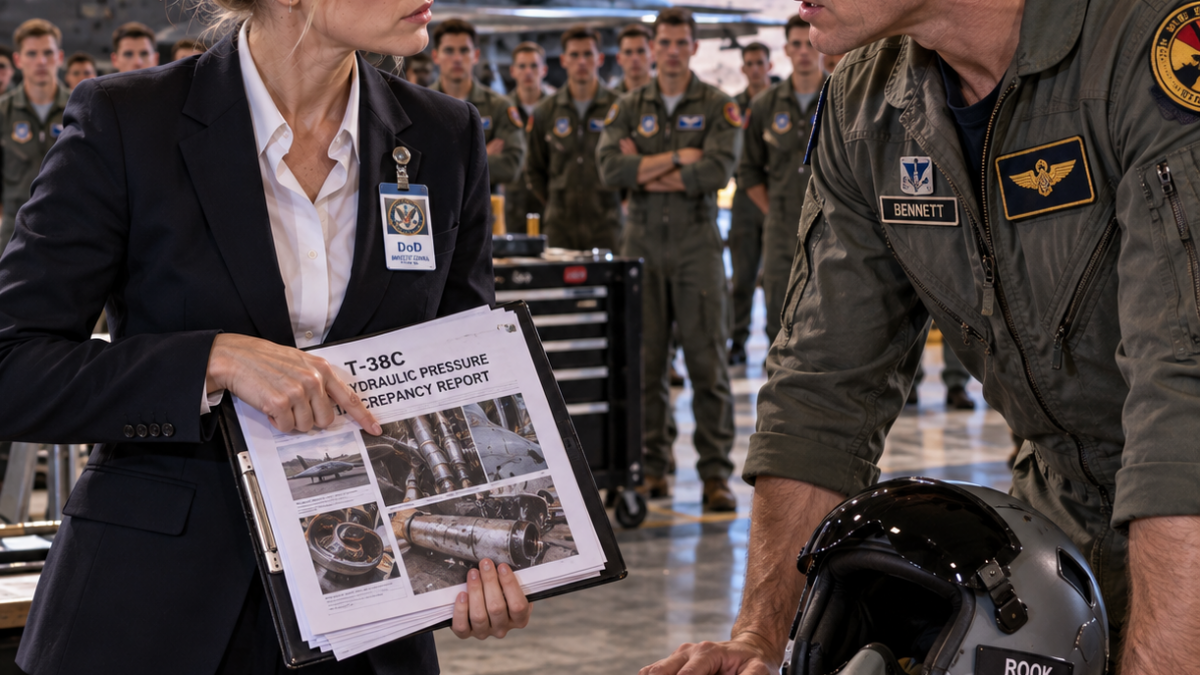
Three maintenance reports landed in front of him.
Tail 312.
All T-38C trainers assigned to his unit.
All had repeated hydraulic-pressure abnormalities.
All had been returned to flight under waivers carrying Bennett’s electronic authorization.
“Normal aging,” he said instantly.
I looked at him.
“That’s interesting.”
“What?”
“You answered before reading them.”
For the first time, he actually looked down.
Two weeks earlier, three junior maintainers had submitted protected hazard notifications.
Metal debris in a hydraulic filter.
Intermittent pump chatter.
Seal degradation around a pitch-control actuator.
Each maintainer recommended grounding until inspection.
Each report had been downgraded within hours.
Flight-safety discrepancy became monitor-only.
Bennett leaned back.
“You’re making a lot out of paperwork.”
“I’ve buried friends whose accidents started as paperwork.”
His mouth tightened.
“We have readiness standards.”
“And your people are being pressured to sign aircraft safe.”
He stood.
“Careful.”
I had heard that tone from colonels, test directors, contractors, and one former husband who mistook volume for authority.
It no longer accelerated my pulse.
“Who’s pressuring them, Major?”
“Nobody.”
He grabbed his helmet and headed toward the door.
That was when I noticed the flight card protruding from his pocket.
Tail 317.
Scheduled departure: 1540.
I checked my watch.
3:18.
“You’re going to fly it.”
Bennett turned.
A small smile returned.
“If your hydraulic catastrophe is real, Inspector, you can watch me bring the jet back myself.”
He left.
I gathered the reports.
Then I saw something I had missed during the first review.
The same administrator account had edited all three maintenance classifications.
I knew the name.
Captain Raymond Ellis.
I also knew something else.
Ellis had been dead for six months.
part2
For perhaps five seconds, I stood alone in Bennett’s office staring at the username.
Dead officers do not log into maintenance systems.
They certainly do not return from the grave to downgrade hydraulic defects in July, August, and September.
I photographed the audit entries with my secure tablet, locked the portfolio, and headed for the flight line.
Tail 317 was already taxiing.
Heat shimmered behind its engines, bending the desert horizon.
Ground crews moved between equipment carts.
Bennett rolled toward Taxiway Charlie like a man who believed everyone eventually chose obedience over confrontation.
I did not chase his jet.
I turned left and climbed the tower stairs.
Master Sergeant Elena Park looked up when I entered.
“Ma’am, restricted area.”
I opened my credential wallet.
“Priority One safety restriction. Tail 317.”
Her expression changed immediately.
No argument.
No posturing.
Just competence.
She scanned the directive, reached for her headset, and transmitted.
“Rook One, Redstone Tower. Hold short Runway Two-Seven. Confirm hold.”
Static.
Then Bennett.
“Tower, Rook One. Request reason.”
“Priority One grounding directive.”
Pause.
“Source?”
Park looked at me.
“Department of Defense Inspector General, Aerospace Safety.”
She keyed the microphone.
“Directive issued by DOD IG Aerospace Safety. Shut down and await tow.”
Four seconds passed.
Everyone in that tower understood what Bennett was considering.
Cross the line.
Force the confrontation.
Turn an argument into an irreversible violation.
Then the engines began winding down.
From the tower glass, I watched the canopy rise.
Bennett climbed out in front of students, maintainers, and a tow crew.
Humiliation makes cautious people reflective.
Men like Bennett often become more dangerous.
An hour later, we sat inside Colonel Marcus Hale’s office.
Chief Master Sergeant Daniel Ruiz stood near the desk.
Bennett sat across from Hale gripping his helmet.
I explained the three reports.
“Chief?” Hale asked.
Ruiz had already ordered inspection.
“They’re borescoping the pitch-control assembly now.”
Bennett shook his head.
“These jets pass operational checks.”
“Not every check.”
He glared at me.
“Three protected reports recommended grounding.”
Hale looked toward Ruiz.
“Who downgraded them?”
“Records show Captain Ellis’s credentials.”
Ruiz stopped breathing for half a second.
Hale frowned.
“Ellis is dead.”
“Exactly.”
Bennett looked down.
Tiny reaction.
Enough.
“You knew the account was being used?”
His head snapped up.
“No.”
“Then why look away?”
“This entire thing is ridiculous.”
A knock interrupted us.
A technical sergeant entered carrying a sealed inspection folder.
Ruiz read the first page.
His face changed.
“Chief?” Hale asked.
“Metal contamination in the hydraulic return line. Progressive fracture indications around the primary pitch-trim actuator housing.”
Silence.
Hale asked the obvious question.
“If it had flown?”
Ruiz chose his words carefully.
“At high dynamic load, the actuator could seize.”
“Recoverable?”
“If it locked at speed…”
He didn’t finish.
Nobody needed him to.
Bennett stared at his helmet.
“But it didn’t.”
That sentence changed the room.
Not because it proved a crime.
Because it revealed his math.
The jet had not crashed.
Therefore his decision had been acceptable.
Nobody had died.
Therefore the warnings had been exaggerated.
Luck had become evidence.
Colonel Hale leaned back.
“Major Bennett, you are removed from flight status effective immediately.”
Bennett looked up.
“Sir—”
“Your badge.”
“You can’t be serious.”
“My maintenance chief just told me you attempted to fly an aircraft with a component that may have seized under load.”
“I was demonstrating confidence in the airframe.”
Hale’s eyes hardened.
“No. You were trying to win an argument.”
Bennett unclipped his badge.
Placed it on the desk.
When he looked at me, I expected anger.
What I saw was calculation.
That worried me more.
After Bennett left, I showed Hale the account logs.
“Could Ellis’s credentials have remained active accidentally?”
“Possibly.”
“But accidents don’t repeatedly modify the same category of safety reports.”
Hale rubbed his jaw.
“Who has administrator privileges?”
“That’s what I intend to learn.”
The next morning, I met the maintainers who had filed the complaints.
Airman First Class Kayla Morris was twenty, small enough that her reflective vest swallowed her shoulders.
She kept glancing toward the door.
“You can close it.”
She did.
Then sat with both hands tucked beneath her thighs.
“We were told reports were confidential.”
“They are.”
“Then why did Major Bennett know which shift filed mine?”
That narrowed the room.
“What did he say?”
“He walked through maintenance the next morning and said people who couldn’t handle operational pressure should reconsider aviation.”
“Who heard it?”
“Everyone.”
“What happened next?”
“My supervisor moved me to overnight inspections.”
“When?”
“Same day.”
“Who ordered it?”
She hesitated.
Then removed a folded paper from her pocket.
Printed email.
Reassignment order.
Authorization line from Colonel Hale’s executive office.
Per command guidance, redistribute personnel creating unnecessary friction in readiness reporting.
Unnecessary friction.
Organizations develop euphemisms the same way families do.
After enough repetition, nobody notices how much dishonesty fits inside ordinary words.
Readiness was supposed to mean aircraft capable of safely completing missions.
Somewhere inside Redstone, it had started meaning aircraft that could remain green on a spreadsheet.
Friction apparently meant anyone who pointed out the difference.
“Who signed this?”
“Lieutenant Colonel Aaron Pike.”
Hale’s deputy commander for operations.
“Did Pike speak to you?”
“No.”
“Bennett?”
“Twice.”
“About hydraulics?”
“Not directly.”
Her eyes dropped.
“He asked whether I wanted to spend my enlistment fixing trainer jets or whether I wanted recommendations for better assignments.”
“What did that mean to you?”
“Stop reporting things.”
I thanked her.
After she left, Hale appeared at my office.
“You interviewed Morris.”
“I did.”
“She filed one of the anonymous complaints?”
“I won’t identify protected reporters.”
He gave me a tired look.
“Natalie, I know who works in my wing.”
“And somebody inside your command knew enough to punish one of them.”
I handed him the email.
He read it.
Confusion appeared.
“I never issued this guidance.”
“But it came from your office.”
“Pike signs routine personnel movements.”
“Was retaliating against a safety reporter routine?”
His expression hardened.
“Watch your wording.”
“Give me better wording.”
He came inside and shut the door.
“Pike told me junior maintainers were abusing the hazard system because they lacked confidence making shop-level judgments.”
“Did you verify that?”
“No.”
The answer cost him.
I had known Marcus Hale fifteen years earlier at Edwards.
He had been respected because he listened to technicians before deciding what a machine was doing.
Watching him now, I understood the deeper failure might not be corruption.
It might be delegation.
He had become busy enough to outsource his conscience.
“Where’s Pike?”
“Washington. Readiness conference.”
“When did he leave?”
“Sunday.”
Convenient.
“I want eighteen months of maintenance status changes. Administrator logins. Readiness reporting above wing level. And Captain Ellis’s full file.”
“Ray Ellis?”
“Yes.”
Hale’s expression shifted.
“He killed himself.”
I stared.
My briefing packet described a single-vehicle motorcycle crash.
Hale continued.
“He went off a canyon road after midnight. Investigation found no braking evidence. His wife told OSI he’d been depressed.”
“When?”
“April ninth.”
I opened the account history.
The earliest unauthorized login using Ellis’s credentials occurred April tenth.
Less than twelve hours after his death.
That afternoon, Chief Ruiz brought me into the archived records room.
We compared paper maintenance sheets against final database entries.
By 4:30, fourteen discrepancies had been softened.
Original:
HYDRAULIC PUMP OUTPUT UNSTABLE UNDER LOAD. GROUND PENDING COMPONENT INSPECTION.
Final:
MINOR PRESSURE VARIATION. MONITOR NEXT SERVICE INTERVAL.
“Who can change these?”
“Maintenance control. QA. Command admin.”
“Pilots?”
“Not directly.”
“Can Bennett request it?”
Ruiz gave me a look.
“Majors can request anything. Doesn’t mean anyone should do it.”
At six, he pulled a paper folder from the shelf.
“This shouldn’t be here.”
Inside was an incident report involving Second Lieutenant Emma Carver.
Eight months earlier, she experienced severe control stiffness during a high-speed training descent.
Declared emergency.
Landed safely.
The official summary called it pilot-induced control mismanagement.
The handwritten maintenance worksheet said something else.
Possible pitch-actuator binding.
Metal debris observed.
“Was the aircraft grounded?”
“Two days.”
“What happened?”
A command waiver.
Major Bennett.
Approved by Lieutenant Colonel Pike.
The same aircraft flew thirteen more sorties before the actuator was quietly replaced during scheduled maintenance.
“Where is Carver?”
Ruiz looked uncomfortable.
“She washed out.”
“For what?”
“Loss of confidence under flight stress.”
I stared at the report.
The wing had blamed a student pilot for responding to a mechanical problem it already suspected was real.
That night, I found Emma’s number.
She answered on the fourth ring.
“Natalie Mercer. DOD Inspector General.”
Silence.
Then:
“Did somebody finally crash?”
I told her no.
Relief lasted perhaps two seconds.
Then anger.
“I told them something was wrong.”
“I need you to walk me through it.”
“I told tower. Bennett. Maintenance. The board. Everybody.”
“What did Bennett say?”
“That the data didn’t show sustained actuator failure.”
“And Pike?”
“That inexperienced pilots sometimes interpret normal resistance as malfunction.”
She laughed bitterly.
“I had a hundred eighty training hours. Enough to fly formation at four hundred knots, apparently not enough to know when the stick felt like concrete.”
“Did anyone threaten you?”
“Not directly.”
That made sense.
Direct threats leave cleaner evidence.
Emma described remedial simulators.
Additional evaluations.
Comments about confidence.
Bennett told her fighter aviation required pilots who trusted their aircraft.
Which sounds reasonable until trust becomes another word for ignoring the airplane.
Eventually, she accepted separation.
“Do you still have anything?”
Pause.
“My cockpit audio.”
I stopped writing.
“How?”
“My dad bought me a recorder for training notes. I used it through my helmet adapter so I could review radio discipline.”
“Send it.”
Thirty minutes later, the file appeared through an approved evidence portal.
Routine calls.
Then her breathing changed.
“Redstone, Hawk Two. Intermittent pitch restriction.”
Tower acknowledged.
A second voice came onto squadron frequency.
Bennett.
“Hawk Two, instruments normal?”
“Pressure fluctuating.”
“Control check.”
“Performed. Stick force increasing.”
“Probably trim loading. Continue profile.”
His voice was completely calm.
That was the worst part.
Emma flew four more minutes.
Then refused.
Declared emergency.
Returned safely.
She saved herself.
The next morning, I played the recording for Hale.
When it ended, he removed his glasses.
“I signed her separation recommendation.”
“Did you know about the recording?”
“No.”
“The maintenance finding?”
“No.”
“Did Pike brief you?”
“He said the board concluded pilot handling.”
I placed the handwritten worksheet in front of him.
He read slowly.
“I should’ve asked.”
“Yes.”
His eyes snapped toward me, almost as though he expected comfort.
I didn’t give it.
Leadership is not innocence plus a busy calendar.
If people repeatedly use your authority to hurt others, there comes a point where failure to know becomes a failure of its own.
“We need Pike back.”
“I’ll recall him.”
“You also need to stay out of evidence collection.”
His jaw tightened.
“This is my wing.”
“Exactly.”
Silence.
Then he nodded.
That afternoon, Bennett appeared outside my workroom wearing service dress instead of a flight suit.
“Can we talk?”
“You have counsel available.”
“I don’t need counsel.”
“That’s usually when people need it most.”
He closed the door.
“I heard you found Carver.”
“Who told you?”
He ignored me.
“Emma wasn’t ready.”
“She flew an aircraft with a documented control anomaly.”
“After the fact.”
“Metal was in the filter that day.”
His face hardened.
“You don’t understand what was happening that year. Training numbers were collapsing. Headquarters threatened to move slots. We were told to stop treating every maintenance squawk like catastrophe.”
“Who told you?”
He hesitated.
Useful.
“Pike?”
Silence.
I waited.
“You think this ends with me because I signed three waivers?”
“I don’t think it ends with you.”
His eyes moved toward the hall.
“Then you’re smarter than I thought.”
I almost laughed.
“You mocked me because you thought I couldn’t tell an F-15 from office furniture.”
“I thought you were another auditor.”
“I am an auditor.”
“No.”
He looked at me.
“You’re digging.”
“What am I going to find?”
A long pause.
“There was a program.”
“What program?”
“Not official.”
“Name.”
“Green Line.”
“What was it?”
“Readiness management.”
“That means nothing.”
“If a squadron fell below a percentage, headquarters flagged it. Pike held Monday reviews. Anything that could legally be deferred got deferred.”
“That’s normal.”
“At first.”
“And later?”
His voice dropped.
“The definition of legally got flexible.”
“Who altered Ellis’s account?”
Bennett’s face changed.
“You know.”
“Ray had access.”
“He’s dead.”
Bennett leaned closer.
“That’s why you should stop saying his name loudly.”
I stared at him.
“Threat?”
“No.”
Quiet.
“Advice.”
Then he left.
I searched Green Line.
Shared drives.
Email archives.
Command calendars.
Nothing.
At 7:12, the evidence server sent an automated alert.
Someone had attempted to delete the maintenance archive I requested.
The login came from inside the wing command suite.
Badge records showed only one person entered during the previous hour.
Major Cole Bennett.
Security found him beside his truck twenty minutes later.
He did not resist.
Did not seem surprised.
Then cyber called.
The deletion came through Bennett’s credentials.
But not Bennett’s computer.
His authentication token had been cloned.
When I told him, he almost smiled.
“Still think I’m the whole problem?”
“No.”
I sat across from him.
“I think you’ve been useful to the whole problem.”
The smile disappeared.
“You signed waivers. Pressured pilots. Intimidated maintainers. Helped destroy Emma Carver’s career. Somebody worse above you doesn’t erase your choices.”
“I never said it did.”
“You keep talking like one layer below the worst person makes you innocent.”
He leaned forward.
“You want the truth? I liked winning.”
I waited.
“I liked being the pilot commanders called when everybody else said the mission couldn’t happen.”
“And Pike rewarded that.”
“Yes.”
“So eventually you stopped asking why responsible people were saying no.”
He looked away.
“Maybe.”
“What about Ellis?”
Silence.
“Cole.”
Finally:
“Ray started Green Line.”
That surprised me.
Bennett explained.
Ellis was brilliant with data.
Maintenance codes.
Parts projections.
Sortie scheduling.
He created a system showing where delays would occur before they became mission problems.
Useful.
Until Pike realized senior headquarters only saw the final percentages.
“You could make readiness improve without fixing the aircraft,” I said.
“You could reclassify downtime.”
“Move grounding discrepancies into deferred categories.”
“Exactly.”
“Keep broken aircraft statistically available.”
Bennett nodded.
“And Ellis objected.”
“Eventually.”
“What changed?”
“Carver.”
Her emergency showed Ellis what his tool had become.
“Did he report it?”
“I don’t know.”
“You do.”
He closed his eyes.
“He told me he was going outside the wing.”
“Where?”
“IG. Safety Center. Maybe OSI.”
“When?”
“Two days before he died.”
The room went still.
I did not jump to murder.
Investigators who fall in love with conspiracy stop seeing evidence.
Accidents exist.
Suicide exists.
Coincidence exists.
But somebody had begun using Ellis’s credentials hours after his death.
Whatever killed him, someone found opportunity.
“Who knew he planned to report?”
“Pike.”
“Anyone else?”
“Hale, maybe.”
“You?”
“Ray told me.”
“And what did you say?”
His voice became small.
“I told him he’d destroy the squadron.”
I heard the shame.
“What did Ray say?”
“He asked whether I’d rather destroy a squadron on paper or a student in an airplane.”
Bennett rubbed his thumb against the table.
“I told him he was dramatic.”
Emma Carver nearly lost control.
Ray Ellis recognized the pattern.
Cole Bennett chose the interpretation that protected his career.
I called the investigator reopening Ellis’s death.
Pike arrived from Washington at 10:40 that night.
Lieutenant Colonel Aaron Pike was fifty-one, immaculate, soft-spoken, and immediately more unsettling than Bennett because he needed no audience.
He entered with a slim briefcase.
Greeted everyone by rank.
Asked whether he should contact counsel.
“That is your choice.”
“I think I will.”
“Then we wait.”
He smiled.
“Inspector Mercer.”
“Yes.”
“I’ve heard about your arrival.”
“I’m sure.”
“This has become unnecessarily disruptive.”
There it was again.
Disruptive.
“To what?”
“Training.”
“Three unsafe aircraft were identified.”
“Preliminary findings.”
“One actuator was cracking.”
“Then grounding it was correct.”
I studied him.
“You agree?”
“I agree with verified evidence.”
“But not reports?”
“Junior personnel make mistakes.”
“So do lieutenant colonels.”
His smile narrowed.
With counsel present, Pike denied altering records.
Described Green Line as a legitimate management initiative.
Claimed Ellis independently created the reclassification system.
Suggested Bennett became too aggressive.
Elegant.
Blame the dead man for the architecture.
Blame the reckless subordinate for the damage.
Then I asked one question.
“Why was Ellis’s account still active after he died?”
“I don’t manage network access.”
“Someone used his credentials at 6:14 the next morning.”
“I wouldn’t know.”
“The first modification reclassified Emma Carver’s aircraft event.”
“I still wouldn’t know.”
The cyber investigator slid a page across the table.
The login came from a command-suite workstation.
Pike’s workstation.
For the first time, something moved in his face.
Tiny.
Enough.
The next morning investigators recovered Ellis’s personal laptop from his widow.
Most files had been wiped.
One encrypted folder remained.
Its title:
IF THEY BLAME THE PILOT.
Ellis had taped the hardware encryption key beneath a desk drawer.
His widow sat holding coffee while technicians opened the folder.
Forty-seven files.
The first dozen showed Green Line in its original form.
A legitimate readiness tool.
Identify parts shortages.
Scheduling problems.
Avoidable delays.
Repeatedly, Ellis excluded safety grounding codes from optimization.
Then Pike’s edits appeared.
Too restrictive.
Command judgment required.
Later:
Recoverable discrepancies.
Not a formal maintenance category.
But soon it meant anything unlikely to fail during the next scheduled sortie.
Hydraulic seepage.
Electrical faults.
Unexplained vibration.
Control resistance.
Green Line did not falsify the actual condition.
It changed the administrative label.
That was how the lie survived normal review.
Every single field could appear defensible.
Only the pattern revealed what the system was doing.
“Open file thirty-one.”
Audio.
Pike’s voice.
“We’re not hiding faults, Ray. We’re managing risk.”
Ellis:
“You’re managing reporting.”
“Same world.”
“No, sir.”
Pike continued.
“If availability drops under ninety-four percent, headquarters pulls eight training slots next fiscal year.”
“You can’t manufacture readiness by relabeling broken aircraft.”
“Nothing is broken until maintenance proves failure.”
My hands tightened.
There was the philosophy.
Warnings do not count.
Technicians do not count.
Pilots reporting strange behavior do not count.
Failure counts.
And when failure finally arrives, blame the person at the controls.
Ellis said:
“Carver nearly lost pitch authority.”
Pike answered:
“Carver overcontrolled.”
“The filter had metal.”
“Replace the filter.”
“Ground the aircraft.”
Then Pike:
“You built this dashboard. Don’t pretend you’re above what it takes to keep a wing operational.”
The recording ended.
Mrs. Ellis covered her mouth.
Her husband had helped create the thing that eventually frightened him.
Human beings rarely divide neatly into hero and villain.
Sometimes the person who built the problem is also the first person brave enough to admit what it became.
Another file contained Ellis’s draft complaint.
Air Force Safety Center.
Inspector General.
Pike named.
Bennett named.
Colonel Hale named too.
Not as participant.
As a commander repeatedly shielded from adverse information through curated readiness briefings.
Important distinction.
Hale had not ordered fraud.
But people had learned which numbers made him happy.
I brought him the document.
He read the paragraph twice.
“I created this.”
“You didn’t create Green Line.”
“I created a wing where bringing me bad numbers felt like failure.”
He looked through the window.
“Every Monday I asked why availability was down. Every Thursday I asked how fast it could recover.”
“Did you tell anyone to falsify records?”
“No.”
“Then don’t confess to crimes you didn’t commit.”
He looked at me.
“But don’t pretend culture is innocent just because culture isn’t illegal.”
His jaw tightened.
“That part belongs to you.”
At noon, Pike was suspended.
Bennett requested another interview.
This time counsel came.
He admitted pressuring maintainers.
Signing waivers without reviewing full technical findings.
Participating in Emma’s remedial process despite hearing her report the control problem in real time.
Then he said:
“I changed my call sign because of Ellis.”
“Vapor Nine?”
He nodded.
“After the Baltic crash, people started making jokes. Vapor because I disappeared when things got bad.”
“Did Ellis give you the name?”
“No.”
Bennett looked toward the hangars.
“He told me I cared more about the story of being a fighter pilot than whether I deserved to be one.”
“You hated him.”
“Yes.”
“When Carver had her incident?”
“Ray asked if I learned anything from ejecting over the Baltic.”
“What did you tell him?”
“That the board cleared me.”
“And he said?”
Bennett swallowed.
“Surviving your mistake doesn’t turn it into a good decision.”
I wrote it down.
By sunset, investigators had enough to refer Pike for criminal investigation.
Bennett faced separate proceedings.
Hale voluntarily requested relief from command while the investigation continued.
It should have felt finished.
At 8:30 that night, Chief Ruiz called from the depot hangar.
“You need to see this.”
Tail 317’s actuator lay beneath bright white lamps.
Beside it sat two replacement assemblies removed from sealed containers.
Ruiz pointed at serial numbers.
“They’re supposed to be new-old-stock.”
“They’re not?”
“Previously installed.”
“How do you know?”
“Tool marks. Wear. Somebody ground away original tracking stamps.”
My stomach tightened.
“How many?”
“No idea.”
“Supplier?”
He handed me a procurement sheet.
Desert Crest Aviation.
Private aerospace contractor outside Phoenix.
Approval signature:
Lieutenant Colonel Aaron Pike.
Green Line was not only hiding unsafe airplanes.
Someone had also been feeding questionable parts into the fleet.
The parts investigation changed everything.
Twenty-six components from Desert Crest.
Eleven previously installed.
Four with incomplete traceability.
Two serial numbers belonging to parts officially listed as destroyed.
Desert Crest’s website displayed American flags, spotless warehouses, smiling technicians, and several paragraphs about supporting the warfighter.
Its president was Randall Pike.
Aaron Pike’s older brother.
Nobody needed me to explain the conflict.
Aaron had not signed the original vendor award.
He did repeatedly approve urgent operational purchases that bypassed normal waiting periods whenever parts shortages threatened readiness.
Desert Crest charged premium prices.
Some parts were not what the paperwork claimed.
The cycle became obvious.
Questionable component entered supply.
Maintenance installed it.
Aircraft developed symptoms.
Green Line softened those symptoms.
Aircraft remained statistically available.
Pike’s readiness percentage survived.
Desert Crest kept selling.
Pilots like Emma Carver were told the jet was fine.
Bennett’s arrogance had looked like the story on my first day.
Now it looked almost small.
He was product and accomplice.
The system rewarded exactly the kind of pilot willing to say yes after more responsible people said no.
Emma returned to Nevada for formal interviews.
She wore jeans and a gray sweater and stared at the runway for several seconds before entering the building.
“I didn’t think I’d ever come back.”
“You didn’t have to.”
“Yes.”
She looked at me.
“I did.”
Investigators played her cockpit audio beside the maintenance evidence.
Emma did not cry hearing her own frightened breathing.
She cried when Ruiz showed her photographs of metal contamination from the actuator.
“So I was right.”
Nobody answered quickly enough.
She laughed through tears.
“That’s stupid. I know I was right. I know what happened.”
She wiped her face.
“But for three years I kept wondering whether maybe they were right about me.”
Bennett was waiting nearby for another proceeding.
Emma asked to see him.
Her attorney advised against it.
She insisted.
I remained as witness.
Bennett stood when she entered.
“Emma.”
“Don’t.”
He sat.
She looked at him.
“When I told you those controls were locking, did you believe me?”
Bennett glanced at counsel.
Emma shook her head.
“Not legally. Not technically. You.”
She leaned forward.
“Did you believe me?”
He looked at his hands.
“Yes.”
Barely audible.
Emma closed her eyes.
“Then why?”
“If I grounded the jet, Pike would ask questions. Ellis would push maintenance. Numbers were down. And I thought…”
“What?”
“That you’d land.”
She stared.
“You thought I’d land.”
“Yes.”
“And if I didn’t?”
No answer.
Emma stood.
Bennett looked up.
“I’m sorry.”
She picked up her coat.
“I spent three years needing to hear you say I was right.”
Then she looked directly at him.
“I don’t need anything else from you.”
She left.
She did not forgive him.
I was glad.
Forgiveness has value when it frees the injured person.
It becomes something uglier when outsiders demand it because consequences make them uncomfortable.
Formal proceedings moved quickly after that.
Pike was removed and referred for prosecution involving false records, contracting conflicts, unauthorized system access, and retaliation.
Desert Crest contracts were suspended.
Bennett accepted responsibility for multiple safety and administrative violations while disputing the most serious criminal allegation.
Hale’s case was different.
No evidence showed he knew about the parts fraud.
No evidence he ordered falsification.
The command review relieved him anyway.
When he packed his office, I found him holding the wing-readiness award from the previous year.
“Ninety-seven point eight percent.”
I looked at the plaque.
“Beautiful number.”
“Meaningless.”
“Not meaningless.”
He looked at me.
“It told your people exactly what you rewarded.”
Hale put the plaque into a cardboard box.
“I spent thirty years telling officers integrity mattered.”
“You probably believed it.”
“Does that improve anything?”
“No.”
He nodded.
That was our final conversation as inspector and commander.
Two weeks later, the Air Force ordered limited fleet-wide inspections for the suspect component batch.
Other installations found questionable parts.
No known catastrophic failures.
Redstone grounded nine more aircraft.
Training schedules collapsed.
Headquarters complained.
Nobody died.
That mattered more.
On my final afternoon at Redstone, I walked through Hangar Three.
The same cadets who had laughed when Bennett mocked me stood around Chief Ruiz.
An open hydraulic assembly rested on a workbench.
One cadet recognized me.
“Ma’am?”
I stopped.
“About your first day…”
“You laughed.”
He flushed.
“Yes, ma’am.”
“So did everyone.”
“I wanted to apologize.”
“Learn something instead.”
He looked up.
I pointed toward the actuator.
“Ask Chief Ruiz why an aircraft can pass a cockpit check and still be unsafe under load.”
The cadet turned.
Ruiz gave him the faintest smile.
“Good question.”
And they went back to work.
Six months later, I met Emma Carver at a diner outside Dayton.
She walked in wearing a brown civilian flight jacket.
Sat across from me.
Stole one of my fries.
Then said:
“I’m flying again.”
“What?”
“Cessna 172.”
“That counts.”
“You know what I mean.”
“I’ve flown aircraft worth eighty million dollars that behaved worse than a properly maintained Cessna.”
She laughed.
She was working toward a civilian instructor rating.
Her military record had been reviewed.
The finding that her emergency resulted from pilot-induced control mismanagement was removed.
“They offered reinstatement.”
“Do you want it?”
“No.”
She answered instantly.
“They took flying away from me.”
She looked out the window.
“I don’t want them deciding how I get it back.”
I understood.
Bennett never returned to military flight status.
His case ended through administrative punishment and a negotiated disposition after he provided substantial testimony about Green Line and Pike’s pressure.
Some believed he deserved prison.
Others thought the loss of his career was enough.
Eventually I stopped trying to calculate the exact amount of suffering that would make the past fair.
Consequences are not revenge.
Their purpose is not to make pain symmetrical.
Their purpose is to stop behavior from repeating.
Aaron Pike’s case lasted longer.
Investigators established that he concealed his family relationship during emergency purchases, used Ellis’s credentials after Ellis died, encouraged manipulation of readiness data, and retaliated against people who threatened the system.
Desert Crest paid millions in restitution.
No evidence ever showed Pike caused Ellis’s death.
The motorcycle investigation reopened.
It ended where the first one had.
Ray Ellis drove off the canyon road himself.
His widow told me she had spent months hoping someone else caused it because anger was easier to carry than grief.
Instead, she was left with something less clean.
A husband who built a useful system.
Watched it become dangerous.
Tried to stop it.
Became terrified of what he had helped create.
Then died before learning whether telling the truth mattered.
His evidence mattered.
His death did not become noble because of it.
Life is rarely tidy enough to give grief that kind of structure.
Colonel Hale retired early.
Before leaving, he sent a letter to the maintenance groups he once commanded.
Chief Ruiz forwarded one paragraph with permission.
Leaders often imagine integrity is tested when someone asks them to commit an obvious wrong. More often, it is tested when a subordinate brings information that threatens the story a leader wants to believe.
I saved that.
Not because it absolved him.
Because it was true.
Redstone changed.
Safety discrepancies could no longer be downgraded by operations personnel without independent maintenance concurrence.
Protected hazard reports were separated from routine personnel systems.
Readiness briefings displayed causes for grounded aircraft instead of one seductive green percentage.
For months, the wing looked terrible.
Availability dropped.
Sorties canceled.
Promotion packages looked less impressive.
Then something happened.
Maintenance stabilized.
Technicians grounded aircraft early.
Small problems stopped becoming expensive ones.
Supply planners finally received honest demand signals.
Pilots learned that raising a maintenance concern did not automatically create questions about confidence.
Within a year, Redstone’s genuine availability exceeded the number Green Line had been manufacturing.
Chief Ruiz called.
“You’ll like this.”
“Probably not.”
“Ninety-five point one.”
“You called an IG inspector about a percentage?”
“A real percentage.”
I laughed.
“That is different.”
My final visit to Redstone came months later.
Hangar Three stood open to the desert wind.
The yellow safety stripe still crossed the floor, faded by thousands of boots.
A new instructor stood beside an F-15.
Young.
I did not recognize him.
He did not recognize me.
Perfect.
A cadet raised her hand.
“If a hydraulic caution disappears after reset, can we continue the profile?”
The instructor shook his head.
“No.”
I stopped walking.
“A disappearing warning is information, not permission.”
Simple sentence.
Six months earlier, half the leadership structure at Redstone behaved as though uncertainty was weakness.
Now young pilots were being taught that machines did not owe them certainty before earning respect.
The instructor continued.
“If maintenance wants the airplane, they get the airplane. Nobody earns points proving a caution light wrong.”
One cadet smiled.
“Even during a check ride?”
“Especially then.”
I left before anyone noticed me.
Outside, sunlight dropped behind the hills.
A T-38 moved toward the runway.
Paused at the hold line.
Waited.
Years earlier, before my spinal injury ended my test-pilot career, I thought the hardest part of aviation was learning how close you could take a machine to its limit without losing it.
Age corrected me.
The hardest part is knowing when not to go.
When the warning matters more than the schedule.
When the twenty-year-old mechanic with grease on her sleeve deserves more attention than the decorated pilot with thousands of hours.
When surviving one bad decision does not transform it into a good one.
I remembered Bennett tapping his helmet that first afternoon.
Ever flown a real jet?
He thought the question established a hierarchy.
Pilots above auditors.
Experience above caution.
Confidence above doubt.
He had been wrong about all three.
The best aviators I ever knew were rarely the loudest people in the hangar.
They understood something arrogant people forget.
The sky does not recognize rank.
Physics does not care about your reputation.
Metal does not respect confidence.
A machine does not become safe because enough powerful people agree to call it safe.
Tail 317 accelerated down the runway.
Its nose lifted.
Gear folded.
The aircraft climbed into the Nevada sky.
I watched until it became a bright speck.
Then my phone vibrated.
Emma.
A photograph from the cockpit of a little Cessna over Ohio farmland.
Below it:
Passed my instructor check ride.
I smiled.
Typed back:
Good. Teach them to listen to the airplane.
Then I put the phone away.
Drove off Redstone.
And for the first time since walking into Hangar Three, I did not think about Bennett’s old call sign.
I thought about Kayla Morris filing the report everyone wanted softened.
Emma trusting the controls in her hands more than the men telling her the aircraft was fine.
Ray Ellis leaving behind enough evidence to expose what his own system became.
Marcus Hale finally admitting that leadership can create dishonesty without ever issuing an illegal order.
Chief Ruiz teaching cadets why machines fail.
The new instructor telling students that a warning disappearing is not permission.
Those were the things that mattered.
Not humiliating a pilot.
Not knowing his hidden history.
Not proving I had once flown faster aircraft than the man who laughed at me.
The real victory was simpler.
The next young pilot who felt a control stiffen would be believed.
The next maintainer who found metal in a filter could say so without being sent to midnight shift.
The next commander would see why the aircraft was grounded instead of receiving a perfect percentage built from manipulated categories.
And somewhere over Ohio, Emma Carver was flying again because she chose the way back herself.
That was enough.
More than enough.
The desert highway stretched west beneath a clear evening sky.
I kept driving.
Behind me, Redstone finally had fewer green boxes on its slides.
And safer airplanes in the air.