𝙍𝙚𝙖𝙙𝙈𝙤𝙧𝙚👉 My Mother-in-Law Put One Word on My Place Card, Certain the Whole Room Would Laugh With Her
part2
It was not.
But before he reached us, I thought about how Celeste had arrived at that single word.
Freeloader.
It had taken twelve years.
Not one argument.
Not one misunderstanding.
A long accumulation of assumptions she liked too much to examine.
I met Caleb in Norfolk in the summer of 2012 after a thunderstorm flooded streets around Waterside. I had stopped at a waterfront restaurant with two officers from my unit. He sat at the next table with several architects celebrating a restoration project.
He asked which highway entrance remained open.
We talked about flooded roads.
Then buildings.
Then the Navy.
I expected him to lose interest when I explained that I worked in logistics.
Most people heard supply officer and imagined warehouses, clipboards, canned food, and forms.
Caleb asked how a ship carrying thousands of people avoided running short of food while deployed.
That question changed everything.
I explained advance planning.
Replenishment windows.
Parts inventories.
Fuel.
Repair cycles.
He asked follow-up questions.
When I explained how one missing valve could hold up an entire maintenance operation, he compared it to a contractor pouring concrete before the correct fittings arrived.
We talked until employees began stacking chairs.
I drove home thinking I had met someone interested in my actual life.
Then I met his parents.
Martin greeted me in his garage with grease on both hands and asked whether the Navy still used diesel components he remembered from his service.
Celeste took my coat and asked what my parents did for work.
My father, Clark Ellis, supervised a distribution center outside Akron, Ohio.
Night shifts during holidays.
Fixed his own appliances.
Knew which grocery store was missing what before half the managers did.
He taught me that if you understood where things came from, where they needed to go, and what happened when they did not arrive, you understood a business better than someone staring at a balance sheet.
He was the only person at my commissioning who never asked if I planned to transfer into something “more exciting.”
Celeste listened long enough to hear the words distribution center.
Then asked whether my Navy job was basically managing a government grocery store.
I tried explaining.
She turned away to tell a housekeeper the flowers were arranged wrong.
Caleb apologized in the car.
“She can be difficult.”
I told him I had served under commanding officers with bigger egos.
What I did not understand yet was that those officers lived inside a system where authority came with accountability.
Celeste had built a social world where nobody required her to explain herself.
We married in 2014.
Small ceremony.
Friends.
Military colleagues.
Family from Ohio.
My father cried.
Martin gave a toast about choosing someone whose work you respect.
Celeste gave a toast about how relieved she was that Caleb had found a woman willing to tolerate his architectural schedule.
A small cut.
Easy to ignore.
The trouble became larger when we bought our first house.
Narrow two-story place in Virginia Beach.
Weathered cedar siding.
Screened porch.
Huge oak tree that filled the driveway with acorns every fall.
Caleb’s architecture practice was growing but unstable.
I was earning an officer’s salary and saving aggressively.
Martin offered us $72,000 toward the down payment.
I resisted.
He asked me to come see him alone.
He sat in his study surrounded by dealership photographs and mechanical watches he repaired himself.
“Dana, I’ve spent my life helping strangers finance cars.”
He pushed the paperwork toward me.
“I’d like to help my own family build something. I don’t want gratitude to become another bill you have to pay.”
We accepted.
For several months, I believed that was the end of it.
Then Celeste began mentioning the house.
At lunches.
Holidays.
Charity events.
“Martin had to step in.”
“Dana’s government salary only goes so far.”
“Thank goodness Caleb comes from people who know how to provide.”
At Thanksgiving, she joked that she hoped the military supplied enough paper towels so I would not need to take any from her kitchen.
Everybody laughed except Martin.
I laughed too.
That was my mistake.
The following January, I drove to Richmond alone.
I brought Martin a check for $800.
And a payment schedule.
Ninety monthly payments.
$72,000.
Full repayment.
He put on his reading glasses.
“Does Caleb know?”
“No.”
Martin removed the glasses.
“Marriage works better when people don’t keep private ledgers of sacrifice.”
He was right.
I was too hurt to hear it.
“I’m not repaying you because Caleb did anything wrong.”
“Then why?”
“Because I can’t listen to Celeste describe my home as something I took from your family.”
Martin stared at me for a long time.
Then accepted the first check.
“On one condition.”
“What?”
“You do not turn this into resentment against my son.”
“I won’t.”
“And someday I will explain this to Celeste.”
He almost smiled.
“She may hear it better from me.”
The payments became routine.
$800 every month.
Every January I sent Martin a summary.
He replied with handwritten notes.
Sometimes he asked about work.
Sometimes where I was deploying.
During deployments, I scheduled payments in advance.
Caleb knew we managed household expenses carefully.
He did not know about Martin.
That secret grew heavier over time.
I told myself it was about Martin’s privacy.
Partly true.
Mostly I did not want to admit how much Celeste’s words hurt.
If I told Caleb, he might confront her.
Then I would have to admit I needed defending.
So I created private control instead.
Repay the money.
End the argument without having it.
That solution worked financially.
Emotionally, it allowed Celeste’s story to spread unchecked.
She told relatives.
Friends.
Foundation donors.
Sometimes strangers congratulated Caleb for supporting a wife who supposedly spent her days ordering office supplies.
Audrey defended me occasionally.
But even she did not know enough to challenge the premise.
Then 2018 happened.
I was serving aboard an amphibious ship in the western Pacific.
A major storm struck an island chain east of the Philippines.
Flooded villages.
Destroyed roads.
No dependable water.
We shifted into disaster relief.
I was assistant supply officer.
Food.
Water.
Medical stores.
Repair equipment.
The first night, I slept in an office chair beside a printer spitting revised requests every fifteen minutes.
The problem with disaster logistics is that every map becomes outdated faster than you can brief it.
Road shown as open?
Bridge gone.
Landing field?
Flooded and filled with debris.
Beach access?
Reef damage.
Helicopters could not fly safely through the worst weather.
Landing craft fought currents and floating wreckage.
Every pallet sent ashore reduced what remained available for the next request.
Rear Admiral Nathaniel Vale supervised the response.
Our first real conversation happened beside the well deck.
He asked whether our stores could sustain operations while supporting displaced civilians.
I showed him calculations.
Revised crew consumption.
Scheduled replenishment.
Emergency reserve.
Risks if nearby port access failed.
“Can we do it?” he asked.
“Yes, sir. If we stay disciplined about where everything goes.”
He looked at sailors unloading pallets.
“Report major shortages directly. Don’t wait for normal chains if timing matters.”
That was all.
But it told me he understood logistics.
Not the glamorous part.
The necessary part.
On the third morning, Marines reported roughly two hundred civilians stranded beyond a destroyed causeway.
Families had been moved from a flooded clinic to an abandoned school.
Water was almost gone.
Several children were dehydrating.
The nearest navigable beach was on the wrong side of damaged reef.
The closer inlet was too shallow for our craft.
We had thousands of bottles on the ship.
They might as well have been on the moon.
I worked with the craft crew.
Smaller loads.
Bring the landing craft as close as the tide allowed.
Hand-transfer cases.
Carry through surf.
Temporary collection point.
The coxswain worried about weight.
I reduced the first load.
Then volunteered to go with it so I could adjust the next one from real conditions instead of guessing from a deck.
My department head approved.
I remember engines.
Saltwater.
Fuel.
Broken vegetation.
Ramp dropping.
Water slamming our legs.
Sailors forming a line.
Marines wading out.
Cases of bottled water held above the surf.
I slipped on broken coral and hit my eyebrow against a loose fitting.
Did not notice the blood until someone pointed it out.
A young Marine captain stood near shore directing civilians away from the landing area.
Sunburned.
Split lip.
Uniform filthy.
I handed him a case.
He looked at my insignia.
“Why is a lieutenant commander delivering water?”
“Because it doesn’t help anybody sitting on my ship.”
He laughed.
Then shouldered the case.
We repeated that run as conditions allowed.
Sailors.
Marines.
Medical teams.
Local volunteers.
An elderly teacher tracked families in a damp notebook protected inside a grocery bag.
A little girl in a yellow shirt carried two bottles to her grandmother.
A father refused water until neighbors received theirs.
Those are the things I remember.
Not headlines.
Not awards.
People holding what they had been waiting for.
Months later, Admiral Vale presented me with a Meritorious Service Medal aboard ship.
He thanked the entire logistics team.
Then quietly told me the Marine captain at the school was his son.
Gabriel.
I had not known.
He said Gabriel had told the family about the officer who refused to leave the water until deliveries were moving.
I was embarrassed.
Dozens of people had done harder work.
But I thanked him.
At Thanksgiving, Martin asked about the medal.
Celeste said government standards for awards must have gotten generous if paperwork qualified.
Audrey changed the subject.
Caleb squeezed my hand beneath the table.
And I let the conversation move on.
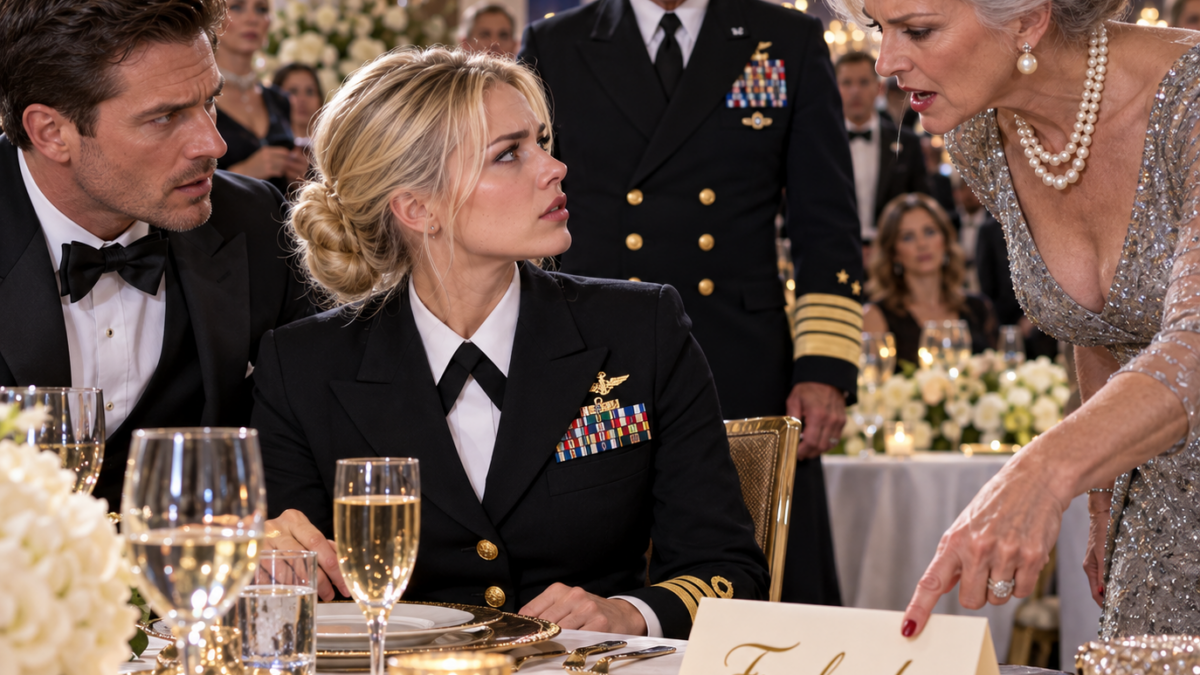
Eight years later, Admiral Vale reached the Riverlight gala table.
Celeste walked beside him.
Smiling.
She introduced everyone.
Then me.
“And this is my daughter-in-law Dana. You’ll have to forgive the joke on her place card, Admiral. We like to keep things lighthearted.”
Vale looked down.
Read Freeloader.
Then looked at me.
His eyes settled on the scar through my left eyebrow.
“Commander Ellis?”
My maiden name.
My throat tightened.
“Yes, sir.”
He reached across the table and shook my hand with both of his.
“Admiral. Good to see you.”
He looked at the card again.
“Whose handwriting is this?”
Celeste laughed.
“Mine. Dana has a wonderful sense of humor about being the least financially ambitious member of the family.”
He did not laugh.
He pulled a black pen from his jacket.
Turned the card over.
Wrote.
Several people around us grew quiet.
When he finished, he handed it toward Celeste.
“Read that aloud.”
Her smile widened.
She thought he had joined the joke.
She began.
“This officer helped bring food and water to thousands of storm survivors.”
Her voice slowed.
“Among them was my son.”
Silence around the table.
She looked at the remaining words.
Then at me.
Then at Vale.
She did not finish.
She placed the card beside her untouched wineglass.
Picked up her evening bag.
Walked out of the ballroom.
No announcement.
No excuse.
Gone.
Admiral Vale touched my shoulder.
“Gabriel is a major now. Still talks about that mission.”
Caleb held my hand so tightly my fingers hurt.
Audrey stared toward the doors.
I looked at Celeste’s empty chair.
I did not feel triumphant.
Mostly tired.
The gala continued.
That is one thing real life does better than drama.
It refuses to stop for your emotional climax.
The foundation director introduced the next speaker.
Marjorie assumed Celeste’s presentation duties.
Servers brought plates.
Auction volunteers circulated.
Guests whispered.
The word Freeloader remained on the front of the ivory card.
Vale never turned the evening into a tribute to me.
When someone asked about our connection, he said only that we had served together during humanitarian relief and that he respected Navy logistics personnel.
I appreciated that.
I did not want my career turned into entertainment for people who had watched Celeste insult me.
Before leaving, he wrapped the card in a clean paper napkin and handed it to me.
“Some things are worth keeping for the record.”
Caleb and I reached our car after ten.
Rain had started.
The garage smelled of concrete and exhaust.
He unlocked the car.
Then stopped.
“I’m ashamed of myself.”
I thought he meant Celeste.
He shook his head.
“I heard her say things for years.”
“Caleb—”
“No.”
He looked at the keys.
“I kept telling myself defending you privately was enough. Changing subjects. Saying she didn’t mean it. Asking you not to respond because Dad was caught in the middle.”
He swallowed.
“I made your silence convenient.”
That hurt more than the place card.
Because it was true.
We drove toward Virginia Beach.
Somewhere outside Williamsburg, Caleb asked why I had never simply told Celeste that we did not depend on his family financially.
I watched the windshield wipers.
Then told him about the payments.
“Ninety transfers.”
He looked at me.
“What?”
“Eight hundred dollars a month. January 2015 through June 2022.”
He pulled into a rest area.
Under a flickering lamp.
Turned toward me.
“You repaid Dad?”
“All of it.”
“And you never told me?”
“No.”
The hurt in his face made me wish I could reorganize eight years into a version that sounded less wrong.
“You told my father something that important, but you couldn’t tell your husband?”
“It came from my personal savings.”
“That isn’t the point.”
“I know.”
“It was our house.”
“I know.”
“You decided I couldn’t be trusted with the reason you were doing it.”
There it was.
My part.
Not equal to Celeste’s cruelty.
Still mine.
I explained.
Her comments.
The humiliation.
The need to know the house was ours without her money attached.
Then I admitted what mattered most.
“Keeping it secret meant I never had to ask you to confront her.”
Caleb looked away.
That landed on him too.
We sat in silence until another car pulled beside us.
Then he took my hand.
“We stop doing this.”
“What?”
“Protecting each other from conversations we should be having.”
I nodded.
The next morning I had forty-seven unread messages.
Apologies.
Curiosity disguised as concern.
People who wanted details for the next Richmond dinner.
One former neighbor sent a photograph taken before Admiral Vale arrived.
My place card upright.
Two women smiling behind it.
I stared at it too long.
Then called Tessa Alvarez.
Retired senior chief.
Had run shipboard food service during the relief operation.
She answered with the same voice she used when a galley depended on her judgment.
I told her everything.
Place card.
Vale.
Celeste leaving.
The house payments.
When I finished, she asked one question.
“Did you put Freeloader on your own card?”
“No.”
“Then stop acting like you created the situation.”
I laughed despite myself.
“Funny,” she said, “how people expect accuracy from you at work and agreeableness everywhere else.”
Then she asked about Audrey.
I admitted Audrey was not returning calls.
That scared me more than I expected.
Audrey had been my closest friend inside the Whitcomb family.
Pediatric nurse.
Three children.
Always late.
Always carrying dessert.
We had shopped for school supplies.
Covered emergency childcare.
Sat on my kitchen floor talking about marriages and parents and work.
I thought she knew me.
But I also had not told her about Martin.
Silence runs both directions.
Celeste called Tuesday.
No apology.
She accused me of orchestrating the admiral’s humiliation.
“You knew exactly who he was.”
“Yes.”
“You knew he would recognize you.”
“No.”
“You sat there and let him attack me.”
I stared at my kitchen wall.
“You wrote the card.”
“It was private family humor.”
“At a table with three hundred guests?”
“You made it public by allowing a guest to challenge me.”
I almost admired the architecture of that logic.
She demanded I send the foundation a letter.
Misunderstanding.
Harmless joke.
Admiral overreacted.
For several seconds, I considered it.
I knew how to write such a letter.
Careful.
Vague.
Enough truth to technically survive.
Enough softness to restore peace.
Then I pictured that gold word.
Freeloader.
“No.”
“You’re being vindictive.”
“You may tell people I refused.”
“Dana—”
“But you will not invent stories about my career anymore.”
Silence.
“And you will not suggest your family supports us financially.”
“You’re making a terrible mistake.”
She hung up.
I placed the phone down.
My hands were steady.
The next afternoon, Marjorie Bell called from the foundation.
Formal.
Vice chair, not friend.
“Dana, you should know the place card was not impulsive.”
I felt my stomach tighten.
“What do you mean?”
“Several people were shown it beforehand.”
Then worse.
Celeste had been calling me a freeloader for months in donor conversations connected to the foundation’s new financial mentoring initiative for military spouses.
My supposed dependence on the Whitcomb family had become an example.
A lesson.
A talking point.
She described Martin’s house contribution as continuing family subsidy.
She had taken a private financial decision from twelve years earlier and turned it into evidence of moral failure.
I met Marjorie the following Friday.
Her office contained three folders.
Draft presentation notes.
Donor correspondence.
A speech Celeste originally wanted to give at the gala.
One passage described helping families escape “comfortable dependency.”
Then referenced a daughter-in-law whose housing existed because of family generosity.
My stomach tightened.
“Was this going into the speech?”
“The executive director removed it.”
“Why?”
“We don’t use identifiable personal examples without consent.”
“How did Celeste respond?”
“She objected.”
Of course.
“She said her own family circumstances were hers to discuss.”
Then came the card.
Handwritten.
Shown to two trustees during reception.
This had not been a spontaneous joke.
Celeste wanted Admiral Vale to participate.
She expected him to laugh.
Maybe add something about government employees.
Validate her story in front of donors.
Instead, he recognized me.
I told Marjorie I did not want my military career used in response.
No tribute.
No board presentation about Commander Dana Whitcomb.
Remove all references to my personal life.
Correct donor materials.
That was enough.
The board had already started reviewing Celeste’s use of private anecdotes.
I drove home angry in a way I had not felt at the gala.
The place card was cruelty.
This was appropriation.
My life had become evidence inside a story I never authorized.
Audrey came Saturday.
Still wearing hospital scrubs.
Eyes swollen.
She refused to come inside.
“Mom barely leaves the house.”
“I’m sorry she’s hurting.”
“You knew the admiral would defend you.”
“No.”
“You never told us about the mission.”
“My work wasn’t secret from you.”
“You never told us about the medal.”
“You never asked.”
The answer sounded defensive.
Because it was.
Then she mentioned the repayments.
Caleb had told her.
“You told Dad all that and never me?”
I stopped.
That part was fair.
“I should have told you.”
Her face softened briefly.
“You were my friend.”
“I know.”
“I told you everything.”
“I know.”
“I didn’t even know this.”
“I was ashamed that your mother’s comments mattered enough to make me repay the money.”
Audrey wiped her cheek.
For a second, I thought we were finally going to talk honestly.
Then she said:
“Couldn’t you have just taken the card away?”
I stared at her.
“What?”
“Mom is seventy-one. Dad is dead. The foundation is everything to her.”
“Audrey—”
“You could have spared her this.”
“I did nothing.”
“You stayed there.”
“Yes.”
“You let it happen.”
“No. She let it happen when she wrote the word.”
“Families protect each other.”
That argument again.
I felt suddenly exhausted.
“Does that include me?”
Audrey did not answer.
There it was.
Eventually she told me I was making everything harder than necessary.
Then walked to her car.
I did not follow.
Caleb came outside.
He admitted he had been afraid to confront Audrey.
He did not want to lose his sister too.
“I understand.”
“You shouldn’t have to pay for that fear.”
That sentence mattered.
The foundation met twice that spring.
In May, Celeste was asked to step down as chair.
Not because I demanded it.
Because trustees believed using private family claims and humiliating a guest at the gala damaged credibility.
She resigned instead of taking a ceremonial role.
I did not celebrate.
I did not intervene.
By June, she decided to sell the family house.
Caleb helped pack Martin’s tools.
Audrey handled china and dining furniture.
One Wednesday, Caleb called me from Martin’s study.
His voice was wrong enough that I asked immediately:
“Is someone hurt?”
“No.”
Paper moved.
“I found something.”
Bottom desk drawer.
Stuck beneath dealership records.
Thick manila folder.
My maiden name written across it.
Dana Ellis.
Inside:
Bank confirmations.
Annual payment summaries.
Ninety entries.
Every $800 transfer.
Every date.
Running balance.
At the bottom:
Account settled in full, June 2022.
Martin had kept everything.
Not just numbers.
Notes in the margins.
Weather.
My promotions.
Assignments.
Times he worried during deployment.
After the typhoon operation, he wrote that he was proud of the work I had done and hoped I knew how much it mattered.
I cried at my desk.
Not at the gala.
Not when Celeste called me a freeloader.
At Martin’s handwriting.
There was also a sealed envelope.
For Celeste, when I find the right time.
Dated late 2022.
Martin died the next year.
He never delivered it.
Caleb asked if he should open it.
“No.”
“It concerns you.”
“It’s addressed to your mother.”
“Do you want her to see the folder?”
“Yes.”
That evening Caleb called from a motel outside Richmond.
He had given Celeste the folder and letter in Martin’s study.
Then gone to the garage.
When he returned an hour later, she was sitting on the floor beside the desk.
Accounting pages everywhere.
Eyes red.
Martin’s letter open.
“She asked if you really paid all of it.”
“What did you say?”
“That Dad’s records match exactly what you told me.”
“And?”
“She kept saying he should have told her sooner.”
I closed my eyes.
Then Caleb said something unexpected.
“Eventually she admitted she never gave Dad many chances to explain why he respected you.”
I did not ask what Martin wrote.
Some things belonged to their marriage.
Knowing he had documented the truth was enough.
Three weeks later, Celeste’s letter arrived.
Thick ivory envelope.
Pale gold border.
It reminded me of the place card so sharply I left it unopened all day.
When I finally read it, there were no excuses.
No grief.
No age.
No misunderstanding.
She admitted she had trivialized my work because she never tried to understand it.
She admitted using Martin’s house contribution to establish superiority.
She admitted showing the Freeloader card to friends before dinner.
She admitted Martin understood my character better than she did.
And that she had dismissed his opinion because it contradicted the story she preferred.
She apologized.
No demand.
No request that I restore her foundation position.
No sentence about family unity.
I read it twice.
Caleb asked if I would respond.
“I don’t know.”
An apology can name damage.
It does not erase years.
Three weeks later, I invited Celeste to Virginia Beach.
Saturday afternoon.
Caleb away.
Two chairs on the screened porch.
Iced tea.
She arrived in linen and pearls.
For once, she looked uncertain.
She thanked me for inviting her.
Then said Martin’s notes had made her realize how often he tried to tell her about my work.
“I thought he was being polite.”
“He liked logistics.”
“I thought that was impossible.”
I almost smiled.
She asked what I actually did.
So I explained.
Supplying ships.
Planning months ahead.
Parts.
Fuel.
Food.
Maintenance.
What happens when one missing component stops everything else.
Then the typhoon.
The school.
The destroyed causeway.
The surf.
Gabriel.
She listened.
Did not interrupt.
When I finished, she asked:
“Were you frightened in the water?”
“Yes.”
The answer surprised her.
“Fear doesn’t mean you stop.”
She looked toward the oak tree.
“I judged a profession I never understood.”
“Yes.”
She nodded.
No defense.
“I believe your apology is sincere.”
Her shoulders loosened.
I continued.
“That does not mean our relationship goes back to what it was.”
They tightened again.
“I understand.”
“I will be civil. You are Caleb’s mother. You will be included in parts of his life.”
She waited.
“But access to mine is going to depend on how you treat me.”
Celeste looked down at her glass.
Then nodded.
No argument.
That was probably the first real evidence of change.
She left without asking to come inside.
I called Audrey that evening.
Voicemail.
I told her Celeste and I had spoken.
I told her I would talk whenever she was ready.
I would not apologize for the gala.
And I would not pretend the card had been harmless.
She never called back.
At the end of July, I learned I had been selected to command a shore-based naval logistics unit in Norfolk.
It was the assignment I had worked toward for years.
Personnel.
Operations.
Ships preparing for deployment.
Real responsibility.
Caleb celebrated with sparkling cider because I had duty early the next morning.
My father in Ohio asked how many people would report to me.
For the first time in months, I had something important in front of me that had nothing to do with the Whitcomb family.
Preparing for command felt familiar.
Rosters.
Inspections.
Maintenance problems.
Supply gaps.
People whose careers would be shaped by decisions I made.
The outgoing commander, Captain Andrea Nolan, asked how I handled disagreements between experienced senior people.
I thought about Celeste.
Caleb.
Audrey.
Martin.
Then answered:
“Professional loyalty means identifying mistakes instead of hiding them.”
Nolan studied me.
“That’s easy when you don’t respect the person making the mistake.”
“Yes, ma’am.”
“Leadership tests you when you do.”
I understood.
More than she knew.
Caleb and I changed too.
Not smoothly.
He started telling me when his mother asked him to pressure me.
I started telling him when something hurt before resentment turned it into a private project.
We argued more openly.
Strangely, that made us safer.
We revisited the payments.
He told me he regretted that I felt compelled to repay Martin.
I told him repayment had been my choice.
Secrecy had also been my choice.
We agreed no future financial decision would be hidden simply because the money came from one person’s income.
That conversation mattered more than any grand apology.
Love and trust are related.
Not identical.
Then Admiral Vale emailed.
He had heard about my command.
He wanted to attend the ceremony.
So did Gabriel.
Now Major Gabriel Vale.
The Marine captain from the island.
I said yes.
Caleb asked if Celeste should be invited.
That took longer.
Inviting her meant allowing her into a moment I deeply valued.
Not inviting her risked letting the ceremony become another battlefield.
I spent several days asking a question I had not asked enough in twelve years.
What do I actually want?
Eventually:
“Send her one.”
Caleb picked up another envelope.
“Audrey?”
I looked at the blank card.
“Yes.”
Not as a test.
An invitation.
My father accepted immediately.
Tessa promised to attend in her retired chief’s uniform “if the buttons cooperate.”
Former shipmates answered.
Friends.
Colleagues.
My life filled the guest list quickly.
There were more people than I realized.
One afternoon I helped a young lieutenant prepare for her first independent logistics assignment.
Two departments had submitted conflicting numbers.
She worried asking for clarification would make her look inexperienced.
“Which figure is right?”
“I don’t know yet.”
“Then you’re not ready to approve anything.”
She looked embarrassed.
“I feel like I should be able to solve it.”
“Solving it begins with admitting you need the missing information.”
She nodded.
I remembered being her age.
Wanting to prove competence by never asking.
Another form of silence.
Celeste’s reply arrived the following week.
Elegant gold handwriting.
Number attending:
No note.
Audrey never responded.
That hurt.
I stopped pretending it did not.
The place card stayed in my desk drawer.
Wrapped inside the clean napkin Vale gave me.
I knew the first two sentences on the back.
Celeste had read those.
I had never read the rest.
A few nights before the ceremony, Caleb found me staring at the drawer.
“You want to know?”
“I don’t know.”
“It’s yours.”
“I know.”
“You don’t have to read it tonight.”
That was all he said.
No pressure.
Progress.
October 2, 2026, dawned clear over Norfolk.
I arrived before eight.
White canopy near the pier.
Rows of chairs.
Gray hull of a support vessel behind the barriers.
Sailors testing microphones.
An ensign carrying programs that threatened to become airborne.
My name was printed beneath:
Incoming Commanding Officer.
I had attended more military ceremonies than I could count.
Standing inside one built around my assumption of command felt entirely different.
Tessa arrived first among my people.
Retired uniform.
Arguing about coffee.
She hugged me.
Then stepped back.
“Well, look at that. They finally figured out where to put you.”
My father arrived from Ohio.
Dark suit.
Eyes scanning the pier the way he used to inspect warehouse docks.
He asked what the ship behind us was doing.
I explained.
He kissed my cheek.
His eyes looked bright.
He did not embarrass either of us by mentioning it.
Caleb approached with seating notes.
Vale and Gabriel had arrived.
Former commanders.
Friends.
There was one empty chair in the family section.
Celeste.
“She isn’t here yet,” Caleb said.
I looked toward the entrance.
Then stopped.
I had invited her.
That was my decision.
Attendance was hers.
The ceremony started at ten.
Colors.
Anthem.
Captain Nolan’s remarks.
Orders.
Transfer of command.
I read the required words.
Relieved her.
Accepted responsibility.
Sailors.
Civilian personnel.
Operations.
No dramatic music.
Just prescribed language carrying real weight.
When it ended, people applauded.
I realized I was smiling.
At the reception, my father hugged me.
Tessa complained that now she could finally retire properly.
Caleb held me for several seconds.
Then Major Gabriel Vale approached.
Marine dress blues.
Broad shoulders.
Scar on his lower lip.
I recognized him instantly.
“Commander Whitcomb.”
“Major.”
He offered his hand.
“I believe you delivered something to me about eight years ago.”
I laughed.
“I remember.”
He reached into a canvas bag.
Pulled out an unopened bottle of water.
Ordinary grocery-store bottle.
Cold enough to bead with condensation.
A handwritten note tied around the neck.
“I thought I should return one.”
For one second I was back in the surf.
Cases passing hand to hand.
Teacher’s wet notebook.
Girl in the yellow shirt.
Gabriel told me his unit had been preparing to ration the last water when our first craft arrived.
Several civilians were already sick.
He had spent the night wondering how he would explain another delay.
“My father used to tell me the mission worked because people like you understood what had to happen before anybody could take credit.”
“I was one person.”
“I know.”
He smiled.
“That’s why I’m thanking the whole team through the person standing in front of me.”
He told me the memory influenced how he now treated support personnel.
That meant more than the medal ever had.
Admiral Vale joined us.
We talked about the island.
The school had been rebuilt.
A new water storage system had been installed.
He promised photographs.
After they left, I untied Gabriel’s note.
A few words.
Thanking the people who brought water when his Marines could not provide enough for the civilians in their care.
I put it in my pocket.
Then saw Celeste.
Back of the reception area.
Charcoal coat.
Simple dress.
Pearls.
Program held in both hands.
She was watching sailors move equipment near the vessel.
I started toward her.
Guests crossed between us.
By the time I reached the back row, she was moving toward the exit.
I considered calling her name.
Did not.
She had come.
That was enough.
At the edge of the pier, she turned.
Our eyes met.
She lifted one hand.
Not quite a wave.
I returned it.
She nodded.
Left.
Later Caleb told me she had arrived just before the ceremony and requested a seat near the back.
“She said she was glad she came.”
I looked toward the parking area.
“And she said she’s proud of you.”
That hurt a little.
Twelve years earlier, those words might have changed my week.
Now I could appreciate them without needing them.
Audrey never came.
No reply.
No message.
I later heard she had been at one of her children’s soccer tournaments.
I did not ask if it had been scheduled before the invitation.
Her absence hurt.
It did not reduce the day.
That evening Caleb and I ate leftover reception food at the kitchen counter.
Still half dressed for the ceremony.
He told me he was proud.
Then apologized again for the years he let his mother’s judgments determine how he handled conflict.
“What matters is next time.”
“Next time?”
“There’s always a next difficult conversation.”
He nodded.
After he went upstairs, I carried Gabriel’s bottle into my study.
Placed it beside the ceremony program.
Then opened the drawer.
Celeste’s apology letter.
The place card.
I removed the napkin.
Front:
Freeloader.
Gold.
Elegant.
Still bright.
I turned it over.
Vale’s handwriting was plain black block letters.
No decoration.
No hesitation.
This officer helped bring food and water to thousands of storm survivors.
Among them was my son.
The people at this table should understand that service is not measured by how much money someone inherits, but by what they are willing to carry when others have nothing.
I read it again.
Then understood why Celeste had stopped.
She expected an admired military man to validate her hierarchy.
Money.
Status.
Inheritance.
Family name.
Vale used the same card to reject the entire premise.
Not because I had an impressive rank.
Because he remembered work.
That distinction mattered.
I thought about Martin’s folder.
Ninety payments.
The little notes.
His quiet understanding.
He gave us money because he loved us.
I repaid him because I needed independence.
Neither of us intended that arrangement to become evidence.
Yet years later, those records exposed how confidently Celeste had turned assumption into fact.
That was the deeper problem.
Not that she thought I had less money.
She believed she knew who I was without ever checking.
And everyone around her helped sustain the story because correcting Celeste was harder than laughing.
I placed the card beneath her apology.
Not hidden.
Not displayed.
A record.
The following months were quieter.
Celeste occasionally sent Caleb notes asking about my command.
Nothing intrusive.
Nothing performative.
She never again described me as financially dependent, at least not where it reached me.
We saw her occasionally.
Civil.
Not intimate.
That distance became comfortable.
Audrey remained silent.
I missed her.
Especially when something happened at work she would have found funny.
Or when I saw school supplies in August and remembered shopping with her children.
For a while, I kept treating that loss as a problem I had to solve.
Then stopped.
Not every damaged relationship is an assignment.
Sometimes the other person has to choose movement too.
My marriage changed more substantially.
Caleb started correcting his mother without waiting for me.
Not dramatically.
Small things.
“No, Mom, Dana isn’t supported by us.”
“No, that isn’t what her job means.”
“No, we aren’t discussing that without her.”
I started doing something equally difficult.
Telling him before I was furious.
“That comment hurt.”
“I need you to address this.”
“I don’t want to attend.”
“I need space.”
Simple sentences.
Harder than they look.
Our house remained the same.
Oak tree.
Acorns.
Screened porch.
But it felt different.
Ours.
Not because Martin’s money had been repaid.
Because we finally stopped letting Celeste define what ownership meant.
My first morning fully responsible for the new command, I arrived before everyone else.
At 6:12, a maintenance shipment showed contradictory records.
Two departments.
Two numbers.
A young officer apologized for bringing it directly to me.
“I should have solved this before bothering you, ma’am.”
“Show me.”
We pulled up the records.
One department had counted shipment release.
The other counted physical receipt.
Same order.
Different stage.
No disaster.
Just ambiguity.
When we finished, I said:
“Never apologize for bringing me an accurate problem.”
He nodded.
“Comfortable reports are useless if they’re wrong.”
That became one of the rules I repeated often.
Not because of Celeste.
Because it was true at work too.
Over time, command consumed me in all the ways I expected.
Personnel issues.
Supply delays.
Maintenance emergencies.
Inspections.
Budget fights.
Young sailors making mistakes.
Senior people making larger ones.
One lieutenant came to me terrified after signing off on a report she later realized included an incorrect quantity.
She expected punishment.
I asked:
“When did you learn it was wrong?”
“This morning.”
“What did you do?”
“I reported it.”
“Then we correct it.”
“I should have caught it.”
“Yes.”
She winced.
I continued.
“And now you know what control should catch it next time.”
She looked surprised.
Leadership is easy when people succeed.
The real test is whether failure becomes information or theater.
I had spent twelve years watching Celeste turn mistakes into rank.
I wanted something different.
Gabriel’s bottle sat on my office shelf.
Beside a photograph of Dad in his warehouse.
Beside Caleb and me on our wedding day.
Three forms of logistics.
Three people who understood, in very different ways, that moving something from where it exists to where it is needed can become an act of care.
My father visited once.
He stood in my office looking at the bottle.
“Is that the famous water?”
“Yes.”
He read Gabriel’s note.
Then looked at me.
“You know what your mother said after your commissioning?”
“What?”
“She said you finally found a job where being stubborn might help people.”
I laughed.
“That sounds like her.”
He smiled.
Then touched the frame from his old distribution center.
“I always knew you’d end up doing something like this.”
“You were the only one.”
“That’s because everybody else thought logistics meant boxes.”
He shrugged.
“Boxes matter.”
I nearly cried.
Instead I hugged him.
Some people understand you early.
That is a gift.
Others understand late.
That can still be meaningful.
Celeste’s understanding remained late.
Careful.
Limited.
She asked questions occasionally.
Real ones.
What happens before a ship deploys?
How do parts get moved between coasts?
Do you still work with disaster relief?
Sometimes I answered.
Sometimes I said I could not discuss something.
She stopped treating that as rejection.
Progress.
One Christmas, she gave me a book.
History of naval logistics.
Not expensive.
No inscription about family.
Just a note:
I thought you might like this. If you already have it, please exchange it.
I laughed when I read that.
Permission.
Even in a gift.
I kept the book.
Audrey took longer.
Almost two years after the gala, she called.
No warning.
I was sitting in my car outside a grocery store.
“Dana?”
“Hi.”
Silence.
Then:
“I owe you an apology.”
I closed my eyes.
She said she had spent months defending Celeste because accepting what happened meant reconsidering how many times she had helped smooth over similar behavior.
She had been angry about the repayments because she felt excluded.
Angry about the mission because it reminded her how little she had asked about my work.
Angry that I did not save Celeste from consequences.
Then one day her oldest daughter came home from school crying because a friend humiliated her in front of classmates.
Audrey told her:
“You don’t have to protect someone from the consequences of what they chose to do.”
She heard herself.
And thought of me.
“I’m sorry.”
I let silence stay.
Then said:
“Thank you.”
“Do you think we can fix things?”
“I don’t know.”
Fair answer.
We started slowly.
Coffee.
No children.
No Celeste.
Then another coffee.
Months later, she came to our house.
Not friendship restored.
Something rebuilt.
Different.
More honest.
She eventually asked why I never showed her the medal.
“Because the medal wasn’t what mattered.”
“What did?”
“The water got there.”
She smiled faintly.
“Mom would never understand that.”
“She understands more now.”
“Maybe.”
We did not turn Celeste into a villain we could bond over.
That would have been too easy.
The family changed because people stopped needing one simple explanation.
Celeste could be cruel and capable of remorse.
Audrey could love me and still fail me.
Caleb could be a good husband and spend years choosing peace over confrontation.
I could be competent at work and terrible at telling my spouse when I was hurt.
Martin could be right about secrecy and still agree to keep mine.
People are complicated.
The hard part is not reducing them to the worst thing they did while also refusing to pretend the worst thing did not matter.
Years passed.
I remained in command long enough to discover how exhausting responsibility becomes when there is nowhere to hide behind someone else’s decision.
I loved it.
Not every day.
Some days I wanted to throw my phone into the Elizabeth River.
But I understood why Martin respected operations.
Why my father liked distribution.
Why Caleb could spend six hours studying a building detail.
There is satisfaction in making systems work for people who may never know your name.
That became more important to me with age.
Less recognition.
More usefulness.
Celeste attended one command event after the change-of-command ceremony.
She sat near the back again.
No pearls this time.
Simple navy jacket.
Afterward, she waited until other guests left before approaching me.
“I’m learning not to make your events about me.”
I almost laughed.
“That’s a useful skill.”
She smiled.
Then said:
“Your father-in-law would have liked today.”
“Yes.”
We stood in silence.
She did not ask for a hug.
I gave her one anyway.
Brief.
My choice.
That mattered.
A few years later, Caleb and I renovated the screened porch.
The oak tree had damaged part of the decking.
During construction, we found one of Martin’s old tools in a garage box.
Worn wrench.
His initials scratched into the handle.
Caleb sat on the floor holding it.
“I miss him.”
“So do I.”
“He would have stopped Mom sooner if he’d lived.”
Maybe.
Maybe not.
People like imagining the dead would solve what the living could not.
“I think he would have tried.”
Caleb nodded.
“That’s probably more honest.”
We mounted the wrench inside the garage.
Not sentimental enough to become a shrine.
Too sentimental to throw away.
The ninety payment records stayed in Martin’s folder.
Eventually Caleb asked whether we should shred them.
I thought about it.
“No.”
“Why?”
“Not evidence.”
“Then?”
“A record.”
Of what?
Not debt.
Not vindication.
A quiet relationship between two people who respected why the other needed the arrangement.
We kept it.
My career continued.
New assignments.
Promotions.
Long meetings.
Young officers becoming less young.
One afternoon, I watched a commander dismiss a junior supply officer who questioned an estimate.
Not cruelly.
Just quickly.
“We’ll make it work.”
The junior officer looked down.
I asked:
“What’s the shortage?”
The room became quiet.
She looked at me.
“About twelve percent if the consumption assumptions hold.”
“And if they don’t?”
“Potentially twenty.”
The commander sighed.
“We’ll adjust.”
“After what?”
He stopped.
We went through it.
Revised plan.
No disaster.
Afterward he found me in the hallway.
“You made me look like I wasn’t listening.”
I looked at him.
“You weren’t.”
He stared.
Then laughed.
“Fair.”
That was a better outcome than most family dinners.
Professional structures make accountability easier.
Families have to build their own.
That was probably the real lesson of the gala.
Celeste had authority because everyone let discomfort become policy.
Nobody wanted the scene.
So she learned scenes only happened when someone resisted.
Once resistance stopped being more frightening than disrespect, her power changed.
Not disappeared.
Changed.
Caleb and I marked our twentieth anniversary quietly.
Dinner near the water.
No gala.
No donors.
He gave me a small box.
Inside was a silver place-card holder.
I stared at him.
He looked immediately nervous.
“Before you kill me—”
I laughed.
Then saw the card.
My name.
Commander Dana Whitcomb.
Nothing else.
On the back, his handwriting:
Still not freeloading.
I laughed so hard the waiter checked on us.
“That is dangerous humor.”
“I waited eight years.”
“Smart.”
I kept that card too.
Beside the other one.
Not because Celeste’s insult remained important.
Because the comparison made me smile.
Years after the Riverlight gala, Admiral Vale died.
Gabriel called me himself.
We had stayed loosely in touch.
Professional messages.
Disaster-relief anniversaries.
Occasional holiday notes.
The funeral was in Virginia.
I attended.
Gabriel found me afterward.
“My father kept a picture of that gala place card.”
I blinked.
“What?”
“He thought it was funny.”
“That does sound like him.”
“He used it sometimes when he talked to young officers.”
I stared.
“What did he say?”
Gabriel smiled.
“Be careful what you call insignificant. Sometimes you’re only advertising what you failed to understand.”
I looked away.
“That’s very admiral.”
“He cleaned up the language for audiences.”
We laughed.
Then Gabriel hugged me.
At home that evening, I opened my desk drawer.
The original card was still there.
Gold front.
Black back.
I read Vale’s words again.
Service is not measured by how much money someone inherits, but by what they are willing to carry when others have nothing.
For years, I thought the sentence was about me.
Eventually I understood it was bigger.
Martin carried generosity without demanding ownership.
My father carried night shifts because his family needed stability.
Caleb learned to carry uncomfortable conversations instead of leaving them to me.
Audrey eventually carried responsibility for her own silence.
Even Celeste, late in life, learned to carry shame without forcing me to remove it.
And I had spent years carrying insults I should have put down much sooner.
Not every burden is service.
That distinction may have taken me longest to learn.
Patience is not automatically virtue.
Silence is not automatically strength.
Endurance is not automatically love.
Sometimes carrying something helps people.
Sometimes it only teaches them they can keep handing it to you.
I stopped doing the second.
That changed everything.
Celeste never again became central to my life.
We developed a limited relationship.
Birthday notes.
Occasional dinners.
A few holidays.
No forced closeness.
Her apology remained real.
So did the damage.
Both could exist.
When she became ill several years later, I visited.
Not every day.
Not because I owed her.
Because I wanted to.
One afternoon she looked toward the hospital window and said:
“I spent years thinking you were proud.”
“I am proud.”
“No.”
She shook her head.
“I meant arrogant.”
I smiled faintly.
“I know.”
“I thought your quietness meant you believed you were better than us.”
“It usually meant I didn’t feel safe explaining myself.”
She closed her eyes.
“That is worse.”
“Yes.”
Silence.
Then:
“I wish Martin had made me listen.”
I thought about that.
“He tried.”
She nodded.
“I know.”
That was enough.
When Celeste died, I did not rewrite her.
At the service, Audrey spoke about her charity work.
Caleb talked about childhood.
I said nothing publicly.
Privately, I remembered good things too.
Her Christmas table.
The way she remembered everyone’s favorite dessert.
How fiercely she loved Caleb.
The afternoon she eventually sat on my porch and listened.
Death does not require dishonesty either.
The Freeloader card stayed in my desk.
I never displayed it.
Never posted it.
Never used it to humiliate her back.
It had already done its work.
Years later, as I prepared to retire from the Navy, I cleaned out my office.
Gabriel’s bottle had long since evaporated slightly despite the seal.
The label had faded.
I held it.
Remembered surf.
Young Marines.
Children.
The entire life Celeste had never bothered to ask about.
Then one of my junior officers appeared at the door.
“Ma’am, what’s that?”
“Water.”
He waited.
I smiled.
“Long story.”
He looked at the shelf.
“Taking it home?”
“Yes.”
The place card was already packed there.
So were photographs.
Martin’s notes.
My father’s warehouse picture.
Caleb and me.
Objects do not tell complete stories.
People do that.
Often badly.
But sometimes an object holds enough truth to remind you which version matters.
At my retirement dinner, Tessa spoke.
That was a mistake.
She had twenty years of embarrassing material.
Caleb laughed hardest.
Audrey attended.
My father was gone by then, but his photograph sat near the entrance.
Gabriel came.
Several former sailors.
Young officers I had once trained now had gray in their hair.
No one mentioned Freeloader.
I was grateful.
At the end, Caleb stood.
I tensed.
He noticed.
“Relax. I learned from the anniversary.”
People laughed.
He said:
“Dana spent her career moving what people needed to where they needed it. Food. Parts. Water. Sometimes uncomfortable truth.”
That got another laugh.
Then:
“She also taught me that silence is not the same as peace.”
I looked at him.
He did not make a speech about Celeste.
Did not turn our marriage into a lesson.
Just thanked me.
That was enough.
After retirement, people asked whether I missed the Navy.
Yes.
And no.
I missed purpose.
Not bureaucracy.
People.
Not email.
I consulted occasionally.
Taught.
Spent more time with Caleb.
Learned what mornings felt like without a schedule built around somebody else’s ship.
One rainy afternoon, we cleaned the study.
Caleb found the napkin containing the old card.
“You still want this?”
I thought.
“Yes.”
He smiled.
“Knew it.”
“Not for the reason you think.”
“What reason?”
“Because it reminds me that somebody else misunderstanding you does not create an obligation to explain yourself forever.”
He nodded.
“That’s better than my reason.”
“Which is?”
“It’s objectively one of the most spectacular social backfires I’ve ever witnessed.”
I laughed.
“Also true.”
We put it back.
The front still said Freeloader.
The back still said what Vale believed.
Neither word controlled me anymore.
That may be the cleanest ending I can offer.
I did not win because an admiral embarrassed my mother-in-law.
I did not win because Martin’s folder proved I repaid $72,000.
I did not win because Celeste lost her foundation position.
None of those things were prizes.
The victory was smaller.
I stopped participating in a story that required me to be silent so other people could remain comfortable.
Caleb stopped asking me to.
Celeste eventually stopped expecting it.
Audrey learned too.
And I learned that independence was not secretly repaying a debt nobody asked me to repay.
Independence was being able to say:
That hurt.
That is not true.
Do not speak about me that way.
No.
I will not fix the consequences of what you chose.
Those sentences felt harder than carrying water through surf.
In some ways, they were.
The Navy trained me to handle shortages, damaged routes, impossible timelines, and crises where hesitation carried real cost.
Family taught me the harder logistics problem.
Deciding what is mine to carry.
And what needs to stay where someone else put it.
Celeste wrote Freeloader.
That belonged to her.
Vale wrote something else.
That belonged to him.
Martin kept ninety receipts.
Those belonged to the record.
My choices belonged to me.
That is the part I carried forward.