FULL ENDING The Man Holding My Daughter at Gunpoint Thought the Old Man in the Corner Was Helpless
part2
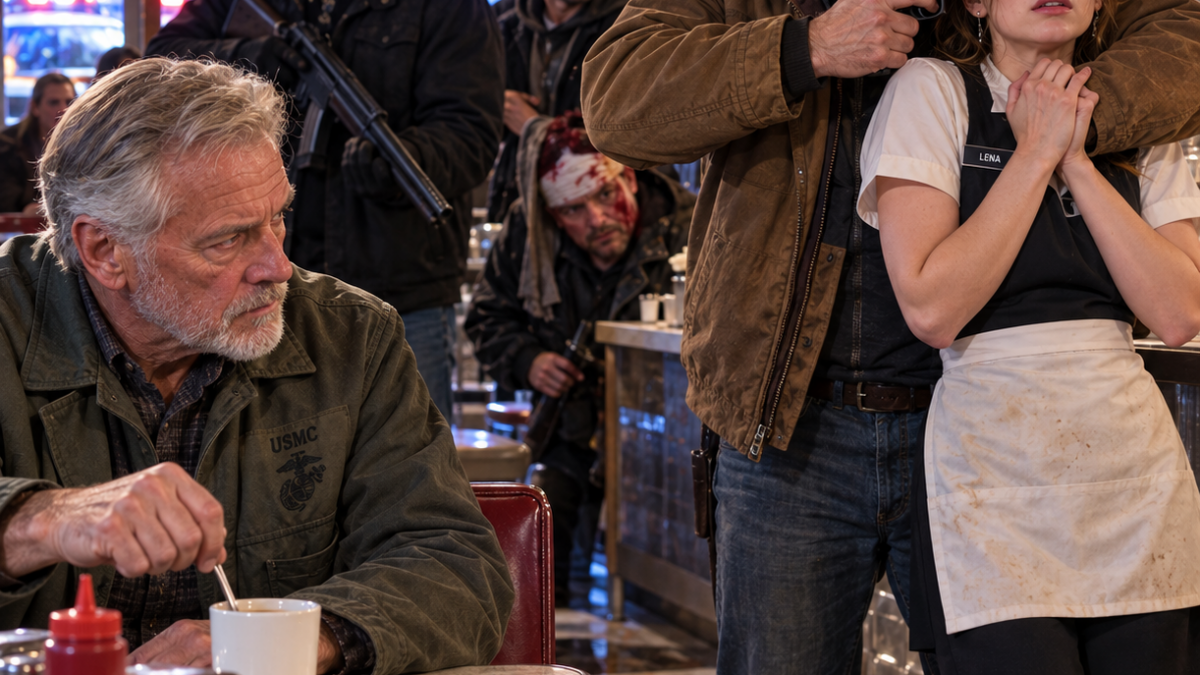
“Phones on the tables,” he said calmly. “Nobody gets hurt if everybody remembers how to listen.”
Frank raised both hands. “Take the register. There’s a safe under the counter.”
The leader barely looked at him.
Lena stood near the kitchen entrance holding a fresh coffee pot.
He grabbed the back of her apron.
Pulled her against him.
Pressed the gun against the side of her head.
The coffee pot fell and shattered.
Dark coffee spread across the pale floor.
“Nobody,” he said pleasantly, “gets to decide what I came here for.”
Lena made one small sound.
Then her eyes found me.
Everything inside my body wanted to stand.
Every instinct that belonged to a father screamed at me to cross the room.
The part of me that had survived other bad rooms knew standing would get her killed.
So I stayed in the booth.
I picked up my spoon.
Stirred the coffee once.
Tapped the saucer twice.
Lena saw it.
The gunman followed her gaze.
He smiled.
“That your grandpa, sweetheart?”
“He’s my father.”
His smile widened.
“Well, Dad, you’d better stay comfortable.”
I looked at the gun against my daughter’s skin.
Then at her.
She was terrified.
But she had seen the signal.
And now she was waiting.
The gunman’s name was Wade Barlow. I learned that later. He was forty-three, a former county detention officer fired after a misconduct investigation. That background made sense once I understood his style. Wade did not shout often. He enjoyed control too much for that. He liked making people calculate how much humiliation they would accept before fear broke them.
His largest man, Trent Maddox, guarded the front door with the shotgun. Miles Vetter patrolled the windows and kept checking outside. The youngest, Cody Finch, collected phones in a plastic bus tub while avoiding everybody’s eyes. The wounded man was Wade’s brother, Erik.
I surrendered my phone.
Cody noticed the Marine Corps emblem on my old key ring.
“You military?”
“Belonged to my brother.”
The lie came easily.
Cody seemed relieved.
I watched everyone else.
Benji crying against his mother.
His father whispering reassurance.
Iris frozen beside the counter.
Sonia standing near the kitchen, one hand covering her mouth.
Frank worried me most. The diner had been his world for thirty years. He was not good at surrendering authority in it. Twice he looked ready to argue. Twice I caught his eyes and shook my head.
Wait.
Outside, sirens began to build.
Wade looked mildly irritated.
Not surprised.
That mattered.
He ordered Trent to secure the entrance and Cody to shove a table near the kitchen door.
Erik slid against the counter.
Blood spread beneath his jacket.
Lena noticed.
Her nursing instincts overrode fear.
“He needs an ambulance.”
Wade looked at her.
“You’re a waitress.”
“I’m a nursing student.”
“Then learn when to stop talking.”
I felt pride and terror at the same time.
Wade answered the wall phone shortly before three.
A negotiator introduced herself.
He demanded an unmarked vehicle, a clear route out, and no pursuit. Rear service entrance. Before sunset.
When she asked about injuries, Wade looked directly at his brother.
“Everybody’s fine.”
Erik heard him.
Their eyes met.
That exchange told me more than the words.
Wade moved through the diner after hanging up, inspecting hostages almost casually. He took Dennis’s truck keys. He frightened Benji for entertainment. Then he stopped at my booth.
“You’re awfully relaxed, old man.”
“I don’t see anything improving if I get excited.”
Trent laughed.
Wade leaned closer.
“You military, Grandpa?”
“Long time ago.”
“What’d you do, cook breakfast for real soldiers?”
“Somebody had to feed them.”
The men laughed.
Wade dropped my spoon into my coffee.
He thought he had humiliated me.
Good.
A man who thinks you are harmless becomes careless around you.
By three-thirty, prolonged fear had settled over the room. Sonia passed out water. Iris found crayons for Benji. Cody thanked Sonia when she gave him a glass.
That interested me.
People do not stop being complicated because they carry guns.
Erik began coughing.
Wade finally asked if anyone knew first aid.
Lena raised her hand.
He ignored her.
Frank said, “Ray was in the military.”
I could have strangled him.
Wade smiled toward me.
“Well, Grandpa. Guess you’re useful after all.”
I told him Erik needed professional care.
Wade told me I would keep him alive until they left.
He allowed Cody to bring clean towels, gloves, water, and the small first-aid kit Sonia kept near the kitchen.
Erik’s wound sat below the ribs.
The amount of blood told me all I needed.
I could slow things.
I could not fix him.
“Don’t let him die,” Wade said.
“Then send him to a hospital.”
For the first time, Wade looked afraid.
Only for a second.
Then he looked at Lena.
His brother mattered, but control mattered more.
I worked.
Minutes later, Sonia approached with another towel.
That was when I smelled it.
Sulfur.
Faint.
Wrong.
I had delivered propane for nine years.
You learn that warning odor.
I looked toward the kitchen.
The exhaust fan had stopped.
Miles stood near a lower cabinet he had no reason to touch.
I watched him.
Then the rear door.
Then the kitchen equipment.
And I understood something I had not considered.
These men were not simply planning to leave.
Propane itself has no useful smell. An odorant is added so leaks become obvious before invisible gas becomes disaster. People who work around it get sensitive. In a restaurant kitchen, even the faintest trace demanded respect.
Sonia smelled it too.
When she brought another towel, I whispered, “Keep people away from switches and heat.”
Her eyes widened slightly.
She nodded.
Erik drifted in and out of consciousness.
Then his hand closed around my wrist.
“He’s not taking me.”
“Who?”
“My brother.”
I leaned closer.
“He can still get you help.”
Erik gave something like a laugh.
“He told me to stay in the car.”
Footsteps approached.
He released me.
Cody stopped near the booth.
“Is he going to make it?”
“Not without surgery.”
“Wade says you’re supposed to fix him.”
“Wade says a lot.”
Cody looked toward the register.
Then lowered his voice.
“He wasn’t supposed to shoot that guard.”
That changed everything.
I asked what guard.
Cody looked like he wanted the sentence back.
County credit union.
That had been their first stop.
An older security guard confronted them.
Shots fired.
Somebody was dead before they ever entered the diner.
The siege was no longer an armed robbery gone wrong.
It was a continuation.
I noticed Cody kept rubbing a little blue ribbon attached to his keys.
“Who’s the ribbon for?”
“My daughter.”
“How old?”
“Eleven months.”
“Name?”
“Millie.”
He looked suddenly young.
He told me he had lost his job, Wade promised money, and he convinced himself he was doing something for his family.
“You can’t undo what happened at the credit union,” I said. “But you still decide what kind of man walks out of this diner.”
Cody looked toward Wade.
“He won’t let me walk away.”
“Then stop making promises to him.”
Cody left without answering.
I did not trust him.
Fear makes people agree with whoever spoke last.
Wade still held the gun.
Sonia came through with sandwiches later. At my booth she leaned close.
“The gas supply’s been tampered with.”
“Can you shut it down?”
“Not while Miles is watching.”
“Don’t risk it yet.”
“He has a lighter.”
I looked toward Miles.
He kept checking his watch.
Kept staring at the rear service entrance.
He was not behaving like a man desperate to escape.
He was waiting.
The next phone call came after four.
Wade again demanded the vehicle.
Rear access road cleared.
No paramedics.
No entry.
Lena sat beside him, hands folded tightly.
I hated how hard she was trying to look brave.
Erik grabbed my sleeve again.
“The bag.”
Wade’s black canvas bag sat beneath the register.
“What’s in it?”
“Not just money.”
“What else?”
Erik looked toward Wade.
Then asked, “You got a daughter?”
“She’s right there.”
He followed my gaze.
“Then don’t believe anything he says about letting people go.”
My stomach tightened.
“Did he talk about the gas?”
Erik’s eyes closed.
No answer.
Frank came over with gloves under Trent’s supervision.
He whispered he had seen one of the robbers before.
Maybe two weeks earlier.
Green pickup behind the restaurant.
Parked near the propane enclosure.
“Why didn’t you mention it?”
“I didn’t think it mattered.”
“It matters now.”
Frank walked away.
I remembered the strange fuel order.
The tank scheduled for a full top-off that Frank had not requested.
The vehicle near the propane enclosure.
The gas leak.
The planned getaway through a rear road.
What looked like chaos had edges.
Someone had thought about this place before today.
Miles came through the dining area at 4:30 and glanced at Erik.
“You’re wasting your time,” he told me.
“Your friend is dying.”
He shrugged.
Then checked the rear door again.
That shrug told me Erik was not part of their exit plan.
The first hostage Wade struck was Dennis.
Benji needed the bathroom and had started crying harder. Dennis stood halfway up and asked Wade to let the child go.
Trent crossed the diner and hit him with the shotgun stock.
Dennis dropped.
Blood ran from his face.
I asked to examine him.
Wade said, “Pick one. Dead brother or truck driver. This isn’t a hospital.”
“Let Lena check him.”
Wade turned toward my daughter.
“You mean the girl sitting there all afternoon pretending she isn’t scared?”
“She knows enough.”
He caught Lena beneath the chin.
Turned her face toward me.
“Your dad has an answer for everything except why he hasn’t done one damn thing to help you.”
Her eyes filled.
Every animal instinct in me wanted to move.
Instead I said, “A man who needs a young woman at gunpoint to control a room probably isn’t as certain of himself as he wants everybody to believe.”
His smile vanished.
For a second, I had pushed too far.
Then he laughed.
“Prove your courage whenever you like, Grandpa.”
I said nothing.
I went back to Erik.
Lena looked at me.
I tapped the saucer twice.
Her eyes steadied.
No signal can remove danger.
All mine told her was that I had not stopped thinking.
Wade read her lowered gaze as surrender.
Good.
Sonia crouched beside me later.
She knew the building’s utilities because Frank hired repairmen who never finished jobs properly.
She confirmed the gas problem was deliberate.
Then she told me something else.
Ashby Land Group.
A development company buying property along County Road 31 near a proposed highway interchange.
Old gas stations.
Vacant lots.
Struggling businesses.
They wanted Frank’s diner.
Frank kept refusing.
Then mortgage problems began.
Payments suddenly marked missing.
A mysterious secondary lien.
Legal letters.
Pressure.
“Why didn’t Frank tell me?”
“Pride.”
That sounded like Frank.
Then Cody approached.
I asked casually whether Wade ever worked for Ashby Land Group.
His face answered before his mouth did.
“Why would you ask that?”
“Somebody has been around the diner.”
Cody looked toward Wade.
“Trent did security work for some real-estate people. Wade knew them too.”
“What did Wade tell you about coming here?”
“Close to the credit union. Back road.”
He was telling the truth as far as he knew.
But he knew enough to be scared.
Erik seized my sleeve.
He was barely conscious now.
“Wade got promised money.”
“For what?”
“Not the bank.”
His words came in pieces.
“The diner. Problem nobody investigates. Fire makes missing money irrelevant.”
“Who promised him?”
“Man called Sloane.”
My mind ran through what we already had.
Ashby Land Group.
Property pressure.
Strange propane order.
Green pickup.
Deliberate leak.
Fire.
This was not simply a gang hiding after a robbery.
The restaurant had been selected.
Before the first shot.
Erik reached beneath his clothing and pulled out a small handgun.
I froze.
He pushed it beneath the blanket between us.
Only weapon Wade had not taken from him.
I concealed it.
Not a plan.
A possibility.
“Don’t let him take the girl out the back,” Erik whispered.
“Why?”
“He isn’t leaving anybody who can talk.”
At 4:52, Erik Barlow died in my booth.
I covered his face with a clean towel.
Across the diner, Wade laughed at something Miles said.
He did not yet know his brother was dead.
That was the moment my role changed.
Until then, I had been trying to keep everyone alive long enough for police to solve the situation.
Now I understood Wade had already chosen an ending.
Waiting for him to become merciful was no longer strategy.
Eventually Wade noticed I had stopped working.
He came over.
Saw the towel.
Stopped.
For several seconds, he looked like an ordinary older brother.
Then he pulled the towel back.
“What happened?”
“He needed surgery.”
“I told you to keep him alive.”
“And I told you what he needed.”
Wade hit me across the face.
My head struck the booth.
Blood filled my mouth.
Lena cried out and started to rise.
Trent forced her down.
Wade looked at her.
I saw the thought.
Hurt the daughter.
Punish the father.
“Don’t make her pay for what you chose.”
He leaned toward me.
“You don’t decide what anybody pays for.”
He could have shot me.
Instead he went back to the phone.
Detective Nora Pike called again.
Wade told her eleven people remained alive.
He counted Erik.
His dead brother.
That lie mattered.
He was constructing reality for the people outside.
Controlling what they knew.
Controlling time.
Controlling entry.
If police believed his numbers and his version, every decision they made would begin from false information.
We needed contact.
Sonia passed my booth collecting plates.
I whispered, “Erik’s dead. Police need to know about the gas.”
She told me there was an old cell phone hidden in dry storage.
Nobody had searched it.
“Can you reach it?”
“Maybe.”
“Only if you can do it without getting killed.”
She looked at me.
“Nothing here is safe anymore, Ray.”
She was right.
Frank brought coffee later.
I asked about Ashby.
His face changed.
“They want everything between the grain elevator and the highway.”
“Why?”
“Distribution center.”
“What’d they offer?”
“Enough to pay debt. Not enough to start over.”
Then he told me about the mortgage disputes.
The lien.
An attorney who suspected forged documents.
Money disappearing into legal bills.
“Why didn’t you tell me?”
Frank looked embarrassed.
“You spent your whole life taking care of people.”
I almost laughed.
So had he.
Pride had kept two old friends from asking each other useful questions.
Near the register, Wade and Miles argued about time.
Miles wanted to leave.
Wade insisted the vehicle plan was working.
Then Cody came over holding a bottle of water intended for Erik.
He saw the towel.
Stopped.
I asked him quietly, “You know Sloane?”
His face drained.
“Erik told you?”
“He mentioned him.”
Cody swallowed.
“Wade said Sloane was handling transportation.”
“Did he arrange the credit union?”
“No. Bank was Wade.”
“The diner?”
Cody hesitated.
“Wade talked about this place before. Said the owner was stubborn.”
That was enough.
“You can still stop helping him.”
Cody rubbed the blue ribbon.
“You keep saying that.”
“Because it stays true until you make another choice.”
At 5:14, a light above the counter flickered.
Sonia emerged carrying clean cups she did not need.
She looked at me once.
No expression.
I could not know whether she reached the phone.
Then Wade announced the hostages would be moved closer to the kitchen before the vehicle arrived.
That made my blood cold.
Closer to the gas.
Farther from the front entrance.
Closer to the rear exit Erik warned me about.
The room was not being arranged for escape.
It was being arranged for destruction.
Wade forced everyone against the interior wall.
Paul carried Benji.
Hannah held onto her husband.
Iris helped Dennis walk.
I stood slowly because my knee had stiffened.
Erik’s handgun pressed against my side beneath my jacket.
It did not make me feel powerful.
Guns do not create solutions by themselves.
Sometimes they only give frightened people one more bad decision to make.
Lena stood close enough that I could see bruises on her neck.
Our eyes met once.
Then she looked down.
Still waiting.
Sonia offered water.
Passing my shoulder, she whispered, “Dispatcher got the warning.”
For the first time all afternoon, I felt hope.
Small.
Dangerous.
Real.
The wall phone rang.
Wade answered.
Detective Pike mentioned a hazardous-material concern.
His face changed.
The police knew.
“Who talked?” he shouted.
Nobody answered.
He grabbed Sonia.
Pressed a gun against her.
Then looked at Cody.
“Did she make a call?”
Cody stared at her.
His mouth opened.
“I didn’t see anything.”
That was his first choice against Wade.
Wade did not believe him.
He threw the water tray against the wall.
Lena stood.
“She didn’t do anything.”
Wade pointed his gun at her.
“Sit down.”
I stepped forward.
Trent’s shotgun swung toward me.
I kept my hands visible.
“Your brother is dead.”
Wade’s attention shifted.
“And delaying medical care helped kill him.”
His face changed.
“Shut up.”
“Erik died believing you were going to leave him.”
“You’re lying.”
“Ask yourself why he believed it.”
Wade hit me again.
Harder.
Lena screamed.
My knees nearly went out.
Wade’s hand shook.
Not fear.
Grief converted into rage because rage was easier.
He dragged Lena back toward the register.
“Next person interferes, she dies.”
Then he ordered Miles to check the rear door.
Cody went back to the kitchen with Sonia.
Outside, heavy vehicles moved over gravel.
Police repositioning.
No helicopter now.
Too quiet.
Benji began coughing.
His mother held a damp napkin over his mouth.
Frank whispered the front windows had been locked for years.
“Don’t force them.”
He hated doing nothing.
So did I.
At 5:37, the phone rang again.
Wade answered while gripping Lena’s apron.
Detective Pike told him police had identified a possible gas danger.
Wade denied it.
Threatened hostages.
Hung up.
Miles appeared from the kitchen angry.
Cody behind him.
Sonia out of sight.
Wade demanded to know what happened.
Miles said Sonia had interfered.
Wade ordered him to restore the gas flow.
Then Cody said, “No.”
The entire room went silent.
Wade turned slowly.
“What?”
“Leave it shut off.”
“You taking orders from a cook?”
“I’m saying we could all die.”
Wade raised his revolver toward Cody’s chest.
Cody froze.
For several seconds, obedience itself failed him.
He finally returned to the kitchen when ordered.
But something had changed.
A gust of fresh air entered.
The rear door had opened.
Sonia stood nearby.
Someone outside shouted.
Police had contact.
Then something metallic crashed in the kitchen.
Sonia yelled Cody’s name.
Wade turned.
I looked at Lena.
She was already looking at me.
For nearly three hours, she had waited for one signal.
I tapped two fingers against the table.
Her eyes moved to my hand.
Then my face.
I gave one slow nod.
Memory does not preserve violence as a clean sequence.
Years later, I could remember the smell of coffee.
The wet shine on the floor.
Lena’s eyes.
A fluorescent light humming overhead.
But not every movement.
Lena dropped.
Wade swung toward her.
His gun fired.
Plaster burst from the wall.
I moved.
Erik’s handgun was in my hand.
Wade turned toward me.
I fired.
He fell against the pie display.
Glass cracked.
His revolver dropped.
Then Trent’s shotgun exploded near the front booth.
Wood shattered.
People screamed.
Another blast tore into a table.
Miles came out of the kitchen with his rifle.
Everything became noise.
I fired toward him.
He went down near the counter.
I moved behind the heavy service counter.
“Dad?”
Lena.
Alive.
“Stay down.”
“Are you hurt?”
“Not badly.”
I had no idea.
Police shouted from outside.
I yelled that hostages were inside and there was a propane hazard.
Trent fired toward the entrance.
Officers answered.
His shotgun stopped.
Then Cody appeared near the kitchen.
Gun in hand.
He looked at police.
At Wade.
At me.
White-faced.
Terrified.
“Cody,” I said. “Put it down.”
“I didn’t want this.”
“Then stop it.”
His shoulders lowered.
The pistol began to drop.
Then Benji moved.
The little boy broke away from his mother toward the counter.
Cody turned sharply.
His pistol rose.
I fired once.
Cody fell against the kitchen doorway.
The gun slid away.
And then officers were everywhere.
Front.
Rear.
Commands.
Hands.
Boots.
Weapons.
I placed Erik’s pistol on the floor and stepped away with both hands raised.
A deputy forced me to my knees.
I stayed there.
Lena was behind the counter telling someone, “That’s my dad. Don’t hurt him.”
Her voice broke.
I wanted to turn.
The deputy told me not to move.
So I didn’t.
For hours I had been asking other people to trust my judgment.
Now I trusted his.
Firefighters confirmed the immediate gas danger had been contained.
Paramedics came in.
Lena had bruising, a cut near her hairline, and marks along her neck.
Dennis went out on a stretcher.
Benji and his parents followed another medic.
Frank stood amid the wreckage of the diner with both hands on his head.
Trent and Miles were dead.
Wade was critically wounded but alive.
Cody was unconscious and breathing.
Erik remained under the towel.
Detective Pike entered.
No applause.
No heroic smile.
Just work.
She asked my name.
I gave it.
Asked about the gas.
I explained.
Then I told her about Erik.
Sloane.
Ashby Land Group.
The strange propane order.
Frank’s mortgage.
Cody’s statements.
Her expression changed.
“How long did you know about that?”
“Maybe an hour.”
“Why didn’t you tell us?”
I looked toward Lena outside.
“I was trying to keep my daughter alive.”
Pike nodded.
“Continue.”
I did.
Eventually, I walked into the gravel lot.
Cold air.
Patrol lights.
Ambulances.
Fire crews.
People waiting behind roadblocks.
Lena saw me.
Climbed off the stretcher.
Ran.
She wrapped both arms around me.
I held her carefully.
“You okay?”
“No.”
“Me neither.”
“Are we safe?”
“The men inside can’t hurt you now.”
I would not promise everything was fine.
Fathers should not promise things they cannot know.
As the last ambulance prepared to leave, Detective Pike approached again.
Wade’s phone contained recent calls to a number registered under a false name.
That number was already appearing in early records linked to Ashby Land Group.
Then she asked about the emergency propane delivery.
“I signed the completed ticket.”
“There’s another version,” she said. “Submitted earlier. Dates don’t match. Authorization doesn’t match.”
I looked at the destroyed diner.
The robbery had never been the whole story.
That night, I sat in a windowless interview room with bad coffee cooling between my hands.
Pike asked everything.
What I saw.
What I smelled.
What Erik said.
Where the handgun came from.
When I moved.
Why I fired.
When she asked if I intended to kill Wade, I gave the only truthful answer.
“I intended to stop him from shooting my daughter.”
The interview lasted past midnight.
Doctors examined me.
Investigators photographed injuries.
They took my clothes.
Someone asked about military service.
By then they had already found records showing my reconnaissance background and combat medical training.
I had never hidden it out of shame.
I simply wanted life after Evelyn to belong to the people I loved instead of the man I had once been.
Lena stayed with a college roommate for several days.
She said she needed quiet.
Every part of me wanted to call every hour.
I didn’t.
We texted.
Did you eat?
Yes.
Class?
Went.
Need anything?
No.
Love you.
Love you too.
Nothing about the diner.
That silence was different from avoidance.
We were both trying to survive memory.
The investigation moved quickly.
Detectives found the unusual fuel order had been submitted through an account connected to a property-management company doing business with Ashby Land Group.
Frank’s authorization appeared copied.
Data came from an office two counties away.
Then investigators found similar irregular service requests connected to other businesses.
A hardware store near the proposed highway interchange.
Destroyed by fire three years earlier.
Owner fighting disputed loan payments.
Insurance settlement.
Property later acquired by Ashby.
A small motel.
Owner refused to sell.
Rear wing burned.
Business closed.
Ashby bought it.
Different incidents.
Different files.
Same pattern.
Martin Sloane, Ashby’s managing partner, called those purchases redevelopment opportunities.
Investigators found payments moving through contractor accounts that made less sense the harder people looked.
One account received money shortly before the credit union robbery.
Wade survived surgery.
He was charged in connection with the security guard’s death and the diner siege.
The black bag contained cash.
But also disputed loan papers and a portable drive taken from the credit union.
Sloane was arrested after warrants reached his office and accounts.
Exactly what the robbery had been meant to accomplish became part of the criminal case.
Frank’s attorney challenged the liens against Maple Bend.
Nothing happened quickly.
Real justice rarely does.
Some claims disappeared.
Others required months of hearings.
Frank still owed legitimate money.
But suddenly he had a chance to keep the diner.
Other property owners along County Road 31 began reopening questions they had been too tired to fight.
That part stayed with me.
I had spent my life thinking evil announced itself with violence.
Sometimes it did.
Wade had brought guns.
But other people brought forms.
Notices.
Fake debts.
Quiet pressure.
A sentence like Don’t make trouble.
Cruelty can wear a suit and file paperwork.
The grand jury reviewed the shootings.
Including mine.
Especially Cody.
I cooperated.
Witness statements.
Physical evidence.
Angles.
Timing.
The moment Benji moved.
The moment Cody turned.
When the grand jury declined to indict me, I expected relief to feel cleaner.
It didn’t.
Cody survived.
He eventually cooperated with investigators.
His testimony helped connect Wade to Sloane and established the gas sabotage was deliberate.
My bullet damaged his shoulder badly.
Doctors were uncertain whether he would regain full use.
His wife, Amber, sent me a letter.
She wrote that Cody remembered our conversation about Millie.
Remembered being told he still had choices.
She did not ask me to call him innocent.
She did not blame me.
She wrote that she hoped their daughter would someday understand her father made terrible decisions and that people still tried to stop him from making worse ones.
I read the letter three times.
Then put it beside Evelyn’s photograph.
Some days I could accept its kindness.
Other days I remembered Cody turning with the pistol while Benji moved.
Maybe he meant to fire.
Maybe he did not.
I will never know.
I eventually stopped trying to force uncertainty into something cleaner.
The newspapers called me a hero.
Television stations wanted interviews.
Somebody found an old Marine photograph and put it beside a headline about a retired recon Marine saving hostages.
I declined.
Those stories wanted a man who had never been afraid.
That man did not exist.
They rarely mentioned Sonia.
Her hidden phone call.
Frank’s mortgage.
Cody’s cooperation.
The other fires.
Erik’s last warning.
They wanted a simple story.
Old Marine kills bad men.
Reality was uglier.
I had nightmares.
Gunshots.
Propane odor.
Lena calling from a room I could not reach.
Sometimes I woke certain I had nodded too early.
North Fork gave me time off.
A counselor at the veterans clinic worked with me.
I did not enjoy that.
I kept going.
Silence had once felt like discipline.
Now I understood silence could also become a hiding place.
In December, Lena came home on a Saturday morning carrying cinnamon rolls.
She had cut her hair to her shoulders, partly to hide the uneven patch where Wade pulled it.
She looked older.
We talked about classes.
Gas prices.
A professor she hated.
Neither of us mentioned the diner for twenty minutes.
Then she put down her coffee.
“I need to ask you something.”
“All right.”
“When you nodded, did you know you were going to shoot him?”
I thought carefully.
“I knew I might have to. I didn’t know exactly what would happen.”
She stared into her coffee.
“I keep remembering your face.”
“What about it?”
“You looked calm.”
I waited.
“I thought if you weren’t scared, maybe I didn’t have to be.”
“I was terrified.”
Her eyes came up.
“Then why didn’t you show it?”
“Because you needed something steady to look at.”
She began crying.
Not quietly for long.
Weeks of anger arrived with the tears.
She told me she had hated me for staying in the booth.
Even though she knew moving would have gotten her killed.
She hated that I looked calm while she thought she was dying.
She hated discovering a side of me she had never seen.
She hated needing it.
I listened.
No defense.
No explanation until she finished.
Finally I said, “I’m not a different man.”
She wiped her face.
“I know.”
“I’m still the guy who ruins pancakes and loses his glasses while they’re on his head.”
That earned half a laugh.
“You saw me in a place I never wanted you to see.”
“I don’t know how to put both versions together.”
“Neither do I.”
That answer helped.
Maybe because it gave her permission not to solve me.
She reached across the table.
Took my hand.
For a while, we sat quietly.
Not waiting.
Just sitting.
The Maple Bend Grill reopened the following spring.
Frank replaced the broken windows and damaged counter.
New kitchen equipment.
Same green sign.
He claimed changing it would make his dead father come back just to complain about the cost.
Sonia returned.
Iris organized a gathering for survivors.
Dennis came with a scar near his jaw and a joke about finally finding a diner willing to comp his meal.
I almost skipped it.
Lena insisted.
The old corner booth was gone.
Frank apologized.
“Furniture got destroyed.”
“It was just a booth.”
We both knew that was not completely true.
Benji came over carrying a drawing.
The diner beneath a bright yellow sun.
Nobody with a gun.
No broken windows.
I asked if he wanted strawberry milk.
He nodded.
Lena went behind the counter to make it.
Sonia laughed.
“Can’t take the waitress out of the nurse.”
I watched my daughter move around the restaurant.
She greeted people.
Talked to Benji.
Did not check my face every few seconds.
That made me prouder than any story in the newspaper.
After most people left, Frank sat beside me.
He told me Sloane’s court case was still moving.
The financial investigations had helped several property owners challenge questionable debts.
Some had already lost businesses that could never come back.
Frank did not pretend exposure erased damage.
Neither did I.
“Ever think about what would’ve happened if you skipped coffee that day?” he asked.
“Sometimes.”
“We might all be dead.”
“Maybe.”
“You don’t believe that?”
“I believe police might have handled it differently.”
Frank stared.
I explained that I spent months replaying everything.
Every moment.
Every choice.
Eventually I understood survival did not prove every decision was perfect.
The men who entered with guns created the danger.
The people behind them created other parts.
I was not responsible for predicting every future from one afternoon.
That realization came slowly.
By summer, Lena arranged a nursing placement in Columbus.
I helped move her into a small apartment with crooked cabinet doors and a balcony overlooking a parking lot.
I did not ask whether she checked the tires.
She noticed.
“You’re slipping.”
“I’m growing.”
“Should I call someone?”
She told me she kept an emergency kit in the trunk.
I admitted that helped.
We laughed.
Neither of us had stopped being afraid for the other.
We were learning fear did not have to become control.
I returned to North Fork Energy.
Fewer hours.
Different Tuesday route.
The company replaced its ordering system after investigators exposed how the fake delivery was submitted.
I began asking customers more questions.
Strange order?
Call.
Unexpected volume?
Verify.
Mismatched authorization?
Stop.
Not heroic.
Just careful.
A small question at the right time sometimes does more than certainty ever could.
On the anniversary of the siege, Lena came home.
We drove to Willow Lake.
Same place where she tangled her fishing line as a child.
We brought sandwiches and coffee.
Sat near the old dock.
She talked about patients.
Friends.
A doctor who apparently could not find his own stethoscope.
Nothing remarkable.
That was the point.
Ordinary had become precious.
When we packed up, Lena noticed me watching two teenagers near the end of the dock.
Checking their footing.
Watching the water.
Old habit.
She touched my coffee cup twice with one fingernail.
I looked at her.
“You’re doing it again, Dad.”
“Doing what?”
“Looking for trouble before it finds somebody.”
“Old habit.”
She studied me.
Then gave one slow nod.
“You can stop watching for a minute.”
I smiled.
“I’ve got this.”
For most of my life, I believed protecting people meant being first to see danger and last to relax.
That afternoon, my daughter taught me the other half.
Sometimes protecting someone means trusting them enough to recognize when danger is gone.
She slipped her arm through mine.
We walked toward the truck.
No gun.
No locked door.
No negotiator.
No invisible gas.
No man demanding I prove what kind of father I was.
Just Lena.
Alive.
Becoming a nurse.
Building a life that belonged to her.
For the first time in a very long while, I did not count the steps between us and the road.
The trials took time.
Wade eventually faced the consequences of the credit union killing, the hostage siege, and the conspiracy surrounding the diner.
Sloane’s case exposed enough records to keep investigators occupied for years.
I attended only when subpoenaed.
Frank followed every headline.
I stopped.
There is a point where information becomes another way of letting people who hurt you occupy your house.
Cody testified.
His cooperation mattered.
So did what he had done.
Both could be true.
Amber sent one Christmas card with a photograph of Millie holding the same blue-ribbon rabbit Cody had kept on his keys.
I placed it in a drawer.
Not because I had become part of their family.
Because that child had existed inside her father’s mind during the worst decisions of his life.
Maybe someday she would help him understand the distance between loving someone and behaving in a way worthy of that love.
I hoped so.
Lena graduated.
I sat in the audience.
Front row because she bought the ticket herself and threatened me if I stood in the back.
When her name was called, she crossed the stage in nursing whites.
No hostage.
No bruises.
No gun at her head.
Just my daughter.
She spotted me.
Touched the edge of her diploma folder twice.
I smiled.
Slow nod.
She laughed before the photographer took the picture.
Afterward she hugged me.
“You made the face.”
“What face?”
“The proud one.”
“I don’t have a proud face.”
“You absolutely do.”
Evelyn should have been there.
That truth sat beside us all day.
Grief does that.
It leaves an empty chair even during good moments.
We went to dinner.
Frank closed the diner early and hosted us.
Sonia made a cake that leaned badly to one side.
Dennis showed up.
Benji’s parents sent flowers.
Detective Pike sent a card.
Nothing grand.
No news cameras.
Perfect.
Years later, people still occasionally recognized me.
“You’re the diner guy.”
I usually said, “I drink there.”
Some wanted the story.
I rarely gave it.
If they pushed, I told them Sonia made the call that warned police about the gas.
Frank survived losing control of the place he loved.
Lena stayed calm while a man held a gun against her.
Cody eventually told investigators what he knew.
Detective Pike kept negotiating even while Wade lied.
Officers entered a building that might have exploded.
The truth had too many people in it for one hero.
That was the version I could live with.
My Marine years became public enough that some people treated me differently.
Frank called me “Recon” for almost a week until I threatened to stop tipping.
Lena found it hilarious.
I hated the attention.
What I valued from that old life had never been reputation.
It was habits.
Observe.
Breathe.
Do not confuse fear with an order.
Know what you can control.
Know what you cannot.
And when you have people beside you, trust them enough to do their part.
That last lesson took longest.
I had spent years thinking Lena needed a father who was always ready.
What she actually needed was a father who could eventually step back.
One autumn afternoon, long after the diner’s new windows had stopped looking new, I stopped there during my route.
Frank poured coffee.
Same black.
No sugar.
“Full tank today?” I asked.
He glared.
“Don’t start.”
I smiled.
The propane order was normal.
I had checked twice.
Lena no longer worked there.
A new nursing student named Maya handled tables during weekends.
Benji was older now and came in after baseball games with his parents.
Sonia still complained about everybody.
I sat at a table near where my old booth had been.
Not the corner.
I no longer needed the corner.
The front door opened.
Five construction workers came in laughing.
For one second, my shoulders tightened automatically.
Five men.
One door.
Then my body caught up with reality.
Tool belts.
Dusty boots.
No threat.
Just lunch.
I let the tension go.
That mattered.
Healing was not forgetting.
It was noticing the difference.
Lena called while I was there.
“Dad, I have news.”
“What?”
“I got the emergency-department position.”
I leaned back.
“Columbus?”
“Yep.”
“That’s good.”
“Say the thing.”
“What thing?”
“Don’t pretend.”
I smiled.
“I’m proud of you.”
“Thank you.”
Then she added, “And I know you’re going to ask about night shifts.”
“I wasn’t.”
“You were.”
“I was waiting.”
“For what?”
“The appropriate time.”
She laughed.
Same laugh as Evelyn when I was being difficult on purpose.
I looked out the window.
North Fork truck in the lot.
County road.
Autumn fields beyond it.
For years, quiet had been how I carried things alone.
Now quiet felt different.
I had learned to speak when it mattered.
Ask one more question.
Tell a friend when something was wrong.
Sit in a counselor’s office even when pride said leave.
Let my daughter say she had been angry with me without defending myself.
Tell her I was scared.
Those things did not feel like combat skills.
They were harder.
Maybe because nobody trained me for them.
Before I left, Frank sat across from me.
“Ray.”
“What?”
“You know the anniversary is next week.”
“I know.”
“We’re not doing anything.”
“Good.”
“But I bought a better coffeemaker.”
“That sounds dangerous.”
He smiled.
“Thought you should know.”
I looked around the diner.
New counter.
Repaired tile.
A faint scar in the wall where the plaster had been patched.
You could miss it if you did not know where to look.
That seemed right.
Some damage remains visible.
Some becomes part of the structure.
The building was not what it had been.
Neither were we.
Still standing.
That had to be enough.
The following weekend, Lena came home.
We went back to Willow Lake.
No sandwiches this time.
Just coffee.
The dock had been repaired since our last visit.
New boards.
Same water.
She sat beside me.
“Do you ever think about Wade?”
“Sometimes.”
“Cody?”
“Yes.”
“Erik?”
“Yes.”
She looked toward the lake.
“Me too.”
We sat quietly.
Then she said, “I used to think the nod meant you knew what would happen.”
I turned toward her.
“What do you think now?”
“That it meant you trusted me.”
I thought about that.
At nine, the signal meant stop pulling your fishing line and look at me.
At twenty-one, it meant drop when I tell you.
Years later, maybe it meant something else.
I am here.
You are not alone.
But you still have to move with your own body.
“Yeah,” I said.
“That’s closer.”
She touched the edge of her coffee twice.
I looked at her.
She gave me the nod.
This time I laughed.
“What’s that for?”
“Your turn.”
“My turn for what?”
“To trust me.”
I looked across the lake.
No danger.
No count.
No exits to map.
Just water moving against wood.
A daughter beside me.
A future neither of us could control.
I relaxed my shoulders.
For once, I let somebody else watch.
And the world did not end.
That was how I knew we had finally made it out.
the end
The Man Holding My Daughter at Gunpoint Thought the Old Man in the Corner Was Helpless
Five armed men locked down a roadside diner and decided my daughter would be the easiest person in the room to control.
Their leader mistook my silence for age, fear, and weakness while I watched him turn a robbery into something far more dangerous.
What none of them understood was that my daughter and I had spent years using one tiny signal that meant the same thing every time: I’m watching, and when I nod, move.
By sixty-four, I had learned that people were comfortable around a quiet man because they could invent whatever explanation for his silence made them feel safe. Around Alder County, Ohio, I was Ray Calder, the gray-haired propane driver who worked for North Fork Energy, drove an aging company truck with a stubborn transmission, and drank coffee without sugar. That description suited me. It left out twenty-three years in the Marine Corps, most of them in reconnaissance work I had stopped discussing long before anybody asked. It left out the left knee that hurt when weather changed, the habit of checking exits when I entered unfamiliar rooms, and the fact that retirement had lasted less than a year before too many quiet hours convinced me I needed something useful to do.
That October Tuesday began with frost silvering the fields. I scraped the windshield with an old grocery-store loyalty card because my actual scraper had vanished again, checked the truck gauges, and left the yard shortly after seven. My route crossed harvested cornfields, narrow county roads, and the bridge where somebody had tied artificial flowers to the railing after a teenager died there the previous winter. I had driven that route for nearly a decade, ever since my wife Evelyn died and home became too quiet. Propane delivery was honest work. Tank levels, pressure, signatures, invoices. Simple things. Or at least I believed they were simple before that morning.
My daughter Lena was twenty-one and considered my carefulness a condition she had inherited against her will. She studied nursing at a community college forty minutes away and worked afternoon shifts at the Maple Bend Grill to help cover tuition, gasoline, and whatever expenses she classified as “none of your business, Dad.” She had Evelyn’s dark eyes and my shoulders, along with an increasingly firm opinion about where parental concern became interference. We loved each other fiercely. We also argued about tire pressure, oil changes, late-night driving, whether she needed pepper spray, and why I always wanted her to text when she arrived somewhere. I had spent her whole life trying to protect her. Lately she had been trying just as hard to prove protection was not the same thing as trust.
The Maple Bend Grill sat beside County Road 31, a squat brick place with a faded green roof and enough gravel parking for six tractor-trailers if the drivers were willing to cooperate. Frank Delaney owned it. He had been my friend since before Lena was born. Every other Tuesday, I filled his propane tank and he paid me in coffee, stale pie, and complaints about township zoning. That morning his delivery order showed a larger refill than normal. When I mentioned it, Frank frowned. “I didn’t order anything extra, Ray. Your office called yesterday and said I was scheduled for a full top-off.” I showed him the order. His account number. Authorization received. He said he would call later because the account had already been giving him trouble.
I should have asked what trouble.
Instead, we argued about baseball.
At 2:10, I parked near the shoulder and went inside for coffee.
Lunch rush had ended. The place smelled like bacon grease, toasted bread, floor cleaner, and Sonia Vega’s cinnamon rolls. Frank stood behind the register comparing invoices. Iris Bell wrapped silverware in napkins. A truck driver named Dennis Harlow occupied a booth by the windows. A young couple sat with their little boy, Benji, who had built a fortress from jelly packets.
Lena came from the kitchen carrying grilled cheese.
“Before you ask, yes, I checked the oil. Yes, I put air in the rear tire. No, I’m not telling you my anatomy grade unless you promise not to make that face if it’s under ninety.”
“I haven’t made a face.”
“You’re making it now.”
She set down my coffee and tapped the saucer twice with one fingernail.
That tiny gesture went back to when she was nine. We had been fishing from an old dock at Willow Lake when her line snagged around a submerged branch. She kept pulling harder, insisting she could free it herself. I told her sometimes the best way out of trouble was to stop pulling, look, and wait until we could work together. Somewhere during that afternoon, two taps became our signal for I’m paying attention. A slow nod meant now.
We used it through her childhood.
Hospital waiting rooms.
School speeches.
Funerals.
Bad news.
Nothing dramatic.
Until 2:17 that Tuesday.
The bell over the diner door rang.
A broad man in a brown work coat entered first. Then a thinner one with a black canvas bag. Two more followed. A fifth came last, bent slightly and holding one side of his body with a hand already darkened by blood.
I watched their reflections in the window.
The first man turned the OPEN sign around and locked the door.
The thin man pulled a handgun.
Another produced a shotgun.
Someone dropped a glass.
I counted five.
One wounded.
One clearly in charge.
And then the leader crossed directly toward my daughter.
part2
“Phones on the tables,” he said calmly. “Nobody gets hurt if everybody remembers how to listen.”
Frank raised both hands. “Take the register. There’s a safe under the counter.”
The leader barely looked at him.
Lena stood near the kitchen entrance holding a fresh coffee pot.
He grabbed the back of her apron.
Pulled her against him.
Pressed the gun against the side of her head.
The coffee pot fell and shattered.
Dark coffee spread across the pale floor.
“Nobody,” he said pleasantly, “gets to decide what I came here for.”
Lena made one small sound.
Then her eyes found me.
Everything inside my body wanted to stand.
Every instinct that belonged to a father screamed at me to cross the room.
The part of me that had survived other bad rooms knew standing would get her killed.
So I stayed in the booth.
I picked up my spoon.
Stirred the coffee once.
Tapped the saucer twice.
Lena saw it.
The gunman followed her gaze.
He smiled.
“That your grandpa, sweetheart?”
“He’s my father.”
His smile widened.
“Well, Dad, you’d better stay comfortable.”
I looked at the gun against my daughter’s skin.
Then at her.
She was terrified.
But she had seen the signal.
And now she was waiting.
The gunman’s name was Wade Barlow. I learned that later. He was forty-three, a former county detention officer fired after a misconduct investigation. That background made sense once I understood his style. Wade did not shout often. He enjoyed control too much for that. He liked making people calculate how much humiliation they would accept before fear broke them.
His largest man, Trent Maddox, guarded the front door with the shotgun. Miles Vetter patrolled the windows and kept checking outside. The youngest, Cody Finch, collected phones in a plastic bus tub while avoiding everybody’s eyes. The wounded man was Wade’s brother, Erik.
I surrendered my phone.
Cody noticed the Marine Corps emblem on my old key ring.
“You military?”
“Belonged to my brother.”
The lie came easily.
Cody seemed relieved.
I watched everyone else.
Benji crying against his mother.
His father whispering reassurance.
Iris frozen beside the counter.
Sonia standing near the kitchen, one hand covering her mouth.
Frank worried me most. The diner had been his world for thirty years. He was not good at surrendering authority in it. Twice he looked ready to argue. Twice I caught his eyes and shook my head.
Wait.
Outside, sirens began to build.
Wade looked mildly irritated.
Not surprised.
That mattered.
He ordered Trent to secure the entrance and Cody to shove a table near the kitchen door.
Erik slid against the counter.
Blood spread beneath his jacket.
Lena noticed.
Her nursing instincts overrode fear.
“He needs an ambulance.”
Wade looked at her.
“You’re a waitress.”
“I’m a nursing student.”
“Then learn when to stop talking.”
I felt pride and terror at the same time.
Wade answered the wall phone shortly before three.
A negotiator introduced herself.
He demanded an unmarked vehicle, a clear route out, and no pursuit. Rear service entrance. Before sunset.
When she asked about injuries, Wade looked directly at his brother.
“Everybody’s fine.”
Erik heard him.
Their eyes met.
That exchange told me more than the words.
Wade moved through the diner after hanging up, inspecting hostages almost casually. He took Dennis’s truck keys. He frightened Benji for entertainment. Then he stopped at my booth.
“You’re awfully relaxed, old man.”
“I don’t see anything improving if I get excited.”
Trent laughed.
Wade leaned closer.
“You military, Grandpa?”
“Long time ago.”
“What’d you do, cook breakfast for real soldiers?”
“Somebody had to feed them.”
The men laughed.
Wade dropped my spoon into my coffee.
He thought he had humiliated me.
Good.
A man who thinks you are harmless becomes careless around you.
By three-thirty, prolonged fear had settled over the room. Sonia passed out water. Iris found crayons for Benji. Cody thanked Sonia when she gave him a glass.
That interested me.
People do not stop being complicated because they carry guns.
Erik began coughing.
Wade finally asked if anyone knew first aid.
Lena raised her hand.
He ignored her.
Frank said, “Ray was in the military.”
I could have strangled him.
Wade smiled toward me.
“Well, Grandpa. Guess you’re useful after all.”
I told him Erik needed professional care.
Wade told me I would keep him alive until they left.
He allowed Cody to bring clean towels, gloves, water, and the small first-aid kit Sonia kept near the kitchen.
Erik’s wound sat below the ribs.
The amount of blood told me all I needed.
I could slow things.
I could not fix him.
“Don’t let him die,” Wade said.
“Then send him to a hospital.”
For the first time, Wade looked afraid.
Only for a second.
Then he looked at Lena.
His brother mattered, but control mattered more.
I worked.
Minutes later, Sonia approached with another towel.
That was when I smelled it.
Sulfur.
Faint.
Wrong.
I had delivered propane for nine years.
You learn that warning odor.
I looked toward the kitchen.
The exhaust fan had stopped.
Miles stood near a lower cabinet he had no reason to touch.
I watched him.
Then the rear door.
Then the kitchen equipment.
And I understood something I had not considered.
These men were not simply planning to leave.
Propane itself has no useful smell. An odorant is added so leaks become obvious before invisible gas becomes disaster. People who work around it get sensitive. In a restaurant kitchen, even the faintest trace demanded respect.
Sonia smelled it too.
When she brought another towel, I whispered, “Keep people away from switches and heat.”
Her eyes widened slightly.
She nodded.
Erik drifted in and out of consciousness.
Then his hand closed around my wrist.
“He’s not taking me.”
“Who?”
“My brother.”
I leaned closer.
“He can still get you help.”
Erik gave something like a laugh.
“He told me to stay in the car.”
Footsteps approached.
He released me.
Cody stopped near the booth.
“Is he going to make it?”
“Not without surgery.”
“Wade says you’re supposed to fix him.”
“Wade says a lot.”
Cody looked toward the register.
Then lowered his voice.
“He wasn’t supposed to shoot that guard.”
That changed everything.
I asked what guard.
Cody looked like he wanted the sentence back.
County credit union.
That had been their first stop.
An older security guard confronted them.
Shots fired.
Somebody was dead before they ever entered the diner.
The siege was no longer an armed robbery gone wrong.
It was a continuation.
I noticed Cody kept rubbing a little blue ribbon attached to his keys.
“Who’s the ribbon for?”
“My daughter.”
“How old?”
“Eleven months.”
“Name?”
“Millie.”
He looked suddenly young.
He told me he had lost his job, Wade promised money, and he convinced himself he was doing something for his family.
“You can’t undo what happened at the credit union,” I said. “But you still decide what kind of man walks out of this diner.”
Cody looked toward Wade.
“He won’t let me walk away.”
“Then stop making promises to him.”
Cody left without answering.
I did not trust him.
Fear makes people agree with whoever spoke last.
Wade still held the gun.
Sonia came through with sandwiches later. At my booth she leaned close.
“The gas supply’s been tampered with.”
“Can you shut it down?”
“Not while Miles is watching.”
“Don’t risk it yet.”
“He has a lighter.”
I looked toward Miles.
He kept checking his watch.
Kept staring at the rear service entrance.
He was not behaving like a man desperate to escape.
He was waiting.
The next phone call came after four.
Wade again demanded the vehicle.
Rear access road cleared.
No paramedics.
No entry.
Lena sat beside him, hands folded tightly.
I hated how hard she was trying to look brave.
Erik grabbed my sleeve again.
“The bag.”
Wade’s black canvas bag sat beneath the register.
“What’s in it?”
“Not just money.”
“What else?”
Erik looked toward Wade.
Then asked, “You got a daughter?”
“She’s right there.”
He followed my gaze.
“Then don’t believe anything he says about letting people go.”
My stomach tightened.
“Did he talk about the gas?”
Erik’s eyes closed.
No answer.
Frank came over with gloves under Trent’s supervision.
He whispered he had seen one of the robbers before.
Maybe two weeks earlier.
Green pickup behind the restaurant.
Parked near the propane enclosure.
“Why didn’t you mention it?”
“I didn’t think it mattered.”
“It matters now.”
Frank walked away.
I remembered the strange fuel order.
The tank scheduled for a full top-off that Frank had not requested.
The vehicle near the propane enclosure.
The gas leak.
The planned getaway through a rear road.
What looked like chaos had edges.
Someone had thought about this place before today.
Miles came through the dining area at 4:30 and glanced at Erik.
“You’re wasting your time,” he told me.
“Your friend is dying.”
He shrugged.
Then checked the rear door again.
That shrug told me Erik was not part of their exit plan.
The first hostage Wade struck was Dennis.
Benji needed the bathroom and had started crying harder. Dennis stood halfway up and asked Wade to let the child go.
Trent crossed the diner and hit him with the shotgun stock.
Dennis dropped.
Blood ran from his face.
I asked to examine him.
Wade said, “Pick one. Dead brother or truck driver. This isn’t a hospital.”
“Let Lena check him.”
Wade turned toward my daughter.
“You mean the girl sitting there all afternoon pretending she isn’t scared?”
“She knows enough.”
He caught Lena beneath the chin.
Turned her face toward me.
“Your dad has an answer for everything except why he hasn’t done one damn thing to help you.”
Her eyes filled.
Every animal instinct in me wanted to move.
Instead I said, “A man who needs a young woman at gunpoint to control a room probably isn’t as certain of himself as he wants everybody to believe.”
His smile vanished.
For a second, I had pushed too far.
Then he laughed.
“Prove your courage whenever you like, Grandpa.”
I said nothing.
I went back to Erik.
Lena looked at me.
I tapped the saucer twice.
Her eyes steadied.
No signal can remove danger.
All mine told her was that I had not stopped thinking.
Wade read her lowered gaze as surrender.
Good.
Sonia crouched beside me later.
She knew the building’s utilities because Frank hired repairmen who never finished jobs properly.
She confirmed the gas problem was deliberate.
Then she told me something else.
Ashby Land Group.
A development company buying property along County Road 31 near a proposed highway interchange.
Old gas stations.
Vacant lots.
Struggling businesses.
They wanted Frank’s diner.
Frank kept refusing.
Then mortgage problems began.
Payments suddenly marked missing.
A mysterious secondary lien.
Legal letters.
Pressure.
“Why didn’t Frank tell me?”
“Pride.”
That sounded like Frank.
Then Cody approached.
I asked casually whether Wade ever worked for Ashby Land Group.
His face answered before his mouth did.
“Why would you ask that?”
“Somebody has been around the diner.”
Cody looked toward Wade.
“Trent did security work for some real-estate people. Wade knew them too.”
“What did Wade tell you about coming here?”
“Close to the credit union. Back road.”
He was telling the truth as far as he knew.
But he knew enough to be scared.
Erik seized my sleeve.
He was barely conscious now.
“Wade got promised money.”
“For what?”
“Not the bank.”
His words came in pieces.
“The diner. Problem nobody investigates. Fire makes missing money irrelevant.”
“Who promised him?”
“Man called Sloane.”
My mind ran through what we already had.
Ashby Land Group.
Property pressure.
Strange propane order.
Green pickup.
Deliberate leak.
Fire.
This was not simply a gang hiding after a robbery.
The restaurant had been selected.
Before the first shot.
Erik reached beneath his clothing and pulled out a small handgun.
I froze.
He pushed it beneath the blanket between us.
Only weapon Wade had not taken from him.
I concealed it.
Not a plan.
A possibility.
“Don’t let him take the girl out the back,” Erik whispered.
“Why?”
“He isn’t leaving anybody who can talk.”
At 4:52, Erik Barlow died in my booth.
I covered his face with a clean towel.
Across the diner, Wade laughed at something Miles said.
He did not yet know his brother was dead.
That was the moment my role changed.
Until then, I had been trying to keep everyone alive long enough for police to solve the situation.
Now I understood Wade had already chosen an ending.
Waiting for him to become merciful was no longer strategy.
Eventually Wade noticed I had stopped working.
He came over.
Saw the towel.
Stopped.
For several seconds, he looked like an ordinary older brother.
Then he pulled the towel back.
“What happened?”
“He needed surgery.”
“I told you to keep him alive.”
“And I told you what he needed.”
Wade hit me across the face.
My head struck the booth.
Blood filled my mouth.
Lena cried out and started to rise.
Trent forced her down.
Wade looked at her.
I saw the thought.
Hurt the daughter.
Punish the father.
“Don’t make her pay for what you chose.”
He leaned toward me.
“You don’t decide what anybody pays for.”
He could have shot me.
Instead he went back to the phone.
Detective Nora Pike called again.
Wade told her eleven people remained alive.
He counted Erik.
His dead brother.
That lie mattered.
He was constructing reality for the people outside.
Controlling what they knew.
Controlling time.
Controlling entry.
If police believed his numbers and his version, every decision they made would begin from false information.
We needed contact.
Sonia passed my booth collecting plates.
I whispered, “Erik’s dead. Police need to know about the gas.”
She told me there was an old cell phone hidden in dry storage.
Nobody had searched it.
“Can you reach it?”
“Maybe.”
“Only if you can do it without getting killed.”
She looked at me.
“Nothing here is safe anymore, Ray.”
She was right.
Frank brought coffee later.
I asked about Ashby.
His face changed.
“They want everything between the grain elevator and the highway.”
“Why?”
“Distribution center.”
“What’d they offer?”
“Enough to pay debt. Not enough to start over.”
Then he told me about the mortgage disputes.
The lien.
An attorney who suspected forged documents.
Money disappearing into legal bills.
“Why didn’t you tell me?”
Frank looked embarrassed.
“You spent your whole life taking care of people.”
I almost laughed.
So had he.
Pride had kept two old friends from asking each other useful questions.
Near the register, Wade and Miles argued about time.
Miles wanted to leave.
Wade insisted the vehicle plan was working.
Then Cody came over holding a bottle of water intended for Erik.
He saw the towel.
Stopped.
I asked him quietly, “You know Sloane?”
His face drained.
“Erik told you?”
“He mentioned him.”
Cody swallowed.
“Wade said Sloane was handling transportation.”
“Did he arrange the credit union?”
“No. Bank was Wade.”
“The diner?”
Cody hesitated.
“Wade talked about this place before. Said the owner was stubborn.”
That was enough.
“You can still stop helping him.”
Cody rubbed the blue ribbon.
“You keep saying that.”
“Because it stays true until you make another choice.”
At 5:14, a light above the counter flickered.
Sonia emerged carrying clean cups she did not need.
She looked at me once.
No expression.
I could not know whether she reached the phone.
Then Wade announced the hostages would be moved closer to the kitchen before the vehicle arrived.
That made my blood cold.
Closer to the gas.
Farther from the front entrance.
Closer to the rear exit Erik warned me about.
The room was not being arranged for escape.
It was being arranged for destruction.
Wade forced everyone against the interior wall.
Paul carried Benji.
Hannah held onto her husband.
Iris helped Dennis walk.
I stood slowly because my knee had stiffened.
Erik’s handgun pressed against my side beneath my jacket.
It did not make me feel powerful.
Guns do not create solutions by themselves.
Sometimes they only give frightened people one more bad decision to make.
Lena stood close enough that I could see bruises on her neck.
Our eyes met once.
Then she looked down.
Still waiting.
Sonia offered water.
Passing my shoulder, she whispered, “Dispatcher got the warning.”
For the first time all afternoon, I felt hope.
Small.
Dangerous.
Real.
The wall phone rang.
Wade answered.
Detective Pike mentioned a hazardous-material concern.
His face changed.
The police knew.
“Who talked?” he shouted.
Nobody answered.
He grabbed Sonia.
Pressed a gun against her.
Then looked at Cody.
“Did she make a call?”
Cody stared at her.
His mouth opened.
“I didn’t see anything.”
That was his first choice against Wade.
Wade did not believe him.
He threw the water tray against the wall.
Lena stood.
“She didn’t do anything.”
Wade pointed his gun at her.
“Sit down.”
I stepped forward.
Trent’s shotgun swung toward me.
I kept my hands visible.
“Your brother is dead.”
Wade’s attention shifted.
“And delaying medical care helped kill him.”
His face changed.
“Shut up.”
“Erik died believing you were going to leave him.”
“You’re lying.”
“Ask yourself why he believed it.”
Wade hit me again.
Harder.
Lena screamed.
My knees nearly went out.
Wade’s hand shook.
Not fear.
Grief converted into rage because rage was easier.
He dragged Lena back toward the register.
“Next person interferes, she dies.”
Then he ordered Miles to check the rear door.
Cody went back to the kitchen with Sonia.
Outside, heavy vehicles moved over gravel.
Police repositioning.
No helicopter now.
Too quiet.
Benji began coughing.
His mother held a damp napkin over his mouth.
Frank whispered the front windows had been locked for years.
“Don’t force them.”
He hated doing nothing.
So did I.
At 5:37, the phone rang again.
Wade answered while gripping Lena’s apron.
Detective Pike told him police had identified a possible gas danger.
Wade denied it.
Threatened hostages.
Hung up.
Miles appeared from the kitchen angry.
Cody behind him.
Sonia out of sight.
Wade demanded to know what happened.
Miles said Sonia had interfered.
Wade ordered him to restore the gas flow.
Then Cody said, “No.”
The entire room went silent.
Wade turned slowly.
“What?”
“Leave it shut off.”
“You taking orders from a cook?”
“I’m saying we could all die.”
Wade raised his revolver toward Cody’s chest.
Cody froze.
For several seconds, obedience itself failed him.
He finally returned to the kitchen when ordered.
But something had changed.
A gust of fresh air entered.
The rear door had opened.
Sonia stood nearby.
Someone outside shouted.
Police had contact.
Then something metallic crashed in the kitchen.
Sonia yelled Cody’s name.
Wade turned.
I looked at Lena.
She was already looking at me.
For nearly three hours, she had waited for one signal.
I tapped two fingers against the table.
Her eyes moved to my hand.
Then my face.
I gave one slow nod.
Memory does not preserve violence as a clean sequence.
Years later, I could remember the smell of coffee.
The wet shine on the floor.
Lena’s eyes.
A fluorescent light humming overhead.
But not every movement.
Lena dropped.
Wade swung toward her.
His gun fired.
Plaster burst from the wall.
I moved.
Erik’s handgun was in my hand.
Wade turned toward me.
I fired.
He fell against the pie display.
Glass cracked.
His revolver dropped.
Then Trent’s shotgun exploded near the front booth.
Wood shattered.
People screamed.
Another blast tore into a table.
Miles came out of the kitchen with his rifle.
Everything became noise.
I fired toward him.
He went down near the counter.
I moved behind the heavy service counter.
“Dad?”
Lena.
Alive.
“Stay down.”
“Are you hurt?”
“Not badly.”
I had no idea.
Police shouted from outside.
I yelled that hostages were inside and there was a propane hazard.
Trent fired toward the entrance.
Officers answered.
His shotgun stopped.
Then Cody appeared near the kitchen.
Gun in hand.
He looked at police.
At Wade.
At me.
White-faced.
Terrified.
“Cody,” I said. “Put it down.”
“I didn’t want this.”
“Then stop it.”
His shoulders lowered.
The pistol began to drop.
Then Benji moved.
The little boy broke away from his mother toward the counter.
Cody turned sharply.
His pistol rose.
I fired once.
Cody fell against the kitchen doorway.
The gun slid away.
And then officers were everywhere.
Front.
Rear.
Commands.
Hands.
Boots.
Weapons.
I placed Erik’s pistol on the floor and stepped away with both hands raised.
A deputy forced me to my knees.
I stayed there.
Lena was behind the counter telling someone, “That’s my dad. Don’t hurt him.”
Her voice broke.
I wanted to turn.
The deputy told me not to move.
So I didn’t.
For hours I had been asking other people to trust my judgment.
Now I trusted his.
Firefighters confirmed the immediate gas danger had been contained.
Paramedics came in.
Lena had bruising, a cut near her hairline, and marks along her neck.
Dennis went out on a stretcher.
Benji and his parents followed another medic.
Frank stood amid the wreckage of the diner with both hands on his head.
Trent and Miles were dead.
Wade was critically wounded but alive.
Cody was unconscious and breathing.
Erik remained under the towel.
Detective Pike entered.
No applause.
No heroic smile.
Just work.
She asked my name.
I gave it.
Asked about the gas.
I explained.
Then I told her about Erik.
Sloane.
Ashby Land Group.
The strange propane order.
Frank’s mortgage.
Cody’s statements.
Her expression changed.
“How long did you know about that?”
“Maybe an hour.”
“Why didn’t you tell us?”
I looked toward Lena outside.
“I was trying to keep my daughter alive.”
Pike nodded.
“Continue.”
I did.
Eventually, I walked into the gravel lot.
Cold air.
Patrol lights.
Ambulances.
Fire crews.
People waiting behind roadblocks.
Lena saw me.
Climbed off the stretcher.
Ran.
She wrapped both arms around me.
I held her carefully.
“You okay?”
“No.”
“Me neither.”
“Are we safe?”
“The men inside can’t hurt you now.”
I would not promise everything was fine.
Fathers should not promise things they cannot know.
As the last ambulance prepared to leave, Detective Pike approached again.
Wade’s phone contained recent calls to a number registered under a false name.
That number was already appearing in early records linked to Ashby Land Group.
Then she asked about the emergency propane delivery.
“I signed the completed ticket.”
“There’s another version,” she said. “Submitted earlier. Dates don’t match. Authorization doesn’t match.”
I looked at the destroyed diner.
The robbery had never been the whole story.
That night, I sat in a windowless interview room with bad coffee cooling between my hands.
Pike asked everything.
What I saw.
What I smelled.
What Erik said.
Where the handgun came from.
When I moved.
Why I fired.
When she asked if I intended to kill Wade, I gave the only truthful answer.
“I intended to stop him from shooting my daughter.”
The interview lasted past midnight.
Doctors examined me.
Investigators photographed injuries.
They took my clothes.
Someone asked about military service.
By then they had already found records showing my reconnaissance background and combat medical training.
I had never hidden it out of shame.
I simply wanted life after Evelyn to belong to the people I loved instead of the man I had once been.
Lena stayed with a college roommate for several days.
She said she needed quiet.
Every part of me wanted to call every hour.
I didn’t.
We texted.
Did you eat?
Yes.
Class?
Went.
Need anything?
No.
Love you.
Love you too.
Nothing about the diner.
That silence was different from avoidance.
We were both trying to survive memory.
The investigation moved quickly.
Detectives found the unusual fuel order had been submitted through an account connected to a property-management company doing business with Ashby Land Group.
Frank’s authorization appeared copied.
Data came from an office two counties away.
Then investigators found similar irregular service requests connected to other businesses.
A hardware store near the proposed highway interchange.
Destroyed by fire three years earlier.
Owner fighting disputed loan payments.
Insurance settlement.
Property later acquired by Ashby.
A small motel.
Owner refused to sell.
Rear wing burned.
Business closed.
Ashby bought it.
Different incidents.
Different files.
Same pattern.
Martin Sloane, Ashby’s managing partner, called those purchases redevelopment opportunities.
Investigators found payments moving through contractor accounts that made less sense the harder people looked.
One account received money shortly before the credit union robbery.
Wade survived surgery.
He was charged in connection with the security guard’s death and the diner siege.
The black bag contained cash.
But also disputed loan papers and a portable drive taken from the credit union.
Sloane was arrested after warrants reached his office and accounts.
Exactly what the robbery had been meant to accomplish became part of the criminal case.
Frank’s attorney challenged the liens against Maple Bend.
Nothing happened quickly.
Real justice rarely does.
Some claims disappeared.
Others required months of hearings.
Frank still owed legitimate money.
But suddenly he had a chance to keep the diner.
Other property owners along County Road 31 began reopening questions they had been too tired to fight.
That part stayed with me.
I had spent my life thinking evil announced itself with violence.
Sometimes it did.
Wade had brought guns.
But other people brought forms.
Notices.
Fake debts.
Quiet pressure.
A sentence like Don’t make trouble.
Cruelty can wear a suit and file paperwork.
The grand jury reviewed the shootings.
Including mine.
Especially Cody.
I cooperated.
Witness statements.
Physical evidence.
Angles.
Timing.
The moment Benji moved.
The moment Cody turned.
When the grand jury declined to indict me, I expected relief to feel cleaner.
It didn’t.
Cody survived.
He eventually cooperated with investigators.
His testimony helped connect Wade to Sloane and established the gas sabotage was deliberate.
My bullet damaged his shoulder badly.
Doctors were uncertain whether he would regain full use.
His wife, Amber, sent me a letter.
She wrote that Cody remembered our conversation about Millie.
Remembered being told he still had choices.
She did not ask me to call him innocent.
She did not blame me.
She wrote that she hoped their daughter would someday understand her father made terrible decisions and that people still tried to stop him from making worse ones.
I read the letter three times.
Then put it beside Evelyn’s photograph.
Some days I could accept its kindness.
Other days I remembered Cody turning with the pistol while Benji moved.
Maybe he meant to fire.
Maybe he did not.
I will never know.
I eventually stopped trying to force uncertainty into something cleaner.
The newspapers called me a hero.
Television stations wanted interviews.
Somebody found an old Marine photograph and put it beside a headline about a retired recon Marine saving hostages.
I declined.
Those stories wanted a man who had never been afraid.
That man did not exist.
They rarely mentioned Sonia.
Her hidden phone call.
Frank’s mortgage.
Cody’s cooperation.
The other fires.
Erik’s last warning.
They wanted a simple story.
Old Marine kills bad men.
Reality was uglier.
I had nightmares.
Gunshots.
Propane odor.
Lena calling from a room I could not reach.
Sometimes I woke certain I had nodded too early.
North Fork gave me time off.
A counselor at the veterans clinic worked with me.
I did not enjoy that.
I kept going.
Silence had once felt like discipline.
Now I understood silence could also become a hiding place.
In December, Lena came home on a Saturday morning carrying cinnamon rolls.
She had cut her hair to her shoulders, partly to hide the uneven patch where Wade pulled it.
She looked older.
We talked about classes.
Gas prices.
A professor she hated.
Neither of us mentioned the diner for twenty minutes.
Then she put down her coffee.
“I need to ask you something.”
“All right.”
“When you nodded, did you know you were going to shoot him?”
I thought carefully.
“I knew I might have to. I didn’t know exactly what would happen.”
She stared into her coffee.
“I keep remembering your face.”
“What about it?”
“You looked calm.”
I waited.
“I thought if you weren’t scared, maybe I didn’t have to be.”
“I was terrified.”
Her eyes came up.
“Then why didn’t you show it?”
“Because you needed something steady to look at.”
She began crying.
Not quietly for long.
Weeks of anger arrived with the tears.
She told me she had hated me for staying in the booth.
Even though she knew moving would have gotten her killed.
She hated that I looked calm while she thought she was dying.
She hated discovering a side of me she had never seen.
She hated needing it.
I listened.
No defense.
No explanation until she finished.
Finally I said, “I’m not a different man.”
She wiped her face.
“I know.”
“I’m still the guy who ruins pancakes and loses his glasses while they’re on his head.”
That earned half a laugh.
“You saw me in a place I never wanted you to see.”
“I don’t know how to put both versions together.”
“Neither do I.”
That answer helped.
Maybe because it gave her permission not to solve me.
She reached across the table.
Took my hand.
For a while, we sat quietly.
Not waiting.
Just sitting.
The Maple Bend Grill reopened the following spring.
Frank replaced the broken windows and damaged counter.
New kitchen equipment.
Same green sign.
He claimed changing it would make his dead father come back just to complain about the cost.
Sonia returned.
Iris organized a gathering for survivors.
Dennis came with a scar near his jaw and a joke about finally finding a diner willing to comp his meal.
I almost skipped it.
Lena insisted.
The old corner booth was gone.
Frank apologized.
“Furniture got destroyed.”
“It was just a booth.”
We both knew that was not completely true.
Benji came over carrying a drawing.
The diner beneath a bright yellow sun.
Nobody with a gun.
No broken windows.
I asked if he wanted strawberry milk.
He nodded.
Lena went behind the counter to make it.
Sonia laughed.
“Can’t take the waitress out of the nurse.”
I watched my daughter move around the restaurant.
She greeted people.
Talked to Benji.
Did not check my face every few seconds.
That made me prouder than any story in the newspaper.
After most people left, Frank sat beside me.
He told me Sloane’s court case was still moving.
The financial investigations had helped several property owners challenge questionable debts.
Some had already lost businesses that could never come back.
Frank did not pretend exposure erased damage.
Neither did I.
“Ever think about what would’ve happened if you skipped coffee that day?” he asked.
“Sometimes.”
“We might all be dead.”
“Maybe.”
“You don’t believe that?”
“I believe police might have handled it differently.”
Frank stared.
I explained that I spent months replaying everything.
Every moment.
Every choice.
Eventually I understood survival did not prove every decision was perfect.
The men who entered with guns created the danger.
The people behind them created other parts.
I was not responsible for predicting every future from one afternoon.
That realization came slowly.
By summer, Lena arranged a nursing placement in Columbus.
I helped move her into a small apartment with crooked cabinet doors and a balcony overlooking a parking lot.
I did not ask whether she checked the tires.
She noticed.
“You’re slipping.”
“I’m growing.”
“Should I call someone?”
She told me she kept an emergency kit in the trunk.
I admitted that helped.
We laughed.
Neither of us had stopped being afraid for the other.
We were learning fear did not have to become control.
I returned to North Fork Energy.
Fewer hours.
Different Tuesday route.
The company replaced its ordering system after investigators exposed how the fake delivery was submitted.
I began asking customers more questions.
Strange order?
Call.
Unexpected volume?
Verify.
Mismatched authorization?
Stop.
Not heroic.
Just careful.
A small question at the right time sometimes does more than certainty ever could.
On the anniversary of the siege, Lena came home.
We drove to Willow Lake.
Same place where she tangled her fishing line as a child.
We brought sandwiches and coffee.
Sat near the old dock.
She talked about patients.
Friends.
A doctor who apparently could not find his own stethoscope.
Nothing remarkable.
That was the point.
Ordinary had become precious.
When we packed up, Lena noticed me watching two teenagers near the end of the dock.
Checking their footing.
Watching the water.
Old habit.
She touched my coffee cup twice with one fingernail.
I looked at her.
“You’re doing it again, Dad.”
“Doing what?”
“Looking for trouble before it finds somebody.”
“Old habit.”
She studied me.
Then gave one slow nod.
“You can stop watching for a minute.”
I smiled.
“I’ve got this.”
For most of my life, I believed protecting people meant being first to see danger and last to relax.
That afternoon, my daughter taught me the other half.
Sometimes protecting someone means trusting them enough to recognize when danger is gone.
She slipped her arm through mine.
We walked toward the truck.
No gun.
No locked door.
No negotiator.
No invisible gas.
No man demanding I prove what kind of father I was.
Just Lena.
Alive.
Becoming a nurse.
Building a life that belonged to her.
For the first time in a very long while, I did not count the steps between us and the road.
The trials took time.
Wade eventually faced the consequences of the credit union killing, the hostage siege, and the conspiracy surrounding the diner.
Sloane’s case exposed enough records to keep investigators occupied for years.
I attended only when subpoenaed.
Frank followed every headline.
I stopped.
There is a point where information becomes another way of letting people who hurt you occupy your house.
Cody testified.
His cooperation mattered.
So did what he had done.
Both could be true.
Amber sent one Christmas card with a photograph of Millie holding the same blue-ribbon rabbit Cody had kept on his keys.
I placed it in a drawer.
Not because I had become part of their family.
Because that child had existed inside her father’s mind during the worst decisions of his life.
Maybe someday she would help him understand the distance between loving someone and behaving in a way worthy of that love.
I hoped so.
Lena graduated.
I sat in the audience.
Front row because she bought the ticket herself and threatened me if I stood in the back.
When her name was called, she crossed the stage in nursing whites.
No hostage.
No bruises.
No gun at her head.
Just my daughter.
She spotted me.
Touched the edge of her diploma folder twice.
I smiled.
Slow nod.
She laughed before the photographer took the picture.
Afterward she hugged me.
“You made the face.”
“What face?”
“The proud one.”
“I don’t have a proud face.”
“You absolutely do.”
Evelyn should have been there.
That truth sat beside us all day.
Grief does that.
It leaves an empty chair even during good moments.
We went to dinner.
Frank closed the diner early and hosted us.
Sonia made a cake that leaned badly to one side.
Dennis showed up.
Benji’s parents sent flowers.
Detective Pike sent a card.
Nothing grand.
No news cameras.
Perfect.
Years later, people still occasionally recognized me.
“You’re the diner guy.”
I usually said, “I drink there.”
Some wanted the story.
I rarely gave it.
If they pushed, I told them Sonia made the call that warned police about the gas.
Frank survived losing control of the place he loved.
Lena stayed calm while a man held a gun against her.
Cody eventually told investigators what he knew.
Detective Pike kept negotiating even while Wade lied.
Officers entered a building that might have exploded.
The truth had too many people in it for one hero.
That was the version I could live with.
My Marine years became public enough that some people treated me differently.
Frank called me “Recon” for almost a week until I threatened to stop tipping.
Lena found it hilarious.
I hated the attention.
What I valued from that old life had never been reputation.
It was habits.
Observe.
Breathe.
Do not confuse fear with an order.
Know what you can control.
Know what you cannot.
And when you have people beside you, trust them enough to do their part.
That last lesson took longest.
I had spent years thinking Lena needed a father who was always ready.
What she actually needed was a father who could eventually step back.
One autumn afternoon, long after the diner’s new windows had stopped looking new, I stopped there during my route.
Frank poured coffee.
Same black.
No sugar.
“Full tank today?” I asked.
He glared.
“Don’t start.”
I smiled.
The propane order was normal.
I had checked twice.
Lena no longer worked there.
A new nursing student named Maya handled tables during weekends.
Benji was older now and came in after baseball games with his parents.
Sonia still complained about everybody.
I sat at a table near where my old booth had been.
Not the corner.
I no longer needed the corner.
The front door opened.
Five construction workers came in laughing.
For one second, my shoulders tightened automatically.
Five men.
One door.
Then my body caught up with reality.
Tool belts.
Dusty boots.
No threat.
Just lunch.
I let the tension go.
That mattered.
Healing was not forgetting.
It was noticing the difference.
Lena called while I was there.
“Dad, I have news.”
“What?”
“I got the emergency-department position.”
I leaned back.
“Columbus?”
“Yep.”
“That’s good.”
“Say the thing.”
“What thing?”
“Don’t pretend.”
I smiled.
“I’m proud of you.”
“Thank you.”
Then she added, “And I know you’re going to ask about night shifts.”
“I wasn’t.”
“You were.”
“I was waiting.”
“For what?”
“The appropriate time.”
She laughed.
Same laugh as Evelyn when I was being difficult on purpose.
I looked out the window.
North Fork truck in the lot.
County road.
Autumn fields beyond it.
For years, quiet had been how I carried things alone.
Now quiet felt different.
I had learned to speak when it mattered.
Ask one more question.
Tell a friend when something was wrong.
Sit in a counselor’s office even when pride said leave.
Let my daughter say she had been angry with me without defending myself.
Tell her I was scared.
Those things did not feel like combat skills.
They were harder.
Maybe because nobody trained me for them.
Before I left, Frank sat across from me.
“Ray.”
“What?”
“You know the anniversary is next week.”
“I know.”
“We’re not doing anything.”
“Good.”
“But I bought a better coffeemaker.”
“That sounds dangerous.”
He smiled.
“Thought you should know.”
I looked around the diner.
New counter.
Repaired tile.
A faint scar in the wall where the plaster had been patched.
You could miss it if you did not know where to look.
That seemed right.
Some damage remains visible.
Some becomes part of the structure.
The building was not what it had been.
Neither were we.
Still standing.
That had to be enough.
The following weekend, Lena came home.
We went back to Willow Lake.
No sandwiches this time.
Just coffee.
The dock had been repaired since our last visit.
New boards.
Same water.
She sat beside me.
“Do you ever think about Wade?”
“Sometimes.”
“Cody?”
“Yes.”
“Erik?”
“Yes.”
She looked toward the lake.
“Me too.”
We sat quietly.
Then she said, “I used to think the nod meant you knew what would happen.”
I turned toward her.
“What do you think now?”
“That it meant you trusted me.”
I thought about that.
At nine, the signal meant stop pulling your fishing line and look at me.
At twenty-one, it meant drop when I tell you.
Years later, maybe it meant something else.
I am here.
You are not alone.
But you still have to move with your own body.
“Yeah,” I said.
“That’s closer.”
She touched the edge of her coffee twice.
I looked at her.
She gave me the nod.
This time I laughed.
“What’s that for?”
“Your turn.”
“My turn for what?”
“To trust me.”
I looked across the lake.
No danger.
No count.
No exits to map.
Just water moving against wood.
A daughter beside me.
A future neither of us could control.
I relaxed my shoulders.
For once, I let somebody else watch.
And the world did not end.
That was how I knew we had finally made it out.