𝗣𝗔𝗥𝗧 𝟮 My Aunt Spent Twenty-One Years Calling Me the Girl Who Sank a Boat Until the Coast Guard Pulled Up to Her Dock
part2
Twenty-one years earlier, the June Star had been the most beautiful boat I had ever seen.
Anyone who cared about modern convenience would have called it impractical. Nineteen feet of polished mahogany, cream-colored bench seats, curved windshield, chrome fittings, and a temperamental engine from another era. Grandpa bought it used in 1978 and named it after my grandmother, June.
Grandma complained that he washed the June Star more often than he washed the family car.
Grandpa told her she was welcome to name the car after him.
By the time I was six, the boat needed serious restoration. Aunt Celia’s husband, Uncle Thomas, volunteered to do the work. He repaired wooden boats in a small shop outside town and approached the June Star like a surgeon trusted with a family member.
I spent entire afternoons sitting on an overturned bucket while he worked.
The smell of sawdust and varnish still takes me back there.
“Twelve coats, Nora,” he told me once, brushing the transom.
“Why not twenty and finish faster?”
“Because doing more of something badly doesn’t make it better.”
Uncle Thomas was not perfect.
But before the wreck, he was kind to me.
When Celia complained I was underfoot, he gave me a rag and told me to polish chrome. He taught me how to recognize rotten wood by sound and why rushing difficult jobs usually meant doing them twice.
Grandma died before the restoration finished.
The day the June Star returned to the lake, Grandpa stood at the dock and cried without trying to hide it.
I was nine.
He let me hold the wheel all the way across the southern arm.
That summer, he taught me to tie a bowline with my eyes closed.
Adam followed us everywhere.
He was one year younger than me, skinny, sunburned, stubborn, and desperate to be treated like he was older than he was. He wanted to drive the June Star too.
Uncle Thomas always told him no.
Not forever.
Just until he completed the proper training.
Adam heard something else.
He heard that his father trusted me more.
Celia made it worse without realizing what she was doing. She constantly warned Adam that water was dangerous while calling me “naturally fearless.”
The truth was that I had been afraid of the lake plenty of times.
Grandpa had simply taught me how to remain useful while frightened.
In August 2005, our parents went to a wedding in Traverse City and planned to stay overnight.
Adam and I were supposed to stay at the Mercer house, watch movies, eat junk food, and leave the boats alone.
Shortly after eleven, Adam stood up, pulled a set of keys from his pocket, and said, “I’m taking the June Star out.”
I stared at him.
“Put those back.”
“Ten minutes.”
“Your dad said no.”
“My dad says no to everything.”
He ran outside.
I followed.
By the time I reached the dock, the engine was already running.
Adam sat behind the windshield grinning.
The mooring lines were loose.
I had two choices.
Let a fifteen-year-old with no proper training take Grandpa’s wooden boat out alone at night.
Or get aboard.
I jumped in.
That became the first decision I spent years regretting.
At first the water was calm.
The lights from houses along shore stretched across the lake.
Adam handled the boat badly but confidently, accelerating too quickly and cutting turns too sharply.
I told him to go back.
He refused.
By the time we reached Round Lake, he wanted to see open water beyond the channel.
We did not know a storm was moving in from Lake Michigan.
The wind hit us beneath the drawbridge.
Rain arrived sideways.
I yelled at Adam to turn around.
Instead, he panicked.
He pushed the throttle forward.
The stern lifted.
The bow swung.
And the June Star struck the South Pier wall.
Mahogany split beneath our feet.
Water came over the seats.
The boat rolled.
Then the world became black water, concrete, rain, and noise.
Adam disappeared.
I remember screaming his name.
Then my hand caught the back of his shirt.
We both wore life jackets, but the current slammed us into the wall and dragged us away again.
Grandpa had once shown me the emergency ladders installed along the channel.
I searched the concrete by touch until my hand found steel.
Adam could barely move his arms.
I pushed his hands onto a rung and wrapped one arm around his chest.
For what felt like hours, waves broke over us.
I kept talking to him.
I do not remember what I said.
Probably nonsense.
Stay awake.
Hold on.
Breathe.
Don’t let go.
The Coast Guard searchlight found us eventually.
A rescue swimmer reached the ladder.
My fingers had locked so tightly around Adam that the swimmer had to pry them loose one at a time.
They wrapped us in blankets at the station.
Someone gave me hot chocolate.
My hands shook so badly most of it spilled into my lap.
I thought the worst part was over.
Then Celia and Thomas arrived.
Celia ran to Adam.
Thomas stood in the doorway staring toward the black water where his restored boat had vanished.
Adam looked at his father.
Then at me.
His face suddenly looked much younger than fifteen.
“Nora was driving,” he whispered.
I waited.
I expected him to correct himself.
He never did.
Uncle Thomas turned away from me.
Aunt Celia stared.
And I made the second decision that would shape the next twenty-one years.
I said nothing.
Uncle Thomas died eighteen months later.
Heart attack.
He collapsed while clearing snow from his driveway.
Doctors said coronary disease had been developing for years.
Aunt Celia preferred a cleaner explanation.
“He never recovered from losing that boat.”
She said it at holidays.
At birthdays.
At his funeral.
Always while looking at me.
Adam cried so hard at the funeral that Rebecca, his girlfriend then and wife now, had to support him.
I stood beside him.
Still protecting him.
Still waiting for him to choose the truth.
He never did.
I enlisted in the Coast Guard that summer.
Partly because Grandpa’s stories had shaped my childhood.
Partly because I wanted a life somewhere nobody knew me as the girl who sank the June Star.
Dad questioned whether somebody with my “history” should work around boats.
Mom suggested I find something safer.
Neither asked why I wanted the service badly enough to ignore them.
Boot camp was hard.
The work made sense.
I served around the Great Lakes, then moved west.
Navigation.
Search planning.
Damage control.
Small-boat handling.
Crew leadership.
Every qualification demanded more than family opinion ever had.
Nobody cared what Celia said at Thanksgiving.
They cared whether I could put a boat where it needed to be when someone else was in trouble.
Eventually I reached Station Cape Disappointment near the mouth of the Columbia River.
The Columbia River Bar is where river current collides with Pacific swell and produces conditions capable of humbling experienced crews.
I trained for years to become a certified Coast Guard surfman.
When I earned the qualification in 2016, it became the proudest professional moment of my life.
I mailed Grandpa a photograph.
He framed it beside an old picture of himself outside Station Charlevoix in 1958.
My parents received a smaller copy.
It disappeared somewhere beneath photographs of Adam’s children and my brother’s college graduation.
Celia joked that the Coast Guard must have finally found a desk strong enough to keep me away from the water.
I stopped reacting.
Five years later, during a January storm off Oregon, a fishing vessel called the Mercy Jane overturned near the Columbia River Bar.
Four people went into freezing water.
I commanded the motor lifeboat sent after them.
We recovered three.
The fourth, a twenty-two-year-old deckhand named Daniel Price, disappeared before we could reach him.
We searched for hours.
I still remember an empty survival suit floating through our searchlight.
One of my crew that night was Boatswain’s Mate Mateo Reyes.
Young.
Talented.
New enough that he had not yet learned how badly the ocean could frighten him.
He went into the water on a secured tether to reach an injured captain while I held our lifeboat in breaking surf.
When Mateo came back aboard, his gloves were torn and his face blue from cold.
Later he told me four minutes in that water had taught him more about fear than every training exercise combined.
In April 2026, I was notified that I would receive the Coast Guard Medal for my actions during the Mercy Jane rescue.
Another message arrived that week.
I had been assigned as the incoming officer in charge at Station Charlevoix.
Grandpa’s old station.
Home.
I called him.
Told him both things.
Then made him promise not to create a spectacle.
He promised.
I should have known better.
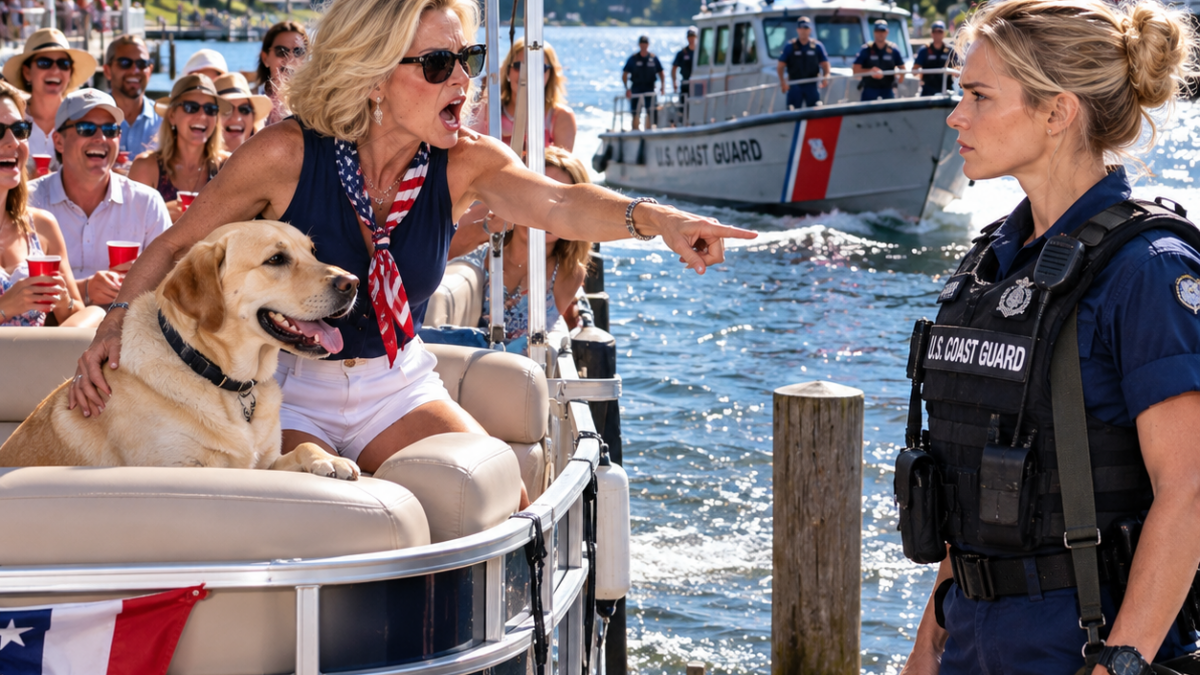
Now, on Celia’s dock, the woman in white stepped from the response boat.
Rear Admiral Margaret Sullivan.
Behind her came Senior Chief Patrick Nolan, the outgoing officer in charge.
And Mateo.
For one second, the entire cove seemed unreal.
The admiral walked first to Grandpa.
“Mr. Whitcomb, your letter was one of the finest I’ve received this year.”
Grandpa gripped her hand with both of his.
“I just wanted somebody to recognize what she does before I run out of time to see it.”
Something tightened behind my ribs.
The admiral turned toward me.
“Nora Whitcomb.”
“Yes, ma’am.”
She opened the blue presentation case.
On the lake, Celia’s pontoon had come within hearing distance.
Thirty relatives watched.
Murphy stood at the bow.
The admiral asked me to stand beside Grandpa.
Then she spoke about the Mercy Jane rescue.
Breaking surf.
Freezing water.
Three fishermen brought home.
A lost deckhand whose absence none of us forgot.
She spoke about command under dangerous conditions and the responsibility of holding a rescue boat in position while people worked at the edge of what was physically possible.
Then she referred to me as Senior Chief Whitcomb.
I heard somebody on the pontoon whisper, “Senior Chief?”
My mother started crying.
Dad looked stunned.
The admiral pinned the medal to my sweatshirt because I was not wearing a uniform.
Mateo stepped beside us.
“Ma’am,” he told Sullivan, “I was on her crew that night. I wouldn’t be standing here if she hadn’t kept that boat exactly where we needed it.”
Murphy barked.
Someone told him to be quiet.
I looked at Celia.
For one second, I wondered whether twenty-one years of certainty had finally cracked.
Then she met my eyes.
She was not ashamed.
She was furious.
Not because she had learned something new about me.
Because everyone else had.
The following morning, she stormed into my parents’ kitchen and accused me of arranging the entire presentation to humiliate her.
I told her Grandpa organized it.
She refused to believe me.
“You sat there letting us leave you on the dock while you knew that boat was coming.”
“I did not know.”
“Don’t lie to me.”
“I’m not.”
“You enjoyed it.”
That one almost made me laugh.
“Celia, I sat where you left me.”
She stormed out and slammed the door.
Two days later, somebody slipped a plain brown envelope beneath the side door.
Inside was a photocopied insurance statement dated September 2005.
June Star claim.
Aunt Celia’s signature.
I read the final paragraph twice.
She claimed she personally watched me take the June Star away from the dock that night.
She said she warned me to return.
She described me operating the boat.
There was one problem.
Celia had been eighty miles away at the wedding in Traverse City.
For the first time in twenty-one years, I wondered whether my family had simply believed Adam.
Or whether an adult had deliberately helped create the lie.
I carried the paperwork into the backyard because I did not want Mom watching my face.
The photocopy was old and crooked.
Near the bottom, someone had circled the phrase personally observed.
The statement was not “Adam told me Nora was driving.”
It was written as eyewitness fact.
A thing Celia could not possibly have seen.
I photographed every page.
Placed the papers in a folder.
Then called the retired attorney who helped Grandpa with his estate.
She told me to preserve everything and verify where the document came from before confronting anybody.
Especially if a false statement had influenced an insurance payment.
I was not interested in collecting damages over something that happened when I was sixteen.
What bothered me was the construction.
An adult had taken a frightened teenager’s lie and given it structure.
Date.
Details.
Signature.
Official paper.
For years I believed the accusation survived because I never contradicted Adam.
Now I understood silence might not have been enough.
Somebody had reinforced it.
I took the document to Grandpa.
He sat on his screened porch repairing a fishing reel beneath a magnifying lamp.
He read slowly.
His expression changed at Celia’s signature.
“I never saw this.”
“The insurer paid you?”
“Thirty-eight thousand after the deductible.”
“What happened to the money?”
He looked toward the lake.
“I gave most of it to Thomas.”
That surprised me.
“Why?”
“He spent three winters restoring that boat. His shop was struggling.”
A memory surfaced.
Uncle Thomas complaining about equipment invoices.
Dad helping settle accounts after Thomas died.
Celia saying the June Star ruined him.
Grandpa explained the insurer had asked whether whoever operated the boat had proper certification.
I had.
Adam had not.
“Did you tell them I was driving?”
“I told them what the family believed.”
“Did anyone ask me?”
His eyes lowered.
“They should have.”
That hurt more than I expected.
Grandpa had always been my safest person.
Even he had allowed the story to become official without asking me privately.
He said I seemed determined not to discuss the accident.
He thought respecting my silence was kindness.
I understood.
Understanding did not erase the loneliness.
The next morning, I searched the county library archives.
The first newspaper report identified me as the operator of the June Star.
Source: a family member.
A later article quoted Celia blaming my carelessness for destroying Thomas’s years of restoration work.
She had not merely accepted the family story.
She had carried it outside.
Into print.
Into town memory.
I drove to the old Mercer workshop.
A marine supply company owned it now.
The building still smelled faintly of sawdust beneath motor oil.
A man named Russell Price recognized me.
He had apprenticed under Uncle Thomas when I was a kid.
“You’re Everett’s granddaughter.”
“The one who joined the Coast Guard.”
I showed him the envelope.
The pencil marks.
He looked at it.
Then sighed.
“I sent it.”
He explained that new owners were clearing old storage.
He found boxes containing insurance records from the June Star.
Celia’s statement.
Settlement papers.
Adjuster notes.
He remembered she and Thomas were away at the wedding when the wreck happened.
Then he saw the newspaper story about my medal presentation.
“I thought you deserved to know what was written about you.”
“Why didn’t you send it twenty years ago?”
“I hadn’t seen it.”
Fair.
Then Russell reached beneath the counter and pulled out another photocopy.
Uncle Thomas’s old estimate for restoring the June Star.
Materials.
Labor.
Equipment.
At the bottom, Thomas had written that his business needed the insurance settlement to remain current on loans.
“Your aunt tells everybody the wreck destroyed him,” Russell said. “Truth is, the shop was already drowning.”
I stared at the handwriting.
Family history shifted beneath me.
The accident had not only become a source of blame.
It had produced money.
Money Thomas needed.
Money obtained through an account Celia could not honestly have witnessed.
Russell hesitated.
“There’s more.”
Of course there was.
“A few weeks before Thomas died, he came in asking if we still had the original accident file.”
“Why?”
Russell looked toward the old workbench.
“He said he found something in Adam’s room that made him think we blamed the wrong kid.”
He led me into the back office and opened an old metal filing cabinet.
Inside was a thin black ledger with a cracked cover.
I recognized it.
Thomas’s work notebook.
The first pages were careful repair entries.
Near the end, the handwriting became rushed.
Russell said Thomas found the spare ignition key in Adam’s tackle box in February 2007.
Adam had told everyone the key was already aboard when I supposedly decided to take the boat.
Thomas remembered hanging it in Grandpa’s garage after the previous family outing.
Finding it did not prove who had been at the wheel during impact.
It proved Adam had planned the trip.
Thomas had begun asking questions.
One entry stopped me.
If Nora saved my son, what have I spent eighteen months punishing her for?
I read it again.
And again.
For nearly two years after the wreck, Thomas barely looked at me.
I thought his silence meant hatred.
Now I knew he had begun questioning the story before he died.
It did not erase what happened.
It did not restore the conversation we never had.
But it mattered.
Adam came to my parents’ house that evening.
I had called him.
Russell had apparently called too.
Adam parked near the road and approached with his hands shoved into his pockets.
At thirty-six, he had children, a mortgage, and a job reviewing property insurance claims.
The irony would have been funny if it were not so ugly.
We sat on the porch steps.
I showed him Celia’s statement.
Then Thomas’s notebook.
Adam covered his mouth with one hand.
Finally he spoke.
“I told Mom.”
My stomach tightened.
“Told her what?”
“That I was driving.”
“When?”
His eyes closed.
“Three weeks after the wreck.”
The words did not make sense at first.
For twenty-one years, I believed Adam maintained the lie because he feared his father.
I believed Celia had trusted her only child and never known differently.
Now he was telling me she knew almost immediately.
She knew when she signed the insurance statement.
She knew when Thomas died.
She knew every time she blamed me.
She knew when she gave my seat to a dog.
“What did she say?”
Adam stared at the ground.
“She said Dad would lose the shop if the insurance company found out.”
He told me Celia said Thomas could not handle another disappointment, especially one caused by his own son.
She told Adam changing the account might complicate coverage because he was not properly qualified to operate the boat.
She promised they would tell everyone after the settlement.
They never did.
After Thomas died, Celia turned the lie into grief.
“Every time she said losing the boat destroyed him,” Adam whispered, “I felt like I killed my father.”
I looked at him.
The fifteen-year-old inside the story deserved sympathy.
The thirty-six-year-old who sat through years of jokes at my expense did not deserve the same excuse.
“You could have stopped her this Fourth of July.”
“I know.”
“You could have stopped her twenty years ago.”
“I know.”
He cried quietly.
I did not hug him.
I stayed beside him.
That was all.
“You need to write down exactly what happened.”
He nodded.
“And talk to an attorney about the insurance issue.”
Another nod.
Then he asked, “If I tell everyone, will you forgive me?”
I watched swallows dart beneath the porch roof.
“I don’t know.”
His face fell.
I continued.
“And you need to tell the truth even if my answer is no.”
That mattered.
Truth offered in exchange for forgiveness is still a negotiation.
I had spent enough of my life negotiating with somebody else’s guilt.
Two days later, a reporter from the Charlevoix Courier called Station Charlevoix asking for an interview about my new assignment as officer in charge.
I declined a personal profile but agreed to talk about the station.
Before hanging up, she mentioned finding the old June Star article.
“The rescue report says the girl was found holding the boy against a pier ladder.”
“Yes.”
“The paper called her responsible for the wreck.”
“Yes.”
She paused.
“Why did nobody interview that girl?”
That question stayed with me.
The reporter’s name was Hannah Porter.
She met me at a waterfront coffee shop carrying two notebooks, a recorder, and a file of old articles.
She listened carefully.
I told her everything.
Including the part where Adam accused me and I chose silence.
I did not pretend I had been fearless.
I told her I was sixteen.
I was exhausted.
I watched adults decide what happened before I could decide whether I wanted to speak.
Hannah asked for documents.
I provided rescue records and copies of Thomas’s notes.
I withheld Celia’s insurance statement until my attorney could advise me.
Adam submitted a signed statement.
He admitted taking the boat.
Admitted operating it when the storm hit.
Admitted blaming me.
Admitted confessing to his mother weeks later.
Rebecca called me afterward.
She had only recently learned the full truth.
She was furious with Adam.
But she thanked me for refusing to pretend what he did was harmless.
I did not know what to say.
The Courier investigation ran on July 23.
Six days after I formally took charge of Station Charlevoix.
The article covered my Coast Guard career and the Mercy Jane rescue.
Then it returned to 2005.
It quoted a retired rescue crew member who remembered prying my hands from the pier ladder.
It included Adam’s confession.
It reported that Celia declined to answer detailed questions about her earlier account.
The story spread quickly.
Relatives who had not called me in years suddenly sent apologies.
Some claimed they had always suspected there was more to the story.
Dad told one family friend, “You could have mentioned that twenty years ago.”
When he repeated that to me, I said, “You lived in the same house as me.”
He did not argue.
Celia resigned as chairwoman of the local lake association after board members began asking questions.
The old insurer acknowledged Adam’s submission but gave no immediate indication whether it would reopen a claim more than two decades old.
I refused to predict legal outcomes.
I had enough current responsibilities.
A few weeks later, a twenty-six-foot sailboat lost power while approaching the channel from Lake Michigan.
Four people aboard.
Two children.
Wind pushing them toward the south pier.
We launched.
Mateo handled the response boat while I supervised.
He brought us alongside in difficult conditions, calm and precise.
We secured a tow.
The family came ashore safely.
Afterward, Mateo leaned against the boathouse and handed me terrible station coffee.
“Do you ever stop thinking about the ones we didn’t get?”
I knew he meant Daniel Price.
“No.”
He nodded.
“Funny thing about the medal. Everybody talks about the three.”
“I think about the fourth.”
“So do I.”
That conversation helped me understand something.
I had not built my career to prove Celia wrong.
The Coast Guard Medal was not an answer to the June Star accusation.
My work had grown from lessons Grandpa taught me long before that wreck.
Fear does not mean useless.
Rescue is doing the next necessary thing even while afraid.
I did not need my family to understand that for it to remain true.
In early August, Celia appeared outside Station Charlevoix in a silver sedan.
She refused to pass through the gate.
I walked out.
She wore one of Thomas’s old green flannel shirts despite the warm weather.
For several seconds she sat gripping the steering wheel.
“Can we walk?”
We went toward the seawall.
Public place.
Open water beside us.
No relatives.
No performance.
Adam told me he talked to you,” she said.
“He did.”
“You saw the insurance statement.”
“Yes.”
Celia stopped beside the railing.
“I signed it because I thought Thomas would lose everything.”
I waited.
“The shop was behind. He wasn’t sleeping. When the adjuster started asking questions, I thought one more piece of paperwork wouldn’t hurt anyone.”
“It hurt me.”
She closed her eyes.
“I know that now.”
“No.”
Her eyes opened.
“You knew it then.”
She started to speak.
I stopped her.
“You knew Adam was driving. You knew I was being blamed. You signed something claiming you personally saw me leave that dock.”
Her face folded.
“I was scared.”
“I was sixteen.”
That silenced her.
I continued.
“You were the adult.”
Tears came.
She told me fear became habit.
After Thomas died, blame became easier than facing the truth.
She had needed somebody responsible for the life she lost.
I became that person.
She admitted the jokes were deliberate.
If she kept everybody laughing, nobody asked why the story did not make sense.
When she said she had mistaken my silence for indifference, I felt something old rise in me.
“A frightened sixteen-year-old failing to defend herself is not permission for an adult to be cruel.”
For the first time in my life, Celia did not contradict me.
She asked whether an apology would help.
“A private apology doesn’t undo twenty-one years of public blame.”
“What do you want?”
“Tell the same people.”
Her face went still.
“Tell them Adam drove. Tell them you knew. Tell them what you signed.”
“Everybody will hate me.”
“Maybe.”
I looked toward the channel.
“I’ve had twenty-one years to learn how that feels.”
We stood silently while a charter boat passed.
Finally she said she would gather the family on Labor Day.
She asked whether I would come.
“Yes.”
Then she asked whether we could become close afterward.
“No promises.”
That answer hurt her.
But she nodded.
Before leaving, Celia said, “Thomas kept something.”
“What?”
“From the June Star.”
My chest tightened.
“What?”
“The last piece recovered from the wreck.”
Labor Day came with clear skies and cool wind.
Thirty relatives gathered on Celia’s lawn.
Same dock.
Same bunting, faded from summer.
Same folding tables.
Murphy wandered among the guests begging for hamburger.
This time, when he settled beneath Grandpa’s chair, I scratched behind his ears.
He had never done anything wrong.
He sat where someone told him to sit.
At three o’clock, Celia called everyone toward the dock.
Adam stood beside her.
She held a sheet of paper that shook in the breeze.
My mother stood next to me twisting her wedding ring.
Dad stared toward the water.
Grandpa sat in a padded chair beneath his Coast Guard cap.
Celia looked at me.
Then spoke.
“I owe Nora an explanation.”
Silence.
“Twenty-one years ago, my son took his grandfather’s boat without permission.”
Several relatives looked toward Adam.
He did not look away.
“Nora followed because she was trying to stop him. Adam drove the June Star into a storm. When the boat struck the pier and sank, Nora kept him alive until the Coast Guard arrived.”
Mom inhaled sharply.
Celia explained Adam’s original lie.
Then his confession three weeks later.
She told them about Thomas’s debts.
The insurance claim.
Her false statement.
She admitted she had never witnessed me leaving the dock.
She admitted knowing the truth while allowing the insurance claim to proceed under a false account.
Her voice cracked when she reached Thomas’s death.
“I blamed Nora because I could not face what I had done.”
Nobody moved.
“I made her responsible for things she didn’t do.”
Her eyes found mine.
“And I kept doing it because the longer I repeated the story, the harder it became to admit I had lied.”
She looked toward Murphy.
“At the Fourth of July party, I gave her place on the boat to a dog because I wanted all of you to laugh at her one more time.”
Murphy chose that exact moment to stand.
He shook himself and trotted toward the dock.
Grandpa’s mouth twitched.
Nobody else laughed.
Celia folded the paper.
“I was wrong. Nora did not sink that boat. Adam was driving.”
She swallowed.
“And she saved his life.”
Adam stepped forward.
He confirmed everything.
He apologized for lying.
For staying silent.
For watching me carry the consequences.
Then he looked directly at me.
I nodded.
Nothing more.
I was done turning other people’s confessions into moments where I had to comfort them.
Dad approached later.
“I should have asked you.”
“Yes.”
“I should have known there was more.”
“Yes.”
“I’m sorry.”
I believed him.
That did not erase holidays spent staring into his drink while Celia humiliated me.
“I appreciate the apology.”
He waited.
I added, “But the years still happened.”
Dad nodded.
For once he did not ask me to make the conversation easier.
Grandpa reached for my hand when I sat beside him again.
“You were always better on that water than any of us.”
“You taught me.”
He shook his head.
“I taught you knots.”
His fingers closed around mine.
“The rest was yours.”
The weeks afterward rearranged the family.
Adam consulted a lawyer about the old insurance matter.
Celia cooperated with inquiries.
Some relatives stopped speaking to her.
Others defended her.
I stayed out of those arguments.
I had spent enough years as the subject of conversations I was not invited into.
I had a station to run.
A crew to train.
And Grandpa’s health was failing.
By September, he used supplemental oxygen.
I visited whenever duty allowed.
Groceries.
Medication.
Coffee.
He asked about the station constantly.
One evening, he asked me to tell him the full Mercy Jane story.
Not the citation.
The real one.
So I told him about Daniel Price.
The missing deckhand.
The hours of searching.
The empty survival suit.
The discomfort of accepting an award for a mission that ended with one family still waiting.
Grandpa listened.
When I finished, he said, “Same girl.”
“What?”
“The one holding Adam against that ladder.”
I looked at him.
“You just got older and learned to operate a bigger boat.”
For most of my life, the 2005 memory had been tangled with shame.
That sentence separated something.
The storm.
The lie.
The rescue.
They were not the same thing.
I had done something good on a terrible night.
Then Grandpa told me something else.
“I always suspected Adam was driving.”
I stared.
He said he woke when the June Star left.
He recognized the abrupt throttle use Adam favored when handling small engines.
He noticed the spare key was missing.
“Why didn’t you say anything?”
He looked toward the lake.
“I thought your silence was a decision.”
“It wasn’t.”
“I know that now.”
“You should have asked.”
“Yes.”
No excuse.
No defense.
He accepted it.
That conversation meant more to me than the medal ceremony.
Grandpa had protected what he thought was my choice.
He finally understood I had never really been offered one.
We sat together until the porch lights came on.
On October 6, Celia arrived at the station carrying something long wrapped in an old striped beach towel.
She placed it on a table.
Unwrapped it.
The June Star’s original mahogany transom.
Cracked.
Weathered.
My grandmother’s name still visible in faded gold.
June Star.
My hand moved across the wood.
Even beneath the damage, I could feel the smoothness of Thomas’s work.
“Twelve coats,” I whispered.
Celia nodded.
“And sand between every one.”
Thomas had arranged to keep the piece after the wreckage was recovered.
He planned to rebuild the boat around it someday.
He died before he could.
Celia stored it behind the workshop for almost twenty years.
Then she asked me something I never expected.
“Will you take me out to where it went down?”
I looked at her.
She said she wanted to see the channel again and decide what should happen to the transom.
“You can say no.”
I thought about it.
Then agreed.
“One condition.”
She waited.
“Murphy comes.”
For the first time, a real smile crossed her face.
Saturday, October 10, was calm.
The lake reflected individual maple leaves.
Most summer boats were already out of the water.
Celia sat in the forward passenger seat of her pontoon with the wrapped transom across her knees.
Murphy occupied the rear bench.
I stood on the dock holding the bow line.
“You ready?”
Celia looked at the wheel.
Then handed me the key.
“You drive.”
Simple words.
But I knew what they cost.
Three months earlier, she had refused me a passenger seat because she wanted the family to remember me as incompetent.
Now she handed me control.
I took the key.
Started the engine.
Eased us out.
Celia watched my hands while we crossed the cove.
The old slip beneath Grandpa’s house passed on our right.
“Thomas used to say you could feel what a boat wanted before it moved,” she said.
“Grandpa said something similar.”
“He learned it from Everett.”
I remembered Thomas handing me tiny brass screws during the restoration.
For years, I believed his silence after the wreck erased those afternoons.
Now I knew he had doubted the accusation before his death.
That brought comfort.
It also made me angry.
Knowledge could not restore the conversation we never had.
The adults failed me.
Even the ones who eventually questioned themselves.
We entered Round Lake.
Passed restaurants quieter than in July.
Approached the drawbridge.
Beyond it stood the two concrete piers leading toward Lake Michigan.
Station Charlevoix sat on the northern shore.
I checked the current.
Slowed.
Celia looked at the station.
“Do they know we’re coming?”
“They know I’m passing through.”
“Do they know why?”
“No.”
She relaxed.
Near the South Pier, I saw Grandpa in a wheelchair.
Dad stood beside him.
A wool blanket covered Grandpa’s legs.
His old Coast Guard cap sat low on his forehead.
He had insisted on coming.
I raised one hand.
He waved.
Celia started crying.
Quietly.
I kept the pontoon steady.
The steel ladder from 2005 had been replaced.
Its location had not.
My body recognized the place before my mind did.
I put the engine in neutral.
For several seconds, neither of us moved.
Celia carried the transom to the rail.
“Thomas thought he could rebuild the whole boat around this.”
“He probably could have.”
“He was tired even before the wreck.”
She looked at the wood.
“He worried about money constantly. I kept telling him the shop would recover.”
I listened.
She admitted that after Thomas died, believing the wreck had killed him gave grief a shape.
Heart disease was random.
The lie was easier.
If the wreck caused his death, someone could be blamed.
If someone could be blamed, the world made sense.
She protected Adam because he was her son.
She sacrificed me because I was available.
“I loved him,” she whispered.
“I know.”
“I loved Adam.”
“I know.”
She turned toward me.
“And I hurt you because I couldn’t face what I had done.”
“Yes.”
There was nothing else to say.
Celia looked toward the water.
She had planned to lower the transom into the channel.
Return the last piece of the June Star to the place where the boat disappeared.
Now she could not do it.
“Does keeping it mean I’m refusing to move forward?”
“No.”
She looked at me.
“Thomas spent three winters making that wood beautiful. Grandpa loved the boat because it reminded him of Grandma. We don’t have to destroy what’s left just because the rest is gone.”
“What should we do?”
“Preserve it.”
There was a small maritime museum near the waterfront.
I suggested the transom could be stabilized and displayed with photographs of the June Star.
Celia offered to pay.
That felt appropriate.
When we turned back toward the cove, Murphy moved forward and rested his enormous head against my leg.
I scratched his ears.
We passed the station.
Mateo stood near the boathouse and waved.
I waved back.
Seeing him reminded me the past held more than one story about my hands.
Celia’s version had never determined what I was capable of.
On the way home, she asked whether I would come to Thanksgiving.
“I already have plans.”
“With your parents?”
“People from the station.”
She nodded.
“I understand.”
I was not sure she did.
So I explained.
“I’m glad you told the truth.”
She watched me.
“I’m glad Adam admitted what happened. I’m glad we’re preserving the transom.”
Her eyes filled.
“But that doesn’t mean we return to the relationship we had.”
“I know.”
“No. I spent twenty-one years being polite while you humiliated me. I’m not going back to family gatherings just because everyone suddenly wants to be kind.”
She remained silent.
“I can be civil. I can talk about Grandpa. The boat. The dock. But I don’t trust you with important parts of my life.”
She looked at her hands.
“And I don’t know if I ever will.”
“That’s fair.”
She did not ask me to change my mind.
That helped.
We returned after sunset.
Dock lights reflected across the water.
I brought the pontoon alongside.
Murphy jumped ashore first, tail wagging like he had navigated the entire trip.
Celia secured his leash.
At the porch steps she stopped.
“Thank you for driving.”
“You’re welcome.”
She looked like she wanted to say more.
Maybe ask for a hug.
Maybe ask whether everything would eventually be okay.
Instead, she nodded and carried the transom inside.
I stood beneath the porch light feeling something I had not expected.
Peace.
Not reconciliation.
Not forgiveness.
Peace.
The museum accepted the transom the following spring.
A conservator stabilized the wood, cleaned the original lettering, and mounted it behind glass.
The display included photographs of the June Star.
Thomas’s restoration notes.
Grandpa’s memories.
And an accurate account of the wreck.
Adam’s corrected statement became part of the historical record.
Nobody would have to rely on family gossip again.
Grandpa attended the opening in a wheelchair.
He was eighty-nine.
His voice had grown softer.
His eyes remained sharp.
When he saw Grandma’s name glowing beneath the museum lights, he reached for my hand.
“Remember the first knot I taught you?”
I picked up a short length of rope from the museum’s educational display.
Closed my eyes.
Tied a bowline.
He laughed.
“Still got it.”
I handed him the knot.
He held it for a long time.
Celia attended too.
She stayed near the back.
We exchanged a polite greeting.
Nothing more.
Adam came with Rebecca and their children.
I spoke to him briefly.
He had completed the legal disclosures his attorney recommended.
The insurer had reviewed the historical file.
Whatever formal consequences followed remained between the involved parties.
I did not ask for updates unless something directly affected me.
Our relationship was different now.
That was appropriate.
My parents were there.
They had begun asking real questions about my work.
They listened to the answers.
Sometimes Dad caught himself before repeating one of the old jokes.
Mom stopped saying Celia “was only teasing.”
Those changes mattered.
They did not erase the past.
I had stopped demanding that repair look like erasure.
After the museum event, I drove Grandpa home.
We passed Celia’s cove.
Her pontoon sat under a gray cover.
Murphy lay in the grass nearby.
Grandpa chuckled.
“That dog got you into a lot of trouble.”
“He didn’t do anything.”
Grandpa looked at me.
“He sat where somebody told him to.”
I nodded.
“People do that too.”
He smiled.
“Exactly.”
At the station the next morning, a new crew member struggled with a line at the cleat.
He apologized when I approached.
“Sorry, Senior Chief. I keep screwing this up.”
I took the rope.
“Watch.”
I demonstrated slowly.
Not just the movements.
Why each turn mattered.
Then handed it back.
“Again.”
He tried.
Failed.
Tried again.
Got it.
I nodded.
We went back to work.
That should have been the end.
In some ways, it was.
But truth has aftershocks.
The family had spent twenty-one years organized around one version of me.
The careless girl.
The dangerous one.
The cousin who destroyed Thomas’s boat.
The reason Celia’s life became harder.
When the story collapsed, people had to examine why believing it had been so convenient.
Some relatives apologized once and expected immediate restoration.
Others disappeared because seeing me reminded them of the jokes they had made.
Aunt Carol sent a long email explaining she never meant harm.
I replied with one sentence.
I believe you didn’t think about the harm.
That was different from saying there was none.
Dad struggled the most.
One evening, several months after the museum opening, he sat with me on Grandpa’s porch.
“I keep thinking about that night.”
“The wreck?”
“No.”
He looked ashamed.
“The Fourth.”
Celia giving Murphy my seat.
Everyone laughing.
Dad staring into his drink.
“I should have said something.”
“Yes.”
He nodded.
“I thought staying quiet would keep things from getting worse.”
“That’s what I thought when I was sixteen.”
He looked at me.
The comparison landed.
Silence had been our family’s favorite method of avoiding immediate discomfort.
Adam stayed quiet because he feared his father.
I stayed quiet because I wanted to protect Adam.
Grandpa stayed quiet because he thought he was respecting me.
Dad stayed quiet because confronting Celia would create conflict.
Mom stayed quiet because she wanted family gatherings to remain pleasant.
Celia used everyone’s silence to build a lie large enough to live inside.
“Somebody eventually pays for peace like that,” I said.
Dad looked toward the lake.
“I know.”
Grandpa died the following winter.
Quietly.
At home.
I had been at the station when Dad called.
By the time I arrived, the porch chair beneath the maple tree was empty.
His Coast Guard cap sat on the side table.
I picked it up.
Held it.
Then sat where he used to sit.
The lake had frozen along the cove.
No boats.
No wakes.
No engines.
Just wind moving through bare branches.
Grandpa left me his old wooden cane, the framed photograph of his 1958 station crew, and a short handwritten note.
Nora—
Never confuse being doubted with being wrong.
You knew the water before they knew you.
Love,
Grandpa
I folded the note and carried it in my wallet for years.
At his funeral, Celia sat three rows behind me.
Adam sat beside her.
My parents sat on my other side.
Nobody spoke about the June Star.
That was good.
Grandpa deserved a funeral about Grandpa.
After the service, Celia approached.
“I’m sorry.”
“For what?”
“For all the years I made him watch me treat you like that.”
It was a strange apology.
Not centered on me.
Still honest.
“Thank you.”
She nodded.
Then walked away.
Our relationship remained exactly what I told her it would be.
Civil.
Limited.
Real.
A year later, I received transfer orders again.
Leaving Charlevoix felt different from every departure before.
The first time I left home, I was running from a story.
This time I was simply moving forward.
At my final station gathering, Mateo gave me a framed chart of Lake Charlevoix with the Columbia River Bar chart inset beneath it.
Across the bottom, the crew had engraved:
Same water. Bigger boat.
I laughed.
“Grandpa would have stolen this.”
Mateo smiled.
“Then we nailed the frame shut.”
I kept it.
Before leaving town, I visited the museum alone.
The June Star transom remained behind glass.
The gold lettering shone softly beneath the lights.
A family stood nearby reading the display.
A little girl pointed toward the rescue section.
“Mom, she saved him?”
Her mother read the text.
“Yes.”
The girl looked toward the photograph of sixteen-year-old me wrapped in a Coast Guard blanket.
“She looks scared.”
I almost laughed.
She was right.
I had spent years believing that photograph showed weakness.
Now I saw something else.
A terrified kid who still held on.
The family moved to another exhibit.
I remained.
Thomas’s line from the ledger had been included in the display.
If Nora saved my son, what have I spent eighteen months punishing her for?
I touched the glass.
Not because I forgave him for everything.
Because I was glad he had finally asked the question.
Late understanding cannot change the past.
But sometimes it stops the past from being the only thing you inherit.
Years after that, Adam called me unexpectedly.
He rarely called.
We mostly exchanged birthday messages and occasional updates about his children.
“Nora?”
“Yeah.”
“Mom’s sick.”
Celia had been diagnosed with cancer.
Treatable, according to doctors.
But serious.
“I’m sorry.”
“She wants to see you.”
I closed my eyes.
“Why?”
“I think she’s scared.”
A bitter answer appeared immediately.
So was I at sixteen.
I did not say it.
Instead I asked, “Does she need something practical?”
“No.”
“Medical help?”
“No.”
“Money?”
“No.”
“Then I’m not sure what she expects.”
Adam was quiet.
“She says she doesn’t want to die with you hating her.”
I almost laughed.
Not because it was funny.
Because after all those years, Celia still imagined my feelings were something she could resolve for herself.
“I don’t hate her.”
Adam sounded surprised.
“You don’t?”
“No.”
“Then what?”
“I don’t trust her.”
Silence.
“That’s different.”
It was.
Hate takes energy.
Distrust requires memory.
I agreed to call.
Not visit.
Celia’s voice sounded older.
Weak.
“Thank you for talking to me.”
“You’re welcome.”
She cried.
I waited.
“I keep thinking about the Fourth.”
“So do I.”
“I thought hurting you would make me feel less ashamed.”
That was more honest than anything she had said years earlier.
“Did it?”
“No.”
“Good.”
She laughed softly.
“I deserve that.”
“No. You deserve whatever consequences came from what you chose. I’m not interested in making suffering into a scoreboard.”
She became quiet.
Then asked, “Do you forgive me?”
I looked out at the harbor outside my current station.
A crew was practicing line handling.
A young boatswain’s mate dropped a rope.
Picked it up.
Tried again.
“I accepted your apology.”
“That’s not what I asked.”
“I know.”
She waited.
I thought about twenty-one years.
The dock.
Murphy.
Thomas.
Adam.
The insurance statement.
The public correction.
The museum.
Grandpa.
“I don’t think forgiveness is one door you either open or close.”
She listened.
“I don’t wake up angry at you.”
She exhaled.
“I’m glad.”
“But I still remember.”
“I understand.”
“And I’m not coming back to build a relationship we never had.”
Her voice trembled.
“I understand.”
This time, I believed she did.
Celia recovered.
We never became close.
That surprised some relatives.
They believed survival should inspire reconciliation.
It did not.
Sometimes survival inspires clarity.
Adam and I became something closer to acquaintances with history.
We could talk.
We could sit at the same table.
I watched his children grow.
He never asked me again whether I forgave him.
That helped.
He eventually told his oldest son the full June Star story before the boy was old enough to drive a boat.
“Why?”
I asked him.
“Because secrets grow.”
That answer was good enough.
My parents changed too.
Slowly.
Mom once started telling a new neighbor the old “Nora sank a boat” story out of habit.
She stopped herself halfway through.
Then said, “Actually, that isn’t what happened.”
Small.
Important.
Dad became the person who corrected other relatives when they simplified the story.
“No,” he would say. “Adam was driving. Nora saved him.”
The first time I heard him do it, I looked at him.
He shrugged.
“Should’ve done it twenty years earlier.”
“Yes.”
He smiled sadly.
“Yes.”
I kept serving.
More stations.
More crews.
More storms.
More people pulled from water.
More people we could not reach.
I promoted.
Eventually the title changed.
The responsibilities grew.
The water remained honest.
That was what I always liked about it.
The lake does not care what your family thinks.
The ocean does not care who was blamed at Thanksgiving.
Wind, current, hull, throttle, judgment.
Reality does not negotiate.
For years I thought that was why I loved boats.
Later I understood I loved them because they required the thing my family had avoided.
Truth.
A boat is either taking on water or it is not.
A line is secure or it is not.
A person is breathing or they are not.
You cannot preserve peace by pretending otherwise.
One summer, long after Grandpa was gone, I returned to Charlevoix on leave.
The museum had updated the June Star display.
Beside the transom was a small screen showing oral-history clips.
Grandpa had recorded one before his death.
I had never seen it.
He appeared on screen wearing his faded Coast Guard cap.
Older than I remembered.
Hands folded over his cane.
The interviewer asked what he wanted visitors to understand about the June Star.
Grandpa considered the question.
Then said:
“People think the important thing is who sank the boat.”
He smiled.
“It isn’t.”
The interviewer asked what was.
Grandpa looked directly into the camera.
“The important thing is what Nora did after it sank.”
I stood alone in the museum and cried.
Not dramatically.
Quietly.
The kind of tears that arrive when somebody says the sentence you needed decades earlier.
That night, I walked to the South Pier.
Same concrete.
Different ladder.
Lake Michigan dark beyond the channel.
I stood near the place where Adam and I had nearly died.
For years I avoided that spot unless duty required it.
Now I rested both hands on the railing.
Closed my eyes.
And remembered accurately.
Adam was driving.
The storm came.
The boat hit.
We went into the water.
I found him.
I found the ladder.
I held on.
That was the story.
Not the newspaper.
Not Celia.
Not the insurance file.
Not twenty-one years of jokes.
Reality had always been simpler than the family version.
I had just been too young to defend it.
I opened my eyes.
A Coast Guard boat moved through the channel in the distance.
Blue light reflecting briefly across the water.
For one second, I saw the vessel turning into Celia’s cove on that Fourth of July.
Grandpa checking his watch.
Murphy sitting in my seat.
The young sailor recognizing me.
The admiral carrying the blue case.
My family suddenly realizing the person they had mocked near boats had built an entire life saving people on them.
At the time, I thought that was vindication.
It was not.
Vindication came later.
When Adam told the truth without requiring forgiveness.
When Celia corrected the lie publicly.
When Dad admitted he should have asked.
When Grandpa admitted silence was not consent.
When the museum preserved the record.
When I learned I did not need any of those things to know who I had been at sixteen.
That was freedom.
The next morning, I visited the station.
A young crew member was struggling with a bowline.
Same problem as years earlier.
He looked embarrassed when he recognized me.
“Ma’am, sorry.”
“Stop apologizing.”
I handed him the line.
“Again.”
He tried.
Failed.
Again.
Better.
Again.
Correct.
I nodded.
“There.”
He smiled.
“Thank you.”
I started toward the dock.
Behind me, he called, “Ma’am?”
I turned.
“How do you get good enough that you don’t mess up?”
I looked at the rope in his hands.
“You don’t.”
He frowned.
“You get good enough to notice the mistake before it matters.”
He considered that.
Then nodded.
I walked toward the water.
Grandpa had taught me something similar.
Thomas too, in his own way.
Doing more of something badly does not make it better.
Twenty-one years of repetition did not make Celia’s story true.
Thirty relatives laughing did not make me incompetent.
A newspaper article did not make me guilty.
My silence did not make their version accurate.
And one Coast Guard boat arriving at the dock did not suddenly transform me into someone worthy.
I had already earned what I earned.
Already done the work.
Already carried frightened people through bad water.
Nobody gave me that.
Nobody could take it away.
That afternoon, I visited the museum one final time before leaving town.
The transom glowed beneath the lights.
June Star.
Grandma’s name.
Thomas’s twelve coats of varnish.
Grandpa’s memories.
Adam’s corrected statement.
The truth.
All preserved together.
Not clean.
Not heroic.
Complete.
A family with two children stopped beside the display.
The boy asked his father, “Who was driving?”
His dad read the panel.
“The cousin.”
“What did the girl do?”
The father looked lower.
“She saved him.”
The boy nodded.
Then moved on.
That simple.
No argument.
No twenty-one years.
Just truth.
I stood there smiling after they left.
For most of my life, I thought clearing my name would require forcing everyone who mocked me to understand exactly how much they had hurt me.
I was wrong.
Some understood.
Some never fully did.
What mattered was that I finally stopped carrying their version of me.
I left the museum and walked toward the harbor.
The wind was light.
Water nearly flat.
Somewhere behind me, the June Star’s last surviving piece rested safely behind glass.
Ahead of me, a Coast Guard crew prepared to get underway.
I could hear lines moving across cleats.
An engine starting.
Someone calling instructions.
Ordinary work.
My favorite kind.
I headed toward the dock.
Not the girl who sank a boat.
Not Celia’s family joke.
Not Adam’s shield.
Not Thomas’s disappointment.
Not the subject of an old newspaper clipping.
Nora Whitcomb.
Coast Guard.
Granddaughter.
Surfman.
Rescuer.
The sixteen-year-old who had been terrified and held on anyway.
The woman who finally understood that those were never different people.
I stepped onto the dock.
A young sailor handed me a line.
I caught it automatically.
Made it fast.
Then looked out across the water.
For twenty-one years, my family had told a story about what happened when one boat sank.
They had forgotten the most important part.
I didn’t.