.Everyone Called Me Cold Until an Investigation Exposed What I Had Been Quietly Carrying for Two Years
part2
The first bill connected to Ben’s business arrived eleven days after his funeral. Ordinary white envelope. Yellow forwarding sticker. I had spent that morning washing the same load of towels twice because I kept forgetting to move them into the dryer. The bill demanded $18,600 and referenced an equipment guarantee tied to Eastline Freight Brokerage, the company Ben had started after leaving active duty. I assumed somebody had failed to update their records. Then another bill arrived. Then three emails. Then a certified letter.
Ben had always been good at transportation. Better with people than with numbers. He knew drivers’ names, mechanics’ birthdays, which soldier had a child in the hospital, which family needed help during deployment. When he left the Army, he wanted to build something that gave veterans predictable work without losing every birthday, anniversary, and Christmas to the road.
Eastline began in a rented office behind a tire warehouse outside Fayetteville.
Three customers.
One borrowed conference table.
A coffeemaker that leaked.
Ben came home smelling like diesel and cheap coffee with the happiest expression I had seen since Avery was born.
Avery drew him a company logo—a little blue highway disappearing into mountains.
He framed it beside his desk.
Then the business grew faster than the controls around it.
A large distribution contract promised regular freight between North Carolina and Texas. One customer delayed payment. Two carriers disputed invoices. Fuel costs jumped. Equipment financing became complicated. Ben’s civilian partner, Brett Calder, assured him every problem could be solved with temporary guarantees and enough patience.
Ben signed documents.
Made promises.
Borrowed.
Guaranteed equipment.
Asked friends to wait.
He called it normal growing pain.
I believed him because I wanted to.
Then he had the first stroke.
He collapsed in the parking lot outside Eastline’s office.
By the time I reached the hospital, surgeons were explaining procedures through language I understood academically and could not process emotionally. He survived the first emergency but never fully regained his speech.
Six weeks later, the second stroke ended any realistic possibility of bringing him home.
The night before he died, I sat beside his bed holding the hand that had repaired Avery’s bicycle and warmed mine on winter mornings.
His fingers moved once against my palm.
I told him we would figure everything out.
I did not know what “everything” meant yet.
Three weeks after the funeral, our attorney showed me.
Unpaid carrier invoices.
Equipment guarantees.
Business credit obligations.
Disputed payments.
Potential personal liabilities.
Approximately $340,000 in total exposure.
Some belonged only to Eastline.
Some were potentially enforceable against Ben’s estate.
Others came from promises he had signed personally without fully understanding the risk.
Our attorney, Teresa Quinn, was practical enough to make comfort sound like cross-examination.
“You are not automatically responsible for your husband’s separate business debts,” she told me. “Bankruptcy or orderly administration may be the sensible option.”
I asked for the names behind every invoice.
Teresa looked over her reading glasses.
“Sarah, you are a widow with a fourteen-year-old daughter. You do not have to destroy your future to rescue a failed company.”
I understood the sentence.
I did not accept it.
Not then.
To me, the bills had faces.
Miguel Delgado in El Paso, standing beside a red truck with his wife and children.
Arthur and Jean Bell, an older couple running a diesel repair shop outside Dayton.
A retired motor pool sergeant who had guaranteed equipment because Ben told him the business was stable.
People who had trusted my husband.
People who might lose homes or businesses because he was gone.
I called Rosa Delgado first.
She did not accuse me.
That made it worse.
“I’m not asking you for anything, Colonel,” she said. “I know your husband passed. I just want somebody to tell us what happened.”
“I’ll find out.”
That became my first mistake.
I confused making things right with taking personal responsibility for everything connected to Ben’s name.
We sold the four-bedroom house Avery had grown up in.
After the mortgage and closing costs, the proceeds covered a large portion of the verified claims.
I rented a smaller place five miles from post.
Canceled subscriptions.
Stopped replacing things that still worked.
Negotiated voluntary repayment agreements.
Seventy percent of my deposited compensation went toward obligations connected to Eastline.
Teresa protected Avery’s college account and forced me to maintain an emergency reserve because she knew I would otherwise spend that too.
At first, Avery treated the changes as something families did after a death.
She helped move boxes.
Taped Ben’s photograph to the refrigerator.
Said her smaller bedroom was fine even though a water stain spread across the ceiling.
By the second Christmas, she started asking questions.
“Are we poor?”
“No.”
“Then why can’t we go anywhere?”
“We have obligations.”
“Do the obligations have names?”
I told her adult finances were not her responsibility.
She looked at the old purse I was sewing because the strap had broken.
“I’m already worrying, Mom. You just won’t tell me what I’m worrying about.”
I should have told her then.
Instead I kissed her forehead and returned to the dining table where I kept a binder containing Ben’s agreements, invoices, payment records, and creditor correspondence.
The black binder.
The same one sitting beneath my chair in Major Flores’s interrogation room.
Near the bottom was an agreement Teresa had warned me about.
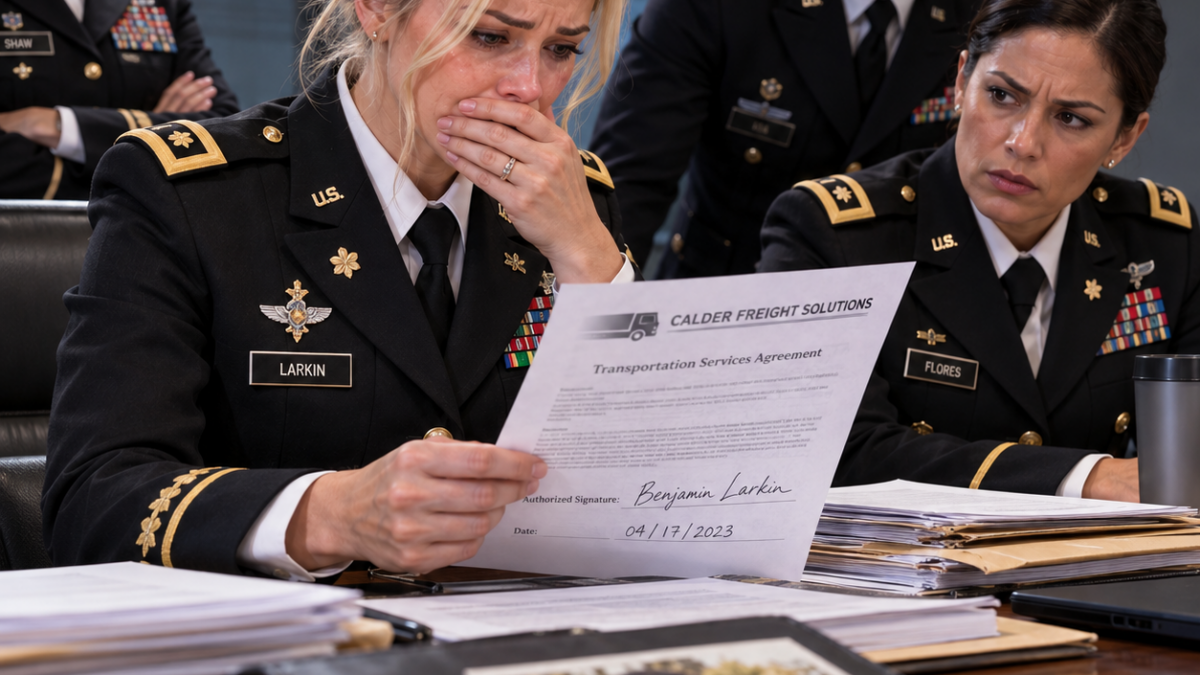
Calder Freight Solutions.
Brett’s newer company.
The paperwork claimed certain Eastline obligations had been transferred before Ben’s hospitalization.
Brett insisted it was routine.
I had never received a clean original.
He said records had been damaged during an office move.
I stuck a yellow note on the folder.
OBTAIN SIGNED COPY.
For almost two years, I never received one.
Then a photocopy appeared in an Army investigation bearing Ben’s signature after his death.
Once counsel arrived, I returned to Major Flores’s office with the black binder.
My attorney sat beside me.
Rourke was no longer in the room.
Good.
Flores had already obtained certified bank information showing that the transfers originated from my private funds, not government accounts. She had also begun checking whether the civilian businesses Rourke described as suspicious actually held contracts connected to decisions under my control.
Most did not.
That weakened the corruption theory immediately.
I opened the binder.
Checks to Rosa Delgado.
Bell Diesel Repair.
The retired sergeant.
Direct payments.
Settlement letters.
Receipts.
Bank confirmations.
Each transaction had a name and a reason.
Flores worked through them carefully.
Her face changed without becoming sympathetic.
Good investigators do not become emotionally helpful halfway through evidence.
They become precise.
“Why didn’t your command know the scale of these obligations?”
“I disclosed what security rules required.”
“That isn’t exactly what I asked.”
I rested both hands on the binder.
“Because my husband died, Major, and everyone wanted to talk about tragedy. They wanted to tell me Ben was wonderful, tell me I was strong, tell me time would heal things. I didn’t have energy to explain that some of the same people sending flowers were also wondering how they would make mortgage payments.”
Flores stayed silent.
Then she returned to the impossible document.
Calder Freight Solutions.
Ben’s signature.
Forty-nine days after burial.
She photographed it for the inquiry record and asked permission to refer potentially criminal concerns to civilian authorities through proper channels.
“Yes.”
When I left, Colonel Shaw waited in the hallway.
“Walk with me?”
We moved toward the parking lot.
“I’m sorry this is happening.”
I said nothing.
Then she surprised me.
“I haven’t been a very good friend since Ben died.”
“Friendship was never a requirement of command.”
She stopped.
“No. But I thought we were friends anyway.”
I did not know how to answer.
She was right.
I had pushed her away with everyone else.
Silence became easier because explaining grief required too much.
Before I could respond, my phone buzzed.
Avery.
A photograph from school.
Someone had posted an anonymous message on a student discussion board claiming her mother was being investigated for stealing Army money.
Comments beneath it mocked my old car.
Our smaller house.
One teenager wrote:
Maybe her dad left nothing because her mom stole it too.
I stood beneath fluorescent hallway lights staring at the screen.
For two years, I believed protecting Avery meant keeping ugly financial details away from her.
Now strangers were filling the empty spaces with lies.
I drove home early.
Avery sat at the kitchen table with her backpack still on.
Ben’s framed photograph lay facedown beside her phone.
“Did Dad steal money?”
“No.”
“Did you?”
“Absolutely not.”
“Then why is everybody talking about us like criminals?”
I sat across from her.
And finally told her the truth.
Not every adult detail.
Enough.
The failed business.
The creditors.
The repayments.
The house sale.
The uncertainty around some claims.
Brett.
The investigation.
The impossible signature.
Avery listened without crying.
When I finished, she asked, “Why didn’t you let me help make decisions about our family?”
“You were fourteen.”
“I was old enough to lose Dad.”
I stopped.
She continued.
“I was old enough to move. Old enough to watch you disappear into paperwork every night. But apparently not old enough to know why?”
There was no answer that would help.
She went to her room.
An hour later, she came back carrying a cardboard box.
Photographs.
Birthday cards.
Small things from Ben’s office.
At the bottom was the framed blue highway drawing she had made for Eastline when she was seven.
She turned it over.
A folded piece of paper had been taped behind the frame.
“Dad put that there after bringing it home from work. He told me it was important. I forgot.”
I unfolded it.
Ben’s handwriting.
A short list of payment discrepancies.
Four invoice numbers.
Two carrier initials.
Then one sentence, underlined twice.
Brett is moving carrier funds again. Need independent audit before signing anything else.
I read it until the words stopped looking familiar.
Twelve days before Ben’s first stroke.
I had spent two years telling myself he was simply a generous man who trusted the wrong partner.
The note suggested he had discovered something.
Maybe not everything.
Enough to become afraid.
I called Teresa.
The next morning, she preserved the original note and contacted a forensic accountant named David Keene.
I paid his retainer from the emergency reserve I had refused to touch for two years.
For the first time since Ben’s death, I spent money to protect our future instead of repairing his past.
David was a retired auditor with wire-frame glasses, an uneven beard, and a habit of doing calculations on yellow paper instead of a computer.
He examined Eastline’s ledger for nearly an hour.
Then pointed at two entries.
“Same shipment.”
“What?”
“Two invoices. Same trailer. Same date. Same freight reference.”
“One shipment, two bills?”
“That’s what it looks like. It doesn’t prove fraud. It tells us where to look.”
We looked.
Most of the people I paid directly confirmed receiving their installments.
Bell Diesel had everything I sent.
The Delgados had their payments.
The retired sergeant had his.
But two creditors supposedly paid through Calder Freight Solutions had received only fractions of the amounts Brett’s records claimed.
A Pennsylvania carrier owned by former Army mechanic Samuel Ellis should have received $11,400.
He received $2,100.
Another subcontractor in North Carolina had similar discrepancies.
For the first time, the money I had been sacrificing began separating into two categories.
Money that repaired real harm.
And money that may have disappeared into a lie.
I thought about every weekend trip Avery did not get.
Every pair of running shoes I refused to replace.
Every time I calculated grocery totals twice.
Some sacrifice had mattered.
Some may have fed the very person who created the problem.
Brett called one evening.
I let it go to voicemail.
His voice sounded exactly as I remembered from backyard cookouts and Ben’s memorial.
Easy.
Familiar.
“Sarah, I heard you’ve been digging into old records. I know you’re stressed about the Army situation, but people are misunderstanding what happened. We should sit down before lawyers make everything worse.”
Brett had attended our wedding.
Knew Avery’s birthday.
Stayed at our house during an ice storm.
Helped Avery build a cardboard truck for a school project.
Now those memories felt contaminated.
Teresa responded formally.
Requests for documentation.
Payment records.
Proof of authority.
Original signatures.
Brett’s attorney denied wrongdoing and demanded that we stop contacting former clients because it was “damaging Calder Freight Solutions.”
They still did not explain how Ben signed a document seven weeks after burial.
Meanwhile, Major Flores’s Army inquiry continued.
She confirmed the transfers were private.
Confirmed no appropriated money was missing.
Confirmed I had not directed Army contracts toward the civilian businesses involved.
Then she discovered something else.
Rourke had found my personal financial records in a restricted folder improperly placed on a shared drive.
Instead of notifying the security manager and allowing authorized staff to resolve the concern, he copied selected pages.
He kept them.
Shared portions with another officer.
Built his own theory.
Then reported me.
Reporting suspected misconduct was not the problem.
Soldiers must be able to report commanders.
The problem was what he had done with private information and, later, what he had chosen not to include.
At that point, though, I did not know everything.
All I knew was that my financial-misconduct allegation was weakening.
The damage to Avery was not.
Then David called.
Calder Freight Solutions had opened a settlement account shortly after Ben died.
Another company existed too.
Different name.
Address linked to Brett’s former bookkeeper.
Payments from disputed Eastline invoices had moved through it.
The former bookkeeper was named Melissa Hart.
And she had kept records.
Teresa arranged the meeting.
Melissa entered the conference room carrying a canvas bag.
Early fifties.
Short brown hair.
Tired eyes.
The expression of someone who had spent years expecting to be blamed.
“I warned Ben,” she said before sitting fully down. “Three times.”
She opened the bag.
Printed reconciliations.
Emails.
Invoices.
A notebook with dates.
She explained that Brett had been redirecting customer payments while telling carriers money had not arrived.
Some transfers were labeled reserves.
Others were supported by duplicate invoices.
When Melissa questioned them, Brett said the amounts were legitimate offsets.
When she kept asking, he accused her of undermining the company.
“Did Ben know?”
“He knew things didn’t reconcile. He didn’t know how much had moved.”
She produced an email dated thirteen days before his first stroke.
Ben to Brett.
Suspend the disputed payments. I want independent examination before anything else is signed. Please confirm.
Brett replied that an audit would destroy their credit relationships and threatened to dissolve the partnership.
Two days later, Ben requested bank statements directly.
I recognized every habit in the message.
His short sentences.
The final please confirm.
The stubbornness that once made him stay up three hours helping a young soldier understand maintenance procedures.
I had spent two years imagining he never saw the danger.
Now I knew he had seen part of it.
And I never got to ask why he kept it from me.
Maybe shame.
Maybe pride.
Maybe he thought he could fix it before I found out.
Avery asked the same question later.
“Why didn’t Dad tell us?”
“I don’t know.”
“Do you think he was scared?”
“Yes.”
“Of Brett?”
“Maybe.”
“Of you?”
That hurt.
“Maybe that too.”
She nodded slowly.
“I wish he trusted us.”
“So do I.”
That sentence became more important than anything else.
I had spent two years protecting Avery with silence.
Ben had apparently tried to protect us the same way.
Different secrets.
Same mistake.
The Army completed its administrative review two weeks later.
Insufficient evidence of financial misconduct.
Funds originated from private sources.
No improper government contracting relationship.
No misuse of appropriated funds.
Temporary restrictions removed.
Colonel Shaw handed me the memorandum.
I read every paragraph.
“Anything I can do?” she asked.
“Yes.”
She waited.
“Fix how personal financial records are handled. People forget those pages belong to families.”
“I will.”
When I left her office, Rourke stood near the hallway.
Pale.
Hands clasped.
He stepped forward.
“Colonel.”
I stopped.
“I owe you an apology.”
I waited.
“But there’s something I need to tell you first.”
I followed him into an empty conference room but left the door open.
He remained standing.
“If this concerns an ongoing administrative matter, Lieutenant, I am not the person who should investigate you.”
“I understand.”
“Then choose your words carefully.”
He looked down.
“I didn’t give the IG everything I found.”
Anger arrived before he finished.
“The folder included a memorandum explaining your personal restitution arrangements. I thought you wrote it to protect yourself if somebody found the transfers.”
“You thought.”
“Yes.”
“So you left it out.”
He swallowed.
“Yes.”
“Why?”
“I wanted them to take the complaint seriously.”
“That is not why.”
Silence.
I waited.
Finally he said, “I was angry with you.”
There it was.
Not ethics.
Not vigilance.
Resentment.
Rourke had interpreted corrections as humiliation.
My refusal to approve inaccurate reports became personal.
He wanted to prove that the severe commander who kept returning his work was hypocritical or corrupt.
The financial transactions looked suspicious enough to support the story he already wanted.
So he submitted the pieces that helped.
He also admitted discussing the allegation with another lieutenant.
That rumor moved beyond headquarters.
Eventually reached someone connected to Avery’s school.
“I didn’t mean for that to happen.”
“Intent doesn’t erase sequence.”
“I know.”
“Do you?”
He looked at me.
“Yes, ma’am.”
I stood.
“You need to make a complete statement to the proper reviewing officer. Do not delete anything. Do not contact witnesses. Include the parts that make you look bad.”
His eyes dropped.
“I really am sorry.”
I believed him.
I also believed some of the regret came from fear of consequences.
Those things can coexist.
“An apology does not repair an incomplete record or undo what happened to my daughter.”
He nodded.
“What can I do?”
“Tell the truth.”
That was all.
The command reviewed his conduct separately from his right to report suspicion.
That distinction mattered to me.
He was not punished for reporting a commander.
He was disciplined for unauthorized copying, disclosure, selective presentation, and mishandling protected financial records.
He lost duties involving sensitive documents.
Received formal administrative action.
Was later reassigned.
I requested nothing.
Not punishment.
Not protection.
Not private forgiveness.
The experience forced me to look at myself too.
Not because Rourke’s choices were my fault.
They were not.
But I had become so determined to prevent favoritism and incompetence that I rarely explained why standards mattered beyond the correction itself.
A wrong readiness report was not wrong because I disliked sloppiness.
It could send soldiers into operations with equipment that failed.
An incorrect serial number was not merely administrative.
It could prevent accountability when something went missing.
I began holding small monthly discussions with junior officers about judgment.
Risk.
Proof.
Ethical reporting.
The difference between suspicion and conclusion.
Sergeant First Class Denise Carter helped establish better channels for soldiers to raise concerns early.
I also changed performance counseling.
More explanation.
Still demanding.
Less assumption that everyone automatically understood the reasons.
Major Pierce noticed.
“You talked to that lieutenant for twenty minutes and didn’t correct him once.”
“Are you disappointed?”
“Concerned.”
“I can assign you inventory.”
“I withdraw my concern.”
Outside the Army, Brett’s problem grew.
Melissa’s records allowed David to trace duplicate freight invoices, altered payment instructions, and balances that did not match actual creditor receipts.
A forensic document examiner raised serious concerns about the authenticity of Ben’s signature on the posthumous agreement.
Brett’s explanations changed.
Then he made the mistake Teresa had been waiting for.
He filed a civil claim against Ben’s estate seeking additional payment under one of the questionable agreements.
That placed the document into formal litigation.
Now its authenticity could be challenged directly.
Its history examined.
Its supporting records demanded.
Brett had turned a suspicious piece of paper into a statement he would have to defend under scrutiny.
“He put his version into the record,” Teresa told me.
“Good?”
“It gives us a path.”
“Is that lawyer language for good?”
“It’s lawyer language for stop celebrating before evidence is tested.”
I appreciated that.
I had lived too long inside conclusions.
The civil case led to more records.
Bank statements.
Corporate filings.
Settlement account data.
The pattern became clearer.
Payments represented as carrier settlements had moved between entities associated with Brett.
Some claims had been inflated.
Some duplicated.
Some obligations were real.
Some were not.
Eventually civilian investigators found enough evidence to pursue fraud and forgery allegations.
Teresa called while I stood in a grocery store holding strawberries.
“Formal charges are moving forward.”
I stared at the fruit.
Tiny red package.
Large legal disaster.
I bought the strawberries.
At home, Avery worked on an essay.
I washed them and placed the bowl beside her laptop.
“They found enough evidence to proceed against Brett.”
“Does that mean our money comes back?”
“Some might.”
“And Dad’s actual debts?”
“We verify them. Legitimate claims stay legitimate.”
She studied me.
“Can you stop paying for things Dad didn’t owe?”
“Yes.”
Then she asked the question that hurt more than the investigation.
“Can we stop living like every dollar belongs to someone else?”
I sat down.
“Yes.”
Her eyes stayed on mine.
“We should have done that sooner.”
That summer, I took five days of leave.
Five.
For me, that qualified as rebellion.
Avery and I rented a small cabin near a North Carolina lake.
We bought groceries without calculating every meal.
Lay on a dock watching clouds.
She brought a paperback.
I brought reports and never opened them.
On the second evening, she asked, “Do you still love Dad?”
“Of course.”
“Even knowing he made mistakes?”
I thought before answering.
“Your father was generous and stubborn. He trusted people he shouldn’t have. He hid problems because he thought he could fix them alone. I loved him when he was alive. I still love him. That does not make every decision he made right.”
Avery leaned against my shoulder.
“I think he was scared you’d be disappointed.”
“I think so too.”
She watched the lake.
“I don’t want either of us to be scared to tell the truth anymore.”
“Neither do I.”
“We promise?”
“Yes.”
That promise mattered more than every repayment agreement I had ever signed.
Weeks later, David completed a reconciliation of valid creditor claims.
For the first time since Ben’s funeral, the number was finite.
Not a catastrophe expanding every time an envelope arrived.
A number.
Verified.
Manageable.
I sat with Avery at the dining table and showed her the budget.
Remaining settlements.
College.
Emergency savings.
Car repairs.
Possible legal recovery.
She asked questions that would have impressed officers twice her age.
Then she took a blue pen and added one line at the bottom.
Mom gets a life.
I stared at those four words.
“What does this cost?”
She smiled.
“Probably more than you’ll want to spend.”
“Of course.”
Thirteen months after the Army inquiry began, Teresa sent the final accounting.
By then Brett had entered negotiated legal proceedings and ultimately pleaded guilty to fraud-related offenses involving falsified documents and diverted payments.
His companies were required to account for funds.
Restitution arrangements became part of broader settlements.
Our civil claims recovered some of what I had paid under false representations.
Not everything returned.
Some money was gone.
Some records were too old.
Some claims could never be reconstructed perfectly.
Justice, Teresa reminded me, is not always an exact balance sheet.
What mattered was knowing which obligations were genuine.
The proceeds from our former home.
My payments.
Recovered funds.
Negotiated settlements.
Together they satisfied every valid creditor claim we had agreed to resolve.
No family remained waiting on a promise I had made.
No false balance required another year of Avery’s childhood.
I printed the final statement.
Placed it on my desk.
Then sat quietly.
I had expected tears.
Relief.
Something.
Instead the ventilation system hummed overhead.
A soldier laughed in the hallway.
Someone dropped a clipboard.
My calendar reminded me about a four o’clock meeting.
Life continued.
At lunch, I called Rosa Delgado.
Miguel had sold an older truck and purchased a smaller rig.
Their son graduated high school.
They finally took a weekend vacation.
Rosa thanked me for answering when others stopped taking their calls.
Then she said something I did not expect.
“Your husband did good things for us before everything fell apart.”
I closed my eyes.
For two years, I had feared everyone would remember Ben only through unpaid money.
“Thank you.”
She paused.
“But you didn’t owe us your whole life, Sarah.”
I had no answer.
Because she was right.
Later that week, Arthur and Jean Bell sent a handwritten card.
A photograph of their repair shop.
Fresh paint.
Grandchildren standing beneath the sign.
Arthur wrote that the steady payments helped them survive a difficult period and the final settlement allowed them to plan retirement.
He wished Avery luck with college.
Then:
Ben would have been proud of how you handled things.
I read that line several times.
I did not know whether Ben would feel proud.
Or ashamed.
Or relieved.
He was not here to tell me.
Eventually I decided imagining the perfect reaction was another way of refusing to let him be human.
My relationship with Colonel Shaw never returned to what it had been before.
Something better replaced it.
More honest.
She stopped assuming silence meant I wanted space.
I stopped pretending accepting help was weakness.
When she invited me to dinner at her house, I went.
Brought dessert.
Stayed to wash dishes.
She looked outside afterward at my old sedan.
“You still driving that?”
“Yes.”
“Does the heater work?”
“Depends how hard I hit the dashboard.”
“You can buy a car now.”
The sentence startled me.
Not because I did not know.
Because part of me still believed every extra dollar belonged somewhere else.
“I might.”
She smiled.
“Dangerous.”
The battalion changed too.
Most soldiers never learned the full case details.
Good.
Privacy should not depend on public vindication.
But the people closest to headquarters stopped using my solitary lunches and old boots as evidence that I looked down on them.
I remained strict about maintenance.
Training.
Reporting.
Safety.
Nothing about compassion required lowering standards.
What changed was how I listened.
A young specialist once approached after formation.
His mother had suffered a medical emergency.
Money was tight.
He was struggling.
Old Sarah might have immediately referred him to support services and considered the issue properly routed.
This time I sat down.
Listened first.
Then connected him with resources.
I did not solve his family’s problem.
I made sure he did not feel like the problem.
One afternoon Major Pierce entered my office with a grin.
“What?”
“Nothing.”
“That expression means something.”
“The soldiers have another nickname for you.”
I narrowed my eyes.
“If you do not tell me, you are doing the next three inventories personally.”
“That’s abuse of command authority.”
“Report me.”
He laughed.
“They call you Iron Heart.”
I stared.
“That is terrible.”
“Could be worse.”
“Much.”
We both knew he was right.
At home, Avery and I built a life not organized entirely around repayment dates.
She was seventeen.
Studying for college entrance exams.
Looking at engineering programs because she liked systems and wanted to understand why complicated things broke.
Ben’s photograph returned to the refrigerator.
Beside it was a picture of me asleep on the lake cabin sofa with my mouth open.
Avery refused to remove it.
We opened a separate account for travel and ordinary pleasures.
Each month I transferred money into it.
Not irresponsibly.
Enough to remind ourselves the future was allowed to contain something besides obligations.
“Where are we going first?” I asked.
“Mountains.”
“North Carolina has mountains.”
“Somewhere you’ve never inspected a military vehicle.”
“That narrows the world significantly.”
She researched Colorado.
On the third anniversary of Ben’s funeral, Avery came with me to the national cemetery.
The previous two years I had gone alone.
That morning was bright and cool.
We stopped for coffee and a blueberry muffin at a gas station.
The drive was quiet.
Not painfully.
Just quiet.
Rows of white headstones stretched beneath tall trees.
Avery carried flowers.
I carried the final creditor settlement in a plain envelope.
Placing financial paperwork beside a grave would not change anything for Ben.
It was for us.
Avery knelt.
Brushed leaves from his marker.
“I got accepted into the summer engineering program,” she told him. “Mom says I’ll probably spend the whole summer taking things apart.”
“I said you might.”
“And she says I have to put them back.”
“That part is important.”
She grinned.
For one second I saw Ben in her smile.
It did not feel like a wound opening.
It felt like something surviving.
I knelt beside her.
Took the settlement document from its envelope.
“I finished what I could, Ben.”
My voice almost failed.
“The families we agreed to help have their settlements. The false claims were separated out. Avery knows the truth.”
I stopped.
Then said what I had never been able to say while he was alive.
“I wish you told me how bad things were.”
Wind moved through the trees.
“I wish we could have been frightened together instead of both trying to protect the other person with secrets.”
Avery’s hand touched mine.
“For years, I thought loving you meant cleaning up everything connected to your name.”
My throat tightened.
“It didn’t.”
Ben’s generosity had been real.
His mistakes were real.
The damage caused by the business was real.
Brett’s fraud was real.
None of those facts erased the others.
I placed the envelope beside the flowers.
“I can love you without disappearing.”
That was the sentence I had needed.
Not from a lawyer.
Not from a commander.
From myself.
Avery stood and held out her hand.
“Ready, Mom?”
I looked at the stone.
Then took her hand.
“Yeah.”
We walked back toward the car.
Avery started discussing Colorado.
Denver or mountains first.
Hiking.
Maybe rafting.
How expensive plane tickets would be.
For once, I listened without immediately calculating what we would have to sacrifice.
At the car, I opened the passenger door.
For years, I imagined Ben sitting there.
A ghost occupying the empty seat between home and work.
Between grief and obligation.
That morning, the seat was simply where Avery threw her backpack.
I started the engine.
The heater rattled.
“We really need a new car,” Avery said.
“We do.”
She stared.
“You’re agreeing?”
“I’ve grown.”
“This is huge.”
“Don’t make it weird.”
She laughed.
Then turned up the radio.
A song came on that Ben used to hate.
Avery began singing badly.
I joined halfway through the chorus.
Also badly.
She laughed so hard she had to lower the volume.
That was how I knew something fundamental had changed.
Not because every dollar came back.
It did not.
Not because everyone apologized.
They did not.
Not because the Army inquiry vanished from memory.
It never would.
The change was simpler.
My daughter was laughing beside me, and I was not calculating whether joy violated some obligation.
I had spent eighteen years learning how to carry responsibility.
For almost three years after Ben died, I confused responsibility with refusing to put anything down.
The distinction seems obvious now.
It was not then.
Duty can become a hiding place.
So can sacrifice.
People praised me for being strong.
I let them.
Strength was easier to explain than fear.
Cold Iron was easier to wear than widow.
Commander was easier than mother.
The investigation exposed financial records I had desperately wanted private.
I hated Rourke for that for a while.
Maybe hate is too strong.
No.
It was accurate.
I hated that his resentment dragged Avery into gossip.
I hated that Colonel Shaw looked away.
I hated that strangers assumed secrecy meant guilt.
But eventually, I saw something I did not want to admit.
Without the inquiry, I might have kept paying.
Kept protecting Ben’s memory instead of understanding it.
Kept treating Avery’s life like the expendable part of our budget.
Kept ignoring the impossible Calder document because investigating it felt disloyal.
That did not make Rourke right.
A harmful act does not become justified because something useful later emerges from it.
I learned that distinction too.
Months after his reassignment, I received a letter from him.
Not email.
Actual paper.
Colonel Larkin,
I have spent a lot of time thinking about what I did.
I still believe suspicious financial activity involving a commander should be reported.
I also understand now that I selected evidence because I wanted my suspicion to be true.
I mishandled information that was not mine to share.
I hurt your family.
I am sorry.
I do not expect forgiveness.
Respectfully,
Caleb Rourke
I read it once.
Put it in a drawer.
I did not respond immediately.
Three weeks later, I wrote back.
Lieutenant Rourke,
Report concerns.
Preserve evidence.
Include context.
Do not confuse conviction with proof.
That is all.
LTC Larkin
No emotional reconciliation.
No meeting.
Enough.
Two years after the investigation, I attended Avery’s high school graduation.
I sat in a folding chair under too-bright gym lights while hundreds of parents held phones above their heads.
Colonel Shaw sat three seats away.
Sergeant Carter was behind us because Avery had invited her.
Major Pierce brought flowers and complained that graduation ceremonies were a violation of the Geneva Conventions.
When Avery’s name was called, I stood before realizing it.
She crossed the stage.
Accepted her diploma.
Looked into the crowd.
Found me.
And smiled.
Afterward, she ran into my arms.
Not the careful hug of a child worried her mother might break.
A full collision.
“You cried.”
“I did not.”
“Your face is wet.”
“Humidity.”
“We’re indoors.”
“Localized humidity.”
She laughed.
Then pulled back.
“Dad should be here.”
The sentence hit.
But it did not flatten me.
“I know.”
She looked toward the ceiling.
“I think he’d be annoying about it.”
“Absolutely.”
“He’d probably tell everybody how smart I am.”
“Repeatedly.”
“And take credit.”
“Entirely.”
She smiled.
That was grief now.
Pain beside laughter.
Not one replacing the other.
Avery left for college that fall.
Engineering.
Colorado.
Of course.
The first night after I drove back from the airport, the rental house felt too quiet.
I stood in the kitchen looking at Ben’s mug.
Chipped handle facing outward.
For years I had treated it like a memorial.
That night, I washed it.
Made tea.
Used it.
Nothing terrible happened.
No betrayal.
No erasure.
It was a mug.
And also Ben’s.
Both could be true.
Months later, I bought another car.
Dependable.
Heater worked.
Avery demanded a photograph.
I sent one.
She replied:
WHO ARE YOU AND WHAT HAVE YOU DONE WITH MY MOTHER?
I wrote:
Iron Heart evolves.
She sent seventeen laughing emojis.
I hated every one.
I smiled anyway.
The Army eventually moved me out of battalion command.
New assignment.
More responsibility.
A desk that was somehow larger and less useful.
At my farewell, Major Pierce spoke first.
He told a story about my obsession with accurate maintenance reports.
Sergeant Carter told everyone I once stopped a convoy movement because one vehicle had the wrong tire pressure data.
I corrected her from the front row.
“Two vehicles.”
Everyone laughed.
Then Colonel Shaw stood.
She looked at me for a long second.
“Sarah taught this brigade something that wasn’t in any regulation.”
I immediately distrusted the direction.
“She taught us that privacy and secrecy are not the same thing. That discipline without humanity becomes brittle. And that a commander can demand excellence without pretending people have no lives outside the formation.”
I looked down.
She continued.
“I also learned that friendship requires showing up before someone asks.”
That one hurt.
Good hurt.
Afterward she hugged me.
I allowed it.
Progress.
Before leaving my office for the last time, I opened the black binder.
The original bank statements were still there.
Creditor letters.
Settlement records.
Copies of the Calder documents.
Ben’s impossible signature.
The note Avery found behind the framed highway drawing.
Brett is moving carrier funds again. Need independent audit before signing anything else.
I ran my finger across Ben’s handwriting.
For years, I thought that binder represented obligation.
Then accusation.
Then evidence.
Now it represented something else.
Truth can survive incomplete people.
Ben had made mistakes.
He had also recognized Brett’s misconduct.
I had made mistakes.
I had also protected real families.
Rourke had reported something genuinely unusual.
He had also manipulated the context because he wanted to be right.
Colonel Shaw had doubted me.
She had also learned.
Nothing was clean.
That used to bother me.
The Army trains people to seek clarity.
Friendly or enemy.
Mission capable or not.
Accounted for or missing.
Life resists those categories.
Ben was not either good or foolish.
He was both.
I was not either strong or damaged.
Both.
Rourke was not either whistleblower or vindictive subordinate.
He had elements of both.
The work was learning which facts belonged to which judgment.
I closed the binder.
Then noticed the yellow sticky note from years earlier.
OBTAIN SIGNED COPY.
I laughed quietly.
I finally had one.
It was forged.
But I had it.
I removed the sticky note and placed it inside the binder.
Some unanswered questions deserve to remain visible.
Years after Ben’s death, Avery and I finally took that Colorado trip we had talked about before college swallowed her schedule.
We stood at an overlook above a mountain lake.
Wind strong enough to make conversation annoying.
She took photographs.
I complained about her standing too close to the edge.
She accused me of conducting a risk assessment.
She was right.
We sat on a rock and ate sandwiches.
No creditors.
No legal calls.
No Army email.
My phone stayed inside the car.
Avery looked at the mountains.
“Mom?”
“Yeah?”
“Do you think Dad would’ve liked this?”
“Yes.”
“You answered fast.”
“He loved anywhere he could complain about parking.”
She laughed.
Then asked, “Do you ever wish we hadn’t found out everything?”
I knew what she meant.
Brett.
The forged documents.
The financial mess.
Ben’s secrecy.
Rourke.
The investigation.
For a while I thought ignorance might have preserved a kinder version of Ben.
But kinder is not always truer.
“No.”
She looked at me.
“I wish your dad had told us himself. I wish Brett hadn’t done what he did. I wish you never had to hear rumors about us.”
I paused.
“But I don’t wish we believed a lie forever.”
Avery nodded.
“Me neither.”
We sat quietly.
Cloud shadows moved over the mountains.
For the first time, I thought about the nickname Cold Iron without resentment.
Maybe there had been iron in me.
I needed some.
Iron carries weight.
It holds shape.
It survives heat.
But iron alone is brittle in the wrong conditions.
You need something else.
Flexibility.
Warmth.
Trust.
A heart, apparently, if Pierce’s ridiculous nickname was going to survive.
When we returned home, I stopped by Ben’s grave alone.
No paperwork.
No final settlement.
No accounting.
Just me.
I sat in the grass.
“Took her to Colorado,” I said.
Silence.
“She loves engineering. Hates early classes. Drinks terrible coffee. That part is definitely your fault.”
Wind moved through the cemetery.
“I’m not paying anymore.”
The sentence surprised me.
“I mean, the actual valid claims are done. But I’m not paying for you emotionally either.”
I almost laughed at how dramatic that sounded.
“You don’t need me to make your life perfect after you’re gone.”
That was the truth.
“You were good. You were scared. You trusted the wrong man. You hid things from me. You loved us.”
I touched the stone.
“All true.”
Then I stood.
No apology.
No promise.
I walked back to my car.
Years later, people still occasionally asked about the investigation.
Mostly officers who had heard incomplete versions.
I learned to answer simply.
“There was an allegation. It was investigated. It was unsupported.”
Some wanted the dramatic story.
I rarely gave it.
Privacy, I had learned, could be healthy when it was a choice rather than a wall.
The lesson I did share with young leaders was simpler.
If you suspect wrongdoing, report it.
But suspicion is not proof.
If you hold authority, understand that people have lives outside the pages you see.
If someone appears private, do not invent the missing explanation.
And if you are carrying something because you believe setting it down would dishonor someone you loved, ask whether the person you are protecting would want you crushed by the weight.
That last lesson took me the longest.
The final time I saw Rosa Delgado in person was at a veteran transportation conference in Texas.
I was there for Army business.
She and Miguel attended through a small-carrier association.
Rosa recognized me first.
She hugged me before I could react.
Miguel shook my hand.
Their business was smaller than before Eastline failed.
Healthier.
He said, “Ben used to talk about you all the time.”
I smiled.
“Hopefully selectively.”
“Always said you could make a room behave just by looking at people.”
“That sounds accurate.”
Rosa laughed.
Then Miguel became serious.
“He tried to fix things at the end.”
“I know.”
“He should’ve asked for help.”
“I know.”
“So should you.”
That one caught me.
Rosa nudged him.
“Don’t lecture the colonel.”
“Retired colonel someday.”
“Still terrifying.”
We laughed.
A few minutes later, they disappeared into the conference crowd.
I stood there realizing the story had become something none of us could own alone.
Ben’s business failure.
Brett’s fraud.
My repayments.
The creditors’ survival.
Avery’s childhood.
Rourke’s accusation.
Each person had carried a different piece.
For years, I thought leadership meant carrying the most pieces yourself.
I was wrong.
Leadership sometimes means knowing which pieces are yours.
Which belong to someone else.
Which need investigators.
Which need lawyers.
Which need a daughter sitting across the table saying, Mom gets a life.
I kept that original budget page.
Blue ink.
Those four words.
It sits inside the black binder now, near the front.
Above it, I wrote the date Avery and I took the first vacation after the case.
Below it, years later, I added another line.
She was right.
That is how I remember the ending now.
Not Brett’s plea.
Not Rourke’s apology.
Not the Army clearing me.
Not the last creditor release.
Those mattered.
But the real ending was smaller.
My daughter laughing in a car with a functioning heater.
Strawberries bought without guilt.
A lake cabin.
Colorado mountains.
Ben’s mug used for tea.
A commander learning how to listen.
A widow finally understanding that devotion is not measured by how much of yourself you erase.
For nearly three years, I believed the honorable thing was to pay everything.
Fix everything.
Carry everything.
Say nothing.
Cold Iron.
Unmoving.
Reliable.
Heavy.
Then an investigation cracked open the story I had built around myself.
It exposed someone else’s lie.
It exposed Rourke’s resentment.
It exposed Brett’s fraud.
It exposed Ben’s fear.
And eventually it exposed mine.
I was afraid that if I stopped paying, people would think Ben had failed them.
Afraid that if I told Avery the truth, she would love him less.
Afraid that if I accepted help, people would think I was weak.
Afraid that if I explained myself, grief would become real again.
So I stayed silent.
Silence protected nothing.
Not forever.
Truth was harder.
Messier.
Kinder.
The last time Major Pierce used the nickname Iron Heart, I threatened him with inventory duty.
He smiled.
“Ma’am, you know you like it now.”
“I tolerate it.”
“That’s Army for love.”
“Leave my office.”
He saluted.
“Cold Iron would’ve written me up.”
“Iron Heart still can.”
He laughed and left.
I smiled after the door closed.
Only for a second.
Some reputations deserve to survive.