.My Father Wore the Medal I Earned, but the Photos on My Sister’s Phone Exposed Why
part2
The party died in under twelve minutes.
Nobody made an announcement. People simply discovered urgent reasons to leave. Aunt Carol suddenly remembered she needed to feed her dog. Our neighbor Jim had an early meeting. Reverend Parker shook my hand for an uncomfortable three seconds, said, “Welcome home,” and left without saying goodbye to Dad.
By 9:30, only Mom, Hannah, Uncle David, Dad, and I remained.
Dad stayed barricaded inside his office.
Fine.
I had evidence to collect.
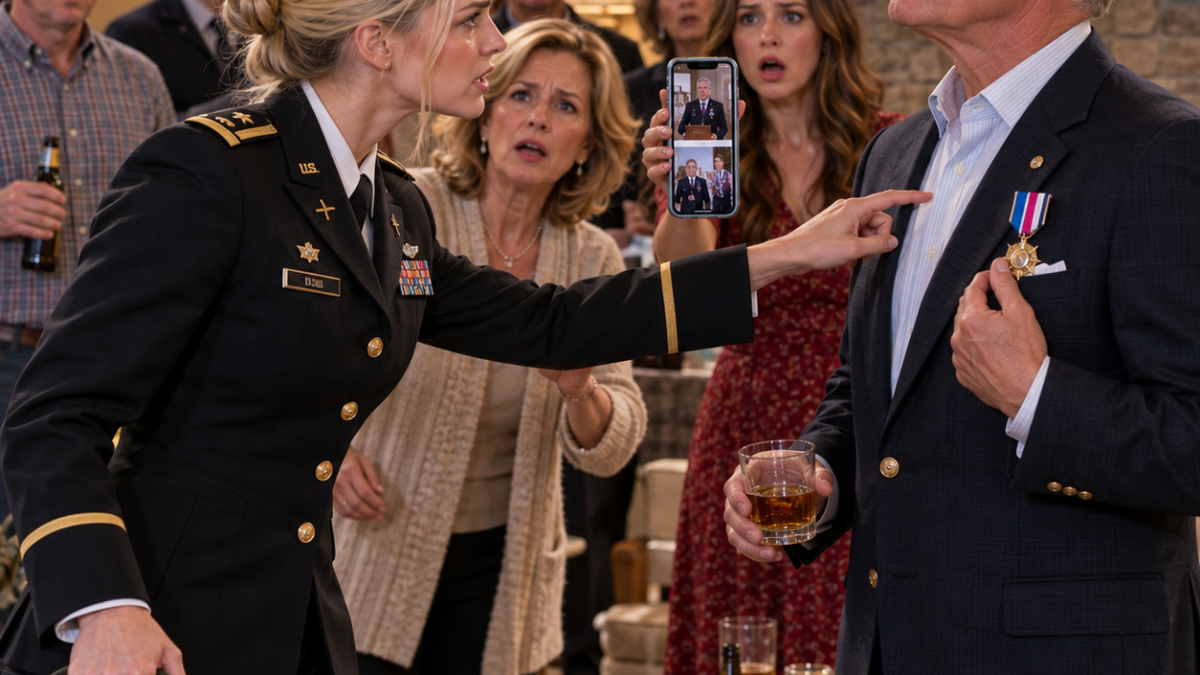
Hannah sent seventy-three photographs and nine videos to my phone.
Seventy-three.
I sat at the kitchen table while a reheated plate of Mom’s meatloaf went cold beside me. Photograph after photograph showed Dad at civic events, church dinners, business fundraisers, veterans gatherings, and charity functions.
Always positioned carefully.
Sometimes he wore my medal.
Sometimes he did not.
Whenever he wore it, his posture changed.
Chest out.
Chin higher.
Smile broader.
Like stolen metal had somehow added two inches to his height.
Then I opened a video.
A man behind the camera asked, “Tom, where’d you get decorated?”
Dad smiled.
He did not directly say the medal belonged to him.
That would have been too easy.
Instead he said, “Long story. Service runs deep in our family.”
Cute.
Technically slippery.
Morally disgusting.
Another voice laughed and said, “Your daughter gets it from you.”
Dad responded, “I taught her everything that mattered before the Army polished the edges.”
I paused the video.
My thumb remained against the screen.
Mom sat across from me.
“I begged him to stop.”
I looked up.
“But you never told me.”
Her mouth opened.
Closed.
That was becoming a family tradition.
Uncle David placed a manila folder on the table.
“This came to my office last month.”
Inside was a sponsorship packet for the Central Ohio Veterans Community Foundation.
Dad had applied for a board position.
His biography referenced “decades of leadership within a military-service family” and used one of the photographs where he wore my medal.
Not an explicit claim.
Just enough fog for people to make the assumption he wanted.
At the bottom of the packet was a handwritten note from a donor.
Great meeting a fellow service man.
I looked toward Dad’s office.
Now I understood why he had been so determined to control the evening.
The medal was no longer feeding only his ego.
It was feeding his reputation.
Possibly his business.
Definitely his access.
I slept badly that night.
At 5:12 the next morning, I gave up, showered, pulled on jeans and an old Army sweatshirt, and went downstairs.
Dad was at the kitchen island drinking coffee from a WORLD’S BEST BOSS mug.
Subtle.
I poured my own.
“Why?”
He stared into the coffee.
“I already told you.”
“No. You called it family pride. I’m asking why you wore my medal in public.”
The refrigerator hummed.
A pickup passed outside.
Finally he spoke.
“People listen when they think you’ve done something important.”
There it was.
Clean.
Ugly.
Honest.
“So you let them think you served.”
“I never said I did.”
“You made sure you never had to.”
He looked up.
“You have no idea what it’s like to spend your life being overlooked.”
I actually laughed.
“You told me my entire career was a bad decision.”
“I was protecting you.”
“You called my promotion a diversity checkbox.”
His jaw tightened.
“You remember everything negatively.”
“No. I remember accurately.”
Hannah walked in.
She looked like she had not slept either.
“Dad.”
He ignored her.
She placed her phone on the counter.
“I recorded you after the Memorial Day dinner.”
Dad froze.
Hannah pressed play.
His own voice filled the kitchen.
Slightly drunk.
Very pleased with himself.
“People don’t care about technical details. They see the medal, they see Rebecca’s deployment photos, and they understand the family has military credibility.”
Another voice—Dad’s business partner, Frank—laughed.
“You’re going to get yourself in trouble.”
Dad replied, “Only if my daughter comes home with a stick up her ass.”
The kitchen went silent.
I reached over and stopped the recording.
Dad’s face had lost its color.
I nodded once.
“Thanks.”
“For what?”
“For finally making this simple.”
I did not post the recording.
I did not upload photographs to social media.
I did not call reporters.
I called a lawyer.
Melissa Grant had served as an Army JAG officer before entering private practice in employment and business law outside Columbus. We met at a diner near downtown because her office was being renovated.
She drank black coffee.
I ate half a grilled-cheese sandwich.
Very glamorous revenge.
I showed her everything.
Photos.
Videos.
Foundation materials.
Dad’s biography.
Hannah’s recording.
Melissa watched silently.
Then she tapped the folder.
“Wearing someone else’s medal is one issue. Using false claims of military service to obtain money, property, contracts, or certain tangible benefits can become a different issue.”
“Did he?”
“We need facts.”
Good answer.
She told me not to publicly accuse Dad of crimes.
Document.
Preserve.
Correct false statements involving me.
Notify organizations controlling their own materials.
Protect my personal records.
Let each organization determine what representations mattered to them.
That was a language I understood.
Facts first.
Emotion later.
That afternoon, I changed the lock on the fireproof document box in my old bedroom.
I removed my medal, orders, evaluations, promotion certificates, and every document Dad might photograph.
Then I emailed the veterans foundation.
Short.
Professional.
No adjectives.
I identified myself.
Confirmed Dad had never served.
Confirmed the medal appearing in several photographs belonged to me.
Attached supporting documentation.
Requested corrections to any materials suggesting otherwise.
At 4:16 p.m., the foundation’s executive director called.
She sounded horrified.
“We were told Thomas had a military background.”
“By whom?”
Silence.
“Thomas.”
That was the first direct lie.
Apparently it would not be the last.
The foundation suspended Dad from all events the following morning while its board reviewed correspondence.
They found emails.
Lots of them.
Dad had written donors using phrases such as “my military experience taught me” and “those of us who understand service.”
When challenged, he claimed he meant his experience as a military parent.
Unfortunately for him, email has a long memory and very little loyalty.
One donor forwarded a message related to a $7,500 community-program sponsorship.
Dad had described himself as having “direct military experience.”
Melissa read that message twice.
“Do not speculate,” she warned me. “Let the foundation determine whether the representation was material.”
I nodded.
Dad did not appreciate my restraint.
He cornered me in the garage that evening while I carried laundry upstairs.
“You’re destroying my reputation.”
I shifted the basket onto my hip.
“No.”
“You contacted the foundation.”
“I corrected information about me.”
“You knew what would happen.”
“I had no idea what you had written to donors.”
His nostrils flared.
“Family protects family.”
That almost deserved applause.
“You wore my medal.”
“I was proud of you.”
“You called my service a phase for six years.”
“You’re twisting things.”
I pulled out my phone.
“Want me to play Hannah’s recording?”
He stopped.
Behind him, our neighbor dragged trash cans toward the curb.
Normal Tuesday evening.
Dad lowered his voice.
“You’ve always wanted to prove you’re better than me.”
I studied him.
Then walked past.
“No, Dad.”
I set the laundry basket on the kitchen table.
“You’re just finally seeing what happens when I stop protecting you from yourself.”
Three days later, Mom knocked on my bedroom door carrying an old cardboard box.
Inside were papers from 1987.
Army recruiting brochures.
A physical-exam appointment.
Letters.
And one document showing Dad had started the enlistment process at nineteen.
Then stopped.
Not because of a heroic injury.
Not because the Army had rejected him after some extraordinary sacrifice.
He panicked.
His own handwritten letter to his older brother said:
I can’t do it. I told everyone I was going. I don’t know how to face them.
I looked at Mom.
“He quit?”
“He changed his mind.”
“Did he tell people he was medically rejected?”
She nodded.
For thirty-nine years, Dad had polished one private embarrassment until it sounded like fate had stolen something from him.
Then I joined.
Every promotion, deployment, ribbon, ceremony, and photograph forced him to stand beside the life he had once walked away from.
Mom sat on the edge of my bed.
“He was proud of you.”
“That doesn’t excuse this.”
“I know.”
“No, Mom. I need you to actually know.”
She looked down.
“You all watched him do this because correcting him was uncomfortable. Meanwhile I was overseas and had no clue my own family was letting him turn my career into his costume.”
Her eyes filled.
I did not comfort her.
Not yet.
Finally she whispered, “I should have told you.”
“Yes.”
No dramatic forgiveness.
No hug.
Just truth.
Sometimes that is enough work for one afternoon.
Then my phone buzzed.
The foundation board had voted.
Dad was out.
Technically, he resigned before they formally removed him.
Classic Thomas Turner.
Quit before the door reached his backside.
The foundation posted a short correction.
No spectacle.
No insult.
Just facts.
Thomas Turner had never served in the United States military.
Certain prior communications had created an inaccurate impression.
The organization regretted the error.
That was enough.
People connected the dots themselves.
Two local businesses withdrew from events Dad chaired.
The chamber of commerce asked him to step down from a community leadership committee.
Frank removed the “military family leadership” language from Turner Commercial Supply’s website.
Then Frank called me.
“I should’ve said something.”
“Yeah.”
“I thought it was mostly harmless.”
“It wasn’t happening to you.”
Long pause.
“Fair.”
Dad blamed me for everything.
At first.
Then Uncle David did something none of us expected.
He invited Dad to breakfast at Miller’s Diner.
Three actual veterans attended.
I did not go.
I heard about it later.
Nobody shouted.
Apparently that made it worse.
One man asked Dad, “When I told you about losing two friends overseas, why did you let me believe you had served too?”
Dad had no answer.
Another asked, “Why were you wearing your daughter’s medal while I talked about mine?”
Nothing.
By lunchtime, Dad came home looking five years older.
He found me on the porch drinking iced coffee.
“I corrected the donor emails.”
I nodded.
“I sent written apologies.”
Another nod.
He waited.
Probably for praise.
I gave him none.
Finally he asked, “What else do you want?”
That question told me he still did not understand.
So I stood.
“Nothing.”
He frowned.
“Nothing?”
“I don’t need anything from you.”
For the first time in my life, I meant it.
And somehow that hurt him more than anger ever had.
The weeks after that were quieter.
The scandal did not become national news.
There were no reporters camping outside the house.
No dramatic courtroom.
Just consequences.
Emails.
Resignations.
Awkward meetings.
Corrections.
People withdrawing invitations.
Veterans who stopped returning Dad’s calls.
Clients who began asking Frank questions.
The kind of consequences that happen when a man builds credibility on implication and suddenly everyone begins reading the fine print.
Dad became smaller at home.
Not physically.
Socially.
The phone stopped ringing as much.
He stopped attending certain breakfasts.
For years, Dad had treated being recognized as a measure of importance.
Now silence followed him.
One night I found him alone at the kitchen table.
No bourbon.
No phone.
He was holding my medal box.
I stopped in the doorway.
He looked up.
“I wasn’t going to open it.”
“Good.”
He set it down.
“I keep thinking about why I did it.”
I said nothing.
He continued.
“The first time was stupid.”
“When?”
“A veterans fundraiser last winter.”
My jaw tightened.
He looked embarrassed.
“Your mother had taken the medal out because she was showing Hannah some of your things. I had a dinner that night. I put it on as a joke.”
“A joke.”
“I know.”
“No. Explain the joke.”
He looked down.
“There wasn’t one.”
That was closer to truth.
“People treated me differently.”
I crossed my arms.
“Because they thought you earned it.”
“Yes.”
“And you liked that.”
“Yes.”
The word came quietly.
He rubbed both hands together.
“People asked questions. I answered around them. Then the next time, it was easier.”
I thought about all the photos.
“How many times did you wear it?”
He hesitated.
“Seven.”
Hannah knew about four.
Uncle David had said more.
Seven.
Seven separate decisions.
Not one misunderstanding.
I nodded.
“Did you ever think about what it represented?”
His face tightened.
“Of course.”
“No. Not the ceremony. Not the photograph. What I earned it for.”
He said nothing.
That silence answered me.
For Dad, the medal had become symbolism.
For me, it had always been memory.
Heat.
Dust.
A radio that would not stop.
A young specialist with blood soaking through gauze faster than we could replace it.
A lieutenant trying to remain calm while everyone else looked at me because I was the senior person still capable of making decisions.
The moment I realized fear had become irrelevant because people needed me more than I needed to feel ready.
I never talked about those details at home.
Dad had mistaken silence for emptiness.
“You wore something connected to the worst week of my life because people bought you drinks,” I said.
He flinched.
Good.
Maybe he finally saw it.
I moved out six weeks later.
Not because of him.
My temporary assignment near Columbus ended, and I accepted a position at Fort Knox.
But leaving felt different from every other departure.
I was not twenty-two.
Not loading a used Honda Civic while secretly hoping Dad would finally admit he believed in me.
I was thirty-two.
My Jeep sat in the driveway.
My duffel was in the back.
A townhouse lease waited in the center console.
Everything important belonged to me.
Dad came outside carrying the walnut presentation box.
The same one where my medal had been stored before deployment.
He held it toward me.
“I repaired the hinge.”
I opened it.
The medal rested against clean blue velvet.
No fingerprints.
No bent clasp.
No navy sport coat beneath it.
Just mine.
“I should never have touched it,” he said.
“No.”
He swallowed.
“I thought if people respected me…”
He stopped.
I waited.
A school bus rolled past.
Somebody’s sprinkler clicked across a lawn.
An American flag moved lazily above a neighbor’s porch.
Ordinary morning.
Finally Dad spoke.
“I spent years making you feel small because watching you succeed reminded me of something I hated about myself.”
That was probably the closest he had ever come to honesty without being cornered by evidence.
I closed the box.
“You made that my problem.”
“I know.”
“I’m not carrying it anymore.”
He nodded.
Then came the line I had wanted since I was twenty-two.
“I’m proud of you, Rebecca.”
I thought it would hit harder.
It didn’t.
Not because I felt nothing.
Because I no longer needed it to finish something inside me.
I hugged Mom.
Hannah ran outside in socks and wrapped both arms around me.
Uncle David had already texted:
Drive safe, Captain.
Dad remained near the porch.
I put the medal box inside the Jeep.
Then I looked back.
“We’re not pretending this never happened.”
“I understand.”
“You don’t tell my military stories anymore.”
“Okay.”
“If somebody asks about me, you say I’m your daughter. That’s it.”
He nodded.
I climbed into the Jeep.
Before shutting the door, I added, “You can be proud without making it yours.”
He looked down.
“I know that now.”
Maybe he did.
Maybe he was still learning.
Either way, it was no longer my assignment.
Months later, the medal went into a small safe in my townhouse.
Not on a wall.
Not under dramatic lighting.
Protected.
Sometimes I opened the box.
Usually I did not.
What mattered more were the people attached to the memories behind it.
The phone calls afterward.
The faces.
The exhaustion.
The responsibility.
The moment when everyone around me waited for somebody to stay calm and I realized that person had to be me.
Dad could have pinned that medal to every jacket he owned.
He still could not wear that moment.
Thanksgiving brought me back to Ohio.
I considered skipping it.
Hannah convinced me otherwise.
“Come for me,” she said.
Fair enough.
The house looked the same.
Same neighborhood.
Same driveway.
Same flag.
Dad opened the door.
No speech.
No introduction by rank.
No joke about the Army.
“Hey.”
“Hey.”
That was enough.
At dinner, a cousin asked about my deployment.
Dad looked at me instead of answering.
My story.
My choice.
I answered as much as I wanted.
Later, while everyone fought over pumpkin pie, I wandered toward Dad’s office.
The old promotional photographs were gone.
So was the framed military-family biography.
In their place was one photograph.
My graduation.
Dad standing beside me.
No medal on him.
No caption about sacrifice.
No attempt to turn my achievement into evidence of his greatness.
Just father and daughter.
He caught me looking.
Neither of us said anything.
I took my coffee and returned to the kitchen.
Repair did not happen quickly.
Dad apologized to some veterans.
A few accepted.
Others did not.
That was their right.
He repaid part of the sponsorship after the foundation determined his representation had influenced its decision.
He stepped away from community events for nearly a year.
At Turner Commercial Supply, Frank removed several promotional references and made Dad stop using military-family branding.
Dad hated that.
Good.
Consequences should be inconvenient.
Mom began therapy.
I found that out from Hannah.
Apparently Mom’s therapist asked why she spent decades smoothing over Dad’s behavior.
That conversation probably deserved its own deployment.
Hannah and I became closer.
She admitted she had been photographing Dad at events partly because she suspected something was wrong but felt afraid to challenge him directly.
“You could have called me.”
“You were overseas.”
“I had a phone.”
“You also had bigger problems.”
I thought about it.
“That doesn’t mean you had to handle him alone.”
She smiled sadly.
“Funny. That sounds like something a big sister would say.”
I threw a napkin at her.
A year later, Dad called.
Not Mom.
Not Hannah.
Dad.
“I need to ask you something.”
I braced myself.
“What?”
“The chamber wants me to speak at a business luncheon.”
“Okay.”
“They want to mention you.”
My jaw tightened.
Then he added quickly, “I told them no.”
I relaxed slightly.
“Why are you asking me?”
“Because I want to know if saying I have a daughter serving is okay.”
That question should have been obvious.
But the fact that he asked mattered.
“Yes.”
“That’s it?”
“That’s it.”
“I don’t say rank?”
“No.”
“Deployments?”
“No.”
“Medal?”
“Absolutely not.”
He laughed once.
Nervously.
“Fair.”
There was a pause.
Then he said, “I’m learning.”
“Keep going.”
That was as much encouragement as I had.
Years passed.
The medal stayed in the safe.
I earned other things.
Promotions.
Responsibilities.
Scars nobody photographed.
Dad’s old scandal became less interesting to people outside our family.
That was good.
He retired from Turner Commercial Supply.
Frank bought out most of his share.
Without the company, boards, dinners, and civic committees, Dad had fewer audiences.
At first he seemed lost.
Then he started volunteering at a food bank.
No veterans organization.
No title.
No biography.
He stacked boxes.
Moved canned goods.
Drove deliveries.
One afternoon, I visited Ohio and found him wearing an old sweatshirt while unloading produce.
Nobody knew who he was.
Nobody cared.
He looked happier than I expected.
On the drive home, Mom said, “Maybe he needed to learn how to be useful without being impressive.”
That sounded like something I would have said.
I looked at her.
“You’ve been practicing.”
She smiled.
“So has he.”
Dad and I never became magically close.
Some damage does not reverse into the relationship that would have existed without it.
We built something different.
Smaller.
More honest.
When he asked questions about my work, he accepted “I can’t discuss that.”
When he met my colleagues, he did not introduce himself as the reason I joined.
When people called me Captain, he stopped straightening like the title belonged partly to him.
That was progress.
Years after the medal incident, Dad asked whether I would meet him for coffee.
We sat at a diner outside Columbus.
He brought an envelope.
Inside was a photocopy of the enlistment letter Mom had shown me.
The one where nineteen-year-old Thomas Turner admitted he was afraid to go.
“I spent most of my life hating this kid,” he said.
I looked at the paper.
“He was nineteen.”
“I know.”
“He changed his mind.”
“I know.”
“That doesn’t make him weak.”
Dad’s eyes became wet.
“I know that now.”
I understood suddenly that the medal had never really been about me.
That did not reduce the harm.
It explained the hunger underneath it.
Dad had spent decades trying to rewrite one frightened decision.
Then I made the decision he had walked away from.
Every promotion became evidence against the person he had tried to forget.
He could either be proud of me or compete with me.
For years, he chose competition.
Eventually the competition turned into imitation.
I slid the letter back.
“You should forgive him.”
Dad looked at me.
“Who?”
“You.”
That hit him.
He stared out the diner window for a long time.
“I don’t know how.”
“Not my assignment.”
He laughed.
“You really like saying that now.”
“I earned it.”
Fair.
When I eventually pinned on lieutenant colonel, my family attended.
Dad sat beside Mom and Hannah.
He stayed through the entire ceremony.
No bridal appointment.
No business call.
No excuses.
Afterward he hugged me.
“Congratulations.”
Just that.
No I always knew.
No I prepared you.
No Turner strength.
Congratulations.
I hugged him back.
Later, Hannah whispered, “He practiced saying only that.”
I laughed.
Apparently restraint required rehearsal in our family.
At dinner, somebody asked Dad what it felt like having a daughter in senior leadership.
He looked at me.
Then answered carefully.
“It feels like she worked very hard.”
Perfect.
Not we.
She.
That single pronoun mattered.
Years later, when Dad became sick, I visited more often.
Illness stripped away many of the things he once used to define himself.
No business.
No boards.
No speeches.
No navy sport coat.
Sometimes I sat beside him while he watched baseball.
Sometimes we talked about nothing.
One evening he asked, “Do you still have the medal?”
“Yes.”
“Do you wear it?”
“When appropriate.”
He nodded.
“Good.”
Then he looked toward the television.
“I’m still ashamed.”
I knew what he meant.
“You should be.”
He winced.
I continued.
“But shame is only useful if it stops you repeating something.”
He looked at me.
“Did I?”
“Yes.”
That seemed to give him more peace than forgiveness would have.
Maybe because it was something concrete.
Something earned.
Dad died several years later.
At the funeral, Reverend Parker spoke about his business, his family, his volunteer work, and his stubbornness.
He did not mention military service.
Because Dad had none.
That mattered.
Afterward, a man from the veterans foundation approached me.
He had attended one of the breakfasts where Dad apologized.
“Your father spent years trying to make that right.”
“I know.”
“He never asked us to forget.”
“I know.”
The man shook my hand.
Then left.
That was enough.
While cleaning Dad’s office weeks later, Hannah and I found the old navy sport coat.
The one from my homecoming.
We stared at it.
She asked, “Burn it?”
I laughed.
“Donate it.”
“To whom?”
“Somebody who needs a jacket and has no idea what happened in it.”
She smiled.
We donated it.
No ceremony.
No symbolism.
Just fabric.
The medal remained with me.
Always had.
Dad had borrowed the metal.
For a while he had borrowed the story.
But he had never owned what it represented.
That distinction became clearer with age.
Honors are strange objects.
They are small.
Lightweight.
Easy to pin onto the wrong jacket.
But the reality behind them cannot be transferred.
Nobody can borrow the fear.
The responsibility.
The nights without sleep.
The voices on the radio.
The moment you make a decision without knowing whether it is right because waiting would be worse.
Nobody can wear that for you.
And nobody can steal it either.
Years after Dad died, I opened the safe one morning before a Veterans Day event at Fort Knox.
The walnut box was still intact.
Hinge repaired.
Blue velvet faded slightly.
The medal rested inside.
I lifted it.
For the first time, the memory that came back was not Dad wearing it.
It was the people I had served with.
That felt like winning.
Not destroying Dad’s reputation.
Not forcing apologies.
Not getting the foundation to issue a correction.
Winning meant the thing he did no longer occupied the center of the memory.
I pinned the medal where it belonged.
Looked at myself once in the mirror.
Then left.
At the ceremony, a young captain asked me afterward, “Ma’am, may I ask what that decoration was for?”
I thought about Dad.
About how desperately he once wanted that question.
About how many rooms he entered hoping somebody would ask.
Then I thought about the week I earned it.
I smiled.
“Some people did their jobs on a very bad day.”
The captain waited.
Apparently hoping for more.
I gave him none.
He nodded.
“Understood.”
That was enough.
For years, I believed victory meant forcing my father to respect me.
I was wrong.
Respect mattered.
Accountability mattered.
Truth mattered.
But the real victory came much earlier.
It came the morning I loaded my Jeep, placed the medal box beside my duffel, and realized I could drive away without his approval.
Everything afterward was repair.
Useful.
Sometimes beautiful.
But optional.
The career stayed mine.
The medal stayed mine.
The memory stayed mine.
And eventually, the story did too.
𝗧𝗛𝗘 𝗘𝗡𝗗
My Father Wore the Medal I Earned, but the Photos on My Sister’s Phone Exposed Why
I came home from deployment expecting a shower, a quiet meal, and one night in the bedroom where I had grown up. Instead, I found my father wearing the medal I had earned overseas while half my family applauded him. By the time my sister showed me what he had been doing while I was gone, I realized he had not borrowed my honor for one evening—he had built an entire reputation around it.
“You really want to humiliate your father over a piece of metal?”
My mother whispered that while my father stood ten feet away wearing the medal I had earned during the worst week of my military career.
That sentence told me exactly what kind of homecoming I was having.
My name is Rebecca Turner. I was thirty-two years old, an Army captain, and I had been back in the United States for less than three hours. I smelled like recycled cabin air, airport coffee, and the industrial detergent the Army seemed to use on every blanket and sheet in existence. My shoulders ached. My left boot was rubbing against a blister I had developed two days earlier. I wanted a shower, a greasy burger, and eight uninterrupted hours in the bed I had slept in during high school.
Instead, there were eleven cars in my parents’ driveway.
I noticed them as soon as the rideshare turned onto Maple Ridge Lane outside Columbus, Ohio. My parents lived in one of those neighborhoods where every third house had an American flag mounted beside the garage and somebody always complained if garbage cans remained visible after noon. Mom had promised me a quiet dinner. Her exact message had been:
Just us. Meatloaf. Your room is ready.
Apparently “just us” now included half our extended family, two neighbors, Dad’s business partner, and Reverend Parker from Mom’s church.
I paid the driver, pulled my green duffel from the trunk, and looked at the house.
Country music came through the walls.
Dad’s choice.
Of course.
Before I reached the porch, I heard his voice through the door.
“This family has always understood sacrifice.”
I stopped with one hand on the knob.
Interesting.
Because when I told him I was enlisting after college, Thomas Turner had leaned against our kitchen counter, crossed his arms, and asked, “You really think you’re built for that?”
Not congratulations.
Not good luck.
Not even be careful.
Just doubt.
Apparently sacrifice had become more attractive while I was gone.
I opened the door.
Every head turned.
Aunt Carol gasped. Mom covered her mouth. My younger sister Hannah jumped off the couch and actually looked happy to see me. For maybe two seconds, it felt like a normal homecoming.
Then I looked toward the fireplace.
Dad stood there wearing a navy sport coat.
Gray hair perfect.
Bourbon in one hand.
Smile polished for company.
Pinned above his left pocket was my medal.
Mine.
I knew the tiny scratch on the suspension bar.
I knew the slight discoloration near the edge.
I knew exactly where it had been stored before I deployed.
Walnut presentation box.
Top drawer of my old dresser.
Behind a stack of college yearbooks.
My duffel slipped from my hand and struck the hardwood floor.
“Dad.”
His smile tightened.
“Welcome home, kiddo.”
I didn’t move.
“Why are you wearing that?”
The room changed.
Nobody reached for a drink.
Nobody coughed.
Even the country song coming from the kitchen suddenly sounded too loud.
Dad glanced down at the medal.
“Oh, this?”
“No. The other medal you stole from my room.”
Aunt Carol looked at her shoes.
Uncle David slowly lowered his beer.
Mom moved toward me.
“Rebecca, you’re exhausted.”
I kept looking at Dad.
“Take it off.”
He laughed.
Not nervously.
Dismissively.
Like I had complained because he borrowed a sweatshirt.
“Relax. Your mother thought it would be nice for the family dinner.”
Mom’s head snapped toward him.
“Thomas, I did not say that.”
He waved her away.
“It’s symbolic.”
“Of what?”
“Family pride.”
I stepped closer.
“You didn’t earn it.”
Color rose in his cheeks.
That embarrassed him.
Good.
He glanced toward his audience.
“You take yourself too seriously.”
Then he said the sentence I remembered long after everything else changed.
“Someone in this family should know how to wear it properly.”
Hannah whispered, “Dad.”
Something cold settled inside me.
For years, I had imagined earning his respect.
Apparently he had decided stealing the costume was easier.
I held out my hand.
“Take it off.”
“You just got home.”
“Take it off.”
“Rebecca—”
“Now.”
My father was six-foot-two and had spent most of my childhood winning arguments through volume and endurance. He ran Turner Commercial Supply, a regional building-products company, and spoke to employees, waiters, insurance agents, relatives, and telemarketers as though each of them were two days late paying him.
Normally somebody surrendered.
I didn’t.
Finally he unclipped the medal.
Then, because Thomas Turner could make even surrender insulting, he dropped it into my palm instead of handing it to me.
“There. Happy?”
I closed my fingers around it.
“No.”
Uncle David spoke from behind me.
“Tom, you need to tell her.”
Dad’s head turned sharply.
“Stay out of this.”
I looked at David.
“Tell me what?”
Nobody answered.
Mom sat down hard on the couch.
Hannah had gone pale.
And suddenly I was not tired anymore.
I was alert.
The same clean, unpleasant alertness that comes when confusion stops being confusion and becomes threat recognition.
“What happened while I was gone?”
Dad started toward his office.
“This is ridiculous.”
I stepped into his path.
“What happened?”
He looked directly at me.
Then smiled.
“You think the whole world revolves around your little Army career.”
That one landed.
Not because it was new.
Because he said it while my medal was still warm from his jacket.
Uncle David swore quietly.
Hannah caught my wrist.
“Rebecca.”
Her phone was in her other hand.
She unlocked it, opened a photograph, and turned the screen toward me.
Dad stood at the Franklin County Veterans Appreciation Dinner.
Same navy jacket.
Same medal.
Different night.
I zoomed in.
Behind him was a banner from the Central Ohio Veterans Community Foundation.
The photograph was dated six months earlier.
I had been overseas.
I swiped.
Another photograph.
Dad shaking hands with the mayor.
Medal on his chest.
Another.
Memorial Day fundraiser.
Another.
A podium.
Another.
Then one that made my mouth go dry.
A promotional flyer.
THOMAS TURNER
BUSINESS LEADER
MILITARY FAMILY ADVOCATE
SPECIAL GUEST
The medal was clearly visible.
I looked at Hannah.
“How many times?”
She swallowed.
“I know about four.”
Uncle David answered from behind me.
“More than four.”
Dad’s office door slammed.
Mom started crying.
I didn’t.
I put the medal carefully into my jacket pocket.
Then I looked around the living room.
Cold meatballs on the kitchen island.
Red plastic cups beside Mom’s good wine glasses.
A grocery-store sheet cake reading WELCOME HOME REBECCA while my father had spent the evening wearing the reason anybody had bothered gathering.
Nice touch.
“I want every photo.”
Hannah nodded.
“Every video.”
Another nod.
“Every event.”
Uncle David looked toward Dad’s closed office.
“There’s more.”
I stared at him.
“How much more?”
He rubbed both hands over his face.
“Your father has been telling people a version of your career that makes him sound like he built it.”
I almost laughed.
“Built it?”
“He says he trained you mentally. Guided your military choices. Connected you with mentors.”
“He doesn’t know a single officer I’ve served with.”
“I know.”
Hannah’s voice became smaller.
“He also lets people think he served.”
That finally silenced me.
I looked at Mom.
She could not meet my eyes.
That was my answer.
And standing beside a welcome-home cake nobody wanted anymore, I realized Dad had not borrowed my medal for dinner.
He had spent months building a second life around it.
part2
The party died in under twelve minutes.
Nobody made an announcement. People simply discovered urgent reasons to leave. Aunt Carol suddenly remembered she needed to feed her dog. Our neighbor Jim had an early meeting. Reverend Parker shook my hand for an uncomfortable three seconds, said, “Welcome home,” and left without saying goodbye to Dad.
By 9:30, only Mom, Hannah, Uncle David, Dad, and I remained.
Dad stayed barricaded inside his office.
Fine.
I had evidence to collect.
Hannah sent seventy-three photographs and nine videos to my phone.
Seventy-three.
I sat at the kitchen table while a reheated plate of Mom’s meatloaf went cold beside me. Photograph after photograph showed Dad at civic events, church dinners, business fundraisers, veterans gatherings, and charity functions.
Always positioned carefully.
Sometimes he wore my medal.
Sometimes he did not.
Whenever he wore it, his posture changed.
Chest out.
Chin higher.
Smile broader.
Like stolen metal had somehow added two inches to his height.
Then I opened a video.
A man behind the camera asked, “Tom, where’d you get decorated?”
Dad smiled.
He did not directly say the medal belonged to him.
That would have been too easy.
Instead he said, “Long story. Service runs deep in our family.”
Cute.
Technically slippery.
Morally disgusting.
Another voice laughed and said, “Your daughter gets it from you.”
Dad responded, “I taught her everything that mattered before the Army polished the edges.”
I paused the video.
My thumb remained against the screen.
Mom sat across from me.
“I begged him to stop.”
I looked up.
“But you never told me.”
Her mouth opened.
Closed.
That was becoming a family tradition.
Uncle David placed a manila folder on the table.
“This came to my office last month.”
Inside was a sponsorship packet for the Central Ohio Veterans Community Foundation.
Dad had applied for a board position.
His biography referenced “decades of leadership within a military-service family” and used one of the photographs where he wore my medal.
Not an explicit claim.
Just enough fog for people to make the assumption he wanted.
At the bottom of the packet was a handwritten note from a donor.
Great meeting a fellow service man.
I looked toward Dad’s office.
Now I understood why he had been so determined to control the evening.
The medal was no longer feeding only his ego.
It was feeding his reputation.
Possibly his business.
Definitely his access.
I slept badly that night.
At 5:12 the next morning, I gave up, showered, pulled on jeans and an old Army sweatshirt, and went downstairs.
Dad was at the kitchen island drinking coffee from a WORLD’S BEST BOSS mug.
Subtle.
I poured my own.
“Why?”
He stared into the coffee.
“I already told you.”
“No. You called it family pride. I’m asking why you wore my medal in public.”
The refrigerator hummed.
A pickup passed outside.
Finally he spoke.
“People listen when they think you’ve done something important.”
There it was.
Clean.
Ugly.
Honest.
“So you let them think you served.”
“I never said I did.”
“You made sure you never had to.”
He looked up.
“You have no idea what it’s like to spend your life being overlooked.”
I actually laughed.
“You told me my entire career was a bad decision.”
“I was protecting you.”
“You called my promotion a diversity checkbox.”
His jaw tightened.
“You remember everything negatively.”
“No. I remember accurately.”
Hannah walked in.
She looked like she had not slept either.
“Dad.”
He ignored her.
She placed her phone on the counter.
“I recorded you after the Memorial Day dinner.”
Dad froze.
Hannah pressed play.
His own voice filled the kitchen.
Slightly drunk.
Very pleased with himself.
“People don’t care about technical details. They see the medal, they see Rebecca’s deployment photos, and they understand the family has military credibility.”
Another voice—Dad’s business partner, Frank—laughed.
“You’re going to get yourself in trouble.”
Dad replied, “Only if my daughter comes home with a stick up her ass.”
The kitchen went silent.
I reached over and stopped the recording.
Dad’s face had lost its color.
I nodded once.
“Thanks.”
“For what?”
“For finally making this simple.”
I did not post the recording.
I did not upload photographs to social media.
I did not call reporters.
I called a lawyer.
Melissa Grant had served as an Army JAG officer before entering private practice in employment and business law outside Columbus. We met at a diner near downtown because her office was being renovated.
She drank black coffee.
I ate half a grilled-cheese sandwich.
Very glamorous revenge.
I showed her everything.
Photos.
Videos.
Foundation materials.
Dad’s biography.
Hannah’s recording.
Melissa watched silently.
Then she tapped the folder.
“Wearing someone else’s medal is one issue. Using false claims of military service to obtain money, property, contracts, or certain tangible benefits can become a different issue.”
“Did he?”
“We need facts.”
Good answer.
She told me not to publicly accuse Dad of crimes.
Document.
Preserve.
Correct false statements involving me.
Notify organizations controlling their own materials.
Protect my personal records.
Let each organization determine what representations mattered to them.
That was a language I understood.
Facts first.
Emotion later.
That afternoon, I changed the lock on the fireproof document box in my old bedroom.
I removed my medal, orders, evaluations, promotion certificates, and every document Dad might photograph.
Then I emailed the veterans foundation.
Short.
Professional.
No adjectives.
I identified myself.
Confirmed Dad had never served.
Confirmed the medal appearing in several photographs belonged to me.
Attached supporting documentation.
Requested corrections to any materials suggesting otherwise.
At 4:16 p.m., the foundation’s executive director called.
She sounded horrified.
“We were told Thomas had a military background.”
“By whom?”
Silence.
“Thomas.”
That was the first direct lie.
Apparently it would not be the last.
The foundation suspended Dad from all events the following morning while its board reviewed correspondence.
They found emails.
Lots of them.
Dad had written donors using phrases such as “my military experience taught me” and “those of us who understand service.”
When challenged, he claimed he meant his experience as a military parent.
Unfortunately for him, email has a long memory and very little loyalty.
One donor forwarded a message related to a $7,500 community-program sponsorship.
Dad had described himself as having “direct military experience.”
Melissa read that message twice.
“Do not speculate,” she warned me. “Let the foundation determine whether the representation was material.”
I nodded.
Dad did not appreciate my restraint.
He cornered me in the garage that evening while I carried laundry upstairs.
“You’re destroying my reputation.”
I shifted the basket onto my hip.
“No.”
“You contacted the foundation.”
“I corrected information about me.”
“You knew what would happen.”
“I had no idea what you had written to donors.”
His nostrils flared.
“Family protects family.”
That almost deserved applause.
“You wore my medal.”
“I was proud of you.”
“You called my service a phase for six years.”
“You’re twisting things.”
I pulled out my phone.
“Want me to play Hannah’s recording?”
He stopped.
Behind him, our neighbor dragged trash cans toward the curb.
Normal Tuesday evening.
Dad lowered his voice.
“You’ve always wanted to prove you’re better than me.”
I studied him.
Then walked past.
“No, Dad.”
I set the laundry basket on the kitchen table.
“You’re just finally seeing what happens when I stop protecting you from yourself.”
Three days later, Mom knocked on my bedroom door carrying an old cardboard box.
Inside were papers from 1987.
Army recruiting brochures.
A physical-exam appointment.
Letters.
And one document showing Dad had started the enlistment process at nineteen.
Then stopped.
Not because of a heroic injury.
Not because the Army had rejected him after some extraordinary sacrifice.
He panicked.
His own handwritten letter to his older brother said:
I can’t do it. I told everyone I was going. I don’t know how to face them.
I looked at Mom.
“He quit?”
“He changed his mind.”
“Did he tell people he was medically rejected?”
She nodded.
For thirty-nine years, Dad had polished one private embarrassment until it sounded like fate had stolen something from him.
Then I joined.
Every promotion, deployment, ribbon, ceremony, and photograph forced him to stand beside the life he had once walked away from.
Mom sat on the edge of my bed.
“He was proud of you.”
“That doesn’t excuse this.”
“I know.”
“No, Mom. I need you to actually know.”
She looked down.
“You all watched him do this because correcting him was uncomfortable. Meanwhile I was overseas and had no clue my own family was letting him turn my career into his costume.”
Her eyes filled.
I did not comfort her.
Not yet.
Finally she whispered, “I should have told you.”
“Yes.”
No dramatic forgiveness.
No hug.
Just truth.
Sometimes that is enough work for one afternoon.
Then my phone buzzed.
The foundation board had voted.
Dad was out.
Technically, he resigned before they formally removed him.
Classic Thomas Turner.
Quit before the door reached his backside.
The foundation posted a short correction.
No spectacle.
No insult.
Just facts.
Thomas Turner had never served in the United States military.
Certain prior communications had created an inaccurate impression.
The organization regretted the error.
That was enough.
People connected the dots themselves.
Two local businesses withdrew from events Dad chaired.
The chamber of commerce asked him to step down from a community leadership committee.
Frank removed the “military family leadership” language from Turner Commercial Supply’s website.
Then Frank called me.
“I should’ve said something.”
“Yeah.”
“I thought it was mostly harmless.”
“It wasn’t happening to you.”
Long pause.
“Fair.”
Dad blamed me for everything.
At first.
Then Uncle David did something none of us expected.
He invited Dad to breakfast at Miller’s Diner.
Three actual veterans attended.
I did not go.
I heard about it later.
Nobody shouted.
Apparently that made it worse.
One man asked Dad, “When I told you about losing two friends overseas, why did you let me believe you had served too?”
Dad had no answer.
Another asked, “Why were you wearing your daughter’s medal while I talked about mine?”
Nothing.
By lunchtime, Dad came home looking five years older.
He found me on the porch drinking iced coffee.
“I corrected the donor emails.”
I nodded.
“I sent written apologies.”
Another nod.
He waited.
Probably for praise.
I gave him none.
Finally he asked, “What else do you want?”
That question told me he still did not understand.
So I stood.
“Nothing.”
He frowned.
“Nothing?”
“I don’t need anything from you.”
For the first time in my life, I meant it.
And somehow that hurt him more than anger ever had.
The weeks after that were quieter.
The scandal did not become national news.
There were no reporters camping outside the house.
No dramatic courtroom.
Just consequences.
Emails.
Resignations.
Awkward meetings.
Corrections.
People withdrawing invitations.
Veterans who stopped returning Dad’s calls.
Clients who began asking Frank questions.
The kind of consequences that happen when a man builds credibility on implication and suddenly everyone begins reading the fine print.
Dad became smaller at home.
Not physically.
Socially.
The phone stopped ringing as much.
He stopped attending certain breakfasts.
For years, Dad had treated being recognized as a measure of importance.
Now silence followed him.
One night I found him alone at the kitchen table.
No bourbon.
No phone.
He was holding my medal box.
I stopped in the doorway.
He looked up.
“I wasn’t going to open it.”
“Good.”
He set it down.
“I keep thinking about why I did it.”
I said nothing.
He continued.
“The first time was stupid.”
“When?”
“A veterans fundraiser last winter.”
My jaw tightened.
He looked embarrassed.
“Your mother had taken the medal out because she was showing Hannah some of your things. I had a dinner that night. I put it on as a joke.”
“A joke.”
“I know.”
“No. Explain the joke.”
He looked down.
“There wasn’t one.”
That was closer to truth.
“People treated me differently.”
I crossed my arms.
“Because they thought you earned it.”
“Yes.”
“And you liked that.”
“Yes.”
The word came quietly.
He rubbed both hands together.
“People asked questions. I answered around them. Then the next time, it was easier.”
I thought about all the photos.
“How many times did you wear it?”
He hesitated.
“Seven.”
Hannah knew about four.
Uncle David had said more.
Seven.
Seven separate decisions.
Not one misunderstanding.
I nodded.
“Did you ever think about what it represented?”
His face tightened.
“Of course.”
“No. Not the ceremony. Not the photograph. What I earned it for.”
He said nothing.
That silence answered me.
For Dad, the medal had become symbolism.
For me, it had always been memory.
Heat.
Dust.
A radio that would not stop.
A young specialist with blood soaking through gauze faster than we could replace it.
A lieutenant trying to remain calm while everyone else looked at me because I was the senior person still capable of making decisions.
The moment I realized fear had become irrelevant because people needed me more than I needed to feel ready.
I never talked about those details at home.
Dad had mistaken silence for emptiness.
“You wore something connected to the worst week of my life because people bought you drinks,” I said.
He flinched.
Good.
Maybe he finally saw it.
I moved out six weeks later.
Not because of him.
My temporary assignment near Columbus ended, and I accepted a position at Fort Knox.
But leaving felt different from every other departure.
I was not twenty-two.
Not loading a used Honda Civic while secretly hoping Dad would finally admit he believed in me.
I was thirty-two.
My Jeep sat in the driveway.
My duffel was in the back.
A townhouse lease waited in the center console.
Everything important belonged to me.
Dad came outside carrying the walnut presentation box.
The same one where my medal had been stored before deployment.
He held it toward me.
“I repaired the hinge.”
I opened it.
The medal rested against clean blue velvet.
No fingerprints.
No bent clasp.
No navy sport coat beneath it.
Just mine.
“I should never have touched it,” he said.
“No.”
He swallowed.
“I thought if people respected me…”
He stopped.
I waited.
A school bus rolled past.
Somebody’s sprinkler clicked across a lawn.
An American flag moved lazily above a neighbor’s porch.
Ordinary morning.
Finally Dad spoke.
“I spent years making you feel small because watching you succeed reminded me of something I hated about myself.”
That was probably the closest he had ever come to honesty without being cornered by evidence.
I closed the box.
“You made that my problem.”
“I know.”
“I’m not carrying it anymore.”
He nodded.
Then came the line I had wanted since I was twenty-two.
“I’m proud of you, Rebecca.”
I thought it would hit harder.
It didn’t.
Not because I felt nothing.
Because I no longer needed it to finish something inside me.
I hugged Mom.
Hannah ran outside in socks and wrapped both arms around me.
Uncle David had already texted:
Drive safe, Captain.
Dad remained near the porch.
I put the medal box inside the Jeep.
Then I looked back.
“We’re not pretending this never happened.”
“I understand.”
“You don’t tell my military stories anymore.”
“Okay.”
“If somebody asks about me, you say I’m your daughter. That’s it.”
He nodded.
I climbed into the Jeep.
Before shutting the door, I added, “You can be proud without making it yours.”
He looked down.
“I know that now.”
Maybe he did.
Maybe he was still learning.
Either way, it was no longer my assignment.
Months later, the medal went into a small safe in my townhouse.
Not on a wall.
Not under dramatic lighting.
Protected.
Sometimes I opened the box.
Usually I did not.
What mattered more were the people attached to the memories behind it.
The phone calls afterward.
The faces.
The exhaustion.
The responsibility.
The moment when everyone around me waited for somebody to stay calm and I realized that person had to be me.
Dad could have pinned that medal to every jacket he owned.
He still could not wear that moment.
Thanksgiving brought me back to Ohio.
I considered skipping it.
Hannah convinced me otherwise.
“Come for me,” she said.
Fair enough.
The house looked the same.
Same neighborhood.
Same driveway.
Same flag.
Dad opened the door.
No speech.
No introduction by rank.
No joke about the Army.
“Hey.”
“Hey.”
That was enough.
At dinner, a cousin asked about my deployment.
Dad looked at me instead of answering.
My story.
My choice.
I answered as much as I wanted.
Later, while everyone fought over pumpkin pie, I wandered toward Dad’s office.
The old promotional photographs were gone.
So was the framed military-family biography.
In their place was one photograph.
My graduation.
Dad standing beside me.
No medal on him.
No caption about sacrifice.
No attempt to turn my achievement into evidence of his greatness.
Just father and daughter.
He caught me looking.
Neither of us said anything.
I took my coffee and returned to the kitchen.
Repair did not happen quickly.
Dad apologized to some veterans.
A few accepted.
Others did not.
That was their right.
He repaid part of the sponsorship after the foundation determined his representation had influenced its decision.
He stepped away from community events for nearly a year.
At Turner Commercial Supply, Frank removed several promotional references and made Dad stop using military-family branding.
Dad hated that.
Good.
Consequences should be inconvenient.
Mom began therapy.
I found that out from Hannah.
Apparently Mom’s therapist asked why she spent decades smoothing over Dad’s behavior.
That conversation probably deserved its own deployment.
Hannah and I became closer.
She admitted she had been photographing Dad at events partly because she suspected something was wrong but felt afraid to challenge him directly.
“You could have called me.”
“You were overseas.”
“I had a phone.”
“You also had bigger problems.”
I thought about it.
“That doesn’t mean you had to handle him alone.”
She smiled sadly.
“Funny. That sounds like something a big sister would say.”
I threw a napkin at her.
A year later, Dad called.
Not Mom.
Not Hannah.
Dad.
“I need to ask you something.”
I braced myself.
“What?”
“The chamber wants me to speak at a business luncheon.”
“Okay.”
“They want to mention you.”
My jaw tightened.
Then he added quickly, “I told them no.”
I relaxed slightly.
“Why are you asking me?”
“Because I want to know if saying I have a daughter serving is okay.”
That question should have been obvious.
But the fact that he asked mattered.
“Yes.”
“That’s it?”
“That’s it.”
“I don’t say rank?”
“No.”
“Deployments?”
“No.”
“Medal?”
“Absolutely not.”
He laughed once.
Nervously.
“Fair.”
There was a pause.
Then he said, “I’m learning.”
“Keep going.”
That was as much encouragement as I had.
Years passed.
The medal stayed in the safe.
I earned other things.
Promotions.
Responsibilities.
Scars nobody photographed.
Dad’s old scandal became less interesting to people outside our family.
That was good.
He retired from Turner Commercial Supply.
Frank bought out most of his share.
Without the company, boards, dinners, and civic committees, Dad had fewer audiences.
At first he seemed lost.
Then he started volunteering at a food bank.
No veterans organization.
No title.
No biography.
He stacked boxes.
Moved canned goods.
Drove deliveries.
One afternoon, I visited Ohio and found him wearing an old sweatshirt while unloading produce.
Nobody knew who he was.
Nobody cared.
He looked happier than I expected.
On the drive home, Mom said, “Maybe he needed to learn how to be useful without being impressive.”
That sounded like something I would have said.
I looked at her.
“You’ve been practicing.”
She smiled.
“So has he.”
Dad and I never became magically close.
Some damage does not reverse into the relationship that would have existed without it.
We built something different.
Smaller.
More honest.
When he asked questions about my work, he accepted “I can’t discuss that.”
When he met my colleagues, he did not introduce himself as the reason I joined.
When people called me Captain, he stopped straightening like the title belonged partly to him.
That was progress.
Years after the medal incident, Dad asked whether I would meet him for coffee.
We sat at a diner outside Columbus.
He brought an envelope.
Inside was a photocopy of the enlistment letter Mom had shown me.
The one where nineteen-year-old Thomas Turner admitted he was afraid to go.
“I spent most of my life hating this kid,” he said.
I looked at the paper.
“He was nineteen.”
“I know.”
“He changed his mind.”
“I know.”
“That doesn’t make him weak.”
Dad’s eyes became wet.
“I know that now.”
I understood suddenly that the medal had never really been about me.
That did not reduce the harm.
It explained the hunger underneath it.
Dad had spent decades trying to rewrite one frightened decision.
Then I made the decision he had walked away from.
Every promotion became evidence against the person he had tried to forget.
He could either be proud of me or compete with me.
For years, he chose competition.
Eventually the competition turned into imitation.
I slid the letter back.
“You should forgive him.”
Dad looked at me.
“Who?”
“You.”
That hit him.
He stared out the diner window for a long time.
“I don’t know how.”
“Not my assignment.”
He laughed.
“You really like saying that now.”
“I earned it.”
Fair.
When I eventually pinned on lieutenant colonel, my family attended.
Dad sat beside Mom and Hannah.
He stayed through the entire ceremony.
No bridal appointment.
No business call.
No excuses.
Afterward he hugged me.
“Congratulations.”
Just that.
No I always knew.
No I prepared you.
No Turner strength.
Congratulations.
I hugged him back.
Later, Hannah whispered, “He practiced saying only that.”
I laughed.
Apparently restraint required rehearsal in our family.
At dinner, somebody asked Dad what it felt like having a daughter in senior leadership.
He looked at me.
Then answered carefully.
“It feels like she worked very hard.”
Perfect.
Not we.
She.
That single pronoun mattered.
Years later, when Dad became sick, I visited more often.
Illness stripped away many of the things he once used to define himself.
No business.
No boards.
No speeches.
No navy sport coat.
Sometimes I sat beside him while he watched baseball.
Sometimes we talked about nothing.
One evening he asked, “Do you still have the medal?”
“Yes.”
“Do you wear it?”
“When appropriate.”
He nodded.
“Good.”
Then he looked toward the television.
“I’m still ashamed.”
I knew what he meant.
“You should be.”
He winced.
I continued.
“But shame is only useful if it stops you repeating something.”
He looked at me.
“Did I?”
“Yes.”
That seemed to give him more peace than forgiveness would have.
Maybe because it was something concrete.
Something earned.
Dad died several years later.
At the funeral, Reverend Parker spoke about his business, his family, his volunteer work, and his stubbornness.
He did not mention military service.
Because Dad had none.
That mattered.
Afterward, a man from the veterans foundation approached me.
He had attended one of the breakfasts where Dad apologized.
“Your father spent years trying to make that right.”
“I know.”
“He never asked us to forget.”
“I know.”
The man shook my hand.
Then left.
That was enough.
While cleaning Dad’s office weeks later, Hannah and I found the old navy sport coat.
The one from my homecoming.
We stared at it.
She asked, “Burn it?”
I laughed.
“Donate it.”
“To whom?”
“Somebody who needs a jacket and has no idea what happened in it.”
She smiled.
We donated it.
No ceremony.
No symbolism.
Just fabric.
The medal remained with me.
Always had.
Dad had borrowed the metal.
For a while he had borrowed the story.
But he had never owned what it represented.
That distinction became clearer with age.
Honors are strange objects.
They are small.
Lightweight.
Easy to pin onto the wrong jacket.
But the reality behind them cannot be transferred.
Nobody can borrow the fear.
The responsibility.
The nights without sleep.
The voices on the radio.
The moment you make a decision without knowing whether it is right because waiting would be worse.
Nobody can wear that for you.
And nobody can steal it either.
Years after Dad died, I opened the safe one morning before a Veterans Day event at Fort Knox.
The walnut box was still intact.
Hinge repaired.
Blue velvet faded slightly.
The medal rested inside.
I lifted it.
For the first time, the memory that came back was not Dad wearing it.
It was the people I had served with.
That felt like winning.
Not destroying Dad’s reputation.
Not forcing apologies.
Not getting the foundation to issue a correction.
Winning meant the thing he did no longer occupied the center of the memory.
I pinned the medal where it belonged.
Looked at myself once in the mirror.
Then left.
At the ceremony, a young captain asked me afterward, “Ma’am, may I ask what that decoration was for?”
I thought about Dad.
About how desperately he once wanted that question.
About how many rooms he entered hoping somebody would ask.
Then I thought about the week I earned it.
I smiled.
“Some people did their jobs on a very bad day.”
The captain waited.
Apparently hoping for more.
I gave him none.
He nodded.
“Understood.”
That was enough.
For years, I believed victory meant forcing my father to respect me.
I was wrong.
Respect mattered.
Accountability mattered.
Truth mattered.
But the real victory came much earlier.
It came the morning I loaded my Jeep, placed the medal box beside my duffel, and realized I could drive away without his approval.
Everything afterward was repair.
Useful.
Sometimes beautiful.
But optional.
The career stayed mine.
The medal stayed mine.
The memory stayed mine.
And eventually, the story did too.