.My Mother Thought My Silence Meant She Could Rewrite My Life
part2
Dad was sitting in his old recliner beside the living-room window, the only piece of furniture in the entire room that looked as though it belonged to the house I remembered. Everything else had been replaced. New sectional. New rugs. New lamps. New art arranged so carefully on the walls that the room looked staged for a real-estate listing. Dad’s ankles were swollen. His hands trembled slightly against the newspaper folded in his lap. On the table beside him sat an empty plastic pill organizer.
“Dad.”
He looked up, surprised, then almost guilty.
“You’re home.”
I crouched beside him and picked up the organizer. Every compartment was empty.
“Where are your pills?”
“I’m okay.”
“That’s not what I asked.”
He looked away.
I held up the pharmacy notice.
“How long?”
He stared at the newspaper.
“A few weeks.”
“Twelve?”
His shoulders dropped.
That hurt more than anger would have.
This was the man who had taught me to change a tire in freezing rain when I was sixteen because he said weather didn’t care whether you felt ready. The man who drove me three hours to MEPS when I enlisted because Mom refused to go. The man who hugged me before my first deployment and whispered, “Just come back breathing. We’ll figure out the rest.”
Now he was ashamed because his medication cost money.
I opened my banking app.
Fourteen transfers over two years.
Medication.
Cardiology.
Hospital bill.
Prescription refill.
Total: a little over thirty-eight thousand dollars.
I looked around the room again.
New sectional.
Imported espresso machine.
Designer fixtures.
Fresh paint.
Shopping bags from places Dad would never enter unless somebody dragged him.
Spa brochures from Scottsdale.
The money hadn’t disappeared.
It had changed shape.
I heard footsteps behind me.
Mom walked into the room carrying red wine.
She saw me and barely raised an eyebrow.
“Oh. You’re back.”
I stood and held up the pharmacy notice.
“Where did Dad’s medication money go?”
Mom took a sip.
“You’ve been home five minutes.”
“Where did it go?”
Something shifted in her face. Barely. Enough.
“The family needed it.”
“For what?”
She gestured around the room like the answer was obvious.
“This.”
I stared at her.
“You spent Dad’s heart-medication money on renovations?”
Her mouth tightened.
“You send a little military cash and suddenly you think you run my house?”
“Thirty-eight thousand dollars is not a little cash.”
She smiled.
Cold.
Almost bored.
“Your father is still alive.”
Behind me, Dad inhaled sharply. It sounded rough.
I lowered my voice.
“He’s rationing heart pills.”
“In a family, people make sacrifices.”
“Dad isn’t yours to sacrifice.”
That erased her smile.
She stepped closer.
“You were always difficult.”
There it was.
Not guilt.
Not concern.
A warning.
Then she leaned toward me.
“If you actually care about your father, you’ll stop asking questions.”
That night, I locked my old bedroom door.
I opened my laptop.
Pulled out the field notebook I had carried through two deployments.
And started asking questions anyway.
By 2:13 in the morning, I had found something much worse than diverted prescription money.
My name was attached to a company I had never heard of.
Then another.
Then another.
Seven LLCs.
Real estate.
Loans.
Personal guarantees.
All carrying versions of my signature.
I stared at the screen until my eyes burned.
Then I wrote two words in my notebook.
IDENTITY THEFT.
Downstairs, my mother and Chloe were still laughing over something as if nothing in the world had changed.
That was their first mistake.
They thought I would confront them.
I didn’t.
I started building a case.
By sunrise, I knew my mother had not simply stolen money from one account or used one old signature without permission. She had built an entire financial structure around my identity. The LLC filings named me as a guarantor, financial officer, or member depending on the document. Loan applications described me as an active-duty service member with stable federal income, excellent credit, and predictable long-term employment. Convenient. Very convenient.
One document contained a scanned version of my signature.
The same exact signature appeared on six more.
Nobody signs perfectly the same way seven times.
A template does.
I copied every public filing I could find and created a timeline. Then I quietly photographed invoices in the downstairs office before anyone woke. Receipts. Renovation bills. Vendor statements. Loan references. I did not yet understand which pieces mattered legally and which were simply suspicious, but military training teaches you not to discard information because you do not understand it on first contact.
Then I found a folder on the family computer labeled MEDICAL.
That one stopped me.
Inside were documents written to look like clinical summaries.
“Behavioral incident reports.”
According to them, I had returned from deployment increasingly paranoid, aggressive, unstable, and dangerous. The reports described broken furniture, screaming episodes, a shattered glass door, and threats against family members.
None of it had happened.
There were photographs.
A cracked table.
A broken cabinet door.
A shattered glass panel.
Things I had never touched.
At the bottom of the folder sat a draft recommendation.
FINANCIAL GUARDIANSHIP.
Proposed guardian: Sarah Dixon.
My mother.
I sat alone in the blue light of the monitor and finally saw the full shape of the trap.
Use my identity while I’m away.
Use my credit.
Use my military income.
Divert money.
Forge documents.
Then, if I return and discover anything, establish a record saying I am mentally unstable.
If the story works, my objections become symptoms.
My anger becomes proof.
My memories become paranoia.
My finances become something she can “protect.”
I copied everything onto two encrypted drives.
One went inside my duffel.
The other went somewhere Mom would never think to search.
Dad’s old tackle box in the garage.
Then I shut down the computer.
At breakfast, Mom poured coffee.
“Sleep well?”
I smiled.
“Like a baby.”
She smiled back.
Neither of us believed the other.
Good.
For the next three weeks, I acted as though I had discovered nothing.
That was harder than any part of deployment.
I ate toast at the kitchen island while Chloe complained about contractors. I drove Dad to medical appointments and listened while Mom discussed curtains. I thanked her when she bought groceries with money I suspected wasn’t hers. I sat through dinners while she talked about how stressful my return had been for everyone.
Then every afternoon, I worked.
My first stop was the county recorder’s office.
The deed to my parents’ house had been altered eighteen months earlier.
According to the filing, Dad had transferred his interest into one of Chloe’s companies.
His signature looked wrong.
The notarization looked worse.
I obtained certified copies and took them to a local attorney named Rebecca Sloan. Her office sat above a pharmacy downtown, across from the diner where Dad used to buy me pancakes after church. She was in her late forties, wore reading glasses low on her nose, and listened without interrupting while I explained what I had found.
Then she spent twenty minutes reviewing the documents.
Finally, she removed her glasses.
“Your father needs to speak for himself while he still has capacity.”
“He does.”
“Then bring him.”
The next morning, Dad and I told Mom we had a cardiology appointment.
That part was true.
We just had another appointment first.
Rebecca showed Dad the altered deed.
His face went gray.
“I never signed that.”
Then she showed him questionable power-of-attorney documents.
He shook his head again.
“Those either.”
Rebecca asked whether he had any original estate documents.
Dad looked at me.
“I have a box.”
That afternoon, we went to First National.
Dad opened a safe-deposit box I didn’t know existed.
Inside were the original deed, his original will, tax documents, insurance paperwork, and a handwritten ledger covering years of household expenses.
Dad recorded everything.
Utilities.
Medical costs.
Home repairs.
Transfers.
Cash withdrawals.
Mom had underestimated him.
So had I.
He knew more than he had admitted.
He had simply been afraid to fight her.
“I kept thinking it would calm down,” he said quietly.
“It won’t.”
“I know that now.”
Rebecca documented the originals, notified the bank’s fraud department, and helped Dad revoke every questionable authorization carrying his name. He also signed a new healthcare directive. Not giving me control over him. Giving himself control back, with me as backup only if he became unable to speak for himself.
That distinction mattered.
I did not want to become my mother with better intentions.
Before we left, Rebecca slid another document across the conference table.
Dad’s actual will.
Chloe had been telling people for years that she would inherit the house because she had “stayed close.”
She wouldn’t.
Dad had divided things evenly years earlier.
But if the fake transfer into Chloe’s LLC had survived, the will might not have mattered.
The property could have vanished before probate ever became relevant.
As we left the bank, Dad stopped beside my SUV.
“I should’ve protected you.”
I shook my head.
“You can protect yourself now.”
He looked at me for a long moment.
Then nodded.
That afternoon, I bought two small security cameras.
One covered the porch.
One covered the living room.
Thirty-six hours later, Mom stood beneath the new chandelier telling Chloe they needed to “get Shayla committed before she talks to anyone important.”
The camera captured every word.
I listened to the recording twice.
Then a third time.
Mom was calm.
Chloe sounded nervous.
“What if she goes to the bank?”
“She won’t have credibility if we move first.”
“What about Dad?”
“He’ll do what I tell him.”
“And the loans?”
Mom sighed.
“Once Shayla is declared unstable, we control the accounts. She won’t be able to challenge anything.”
I sat in my parked car listening to my own mother discuss converting my mental health into a financial weapon.
Then Chloe asked, “When?”
Mom answered.
“The housewarming.”
That was when I understood the party wasn’t really a party.
It was a stage.
Mom invited nearly fifty people from church, the neighborhood, Chloe’s real-estate circle, and Dad’s old friends. She wanted witnesses. She wanted photographs. She wanted an audience prepared to remember me as unstable.
The housewarming was supposed to be her victory lap.
New furniture.
New chandelier.
Fresh driveway landscaping.
Caterers.
Wine.
Perfect little appetizers.
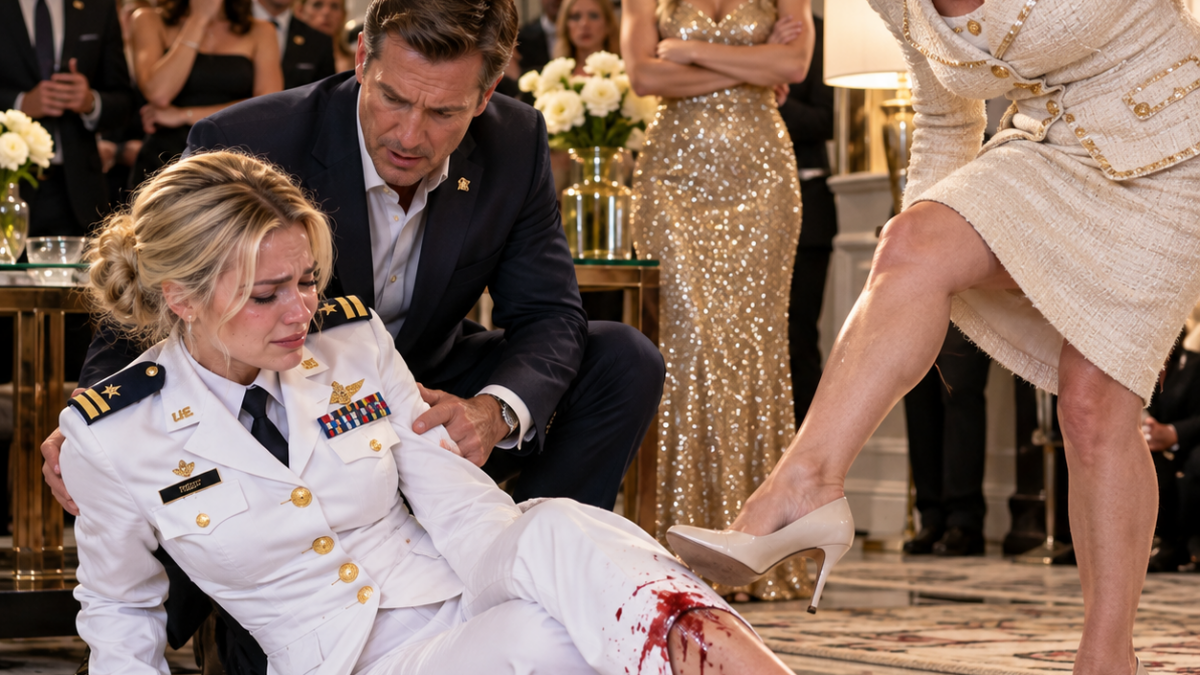
Mom wore cream.
Chloe wore champagne.
Dad stayed upstairs because he wasn’t strong enough for the crowd.
I had already arranged for him to leave the next morning for a VA cardiac rehabilitation program.
Mom did not know.
Around eight, she began baiting me.
“Shayla, take those dishes into the kitchen.”
“I’m talking to Dad’s friend.”
“Then stop talking.”
People heard.
That was the point.
Chloe joined in.
“You’ve been acting weird since you came home.”
I saw three phones come out.
Witnesses.
An audience.
Maybe both.
Then Mom raised her voice.
“This is exactly what I’ve been dealing with since she returned from deployment.”
I understood the tactic.
They weren’t improvising.
They were creating the next entry in their fake psychiatric narrative.
I refused to give them one.
“I’m going outside.”
Mom grabbed my arm.
I pulled free.
Not violently.
Not even hard.
She stumbled half a step and immediately shouted, “Did everyone see that?”
Chloe lifted her phone.
“Shayla, calm down.”
The performance would have been almost funny if it weren’t so dangerous.
Then the old scar in my leg cramped.
I caught the edge of the kitchen island.
Mom looked down.
Something ugly crossed her face.
“Quit faking it.”
Then her heel slammed into my reconstructed calf.
The scar split.
I dropped.
My airway seized.
And the next several minutes became blood, hardwood, voices, oxygen, and the stranger from the fireplace taking control of a room nobody else knew how to handle.
The ambulance carried me away twenty minutes later.
Inside, one paramedic stabilized my leg while another checked my breathing. The gray-haired stranger had ridden with us because he had identified himself as a witness and the paramedics wanted someone who could describe the assault clearly.
My phone buzzed.
MOM.
I opened the message.
I already contacted your command. I told them you’re unstable and dangerous. Tomorrow the hospital gets the paperwork. You brought this on yourself.
The stranger saw my face.
“Bad news?”
I locked the phone.
“No.”
Then I opened it again.
“Evidence.”
His eyes narrowed slightly.
The ambulance passed beneath a streetlight, and he stared at the scar above my eyebrow.
“Syria?”
I looked at him.
“Yeah.”
He went quiet.
Very quiet.
Then something changed in his expression.
Not recognition exactly.
Something deeper.
I had the strange feeling this man knew who I was.
At 9:58 the next morning, I was dressed in uniform inside my hospital room.
My leg was bandaged.
My breathing had stabilized.
The attending physician had documented that I was alert, oriented, competent, and showed no basis for involuntary psychiatric detention.
At 10:00, Mom arrived.
Chloe walked behind her carrying a red folder.
Mom started performing before she even reached the room.
“My daughter has severe PTSD. She’s dangerous. I’m terrified she may hurt herself.”
A nurse stepped between her and the door.
“The patient requested no visitors.”
“I’m her mother.”
“That does not override her request.”
Mom’s smile tightened.
Then she raised the red folder.
“I have an evaluation.”
The door opened.
I stepped into the hallway.
Her face changed when she saw my uniform.
She had expected a sedated woman in a hospital gown.
Instead, she got me standing upright.
Chloe recovered first.
“You need help, Shayla.”
I looked at the folder.
“So you really brought it.”
Mom lowered her voice.
“This doesn’t have to become ugly.”
“It already did.”
The gray-haired man from the ambulance stepped forward.
He opened his identification.
“Major Eric Vance. Marine judge advocate.”
Mom’s expression flickered.
Vance wasn’t there to arrest anyone. He was there because he had witnessed the assault, hospital security needed his statement, and after learning about the identity fraud, I had requested military legal assistance.
Then he looked at the scar above my eyebrow again.
“Al-Shaddadi,” he said.
“Four years ago.”
I froze.
He continued.
“A vehicle was hit.”
The hallway disappeared.
Smoke.
Metal.
Shouting.
“I was trapped,” Vance said.
I remembered the blood.
A twisted Humvee door.
A man pinned while a second blast risk climbed with every second.
“You pulled me out.”
Memory snapped into place.
He had been younger then.
Blood across his face.
One arm hanging wrong.
I had grabbed his vest and dragged until my damaged leg almost gave out.
Vance had been that officer.
Mom interrupted.
“This has nothing to do with her mental condition.”
Vance turned toward her.
“No, ma’am. But the records do.”
I wheeled a hospital table into the doorway and placed my laptop on top.
Chloe laughed.
“A PowerPoint? Seriously?”
I connected the screen to the television.
“Not exactly.”
First screen.
Fourteen transfers.
Thirty-eight thousand dollars.
Every memo labeled for Dad’s medical care.
Second screen.
Luxury purchases occurring within days of those transfers.
Furniture.
The chandelier.
Spa weekends.
Jewelry.
Renovation invoices.
Third screen.
Seven LLCs.
My name.
My military employment.
My forged signature.
Fourth screen.
Loans.
Guarantees.
Applications using my identity.
Fifth screen.
The fabricated behavioral reports.
For the first time, Chloe stopped smiling.
We had not even reached the camera footage.
Mom recovered quickly.
She always did.
“None of that proves I did anything.”
I nodded.
“That’s why I kept looking.”
I played the first recording.
Dad sat on the porch holding an empty pill organizer.
His voice was barely audible.
“I can make it another week.”
Behind him, delivery workers carried a designer chair through the front door.
Nobody in the hospital room spoke.
Then I played the living-room recording.
Mom’s voice came through clearly.
“Once Shayla is declared unstable, we can control the accounts.”
Chloe answered.
“What about the loans?”
“She won’t be able to challenge anything if she’s under guardianship.”
Chloe stared at the screen.
Then at Mom.
“You said that camera wasn’t recording.”
Mom snapped toward her.
“Shut up.”
Wrong move.
Vance wrote something down.
I opened the next file.
Dad’s original deed.
His real will.
The revocation documents.
And a statement from Rebecca Sloan confirming that Dad had signed voluntarily and understood the effect of every document.
Mom lunged toward the table.
“You stole private papers.”
“No.”
Rebecca’s voice came through the speakerphone.
“I have the originals.”
Mom stopped.
Rebecca continued calmly.
“And the county recorder has been notified about the disputed deed.”
Chloe backed away from Mom.
“You told me Dad signed everything.”
“Don’t start.”
“You said Shayla agreed to the companies.”
“Chloe.”
“You lied to me.”
There it was.
The partnership lasted exactly as long as neither woman believed she might personally face consequences.
A hospital security officer entered the hallway.
Behind him stood a city detective investigating the assault from the party.
He looked at Mom.
“Mrs. Dixon, I need to speak with you about last night.”
Her face went pale.
Then my phone vibrated.
First National Fraud Department.
Accounts connected to the disputed companies had been restricted pending review.
I didn’t smile.
I simply turned the screen toward Chloe.
Her knees seemed to weaken.
And Mom finally realized this was no longer a family argument.
The legal fallout was not instant.
Real life rarely works that way.
It was slower.
Document by document.
Interview by interview.
Subpoena by subpoena.
The city handled the assault investigation.
The bank handled the fraud review.
Military investigators documented misuse of my service information and the attempt to interfere with my career through fabricated mental-health claims.
Federal investigators became involved because my identity had been used across multiple lending institutions and state lines.
Rebecca challenged the property transfer.
The supposedly notarized deed began collapsing almost immediately.
Dad had been across town at a cardiac appointment on the date he supposedly signed it.
There was a hospital check-in record.
A parking receipt.
And because Dad saved nearly everything, a diner receipt from forty minutes later.
I laughed when Rebecca showed me that one.
“Pancakes beat forgery.”
Dad almost smiled.
The house returned to his uncontested ownership while the civil process moved forward.
Chloe’s real-estate firm suspended her.
Two clients dropped her before lunchtime.
By dinner, her social-media pages had disappeared.
Mom stopped attending church after people from the housewarming party began talking about what they had witnessed.
The chandelier stayed.
Funny enough.
Almost everything underneath it became part of the financial fight.
Dad never went back.
The VA placed him in cardiac rehabilitation first.
Three months later, he moved into a small apartment near the medical center.
Nothing fancy.
One bedroom.
A balcony.
A recliner he chose himself.
The first afternoon I visited, he opened his pill organizer.
Every compartment was full.
He stared at it longer than necessary.
Then he said, “I still check sometimes.”
“For what?”
“To make sure they’re really there.”
I understood.
Fear creates habits.
Habits outlive danger.
My command completed its review of Mom’s claims about my mental stability. Hospital records, witnesses from the party, service evaluations, and the fabricated files made the result straightforward.
No disciplinary action.
No finding of instability.
No career-ending scandal.
Exactly what Mom had tried to create for me disappeared under actual evidence.
That should have made me feel victorious.
It didn’t.
Mostly, I felt tired.
Vance noticed.
We were sitting in a cafeteria at the VA after one of Dad’s appointments when he said, “You expected to feel different.”
I looked at him.
“Is it that obvious?”
“Yes.”
“I thought once people believed me…”
“You’d feel repaired?”
I stared at my coffee.
“Maybe.”
He shook his head.
“Evidence protects the truth. It doesn’t undo what people were willing to do before they saw it.”
That sentence stayed with me.
Six weeks later, a federal grand jury returned charges connected to the identity and lending scheme.
Mom called from an unknown number.
I almost didn’t answer.
Then I did.
“I can fix this if you help me.”
I stayed silent.
“Shayla, I’m your mother.”
Through Dad’s apartment window, I could see him outside playing chess with another veteran.
For once, he looked relaxed.
Mom kept talking.
“We can be a family again.”
I ended the call.
Because she still did not understand.
The family she wanted back was the one where everyone else stayed quiet.
That family was already gone.
Chloe tried another approach.
She sent a long email claiming Mom had manipulated her.
Some of that was probably true.
But buried between paragraphs about pressure and fear was one sentence that mattered.
I knew the companies were using your name, but Mom said you had agreed.
I read it twice.
Then sent it to Rebecca.
Chloe called thirty minutes later.
“Did you forward my email?”
“Yes.”
“How could you?”
I almost laughed.
“How could I?”
“I was trying to apologize.”
“No. You were trying to explain.”
“What’s the difference?”
“An apology tells me what you did. An explanation tells me why you shouldn’t have consequences.”
She went silent.
Then she cried.
That hurt more than I expected.
Chloe was my younger sister.
I remembered teaching her how to ride a bike.
Braiding her hair badly before school.
Helping her cheat at hide-and-seek by pretending not to see her feet under the curtains.
Those memories did not vanish because she participated in fraud.
That was the hardest part.
People can do terrible things and still have once been people you loved.
Reality does not organize itself neatly around betrayal.
I did not tell Chloe I hated her.
I didn’t.
I also did not rescue her.
That difference mattered.
Dad struggled with it too.
One evening, I found him sitting on his balcony holding a photograph of Mom from twenty years earlier.
“You miss her?”
He nodded.
“I miss who I thought she was.”
I sat beside him.
“That counts.”
He looked at me.
“Does it?”
“Yes.”
We stayed quiet for a while.
Then Dad said, “I should’ve stopped her sooner.”
“You were sick.”
“I was scared.”
“Both can be true.”
He looked back at the photograph.
“I kept telling myself peace was better than fighting.”
I thought about my own silence.
About years of letting Mom call me dramatic because arguing felt pointless.
About how often I had been the strong one simply because nobody expected to protect me.
“Sometimes peace is just fear with better manners,” I said.
Dad smiled sadly.
“That sounds like something I should’ve taught you.”
“You taught me to change tires in sleet.”
“Close enough.”
Two months later, I was drinking terrible base coffee when the evening news mentioned my hometown.
I looked up.
Federal vehicles lined the street where I grew up.
Neighbors stood behind police tape recording with their phones.
Agents carried computers, folders, and evidence boxes out of the house.
Then Chloe came through the front door.
No champagne-colored dress.
No expensive phone raised for somebody else’s humiliation.
No smirk.
She kept her head down while cameras clicked.
Mom came out next.
For twenty-six years, I had watched that woman control every room she entered.
Not this one.
She paused on the porch beneath the light she had bought with money meant to keep Dad alive.
Then an agent guided her toward a waiting vehicle.
I turned off the television.
That was enough.
My phone buzzed.
Dad.
A photograph appeared.
He was sitting on his balcony with a chessboard between him and another veteran.
Caption:
Won my first game today.
I laughed.
Don’t let them go easy on you.
His reply came almost immediately.
You never did.
I placed the phone beside my coffee.
On my desk sat a new mission packet.
Maps.
Timelines.
Personnel assignments.
The ordinary machinery of my life.
Outside, a Black Hawk lifted from the flight line. Rotor wash pushed dust across the pavement. Young Marines jogged toward formation.
Nobody around me knew what had happened inside that Ohio house.
They didn’t need to.
Dad had his medicine.
My name was mine again.
The fraudulent companies were collapsing.
The fake psychiatric record had become evidence instead of a weapon.
Mom had lost access to the money, the house she tried to control, the reputation she protected more fiercely than her husband, and both daughters in different ways.
Chloe had learned that being the favorite child did not mean being protected when the person favoring you needed someone else to blame.
And me?
I did not feel victorious.
Mostly, I felt quiet.
That surprised me.
For years, I thought justice would sound loud.
A judge’s gavel.
Handcuffs.
A perfect speech where everyone admitted what they had done.
It didn’t.
Justice sounded like Dad laughing on the phone because he had made his own coffee.
It sounded like pills rattling inside a full organizer.
It sounded like my apartment door locking behind me at night with nobody on the other side deciding whether I deserved peace.
The legal process lasted longer than anyone wanted.
Months became a year.
Charges narrowed.
Some allegations were stronger than others.
Attorneys negotiated.
Documents were challenged.
Experts examined signatures and financial records.
I attended only the proceedings where I was needed.
That decision helped.
For a while, I thought watching every consequence land would give me closure.
Instead, it kept me tethered to Mom.
So I stopped attending anything I did not have to.
Rebecca kept me informed.
Vance reminded me when my statement was needed.
I went to work.
Visited Dad.
Went to physical therapy.
Relearned what my leg could do after the scar reopened.
That last part was harder than I admitted.
The injury had always been mine.
Painful, ugly, limiting in ways I hated, but mine.
Mom kicking it transformed the scar.
For weeks afterward, every flare of pain carried her face with it.
I hated that.
My physical therapist was a woman named Dana who had the emotional sensitivity of a drill instructor and the patience of a saint.
One afternoon, I stopped halfway through an exercise.
“I’m done.”
“No.”
“I said I’m done.”
“You said you’re angry.”
“That too.”
Dana folded her arms.
“You want to leave because your leg hurts or because you remembered her?”
I stared at her.
“That’s invasive.”
“Correct.”
I looked down.
“My leg.”
“Liar.”
I almost laughed.
Then I sat on the edge of the treatment table.
“I don’t want her attached to it.”
“To what?”
“The scar.”
Dana nodded slowly.
“Then don’t give it to her.”
I looked up.
“She reopened it.”
“She doesn’t own the story.”
That irritated me because it sounded too simple.
Over the next few months, I understood what she meant.
The scar existed before the party.
It came from a blast.
From a vehicle strike.
From people I had dragged out.
From surgeons who rebuilt tissue.
From months learning to walk without hating every step.
Mom had injured it.
She had not created it.
She did not get to become its meaning.
That mattered.
Vance and I spoke occasionally after the investigation moved into formal proceedings.
The first time we had coffee outside the hospital, he told me what he remembered from Al-Shaddadi.
“I thought I was dead.”
“You looked terrible.”
“I was missing half my blood.”
“Explains it.”
He smiled.
Then his expression changed.
“I remembered your voice before your face.”
“That seems to be happening to me a lot.”
“What?”
“People remembering my voice.”
He shrugged.
“Sometimes a voice is what keeps a situation from becoming panic.”
I looked at him.
“You know I was terrified.”
“Of course.”
That answer relieved me.
People like to turn survival into fearlessness.
It isn’t.
I had been afraid during that blast.
Afraid in the hospital hallway.
Afraid when I saw seven companies using my name.
Afraid every time Mom threatened my command.
Courage had never meant absence of fear.
It meant keeping enough control to make the next useful decision.
The next useful decision became the rhythm of my recovery.
Physical therapy.
Credit repair.
Legal documentation.
Dad’s medical appointments.
Security changes.
Passwords.
Fraud alerts.
One useful thing at a time.
My credit reports took months to untangle.
Accounts had to be disputed individually.
Lenders wanted affidavits.
Signatures.
Military records.
Proof of deployment dates.
At one point, an investigator asked whether I could establish that I was overseas on the date a loan application supposedly carried my signature in Ohio.
I laughed.
“What?”
“I can establish where I was to the minute.”
Military bureaucracy had finally become beautiful.
Travel orders.
Duty records.
Access logs.
Official movement.
The same system people complain about when filling out forms became a wall between me and the forged documents.
One lender reviewed an application that claimed I had signed in person at 11:15 on a Tuesday morning.
At 11:15 that morning, I had been inside a secured facility thousands of miles away.
That loan collapsed quickly.
Others took longer.
Eventually, the seven LLCs began disappearing from my name.
One by one.
Each corrected record felt less like victory and more like somebody returning a small piece of property.
My identity.
Dad improved too.
Cardiac rehabilitation strengthened him slowly.
The swelling decreased.
His medications stabilized.
He gained weight.
His hands stopped trembling as much.
One afternoon, I brought him groceries and found him standing in the kitchen attempting to cook eggs.
“You own a chair.”
“I’m aware.”
“Doctors invented sitting.”
“I’m making breakfast.”
“It’s three in the afternoon.”
“Time is a construct.”
“Rehab is making you philosophical.”
He grinned.
I realized I had missed that grin.
For years, Dad had become smaller inside Mom’s world.
Quiet.
Apologetic.
Always checking whether his needs were too expensive.
Now he argued about coffee brands.
Bought a used chess set.
Complained about neighbors parking badly.
Ordinary irritation returned.
I loved it.
Mom eventually entered a plea on some charges while other matters remained contested longer. Chloe reached her own agreement separately. The details became less important to me than I expected. Restitution orders. Restrictions. Financial penalties. Supervision. Civil judgments. Career consequences.
People asked whether I thought the outcome was enough.
I never knew how to answer.
Enough for what?
Enough to return Dad’s untreated months?
Enough to remove the memory of Mom’s heel hitting my leg?
Enough to restore trust?
Law can assign consequences.
It cannot restore time.
So I stopped measuring it against impossible standards.
The system did what systems can do.
It documented.
Restricted.
Corrected.
Punished.
Protected.
Healing remained ours.
Chloe wrote again almost a year after the party.
This time, the letter was handwritten.
No lawyer.
No dramatic language.
No claims that Mom manipulated everything.
She wrote:
I knew Dad’s money was being used for the house.
I knew your name was on companies you didn’t talk about.
I told myself you had agreed because asking you would have forced me to know the truth.
When Mom said you were unstable, I helped because it protected me.
I am sorry.
I read that paragraph three times.
Then I drove to Dad’s apartment.
He listened while I read it aloud.
“What do you think?” I asked.
Dad stared toward the balcony.
“I think she finally said what she did.”
“Does that mean I should forgive her?”
“No.”
I looked at him.
He shrugged.
“You asked what I think. I think an honest apology is better than a dishonest one.”
“That’s not the same as forgiveness.”
“No.”
“What would you do?”
He smiled tiredly.
“I spent forty years making bad decisions because I didn’t want people angry with me. Don’t copy me now.”
Fair.
I did not answer Chloe immediately.
Two weeks later, I wrote:
I believe this apology.
I’m not ready for more than that.
She replied once.
I understand.
Then she stopped.
That mattered more than another paragraph.
Respecting a boundary was the first useful thing she had done for me in a long time.
Mom did not change that way.
Her messages remained transactional.
Help me.
Tell them you misunderstood.
Say you were under stress.
Say the kick was accidental.
Say the money was for family expenses.
Say Dad agreed.
Every request required me to change reality so she could escape it.
Eventually, I blocked every number I knew.
Then new numbers appeared.
I blocked those too.
For months, I felt guilty.
Not because I thought she was innocent.
Because she was my mother.
Family loyalty is one of the easiest tools to weaponize because the victim helps hold the handle.
Vance told me that.
We were walking out of a courthouse after one of the last hearings I attended.
“You can love someone and still refuse access.”
I looked at him.
“That sounds like legal advice.”
“It’s free.”
“Suspicious.”
He smiled.
“Consider it repayment.”
“You don’t owe me.”
“Neither do you.”
That echoed something Dad had said.
Maybe that was the lesson everyone had been trying to teach me from different directions.
Loyalty is not debt.
Love is not access.
Kindness is not permission.
Two years after I came home, I received new orders.
The assignment would take me across the country.
Dad pretended he was fine with it.
“You should go.”
“I know.”
“Good opportunity.”
“Yes.”
“You’ll call.”
“Dad.”
“I’m just checking.”
I helped him move a few boxes from one apartment to another before I left. He had upgraded to a place with better access to the medical center and a larger balcony. Still one bedroom. Still his own recliner.
On the last night, we ordered takeout.
Dad opened his pill organizer.
Every compartment was full.
He noticed me looking.
“I don’t check as much anymore.”
“That’s good.”
“Still check sometimes.”
“That’s okay.”
He closed it.
Then he looked at my leg.
“How’s that?”
“Ugly.”
“Always was.”
“Thanks.”
He laughed.
I looked around the apartment.
No chandelier.
No luxury SUV.
No imported espresso machine.
No designer furniture.
Dad looked happier than I had seen him in years.
“Do you miss the house?”
He thought about it.
“No.”
“Not even the recliner?”
“I took the recliner.”
“True.”
He smiled.
“Home isn’t the building, kid.”
I knew that now.
The morning I left, he walked me to my SUV.
No long speech.
No emotional performance.
He hugged me carefully because of my leg.
Then he said the same thing he had said before my first deployment.
“Just come back breathing. We’ll figure out the rest.”
I laughed.
“You need new material.”
“It worked the first time.”
Fair.
The new assignment gave me distance.
Not escape.
Distance.
There is a difference.
For months, I woke without wondering whether a car outside belonged to Mom.
I opened mail without expecting another fraudulent account.
I answered my phone without bracing for family accusations.
The nervous system takes longer to believe safety than the mind.
Sometimes I still checked my credit report twice in one week.
Sometimes I checked my locks after already checking them.
Sometimes my leg cramped and I was back beneath that chandelier for half a second.
But those moments passed.
Slowly.
Then one afternoon, I received an email from my command.
Promotion.
Not because of the investigation.
Not because anybody felt sorry for me.
My record.
My work.
My evaluations.
My name.
Mine.
I called Dad.
He answered on the third ring.
“You’re interrupting chess.”
“I got promoted.”
Silence.
Then his voice changed.
“You did?”
“Yeah.”
A shout came through the phone.
“MY KID GOT PROMOTED.”
I pulled the phone away from my ear.
“Dad.”
Apparently, half the veterans’ recreation room heard.
Someone started clapping.
Dad came back on the line.
“Sorry.”
“No, you’re not.”
“No.”
I laughed so hard my leg hurt.
That evening, I sat alone on the small balcony of my apartment with bad coffee and thought about the person I had been the night I arrived home.
I had believed my job was to fix Dad.
Fix the money.
Fix the house.
Expose Mom.
Protect Chloe from whatever I could.
Correct every lie.
That instinct came from the same place as service.
See danger.
Move toward it.
Solve.
But not everything was mine to solve.
Dad had needed help, not ownership.
Chloe needed consequences, not rescue.
Mom needed accountability, not another person rearranging reality around her.
And I needed something I had rarely allowed myself.
A life that was not defined by crisis.
Months passed.
Dad got better at chess.
I got worse at answering texts quickly.
Chloe remained at a distance.
Once, on my birthday, she sent a simple message.
Happy birthday. No need to answer.
I did answer.
Thank you.
Nothing more.
That was enough.
Mom remained blocked.
People sometimes asked whether I regretted that.
I did not.
Regret and grief are different.
I grieved the mother I wanted.
The one I thought existed when I was younger.
The woman who packed school lunches, fixed my hair badly before picture day, and cried when I left for boot camp even though she spent years pretending she hadn’t.
Those memories were real.
So were the forged documents.
So was the kick.
So was the stolen medication money.
Holding both truths was harder than choosing one.
But adulthood requires exactly that sometimes.
A person can love you and still harm you.
A person can have good memories with you and still become unsafe.
History does not require access.
Years after the original case closed, I returned to Ohio for Thanksgiving.
Dad had moved into a veterans’ community with independent apartments and shared recreation space. He chose it himself after deciding he was tired of cooking.
“You never cooked.”
“Exactly.”
His unit was small.
Clean.
Warm.
A chessboard permanently occupied one table.
I arrived wearing jeans, not uniform.
Dad opened the door.
“You’re late.”
“Traffic.”
“Excuse.”
“Good to see you too.”
He hugged me.
His grip was stronger.
Inside, the pill organizer sat on the kitchen counter.
Full.
I noticed.
Then deliberately looked away.
Dad noticed that too.
Progress.
We ate with several residents in the dining room. Turkey. Potatoes. Cranberry sauce that looked medically suspicious.
One retired sergeant asked about my scar.
Before I could answer, Dad said, “Mind your business.”
The table erupted in laughter.
I almost cried.
Not because the moment was dramatic.
Because years earlier, Dad had been the one afraid to take up space.
Now he defended mine without thinking.
After dinner, we sat outside under a heater.
Cold air sharpened the edges of everything.
Dad handed me coffee.
“Remember when you came home?”
“Unfortunately.”
“You scared me.”
I looked at him.
“Me?”
“You walked in asking questions.”
“That was scary?”
“I knew what you’d find.”
I sat quietly.
Dad stared into his cup.
“I should’ve told you.”
“Why didn’t you?”
“Because if I said it out loud, I had to admit what my marriage was.”
That answer felt familiar.
People avoid truth not because they cannot see it.
Sometimes they see it perfectly.
They just do not want to pay the price of saying it.
“I’m sorry,” Dad said.
“You already apologized.”
“I know.”
“Then stop.”
He smiled.
“Yes, ma’am.”
We sat there until the coffee cooled.
On the drive back to my hotel, I passed the neighborhood where I grew up.
I did not turn in.
The old house had been sold after the legal process concluded. Another family lived there now. The chandelier was probably gone. Maybe not. I didn’t care.
For a long time, I believed that house held the worst thing my mother did to me.
Eventually, I understood the worst thing was not the kick.
Not even the forged signatures.
It was the attempt to take my credibility.
Money can be returned.
Records can be corrected.
A scar can close.
But if she had convinced enough people I was unstable, every truth I told would have sounded like illness.
That was the trap.
She wanted control over reality itself.
That was why documentation saved me.
Not because paperwork is magical.
Because facts placed outside one person’s control become harder to erase.
Bank records.
Cameras.
Medical notes.
Duty logs.
Original deeds.
Messages.
Witnesses.
Dad’s little handwritten ledger.
The truth existed in more places than Mom could reach.
Maybe that was why I became so attached to evidence afterward.
Not obsessive.
Careful.
When something mattered, I wrote it down.
When money moved, I saved the record.
When someone made an important agreement, I wanted it clear.
Some people called that distrust.
I called it peace.
There is peace in knowing you do not have to argue with memory.
Years later, Major Vance retired.
He invited Dad and me to the ceremony.
Dad came wearing the same navy blazer he had owned since approximately the invention of television.
“You need another jacket.”
“This one has history.”
“It has shoulder pads.”
“Authority.”
We sat in the second row.
During his speech, Vance talked about service, law, and the strange ways people reappear in one another’s lives.
He did not mention Al-Shaddadi directly.
He did not mention the hospital hallway.
Afterward, he found me near the reception table.
“You look better.”
“That is a dangerous sentence.”
“Your leg.”
“Oh.”
He smiled.
“How is it?”
“Still attached.”
“Strong standard.”
“Runs in the family.”
Dad joined us carrying two pieces of cake.
Vance looked at him.
“You’re Arthur?”
“Depends who’s asking.”
I laughed.
They shook hands.
Dad handed me cake.
For one strange moment, I thought about how close Vance had come to dying years earlier.
How close Dad had come to losing access to medication.
How close I had come to having a false psychiatric record used against me.
Lives turn on small things.
A door opening.
A camera recording.
A nurse writing a note.
A bank flagging one transfer.
A stranger remembering a scar.
People talk about justice like it arrives dramatically.
My experience was the opposite.
Justice arrived through boring systems functioning correctly after people finally gave them the truth.
The paramedic documented the wound.
The doctor documented my condition.
The bank froze accounts.
The recorder compared deeds.
My command checked facts.
Investigators followed paper.
Lawyers preserved originals.
Nothing cinematic.
Everything important.
When Vance’s ceremony ended, Dad and I drove to a diner.
Same habit.
Different state.
Terrible coffee.
Good pie.
Dad cut his slice carefully.
“You know what your mother never understood?”
I waited.
“That you were more stubborn than she was.”
I laughed.
“That’s your great insight?”
“Yes.”
“She nearly ruined my life.”
“And failed because you’re annoying.”
“Beautiful parenting.”
Dad smiled.
Then became serious.
“I’m proud of you.”
The words landed differently than they would have years before.
Not like rescue.
Not like validation I had been waiting for.
Just love.
“Thanks.”
He nodded.
That was enough.
Eventually, the story stopped being something I told myself every day.
That was another kind of healing.
For a while, I categorized time as before the party and after the party.
Before I knew.
After I knew.
Before the fraud.
After the investigation.
Before Mom kicked me.
After the scar reopened.
Then life became larger than the event.
New assignments.
New people.
New mistakes.
Dad’s chess wins.
My promotion.
Chloe’s occasional messages.
Ordinary Mondays.
The crisis stopped being the center.
I wanted that more than revenge.
Years later, someone at work asked why I never talked about my family much.
I said, “It’s complicated.”
They nodded.
That was enough.
I no longer felt compelled to explain every betrayal so people would understand my boundaries.
Boundaries do not require a jury.
That lesson came late.
But it stayed.
The last time I saw Chloe, we met at a coffee shop halfway between our cities.
She looked older.
So did I.
She had rebuilt part of her career in another field. Less glamorous. Less public.
We sat for almost an hour before she said what we were both avoiding.
“Do you hate me?”
“No.”
She looked surprised.
“I thought you would.”
“Hating you would take too much energy.”
“That’s brutal.”
“Accurate.”
She smiled sadly.
Then she looked at my leg.
“I’m sorry I laughed.”
I knew exactly what she meant.
The party.
Me on the floor.
Her saying military drama.
“That part took me longer to forgive than the money.”
Her eyes filled.
“I know.”
“No, you didn’t.”
She swallowed.
“You’re right.”
That mattered.
People often rush toward I know because it sounds empathetic.
Sometimes the more honest answer is I didn’t know because I didn’t want to.
Chloe eventually said that too.
We did not become close again.
But we became civil.
Then honest.
Maybe someday close.
I stopped predicting.
Dad remained my constant.
Older.
Slower.
Still impossible.
When I called after a difficult mission-planning week, he listened.
Then said, “Eat something.”
“Excellent strategic guidance.”
“You sound tired.”
“I am.”
“Then stop drinking coffee and eat.”
“Who made you a doctor?”
“Experience.”
He had become the parent I needed.
Maybe he always had been.
He just had to become himself again.
That may have been the greatest consequence of everything.
Not Mom losing the house.
Not charges.
Not accounts frozen.
Dad returning to his own life.
The first time he bought his own medication after the case, he sent me a photograph of the pharmacy bag.
Caption:
Paid for. Mine.
I saved that picture.
Not because it was dramatic.
Because it was normal.
Normal became precious after chaos.
One morning, years after the housewarming party, I stood on a flight line holding a mission folder while rotor wash pushed dust across the pavement. A young Marine jogged toward me.
“Ma’am, crew’s ready.”
I looked toward the aircraft.
Then at the folder.
Maps.
Timelines.
Personnel assignments.
The ordinary machinery of service.
My phone buzzed once.
Dad.
I checked it.
A photograph of a chessboard.
Won again.
I smiled.
Show-off.
His reply:
Inherited it from you.
I put the phone away.
For a moment, I thought about the woman I had been when I first came home.
Dragging a duffel down an Ohio sidewalk.
Believing home meant a building.
Believing family loyalty meant absorbing whatever pain came attached.
Believing strength meant never needing help.
I knew better now.
Home was the place where my name belonged to me.
Where medicine went to the person who needed it.
Where nobody used love as a reason to steal autonomy.
Where silence was peaceful instead of fearful.
Where a locked door meant privacy, not danger.
I picked up the mission folder.
Before leaving the building, I glanced once at the framed photo of Dad on my desk.
He was sitting on his balcony beside a chessboard, smiling like a man who had finally remembered he was allowed to enjoy being alive.
Then I grabbed my coffee and headed downstairs.
The crew was waiting.
One Marine raised his hand.
“Ma’am, ready?”
I looked forward.
Not toward Ohio.
Not toward my mother.
Not toward the house.
Not toward the woman who had tried to turn my injury, my money, my military service, and even my own credibility into tools she could control.
There was nothing behind me I needed to repair anymore.
Dad had his medicine.
My name was mine.
My records told the truth.
The companies were gone.
The false psychiatric file had become evidence instead of a weapon.
My leg had healed again.
And I had finally learned the difference between surviving a family and belonging to one.
“Ready,” I said.
I climbed aboard.
The engines rose.
The ground fell away beneath us.
For years, I thought moving forward meant finally getting far enough from the past that I could stop seeing it.
I was wrong.
Moving forward meant I could see it clearly and still choose where to look next.
So I faced forward.
And this time, I did not look back.