.My Sister’s Boyfriend Took Me to a Shooting Range to Teach Me the Basics, Never Realizing the Instructor Already Knew My Name
part2
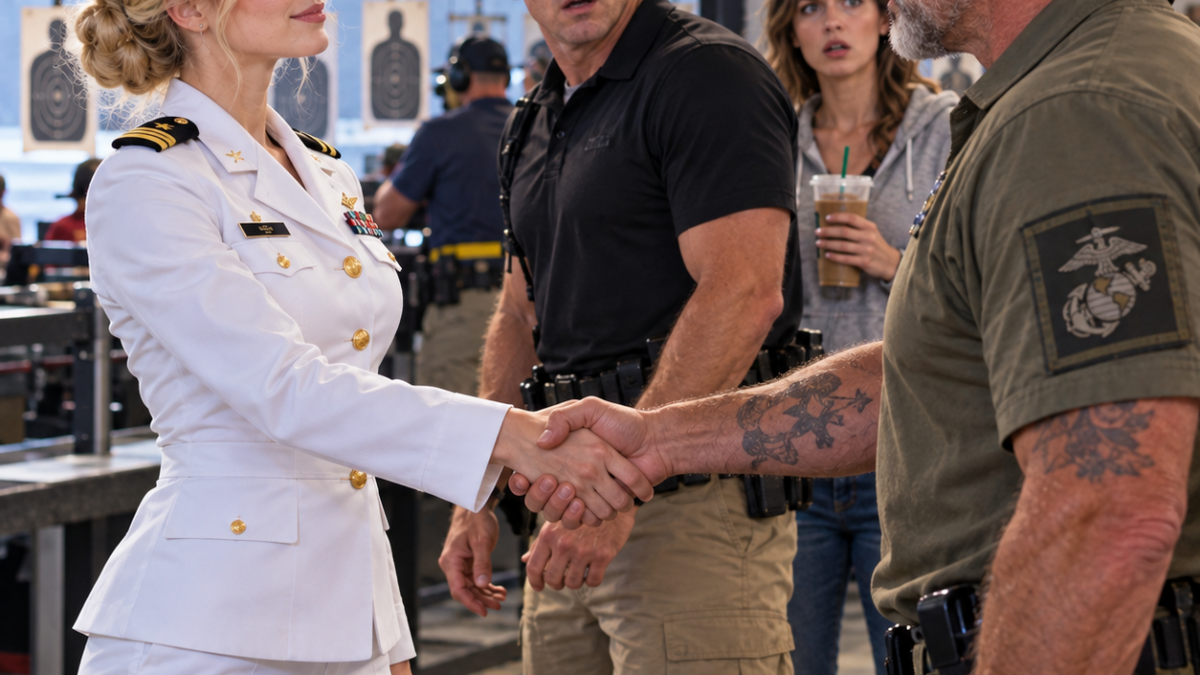
The range sat off a two-lane county highway behind a feed store and an equipment rental lot. Inside, fluorescent lights hummed over ammunition shelves, a television near the ceiling played a football replay with the sound muted, and someone had spilled coffee near the waiver station. Brett dropped an expensive range bag onto the counter. “Start her on something light,” he told the man working behind it. Not asked. Told. The instructor looked around sixty, broad through the shoulders, gray-haired, with an old Marine Corps tattoo on his forearm. His nametag read CASTELLON. I took the clipboard he offered and filled in the standard information. Name. Address. Emergency contact. Signature. When Roy Castellon looked down at the form, he stopped moving completely.
He read the name again. Then looked at me. Then back at the form. Brett was too busy arranging ear protection to notice. Castellon lowered his voice. “Ma’am.” Something had changed in his face. Not surprise exactly. Recognition. Professional recognition. “Is this a joke?” “No.” His eyes narrowed. “Are you Hollow Point?” My hand stopped over the pen. Behind me, Brett said, “What?” Castellon ignored him. I had not heard that callsign spoken by a stranger in years. Not in Nebraska. Not beside shelves of hunting ammunition and a cooler filled with Gatorade. I studied the old Marine tattoo. “You were Recon?” Castellon straightened and extended his hand. “Gunnery Sergeant Roy Castellon. Retired.”
I shook it.
His grip was firm. His eyes weren’t.
“I heard the hostage story from one of my old instructors,” he said quietly. “Three-quarter-second exposure. Bad wind. Long shot. Everybody teaching precision work knew that case.”
Brett stepped closer. “What hostage story?”
Castellon finally looked at him. “You brought her here to teach her?”
Brett’s smile returned automatically. “Yeah. Just the fundamentals.”
Castellon stared at him for two full seconds.
Then he laughed.
Not cruelly.
That somehow made it worse.
“Officer,” he said, “she does not need fundamentals from you.”
Jenna slowly lowered her coffee.
Brett blinked. “What exactly are you talking about?”
Castellon pointed toward me. “Your girlfriend’s sister is the shooter from a case we used as an example of composure under pressure.”
Two customers near the ammunition wall stopped pretending they weren’t listening.
Brett looked at me.
“No.”
Just that.
No.
As though reality had submitted its paperwork incorrectly.
Castellon looked back at me. “That was you, wasn’t it?”
I could have lied. I had spent years doing versions of it. Shrugging. Changing topics. Letting relatives believe whatever story made dinner easier. But I looked through the glass doors toward the firing lanes, then at Brett.
“Yeah.”
His face changed slowly.
Confidence first.
Then confusion.
Then embarrassment.
Then something dangerously close to anger.
“You never told me.”
I almost laughed.
Instead, I gave him the answer he had earned over two years.
“You never asked.”
For a second, nobody spoke. Brett looked around, suddenly aware of the people who had heard everything. His instinct was the same one I had seen from insecure men in uniform throughout my career: regain control by talking. “Hold on. Hollow Point? What does that even mean?” He followed me toward the range door. Castellon answered before I could. “It means she operated at a level most shooters never reach.” Brett’s jaw tightened. “I’m police.” Castellon nodded. “I know.” That tiny pause did more damage than an insult ever could.
Jenna caught up beside me. “You told me you did overwatch.” “I did.” “You never said sniper.” “Technically, I told you enough to know I wasn’t moving boxes.” Her face flushed. Behind us, Brett muttered, “Nobody said you moved boxes.” I turned. “You told Uncle Ray I worked supply.” Brett looked at Jenna. “That’s what Jenna said.” Jenna’s head snapped toward him. “No. I said she didn’t talk about her job.” Silence. There it was. A crack. Not between Brett and me. Between Brett and the version of himself Jenna had been dating.
Castellon handed me hearing protection. “If you’re comfortable, I’d love to see you shoot.” Brett folded his arms. “With what?” Castellon glanced at me. “Anything she wants.” I studied the rental wall. “Nothing fancy.” Castellon smiled. “That’s exactly what someone like you would say.” Twenty minutes later, Brett stopped smiling entirely. Not because I performed a circus trick. I didn’t. I simply did what years of repetition had taught my body to do. Slow. Controlled. Boring. Breath. Sight picture. Pressure. Reset. Again.
The target came back.
The group was tight.
Castellon whistled once.
Brett stared at the paper, then at his own target hanging two lanes down. He folded his inward before anyone could compare them.
I noticed.
So did Jenna.
Neither of us said a word.
That somehow hurt him more.
Castellon leaned closer to inspect my target. “Still got it.” “Apparently my hands remember things my knees don’t.” He laughed. Brett didn’t. Jenna stood behind the safety line studying me with an expression I had never seen before. It wasn’t awe. I would have hated awe. It was reconsideration. The kind that happens when somebody realizes a story they accepted for years was mostly empty space filled by another person’s assumptions.
On the drive back to my parents’ house, nobody turned on music. That had never happened in Brett’s truck. Usually he filled silence like it owed him money. This time, both hands stayed on the wheel. Jenna watched the highway. I watched cornfields slide past my window. Finally Brett said, “So what exactly did you do?” I looked at the back of his head. “That’s complicated.” “Try me.” Interesting. Two years of knowing me and now he wanted details.
“I worked with a reconnaissance element.”
“And the hostage thing?”
I hesitated.
The part people love is the shot.
That was never the part I remembered.
I remembered nineteen hours of waiting. Cold coffee. Dust inside my sleeve. A radio operator whispering updates. Three civilians inside a building with a man who kept threatening to kill them. Negotiations slowly failing. A breach team preparing. The wind shifting just enough to ruin an earlier solution. Then, finally, an opening that lasted less than a second.
A decision.
Afterward, three hostages walked out alive.
That was enough.
“That’s what Castellon knew about,” I said.
Brett gave a small scoff. “One shot made you famous?”
Jenna turned toward him. “Are you serious?”
“I’m asking.”
“No,” I said. “Years of work came before it. The shot is just the story people repeat because it fits in one sentence.”
He said nothing.
That answer irritated him because it did not give him anything easy to compete against. Brett understood awards, scores, qualification percentages, commendations. He understood measurable things because measurable things could be ranked. What he struggled with was the idea that competence might exist without performance.
When we reached the house, Uncle Ray was standing beside the grill. “Well?” he called. Brett climbed out. Ray grinned. “Did our Marine learn anything?” Brett slammed the truck door harder than necessary. Before he could answer, Jenna said, “Actually, Brett did.” Every head on the porch turned. Mom froze with a bowl of coleslaw in her hands. Jenna looked at Dad. “Did you know she was a sniper?”
Dad took one sip of iced tea.
“Yes.”
The porch exploded.
My cousin dropped a plastic fork. Aunt Susan said, “What?” Mom muttered, “Oh, Lord.” Dad shrugged. “She asked me not to make a thing out of it.” Brett stared at him. “You let me talk to her like that?” Dad’s face went flat. “I assumed a police officer knew how to ask questions.”
That landed hard.
Brett looked at me as though Dad’s answer somehow proved we had conspired against him. “Everyone knew except me?” “Most of them didn’t,” I said. “Dad did.” “Jenna knew something.” Jenna crossed her arms. “I knew Claire had done reconnaissance and overwatch work. I didn’t know everything because she doesn’t talk about it.” Brett scoffed. “Convenient.” My father set his drink down. “Son, you might want to stop using that word today.”
Dinner that evening felt like a courtroom with baked beans. Suddenly everyone wanted to sit near me. I hated it. I had spent years trying not to turn my service into family entertainment, and now Uncle Ray wanted stories, Aunt Susan wanted to know whether I had medals, and one cousin wanted photographs. I shut most of it down. Grandma said, “I always knew she was stubborn.” That made me laugh. Brett barely touched his brisket.
Then my cousin Tyler made the mistake that changed the mood.
“Wait,” he said. “Wasn’t Brett the guy who said women shouldn’t be in combat?”
Forks stopped.
Brett looked up. “I never said that.”
Tyler pulled out his phone. “Oh, you absolutely did.”
Apparently, during Thanksgiving the year before, Tyler had been testing a new phone camera and recorded half the table. Nobody remembered.
The video did.
Tyler found it.
Brett’s voice came through the speaker.
“I respect women who serve. I just think pretending physical differences don’t matter gets people killed.”
Then my voice in the background.
“Interesting.”
Brett continued.
“Your sister’s situation is different anyway. She’s support.”
The table became completely still.
Jenna’s face changed. “You said that?”
Brett pushed his chair back. “It was a general conversation.”
“You were talking about her.”
“I didn’t know.”
I set down my fork.
“That’s the problem.”
He looked at me.
For once, I did not rescue him from the silence.
“You didn’t know,” I said. “You just kept talking anyway.”
No yelling.
No speech.
Just the truth.
Dad looked at his plate, probably hiding a smile.
Brett stood. “I need some air.”
Jenna didn’t follow him.
That was new.
He stayed outside for almost twenty minutes. When he came back, everyone had deliberately moved the conversation to football. I appreciated the mercy. Brett sat beside Jenna. She did not touch his arm. That small absence was impossible not to notice. Later, while people cleared the table, I carried dishes into the kitchen. Jenna followed.
“Why didn’t you tell me?”
I rinsed a plate. “Tell you what?”
“Any of it.”
“I told you I was Marines.”
“That isn’t the same.”
I looked at her.
“Remember two Christmases ago when you asked what I did overseas?”
She frowned.
“I said I worked reconnaissance support and precision overwatch.”
Her face slowly changed.
“I thought that meant you helped other people do it.”
“I know.”
“Why didn’t you correct me?”
“Because you didn’t make a joke out of it.”
That answer surprised her.
“I wasn’t trying to hide from you. You just didn’t ask another question.”
Jenna leaned against the counter. “That’s fair.”
Then she looked toward the window, where Brett stood outside with Uncle Ray.
“He does that a lot.”
“What?”
“Decides what people are.”
I turned off the faucet.
“Maybe.”
“You noticed?”
“I notice most things.”
She laughed weakly. “Of course you do.”
Monday morning, I drove back to the range alone. Castellon had called Dad’s landline—yes, my parents still had one—and asked if I could stop by before leaving town. When I arrived, he was drinking gas-station coffee from a paper cup. He motioned toward a small office behind the counter and handed me an old folder.
Inside were printed training notes.
One page referenced the hostage case.
No name.
Just the callsign.
HOLLOW POINT.
I stared at it longer than I wanted to.
“I taught this case for years,” he said.
“Why?”
“Because the important part wasn’t marksmanship.”
He tapped the paper.
“It was judgment.”
That landed somewhere I had spent years avoiding.
For most people, the story ended with the shot.
For me, it never did.
I remembered everything before it. Every option we rejected. Every second spent calculating whether the situation justified what we were preparing to do. Every possible way I could have been wrong. Afterward, three hostages walked out alive, and everyone else moved on to debriefing, congratulations, paperwork, and stories.
I moved on too.
Mostly.
But sometimes at three in the morning, my mind still replayed the window opening.
What if the timing had been wrong?
What if the wind had shifted?
What if my read had been wrong?
What if three people had paid for one decision?
Castellon studied my face.
“They walked out.”
“I know.”
“Sometimes you need to hear it anyway.”
I looked down at the training page.
“Did you know any of them?”
“No. One of the instructors who developed the lesson had worked with someone from your unit. He cared less about the shot than why you waited.”
I swallowed.
Nobody in my family had ever asked about that.
Nobody at the range cared that morning about the dramatic part I spent years fearing people would want.
Castellon cared about judgment.
Maybe that was why the recognition didn’t bother me as much as I expected.
He slid a business card across the desk.
“I teach civilian precision courses two Saturdays a month. Hunters. Competition shooters. Some law enforcement. Nothing fancy.”
I raised an eyebrow.
“Come guest instruct.”
My instinct was immediate.
“No.”
He smiled. “That sounded automatic.”
“It was.”
“Why?”
I almost gave him three different excuses.
Travel.
Work.
Not interested.
Then I remembered Brett saying he wanted to build my confidence.
I laughed.
Castellon looked confused. “What?”
“Nothing.”
I picked up the card.
“Yeah. I’ll do it.”
He nodded.
For the first time in years, that part of my life did not feel like something I needed to lock away in order to remain myself.
That mattered more than embarrassing Brett ever could.
Jenna called Tuesday night. Not texted. Called. That usually meant trouble. I was standing in my apartment kitchen eating leftover Chinese food over the sink. “What happened?” She exhaled. “I asked Brett why he kept calling you support.” I leaned against the counter. “And?” “He said he assumed.” Of course he did.
“He assumed because you never bragged. He assumed because you didn’t correct him. He assumed because you’re smaller than him.”
She sounded disgusted.
Mostly with herself.
“I let him do it.”
“Jenna—”
“No. I did.”
I heard a cabinet close on her end.
“For two years, he treated every conversation like a competition. I thought that was just Brett.”
“It probably is.”
She laughed once, unhappily.
Then she told me something I hadn’t known.
Brett had already been warned at work about his attitude.
Nothing dramatic.
No corruption.
No civil-rights investigation.
Complaints from younger officers.
Talking over people.
Taking credit.
Turning routine calls into personal hero stories.
One female officer had requested not to ride with him anymore because he repeatedly interrupted her during calls, then retold the events later with himself at the center.
“That’s not my business,” I said.
“I know.”
“But it sounds familiar.”
“Exactly.”
Jenna went quiet.
Then she said, “I told him I needed space.”
That surprised me.
“Because of the range?”
“No.”
Her answer came quickly.
“Because the range made me notice the rest.”
There was the real consequence.
Not a bad target.
Not a bruised ego.
A spotlight.
Once somebody sees a pattern, it becomes difficult to make them unsee it.
Three days later, Brett texted me.
The first message was long.
He deleted it.
Another appeared.
Deleted.
Finally:
Castellon sent me material on the hostage case. I had no idea. I’m sorry.
I read it.
Then another message appeared.
Not sorry because you were better than me. Sorry because I decided what you were before I knew you.
Better.
Still late.
I typed:
That part matters more.
He replied almost immediately.
I know.
Then nothing.
For the first time since I met Brett, he allowed silence to exist without filling it.
Jenna later told me his lieutenant called him into a meeting after another officer complained about him during training. Again, no giant scandal. No dramatic firing. No badge ripped away. Real life rarely works that cleanly. His supervisor removed him from a mentoring rotation he had been bragging about for months.
Apparently they wanted someone who listened better.
I almost admired the poetry.
Almost.
A week later, I taught Castellon’s Saturday class.
Ten shooters.
Coffee in foam cups.
Cold Nebraska morning.
No applause.
No family audience.
Perfect.
Castellon introduced me only as Claire, former Marine, guest instructor.
No callsign.
No hostage story.
I appreciated that.
We worked fundamentals. Safety. Position. Breathing. Patience. How to recognize when anxiety was causing people to rush. Halfway through, a young woman named Megan struggled after two men beside her started offering unsolicited corrections every time she raised the rifle.
I recognized the look instantly.
Seventeen years old.
Standing outside my high school range.
Good enough to win.
Still treated like a guest.
I stepped beside her.
“Ignore everybody for one minute.”
She smiled nervously. “Even them?”
“Especially them.”
She laughed.
One of the men opened his mouth.
Castellon held up one finger from behind us.
He closed it.
Megan settled.
Her next group tightened.
She looked at the target, then at me.
“Better.”
“Because you stopped listening to six instructions at once.”
“I thought more advice was good.”
“Good advice is good. Volume isn’t.”
Castellon watched from behind us and nodded once.
That little nod meant more to me than Brett’s apology.
Because respect feels different when nobody has to be humiliated first.
I kept teaching.
Over the next month, Castellon invited me back twice more. I found myself enjoying it in a way I had not expected. Not the shooting itself. The teaching. Watching someone arrive tense and leave understanding something about their own judgment. There was no operational consequence. No one’s life depended on the target. That made it almost peaceful.
One Saturday, an older police officer attended the class. He recognized Castellon and kept mentioning his department’s qualification scores. Halfway through, he asked what agency I had worked for.
“Marines.”
“Doing what?”
“Various things.”
He smiled. “That classified?”
“Some.”
He nodded knowingly.
Then he started explaining grip.
I let him.
From behind the counter, Castellon caught my eye.
He did not interrupt.
Neither did I.
Five minutes later, the officer watched my demonstration.
He stopped offering grip advice.
Castellon bit the inside of his cheek to avoid laughing.
Some lessons teach themselves.
Back home, things with Jenna and Brett became complicated. She did not immediately leave him. I did not tell her to. My sister was thirty-five years old. She did not need another person deciding what her relationship meant before asking her.
That would have been ironic.
Instead, I listened.
Brett started counseling after his lieutenant recommended it.
At first, Jenna said he treated the whole thing like a performance.
“I’m working on communication,” he announced one evening.
Jenna responded, “That sounded like a press release.”
I laughed when she told me.
Gradually, some things changed.
He stopped wearing his badge off duty unless there was a reason.
He stopped telling police stories at every family meal.
He apologized to the female officer who had refused to ride with him.
She apparently said, “Thank you,” then continued requesting different partners.
That bothered him.
Good.
Apologies do not purchase access.
I understood that better than most people.
The harder issue was how Brett treated Jenna.
Once she saw his need to dominate conversations, she noticed how often he did it to her. Restaurants. Finances. Vacations. Which car to buy. Which friends were “good influences.” Nothing dramatic enough to notice individually.
Patterns rarely are.
She pushed back.
They fought.
Then, unexpectedly, Brett began listening sometimes.
Not always.
Enough.
Months passed.
At Christmas, Brett came to my parents’ house again. He and Jenna were still together. Barely, from what I understood. But something had changed. No badge on his belt. No training stories before dessert. No photographs of tactical gear. He carried Mom’s casserole dish from the kitchen without announcing that either.
Progress.
Small-town miracles happen.
After dinner, Uncle Ray grinned across the table. “Brett, tell that story about the gas station chase.”
Old Brett would have started before Ray finished the sentence.
This time Brett shook his head.
“Nah.”
Ray looked disappointed.
Brett glanced toward me.
“She’s got better stories.”
I shook my head.
“Nope.”
Everyone laughed.
Later, while I rinsed plates, Brett walked into the kitchen. For one horrible second I thought I was getting another apology speech. Instead, he picked up a towel and started drying.
Smart man.
After a minute, he said, “I used to think quiet people were quiet because they didn’t have anything to say.”
I handed him a plate.
“And now?”
“Sometimes they’ve just learned not everybody deserves the whole story.”
That might have been the first genuinely intelligent thing he ever said to me.
I nodded.
“Getting there.”
He smiled.
Then Dad yelled from the living room that someone had changed the football game. Mom accused Uncle Ray. Grandma demanded pie. Normal life resumed.
A month later, Castellon added me permanently to his guest-instructor rotation. I still didn’t tell strangers much about my service. I did not start wearing veteran shirts or turning dinner into war stories. That was never me. But I stopped shrinking the truth for people who had already decided confidence required noise.
That change affected more than the range.
At work, when younger colleagues asked what I had done before my current assignment, I stopped giving the automatic “logistics” answer that had gradually become family shorthand.
I told them enough.
Reconnaissance.
Precision support.
Leadership.
Training.
Not every detail.
Just truth.
It felt strange at first.
Almost boastful.
Then I realized how thoroughly I had confused humility with erasure.
There is nothing humble about letting someone else write your biography incorrectly because correcting them feels uncomfortable.
Sometimes silence is wisdom.
Sometimes silence is fear dressed elegantly.
Sometimes it is exhaustion.
Sometimes it is pride.
I had been practicing all four without realizing it.
The callsign remained the hardest part.
Hollow Point.
I never liked it.
Other Marines did.
Callsigns have a way of turning complicated human beings into memorable nouns. Mine came after an early training exercise because someone thought my shooting was “too precise to be polite.” It stuck. Later, the hostage operation gave the name a mythology I never wanted.
People heard Hollow Point and imagined certainty.
They did not understand how much doubt lived underneath.
Before every serious decision, I asked myself what I might be missing.
Good shooters are not fearless.
Good leaders are not certain.
Competence often means understanding exactly how badly a mistake could matter.
That was the lesson Castellon had preserved in his training notes.
Not the hit.
The wait.
The judgment.
The decision not to take three earlier opportunities because they were wrong.
That was what made me finally keep the old page instead of burying it.
I framed nothing.
I put it in a drawer.
HOLLOW POINT.
One page.
One case.
Not my identity.
Just part of it.
Jenna eventually asked to see the page.
We were sitting at my parents’ kitchen table one afternoon while Mom sorted receipts.
“Why did you hide that from us?”
“I didn’t hide it exactly.”
She raised an eyebrow.
“Fine. I avoided it.”
“Why?”
I thought for a moment.
“Because when people hear one dramatic thing, they stop seeing the person around it.”
Jenna nodded slowly.
“Brett did that.”
“So did everyone at dinner after the range.”
Including her.
“Yes.”
She reached across the table.
“I’m sorry.”
“For what?”
“For letting him speak for you.”
That apology mattered.
More than Brett’s, in some ways.
Because she was my sister.
“You didn’t know.”
She shook her head.
“No. That’s the same excuse he used.”
I smiled slightly.
“Fair.”
She looked toward Mom, then lowered her voice.
“I think I liked that he sounded sure about everything.”
“Most people do.”
“I didn’t notice how often being sure meant nobody else got to talk.”
That was probably the clearest explanation of Brett I ever heard.
Certainty can be seductive.
Especially if you grew up around people who hesitate.
Dad was quiet. Mom avoided conflict. Jenna had always liked decisive people.
Brett arrived sounding like a man who never doubted himself.
The problem was that people who never doubt themselves usually make everyone else carry the doubt.
By spring, Brett and Jenna broke up.
Not explosively.
No cheating scandal.
No screaming scene.
Jenna simply realized she no longer wanted to negotiate for room inside every conversation.
Brett took it badly at first.
Then, according to Jenna, surprisingly well.
He moved into an apartment closer to his precinct.
They stopped talking for a while.
I stayed out of it.
Brett texted me once.
Jenna ended things.
I replied:
I know.
He wrote:
You were right about me.
I stared at that sentence.
Then typed:
I never said you couldn’t change.
He did not respond for several hours.
Finally:
I’m trying.
Good, I thought.
Then I put my phone away.
His improvement no longer needed to be tied to my sister.
That would have been another performance.
Months later, I heard through Dad that Brett had transferred to a different unit after completing additional training. He had not been promoted. He was apparently doing fine.
That was enough information.
Jenna started dating again eventually, though she became suspicious of men who said “leadership” during first dates.
Probably healthy.
I kept teaching.
One Saturday, a sixteen-year-old girl came to Castellon’s class with her father. She was excellent. Better than she knew. Every time she made a mistake, she apologized. Every time she did something well, she looked toward her father to see whether he had noticed.
I knew that look.
During a break, I sat beside her.
“You compete?”
“My school has a team.”
“You any good?”
She shrugged.
Her father answered from behind us. “She’s probably the best one there.”
The girl looked embarrassed.
“Going to regionals?”
Her eyes shifted.
“The coach said they already have the lineup.”
Something inside me became very still.
“Were you invited to try out?”
“Sort of.”
That answer told me everything.
I looked at her father.
He looked angry too.
I did not storm the school.
I did not call anyone.
I simply gave the girl my card.
“If you ever want help preparing, call Castellon.”
She looked at the card.
“What if they still don’t pick me?”
“Then you decide whether that team deserves your talent.”
She smiled faintly.
That was the sentence seventeen-year-old me needed.
Not “prove them wrong.”
Not “make them regret it.”
Decide whether the room deserves you.
There is power in that distinction.
For years, I had built part of my identity around rooms that did not choose me.
The high school team.
Family conversations.
Men like Brett.
Every time they underestimated me, some part of me kept using their blindness as motivation.
That works.
For a while.
But it also keeps them emotionally important.
I was finally getting tired of succeeding in arguments nobody else knew we were having.
So I stopped.
I taught because I liked teaching.
I shot because I enjoyed the discipline.
I visited my family because I wanted to see them.
I told stories only when the story belonged in the room.
No more silent competitions.
That was harder than shooting.
One evening, Dad and I sat on the porch after dinner. He had been unusually quiet.
“You know,” he said, “I should’ve said something when Brett kept talking down to you.”
I looked at him.
“You did a little.”
“Not enough.”
I waited.
Dad stared toward the yard.
“I thought you found it funny.”
“Sometimes.”
“That’s not the same.”
“No.”
He rubbed his hands together.
“I think I got proud of knowing something he didn’t.”
That surprised me.
Then I laughed.
“Apparently it’s hereditary.”
He looked at me.
“What?”
“I did the same thing.”
Dad smiled.
“Well. At least I know where you got your character flaws.”
“Mom?”
“Obviously.”
She yelled from inside, “I heard that.”
We both laughed.
That conversation was small.
It mattered.
Because for years I had imagined Dad as the one person who fully understood why I stayed quiet.
He didn’t.
He had his own reasons.
His own ego.
His own satisfaction watching Brett discover the truth.
Realizing that freed me from idealizing even the people who supported me.
Everyone in that weekend had been human.
Brett arrogant.
Jenna passive.
Dad amused.
Me secretive.
Castellon curious.
Nobody completely villainous.
Nobody completely right.
That complexity made the story less satisfying as revenge.
More useful as truth.
A year after that original range trip, I walked into Castellon’s shop early on a Saturday morning. He had already made coffee.
“Terrible?”
“Always.”
He poured me a cup.
A man near the counter was filling out a waiver while his wife adjusted hearing protection. He looked toward me.
“You one of the instructors?”
“Yes.”
“You shoot much?”
I smiled.
“Sometimes.”
Castellon nearly choked on his coffee.
The man nodded seriously. “I’ve been shooting twenty years. If you want, I can help with grip.”
“Appreciate it.”
Castellon turned away so the man would not see his face.
Ten minutes later, class began.
I gave the safety brief.
The man stopped offering advice.
No one laughed at him.
That was important.
Humiliation teaches the wrong lesson.
Brett had taught me that unintentionally.
When people are wrong, you can correct them without destroying them.
Sometimes letting reality arrive calmly is enough.
After class, the man came over.
“I probably shouldn’t have assumed.”
“No.”
He laughed.
“Fair.”
Then he asked a question.
A real one.
We talked for ten minutes.
That exchange felt better than every moment Brett had been embarrassed.
Because learning had happened without anyone needing to lose status first.
Castellon watched him leave.
“You’re getting soft.”
“I’m evolving.”
“Terrible habit.”
“Age.”
He nodded toward the back office.
“I found another copy of the old training packet.”
“Burn it.”
“I’m selling it online.”
“I will deny everything.”
He laughed.
I did too.
Sometimes I wondered what would have happened if Castellon had never recognized my name.
Brett would have taught his lesson.
I would have shot well enough to confuse him.
Maybe Dad would have eventually said something.
Maybe not.
Jenna might have continued seeing Brett’s behavior as personality instead of pattern.
Maybe the relationship would have lasted another year.
Maybe five.
We like to imagine turning points as inevitable.
They aren’t.
A retired Gunnery Sergeant glanced at a waiver.
That was all.
Sometimes a life changes because one person reads a name carefully.
That thought made me more attentive to names.
At the range.
At work.
With students.
I stopped assuming quiet people had nothing to say.
Brett was right about one thing.
People develop bad habits.
Mine had been disappearing inside my own competence.
His had been filling every room with certainty.
Jenna’s had been mistaking certainty for strength.
We all had things to unlearn.
The difference was whether we noticed before someone else paid for them.
At Christmas the following year, Brett did not come.
Jenna was single and looked happier than she had in months. Uncle Ray asked about him once. She said, “He’s doing okay.” Then changed the subject. Nobody pushed.
Dinner was ordinary.
Brisket.
Cornbread.
Football.
Grandma demanding pie before everyone had finished dinner.
Tyler brought up the old range story.
“Remember when Brett tried to teach Claire to shoot?”
Everyone laughed.
I did too.
Then Tyler said, “Tell the Hollow Point story.”
The table quieted.
A year earlier, I would have shut it down.
This time I thought about Castellon’s folder.
About the hostages walking out.
About the part of the story that mattered.
“I’ll tell you some of it.”
Everyone listened.
I did not describe the shot.
I described the waiting.
The uncertainty.
The team.
The radio operator.
The breach element.
The decision to hold when everyone wanted action.
I told them leadership often looks like doing nothing until the right moment.
I told them the people who walked out alive mattered more than the person who pulled the trigger.
Uncle Ray looked disappointed by the lack of action details.
Grandma said, “Sounds smarter than most of your uncle’s stories.”
Ray protested.
Everyone laughed.
Jenna looked at me.
Not impressed.
Understanding.
That was better.
Later, she helped me wash dishes.
“You really are different.”
“You keep saying that.”
“I keep noticing it.”
“How?”
“You’re not hiding.”
I looked down at the plate in my hands.
“No.”
“Does it feel weird?”
“Yes.”
“Bad?”
“Less than it used to.”
She smiled.
“Good.”
We finished the dishes.
No revelation.
No applause.
Just sisters.
That was enough.
By then I had accepted something I resisted for years.
Being private and being invisible are not the same thing.
Privacy is a choice.
Invisibility can become a habit.
I had let the second disguise itself as the first.
The callsign stayed private most of the time.
The service details stayed mine.
But when people I loved asked honest questions, I answered.
When someone reduced my career to “logistics,” I corrected them.
Not defensively.
Simply.
“I did logistics too. I also did reconnaissance and precision work.”
That sentence was enough.
No proving.
No target needed.
The first time I said it at a family gathering, nobody fainted.
Amazing.
Mom asked whether I wanted more potatoes.
Life continued.
Sometimes the things we are most afraid to say feel huge only because we have carried them silently for so long.
Years later, I still teach with Castellon when our schedules line up. He is slower now. Complains about his back. Drinks worse coffee somehow. The old Marine tattoo has faded further.
I am slower too.
My knees complain after long days.
My hands remain steady.
The young woman from that first class, Megan, eventually started competing. She sends Castellon results occasionally. Once she won a regional match.
He printed the email and taped it beside the register.
When I saw it, I smiled.
“That’s ridiculous.”
“Proud instructor.”
“You barely taught her.”
“I supervised.”
“Of course.”
He pointed at me.
“Leadership.”
I rolled my eyes.
On another wall hangs nothing about me.
No Hollow Point.
No newspaper clipping.
No hostage story.
That was my request.
Castellon respected it.
He never needed other people to know he knew me.
That may be why I trusted him.
Respect is quieter than admiration.
Brett taught me that too.
Last I heard, he was still a police officer.
He and Jenna never got back together.
He completed a leadership-development program his department recommended and eventually became a field training officer again, though it took time.
Jenna told me once that another officer said he had changed.
“Listens more.”
I smiled.
“That must be exhausting for him.”
She laughed.
Then said, “I hope it’s real.”
“So do I.”
That surprised her.
“You don’t hate him?”
“No.”
“After all that?”
“He was arrogant, not evil.”
She considered that.
“And he taught me something useful.”
“What?”
“Never assume people know the difference between quiet and empty.”
Jenna nodded.
“Fair.”
Brett eventually sent me one last text.
Years after the range.
I still think about that weekend. I’m embarrassed by who I was.
I read it while sitting in my truck outside the grocery store.
I typed:
Good. Embarrassment is useful if you don’t live there forever.
His answer came a minute later.
Working on it.
I put the phone away.
That felt finished.
No friendship.
No reunion.
No need.
Just two people acknowledging that one of them had been wrong and had hopefully become less wrong.
People love clean endings.
Real life rarely offers them.
Mine looked like bad range coffee, family dinners, slow apologies, and a callsign sitting inside a drawer instead of running my life.
Sometimes I thought about seventeen-year-old me standing outside my high school range while boys I had beaten drove away to regionals.
She wanted somebody to notice.
Years later, I finally understood something she didn’t.
Being overlooked and being incapable are two completely different things.
Being overlooked can hurt.
But if you build your entire identity around eventually humiliating the people who overlooked you, they still own too much space inside you.
The cleanest revenge is not making them feel small.
It is reaching a point where their opinion no longer determines your size.
I still have Castellon’s old training page.
HOLLOW POINT.
Two words Brett once knew nothing about.
Two words that rearranged an entire family weekend.
Every once in a while, an overly confident guy at the range starts explaining my stance before bothering to ask who I am.
Castellon usually notices.
He looks at me.
I look at him.
Neither of us interrupts.
Not because we want anyone embarrassed.
Because sometimes the fastest way to cure an assumption is to let it survive just long enough to meet reality.
Then I take my position.
Slow breath.
Eyes forward.
No audience necessary.
No callsign required.
And the lesson begins.
𝗧𝗛𝗘 𝗘𝗡𝗗
My Sister’s Boyfriend Took Me to a Shooting Range to Teach Me the Basics, Never Realizing the Instructor Already Knew My Name
Brett thought my silence proved he understood more than I did.
He had spent an entire weekend turning my Marine career into a joke for my own family.
Then an old callsign surfaced at the range, and suddenly he was the only person in the room who didn’t know what it meant.
“Keep your finger straight until you’re ready.”
Brett tapped the side of his own holster as though he were explaining firearm safety to a nervous twelve-year-old. I looked at his finger, then at mine, then at my sister Jenna standing ten feet away with a Starbucks cup and the expression of a woman watching her boyfriend perform a public service. “Got it,” I said. Brett smiled in that patient, slightly superior way I had come to recognize over the two years he had been dating my sister. We were standing inside a county shooting range in Nebraska on Sunday morning, but the lesson had really begun twenty-four hours earlier at my parents’ family reunion, when Brett decided a backyard full of relatives was the perfect audience for another performance about his police career.
My parents lived outside a small Nebraska town where driveways were long, churches outnumbered traffic lights, and everybody still remembered whose son had been arrested after prom in 2009. By noon Saturday, folding tables covered the backyard. Mom had baked enough cornbread to survive a tornado. Uncle Ray was smoking brisket beside the detached garage. Kids ran through sprinklers while a faded American flag moved lazily above the porch. Brett arrived wearing his county badge clipped to his belt despite being off duty at a family barbecue. That detail told you most of what you needed to know. Friday night, he had spent forty minutes describing his department’s qualification course. Saturday morning, he explained his tactical vest to my grandfather. By afternoon, after three Coors Lights, he was showing cousins photographs from a training house and explaining how civilians could never understand “real pressure.”
I believed him about the pressure. Stress comes in different sizes. I just had no interest in measuring mine against his over potato salad. Then he looked across the yard and spotted me carrying a tray of hamburger buns. “There she is.” I stopped. “Who?” He grinned. “Our other public servant.” Several relatives laughed politely. Brett leaned against the porch railing. “I keep telling Jenna we need to get you some proper range time.” My father stopped turning steaks on the grill. That should have warned Brett. It didn’t. “You shoot much?” he asked. “Sometimes.” He repeated the word like I had confessed to owning a pink BB gun. Jenna touched his arm. “Brett.” He spread his hands. “What? I’m offering.”
Then he raised his voice so half the backyard could hear. “I’ll take her tomorrow. Teach her the basics.” Aunt Susan smiled. “That’s sweet.” I almost laughed. Brett continued. “No shame starting from zero. Most people didn’t grow up around firearms like I did.” Dad looked at me. I looked back. His mouth twitched once. Dad had put my first .22 in my hands when I was eight. By fourteen, I could outshoot every teenage boy who came through our property during deer season. By seventeen, I was beating the boys in my high school shooting club badly enough that they stopped joking before practice. They still took the boys to regionals instead of me. Nobody ever officially said girls couldn’t compete. The advisor simply kept forgetting to put my name on the roster.
That humiliation sent me somewhere much farther than regionals. Three days after my eighteenth birthday, I joined the United States Marine Corps. But Brett didn’t know that version of the story. To him, I had “done some logistics stuff.” That was how he described my career at Christmas, at Jenna’s birthday, on the Fourth of July, usually right before launching into another story about himself. Once, he spent twenty minutes describing a tense traffic stop before asking whether women in the Marines were allowed to do anything “properly hands-on.” Another time, he told Dad he respected support personnel. Dad nearly inhaled his beer. I never corrected Brett. Partly because some details of my service were not dinner-table material. Partly because I had learned overseas that people who underestimate you often give away useful information for free.
So I shrugged. “Sure. Take me.”
Brett smiled like he had won something.
That night, Dad found me alone in the kitchen loading the dishwasher. “You’re really going?” “Yep.” He handed me a plate. “You gonna tell him?” “Nope.” Dad laughed once, a short bark. Then Mom yelled from the living room asking who had taken her pie server. Sunday morning, Brett drove. Naturally. His Ford F-150 smelled like coffee, leather conditioner, and pine-tree air freshener. Jenna rode shotgun. I sat in the back while Brett spent fifty-eight minutes explaining trigger control, breathing, grip, sight alignment, and how he didn’t want me “developing bad habits.” I agreed with everything. “You’ll probably flinch the first few rounds,” he said. “Probably.” Jenna looked back at me once. She knew that tone. Apparently she decided not to save him.
part2
The range sat off a two-lane county highway behind a feed store and an equipment rental lot. Inside, fluorescent lights hummed over ammunition shelves, a television near the ceiling played a football replay with the sound muted, and someone had spilled coffee near the waiver station. Brett dropped an expensive range bag onto the counter. “Start her on something light,” he told the man working behind it. Not asked. Told. The instructor looked around sixty, broad through the shoulders, gray-haired, with an old Marine Corps tattoo on his forearm. His nametag read CASTELLON. I took the clipboard he offered and filled in the standard information. Name. Address. Emergency contact. Signature. When Roy Castellon looked down at the form, he stopped moving completely.
He read the name again. Then looked at me. Then back at the form. Brett was too busy arranging ear protection to notice. Castellon lowered his voice. “Ma’am.” Something had changed in his face. Not surprise exactly. Recognition. Professional recognition. “Is this a joke?” “No.” His eyes narrowed. “Are you Hollow Point?” My hand stopped over the pen. Behind me, Brett said, “What?” Castellon ignored him. I had not heard that callsign spoken by a stranger in years. Not in Nebraska. Not beside shelves of hunting ammunition and a cooler filled with Gatorade. I studied the old Marine tattoo. “You were Recon?” Castellon straightened and extended his hand. “Gunnery Sergeant Roy Castellon. Retired.”
I shook it.
His grip was firm. His eyes weren’t.
“I heard the hostage story from one of my old instructors,” he said quietly. “Three-quarter-second exposure. Bad wind. Long shot. Everybody teaching precision work knew that case.”
Brett stepped closer. “What hostage story?”
Castellon finally looked at him. “You brought her here to teach her?”
Brett’s smile returned automatically. “Yeah. Just the fundamentals.”
Castellon stared at him for two full seconds.
Then he laughed.
Not cruelly.
That somehow made it worse.
“Officer,” he said, “she does not need fundamentals from you.”
Jenna slowly lowered her coffee.
Brett blinked. “What exactly are you talking about?”
Castellon pointed toward me. “Your girlfriend’s sister is the shooter from a case we used as an example of composure under pressure.”
Two customers near the ammunition wall stopped pretending they weren’t listening.
Brett looked at me.
“No.”
Just that.
No.
As though reality had submitted its paperwork incorrectly.
Castellon looked back at me. “That was you, wasn’t it?”
I could have lied. I had spent years doing versions of it. Shrugging. Changing topics. Letting relatives believe whatever story made dinner easier. But I looked through the glass doors toward the firing lanes, then at Brett.
“Yeah.”
His face changed slowly.
Confidence first.
Then confusion.
Then embarrassment.
Then something dangerously close to anger.
“You never told me.”
I almost laughed.
Instead, I gave him the answer he had earned over two years.
“You never asked.”
For a second, nobody spoke. Brett looked around, suddenly aware of the people who had heard everything. His instinct was the same one I had seen from insecure men in uniform throughout my career: regain control by talking. “Hold on. Hollow Point? What does that even mean?” He followed me toward the range door. Castellon answered before I could. “It means she operated at a level most shooters never reach.” Brett’s jaw tightened. “I’m police.” Castellon nodded. “I know.” That tiny pause did more damage than an insult ever could.
Jenna caught up beside me. “You told me you did overwatch.” “I did.” “You never said sniper.” “Technically, I told you enough to know I wasn’t moving boxes.” Her face flushed. Behind us, Brett muttered, “Nobody said you moved boxes.” I turned. “You told Uncle Ray I worked supply.” Brett looked at Jenna. “That’s what Jenna said.” Jenna’s head snapped toward him. “No. I said she didn’t talk about her job.” Silence. There it was. A crack. Not between Brett and me. Between Brett and the version of himself Jenna had been dating.
Castellon handed me hearing protection. “If you’re comfortable, I’d love to see you shoot.” Brett folded his arms. “With what?” Castellon glanced at me. “Anything she wants.” I studied the rental wall. “Nothing fancy.” Castellon smiled. “That’s exactly what someone like you would say.” Twenty minutes later, Brett stopped smiling entirely. Not because I performed a circus trick. I didn’t. I simply did what years of repetition had taught my body to do. Slow. Controlled. Boring. Breath. Sight picture. Pressure. Reset. Again.
The target came back.
The group was tight.
Castellon whistled once.
Brett stared at the paper, then at his own target hanging two lanes down. He folded his inward before anyone could compare them.
I noticed.
So did Jenna.
Neither of us said a word.
That somehow hurt him more.
Castellon leaned closer to inspect my target. “Still got it.” “Apparently my hands remember things my knees don’t.” He laughed. Brett didn’t. Jenna stood behind the safety line studying me with an expression I had never seen before. It wasn’t awe. I would have hated awe. It was reconsideration. The kind that happens when somebody realizes a story they accepted for years was mostly empty space filled by another person’s assumptions.
On the drive back to my parents’ house, nobody turned on music. That had never happened in Brett’s truck. Usually he filled silence like it owed him money. This time, both hands stayed on the wheel. Jenna watched the highway. I watched cornfields slide past my window. Finally Brett said, “So what exactly did you do?” I looked at the back of his head. “That’s complicated.” “Try me.” Interesting. Two years of knowing me and now he wanted details.
“I worked with a reconnaissance element.”
“And the hostage thing?”
I hesitated.
The part people love is the shot.
That was never the part I remembered.
I remembered nineteen hours of waiting. Cold coffee. Dust inside my sleeve. A radio operator whispering updates. Three civilians inside a building with a man who kept threatening to kill them. Negotiations slowly failing. A breach team preparing. The wind shifting just enough to ruin an earlier solution. Then, finally, an opening that lasted less than a second.
A decision.
Afterward, three hostages walked out alive.
That was enough.
“That’s what Castellon knew about,” I said.
Brett gave a small scoff. “One shot made you famous?”
Jenna turned toward him. “Are you serious?”
“I’m asking.”
“No,” I said. “Years of work came before it. The shot is just the story people repeat because it fits in one sentence.”
He said nothing.
That answer irritated him because it did not give him anything easy to compete against. Brett understood awards, scores, qualification percentages, commendations. He understood measurable things because measurable things could be ranked. What he struggled with was the idea that competence might exist without performance.
When we reached the house, Uncle Ray was standing beside the grill. “Well?” he called. Brett climbed out. Ray grinned. “Did our Marine learn anything?” Brett slammed the truck door harder than necessary. Before he could answer, Jenna said, “Actually, Brett did.” Every head on the porch turned. Mom froze with a bowl of coleslaw in her hands. Jenna looked at Dad. “Did you know she was a sniper?”
Dad took one sip of iced tea.
“Yes.”
The porch exploded.
My cousin dropped a plastic fork. Aunt Susan said, “What?” Mom muttered, “Oh, Lord.” Dad shrugged. “She asked me not to make a thing out of it.” Brett stared at him. “You let me talk to her like that?” Dad’s face went flat. “I assumed a police officer knew how to ask questions.”
That landed hard.
Brett looked at me as though Dad’s answer somehow proved we had conspired against him. “Everyone knew except me?” “Most of them didn’t,” I said. “Dad did.” “Jenna knew something.” Jenna crossed her arms. “I knew Claire had done reconnaissance and overwatch work. I didn’t know everything because she doesn’t talk about it.” Brett scoffed. “Convenient.” My father set his drink down. “Son, you might want to stop using that word today.”
Dinner that evening felt like a courtroom with baked beans. Suddenly everyone wanted to sit near me. I hated it. I had spent years trying not to turn my service into family entertainment, and now Uncle Ray wanted stories, Aunt Susan wanted to know whether I had medals, and one cousin wanted photographs. I shut most of it down. Grandma said, “I always knew she was stubborn.” That made me laugh. Brett barely touched his brisket.
Then my cousin Tyler made the mistake that changed the mood.
“Wait,” he said. “Wasn’t Brett the guy who said women shouldn’t be in combat?”
Forks stopped.
Brett looked up. “I never said that.”
Tyler pulled out his phone. “Oh, you absolutely did.”
Apparently, during Thanksgiving the year before, Tyler had been testing a new phone camera and recorded half the table. Nobody remembered.
The video did.
Tyler found it.
Brett’s voice came through the speaker.
“I respect women who serve. I just think pretending physical differences don’t matter gets people killed.”
Then my voice in the background.
“Interesting.”
Brett continued.
“Your sister’s situation is different anyway. She’s support.”
The table became completely still.
Jenna’s face changed. “You said that?”
Brett pushed his chair back. “It was a general conversation.”
“You were talking about her.”
“I didn’t know.”
I set down my fork.
“That’s the problem.”
He looked at me.
For once, I did not rescue him from the silence.
“You didn’t know,” I said. “You just kept talking anyway.”
No yelling.
No speech.
Just the truth.
Dad looked at his plate, probably hiding a smile.
Brett stood. “I need some air.”
Jenna didn’t follow him.
That was new.
He stayed outside for almost twenty minutes. When he came back, everyone had deliberately moved the conversation to football. I appreciated the mercy. Brett sat beside Jenna. She did not touch his arm. That small absence was impossible not to notice. Later, while people cleared the table, I carried dishes into the kitchen. Jenna followed.
“Why didn’t you tell me?”
I rinsed a plate. “Tell you what?”
“Any of it.”
“I told you I was Marines.”
“That isn’t the same.”
I looked at her.
“Remember two Christmases ago when you asked what I did overseas?”
She frowned.
“I said I worked reconnaissance support and precision overwatch.”
Her face slowly changed.
“I thought that meant you helped other people do it.”
“I know.”
“Why didn’t you correct me?”
“Because you didn’t make a joke out of it.”
That answer surprised her.
“I wasn’t trying to hide from you. You just didn’t ask another question.”
Jenna leaned against the counter. “That’s fair.”
Then she looked toward the window, where Brett stood outside with Uncle Ray.
“He does that a lot.”
“What?”
“Decides what people are.”
I turned off the faucet.
“Maybe.”
“You noticed?”
“I notice most things.”
She laughed weakly. “Of course you do.”
Monday morning, I drove back to the range alone. Castellon had called Dad’s landline—yes, my parents still had one—and asked if I could stop by before leaving town. When I arrived, he was drinking gas-station coffee from a paper cup. He motioned toward a small office behind the counter and handed me an old folder.
Inside were printed training notes.
One page referenced the hostage case.
No name.
Just the callsign.
HOLLOW POINT.
I stared at it longer than I wanted to.
“I taught this case for years,” he said.
“Why?”
“Because the important part wasn’t marksmanship.”
He tapped the paper.
“It was judgment.”
That landed somewhere I had spent years avoiding.
For most people, the story ended with the shot.
For me, it never did.
I remembered everything before it. Every option we rejected. Every second spent calculating whether the situation justified what we were preparing to do. Every possible way I could have been wrong. Afterward, three hostages walked out alive, and everyone else moved on to debriefing, congratulations, paperwork, and stories.
I moved on too.
Mostly.
But sometimes at three in the morning, my mind still replayed the window opening.
What if the timing had been wrong?
What if the wind had shifted?
What if my read had been wrong?
What if three people had paid for one decision?
Castellon studied my face.
“They walked out.”
“I know.”
“Sometimes you need to hear it anyway.”
I looked down at the training page.
“Did you know any of them?”
“No. One of the instructors who developed the lesson had worked with someone from your unit. He cared less about the shot than why you waited.”
I swallowed.
Nobody in my family had ever asked about that.
Nobody at the range cared that morning about the dramatic part I spent years fearing people would want.
Castellon cared about judgment.
Maybe that was why the recognition didn’t bother me as much as I expected.
He slid a business card across the desk.
“I teach civilian precision courses two Saturdays a month. Hunters. Competition shooters. Some law enforcement. Nothing fancy.”
I raised an eyebrow.
“Come guest instruct.”
My instinct was immediate.
“No.”
He smiled. “That sounded automatic.”
“It was.”
“Why?”
I almost gave him three different excuses.
Travel.
Work.
Not interested.
Then I remembered Brett saying he wanted to build my confidence.
I laughed.
Castellon looked confused. “What?”
“Nothing.”
I picked up the card.
“Yeah. I’ll do it.”
He nodded.
For the first time in years, that part of my life did not feel like something I needed to lock away in order to remain myself.
That mattered more than embarrassing Brett ever could.
Jenna called Tuesday night. Not texted. Called. That usually meant trouble. I was standing in my apartment kitchen eating leftover Chinese food over the sink. “What happened?” She exhaled. “I asked Brett why he kept calling you support.” I leaned against the counter. “And?” “He said he assumed.” Of course he did.
“He assumed because you never bragged. He assumed because you didn’t correct him. He assumed because you’re smaller than him.”
She sounded disgusted.
Mostly with herself.
“I let him do it.”
“Jenna—”
“No. I did.”
I heard a cabinet close on her end.
“For two years, he treated every conversation like a competition. I thought that was just Brett.”
“It probably is.”
She laughed once, unhappily.
Then she told me something I hadn’t known.
Brett had already been warned at work about his attitude.
Nothing dramatic.
No corruption.
No civil-rights investigation.
Complaints from younger officers.
Talking over people.
Taking credit.
Turning routine calls into personal hero stories.
One female officer had requested not to ride with him anymore because he repeatedly interrupted her during calls, then retold the events later with himself at the center.
“That’s not my business,” I said.
“I know.”
“But it sounds familiar.”
“Exactly.”
Jenna went quiet.
Then she said, “I told him I needed space.”
That surprised me.
“Because of the range?”
“No.”
Her answer came quickly.
“Because the range made me notice the rest.”
There was the real consequence.
Not a bad target.
Not a bruised ego.
A spotlight.
Once somebody sees a pattern, it becomes difficult to make them unsee it.
Three days later, Brett texted me.
The first message was long.
He deleted it.
Another appeared.
Deleted.
Finally:
Castellon sent me material on the hostage case. I had no idea. I’m sorry.
I read it.
Then another message appeared.
Not sorry because you were better than me. Sorry because I decided what you were before I knew you.
Better.
Still late.
I typed:
That part matters more.
He replied almost immediately.
I know.
Then nothing.
For the first time since I met Brett, he allowed silence to exist without filling it.
Jenna later told me his lieutenant called him into a meeting after another officer complained about him during training. Again, no giant scandal. No dramatic firing. No badge ripped away. Real life rarely works that cleanly. His supervisor removed him from a mentoring rotation he had been bragging about for months.
Apparently they wanted someone who listened better.
I almost admired the poetry.
Almost.
A week later, I taught Castellon’s Saturday class.
Ten shooters.
Coffee in foam cups.
Cold Nebraska morning.
No applause.
No family audience.
Perfect.
Castellon introduced me only as Claire, former Marine, guest instructor.
No callsign.
No hostage story.
I appreciated that.
We worked fundamentals. Safety. Position. Breathing. Patience. How to recognize when anxiety was causing people to rush. Halfway through, a young woman named Megan struggled after two men beside her started offering unsolicited corrections every time she raised the rifle.
I recognized the look instantly.
Seventeen years old.
Standing outside my high school range.
Good enough to win.
Still treated like a guest.
I stepped beside her.
“Ignore everybody for one minute.”
She smiled nervously. “Even them?”
“Especially them.”
She laughed.
One of the men opened his mouth.
Castellon held up one finger from behind us.
He closed it.
Megan settled.
Her next group tightened.
She looked at the target, then at me.
“Better.”
“Because you stopped listening to six instructions at once.”
“I thought more advice was good.”
“Good advice is good. Volume isn’t.”
Castellon watched from behind us and nodded once.
That little nod meant more to me than Brett’s apology.
Because respect feels different when nobody has to be humiliated first.
I kept teaching.
Over the next month, Castellon invited me back twice more. I found myself enjoying it in a way I had not expected. Not the shooting itself. The teaching. Watching someone arrive tense and leave understanding something about their own judgment. There was no operational consequence. No one’s life depended on the target. That made it almost peaceful.
One Saturday, an older police officer attended the class. He recognized Castellon and kept mentioning his department’s qualification scores. Halfway through, he asked what agency I had worked for.
“Marines.”
“Doing what?”
“Various things.”
He smiled. “That classified?”
“Some.”
He nodded knowingly.
Then he started explaining grip.
I let him.
From behind the counter, Castellon caught my eye.
He did not interrupt.
Neither did I.
Five minutes later, the officer watched my demonstration.
He stopped offering grip advice.
Castellon bit the inside of his cheek to avoid laughing.
Some lessons teach themselves.
Back home, things with Jenna and Brett became complicated. She did not immediately leave him. I did not tell her to. My sister was thirty-five years old. She did not need another person deciding what her relationship meant before asking her.
That would have been ironic.
Instead, I listened.
Brett started counseling after his lieutenant recommended it.
At first, Jenna said he treated the whole thing like a performance.
“I’m working on communication,” he announced one evening.
Jenna responded, “That sounded like a press release.”
I laughed when she told me.
Gradually, some things changed.
He stopped wearing his badge off duty unless there was a reason.
He stopped telling police stories at every family meal.
He apologized to the female officer who had refused to ride with him.
She apparently said, “Thank you,” then continued requesting different partners.
That bothered him.
Good.
Apologies do not purchase access.
I understood that better than most people.
The harder issue was how Brett treated Jenna.
Once she saw his need to dominate conversations, she noticed how often he did it to her. Restaurants. Finances. Vacations. Which car to buy. Which friends were “good influences.” Nothing dramatic enough to notice individually.
Patterns rarely are.
She pushed back.
They fought.
Then, unexpectedly, Brett began listening sometimes.
Not always.
Enough.
Months passed.
At Christmas, Brett came to my parents’ house again. He and Jenna were still together. Barely, from what I understood. But something had changed. No badge on his belt. No training stories before dessert. No photographs of tactical gear. He carried Mom’s casserole dish from the kitchen without announcing that either.
Progress.
Small-town miracles happen.
After dinner, Uncle Ray grinned across the table. “Brett, tell that story about the gas station chase.”
Old Brett would have started before Ray finished the sentence.
This time Brett shook his head.
“Nah.”
Ray looked disappointed.
Brett glanced toward me.
“She’s got better stories.”
I shook my head.
“Nope.”
Everyone laughed.
Later, while I rinsed plates, Brett walked into the kitchen. For one horrible second I thought I was getting another apology speech. Instead, he picked up a towel and started drying.
Smart man.
After a minute, he said, “I used to think quiet people were quiet because they didn’t have anything to say.”
I handed him a plate.
“And now?”
“Sometimes they’ve just learned not everybody deserves the whole story.”
That might have been the first genuinely intelligent thing he ever said to me.
I nodded.
“Getting there.”
He smiled.
Then Dad yelled from the living room that someone had changed the football game. Mom accused Uncle Ray. Grandma demanded pie. Normal life resumed.
A month later, Castellon added me permanently to his guest-instructor rotation. I still didn’t tell strangers much about my service. I did not start wearing veteran shirts or turning dinner into war stories. That was never me. But I stopped shrinking the truth for people who had already decided confidence required noise.
That change affected more than the range.
At work, when younger colleagues asked what I had done before my current assignment, I stopped giving the automatic “logistics” answer that had gradually become family shorthand.
I told them enough.
Reconnaissance.
Precision support.
Leadership.
Training.
Not every detail.
Just truth.
It felt strange at first.
Almost boastful.
Then I realized how thoroughly I had confused humility with erasure.
There is nothing humble about letting someone else write your biography incorrectly because correcting them feels uncomfortable.
Sometimes silence is wisdom.
Sometimes silence is fear dressed elegantly.
Sometimes it is exhaustion.
Sometimes it is pride.
I had been practicing all four without realizing it.
The callsign remained the hardest part.
Hollow Point.
I never liked it.
Other Marines did.
Callsigns have a way of turning complicated human beings into memorable nouns. Mine came after an early training exercise because someone thought my shooting was “too precise to be polite.” It stuck. Later, the hostage operation gave the name a mythology I never wanted.
People heard Hollow Point and imagined certainty.
They did not understand how much doubt lived underneath.
Before every serious decision, I asked myself what I might be missing.
Good shooters are not fearless.
Good leaders are not certain.
Competence often means understanding exactly how badly a mistake could matter.
That was the lesson Castellon had preserved in his training notes.
Not the hit.
The wait.
The judgment.
The decision not to take three earlier opportunities because they were wrong.
That was what made me finally keep the old page instead of burying it.
I framed nothing.
I put it in a drawer.
HOLLOW POINT.
One page.
One case.
Not my identity.
Just part of it.
Jenna eventually asked to see the page.
We were sitting at my parents’ kitchen table one afternoon while Mom sorted receipts.
“Why did you hide that from us?”
“I didn’t hide it exactly.”
She raised an eyebrow.
“Fine. I avoided it.”
“Why?”
I thought for a moment.
“Because when people hear one dramatic thing, they stop seeing the person around it.”
Jenna nodded slowly.
“Brett did that.”
“So did everyone at dinner after the range.”
Including her.
“Yes.”
She reached across the table.
“I’m sorry.”
“For what?”
“For letting him speak for you.”
That apology mattered.
More than Brett’s, in some ways.
Because she was my sister.
“You didn’t know.”
She shook her head.
“No. That’s the same excuse he used.”
I smiled slightly.
“Fair.”
She looked toward Mom, then lowered her voice.
“I think I liked that he sounded sure about everything.”
“Most people do.”
“I didn’t notice how often being sure meant nobody else got to talk.”
That was probably the clearest explanation of Brett I ever heard.
Certainty can be seductive.
Especially if you grew up around people who hesitate.
Dad was quiet. Mom avoided conflict. Jenna had always liked decisive people.
Brett arrived sounding like a man who never doubted himself.
The problem was that people who never doubt themselves usually make everyone else carry the doubt.
By spring, Brett and Jenna broke up.
Not explosively.
No cheating scandal.
No screaming scene.
Jenna simply realized she no longer wanted to negotiate for room inside every conversation.
Brett took it badly at first.
Then, according to Jenna, surprisingly well.
He moved into an apartment closer to his precinct.
They stopped talking for a while.
I stayed out of it.
Brett texted me once.
Jenna ended things.
I replied:
I know.
He wrote:
You were right about me.
I stared at that sentence.
Then typed:
I never said you couldn’t change.
He did not respond for several hours.
Finally:
I’m trying.
Good, I thought.
Then I put my phone away.
His improvement no longer needed to be tied to my sister.
That would have been another performance.
Months later, I heard through Dad that Brett had transferred to a different unit after completing additional training. He had not been promoted. He was apparently doing fine.
That was enough information.
Jenna started dating again eventually, though she became suspicious of men who said “leadership” during first dates.
Probably healthy.
I kept teaching.
One Saturday, a sixteen-year-old girl came to Castellon’s class with her father. She was excellent. Better than she knew. Every time she made a mistake, she apologized. Every time she did something well, she looked toward her father to see whether he had noticed.
I knew that look.
During a break, I sat beside her.
“You compete?”
“My school has a team.”
“You any good?”
She shrugged.
Her father answered from behind us. “She’s probably the best one there.”
The girl looked embarrassed.
“Going to regionals?”
Her eyes shifted.
“The coach said they already have the lineup.”
Something inside me became very still.
“Were you invited to try out?”
“Sort of.”
That answer told me everything.
I looked at her father.
He looked angry too.
I did not storm the school.
I did not call anyone.
I simply gave the girl my card.
“If you ever want help preparing, call Castellon.”
She looked at the card.
“What if they still don’t pick me?”
“Then you decide whether that team deserves your talent.”
She smiled faintly.
That was the sentence seventeen-year-old me needed.
Not “prove them wrong.”
Not “make them regret it.”
Decide whether the room deserves you.
There is power in that distinction.
For years, I had built part of my identity around rooms that did not choose me.
The high school team.
Family conversations.
Men like Brett.
Every time they underestimated me, some part of me kept using their blindness as motivation.
That works.
For a while.
But it also keeps them emotionally important.
I was finally getting tired of succeeding in arguments nobody else knew we were having.
So I stopped.
I taught because I liked teaching.
I shot because I enjoyed the discipline.
I visited my family because I wanted to see them.
I told stories only when the story belonged in the room.
No more silent competitions.
That was harder than shooting.
One evening, Dad and I sat on the porch after dinner. He had been unusually quiet.
“You know,” he said, “I should’ve said something when Brett kept talking down to you.”
I looked at him.
“You did a little.”
“Not enough.”
I waited.
Dad stared toward the yard.
“I thought you found it funny.”
“Sometimes.”
“That’s not the same.”
“No.”
He rubbed his hands together.
“I think I got proud of knowing something he didn’t.”
That surprised me.
Then I laughed.
“Apparently it’s hereditary.”
He looked at me.
“What?”
“I did the same thing.”
Dad smiled.
“Well. At least I know where you got your character flaws.”
“Mom?”
“Obviously.”
She yelled from inside, “I heard that.”
We both laughed.
That conversation was small.
It mattered.
Because for years I had imagined Dad as the one person who fully understood why I stayed quiet.
He didn’t.
He had his own reasons.
His own ego.
His own satisfaction watching Brett discover the truth.
Realizing that freed me from idealizing even the people who supported me.
Everyone in that weekend had been human.
Brett arrogant.
Jenna passive.
Dad amused.
Me secretive.
Castellon curious.
Nobody completely villainous.
Nobody completely right.
That complexity made the story less satisfying as revenge.
More useful as truth.
A year after that original range trip, I walked into Castellon’s shop early on a Saturday morning. He had already made coffee.
“Terrible?”
“Always.”
He poured me a cup.
A man near the counter was filling out a waiver while his wife adjusted hearing protection. He looked toward me.
“You one of the instructors?”
“Yes.”
“You shoot much?”
I smiled.
“Sometimes.”
Castellon nearly choked on his coffee.
The man nodded seriously. “I’ve been shooting twenty years. If you want, I can help with grip.”
“Appreciate it.”
Castellon turned away so the man would not see his face.
Ten minutes later, class began.
I gave the safety brief.
The man stopped offering advice.
No one laughed at him.
That was important.
Humiliation teaches the wrong lesson.
Brett had taught me that unintentionally.
When people are wrong, you can correct them without destroying them.
Sometimes letting reality arrive calmly is enough.
After class, the man came over.
“I probably shouldn’t have assumed.”
“No.”
He laughed.
“Fair.”
Then he asked a question.
A real one.
We talked for ten minutes.
That exchange felt better than every moment Brett had been embarrassed.
Because learning had happened without anyone needing to lose status first.
Castellon watched him leave.
“You’re getting soft.”
“I’m evolving.”
“Terrible habit.”
“Age.”
He nodded toward the back office.
“I found another copy of the old training packet.”
“Burn it.”
“I’m selling it online.”
“I will deny everything.”
He laughed.
I did too.
Sometimes I wondered what would have happened if Castellon had never recognized my name.
Brett would have taught his lesson.
I would have shot well enough to confuse him.
Maybe Dad would have eventually said something.
Maybe not.
Jenna might have continued seeing Brett’s behavior as personality instead of pattern.
Maybe the relationship would have lasted another year.
Maybe five.
We like to imagine turning points as inevitable.
They aren’t.
A retired Gunnery Sergeant glanced at a waiver.
That was all.
Sometimes a life changes because one person reads a name carefully.
That thought made me more attentive to names.
At the range.
At work.
With students.
I stopped assuming quiet people had nothing to say.
Brett was right about one thing.
People develop bad habits.
Mine had been disappearing inside my own competence.
His had been filling every room with certainty.
Jenna’s had been mistaking certainty for strength.
We all had things to unlearn.
The difference was whether we noticed before someone else paid for them.
At Christmas the following year, Brett did not come.
Jenna was single and looked happier than she had in months. Uncle Ray asked about him once. She said, “He’s doing okay.” Then changed the subject. Nobody pushed.
Dinner was ordinary.
Brisket.
Cornbread.
Football.
Grandma demanding pie before everyone had finished dinner.
Tyler brought up the old range story.
“Remember when Brett tried to teach Claire to shoot?”
Everyone laughed.
I did too.
Then Tyler said, “Tell the Hollow Point story.”
The table quieted.
A year earlier, I would have shut it down.
This time I thought about Castellon’s folder.
About the hostages walking out.
About the part of the story that mattered.
“I’ll tell you some of it.”
Everyone listened.
I did not describe the shot.
I described the waiting.
The uncertainty.
The team.
The radio operator.
The breach element.
The decision to hold when everyone wanted action.
I told them leadership often looks like doing nothing until the right moment.
I told them the people who walked out alive mattered more than the person who pulled the trigger.
Uncle Ray looked disappointed by the lack of action details.
Grandma said, “Sounds smarter than most of your uncle’s stories.”
Ray protested.
Everyone laughed.
Jenna looked at me.
Not impressed.
Understanding.
That was better.
Later, she helped me wash dishes.
“You really are different.”
“You keep saying that.”
“I keep noticing it.”
“How?”
“You’re not hiding.”
I looked down at the plate in my hands.
“No.”
“Does it feel weird?”
“Yes.”
“Bad?”
“Less than it used to.”
She smiled.
“Good.”
We finished the dishes.
No revelation.
No applause.
Just sisters.
That was enough.
By then I had accepted something I resisted for years.
Being private and being invisible are not the same thing.
Privacy is a choice.
Invisibility can become a habit.
I had let the second disguise itself as the first.
The callsign stayed private most of the time.
The service details stayed mine.
But when people I loved asked honest questions, I answered.
When someone reduced my career to “logistics,” I corrected them.
Not defensively.
Simply.
“I did logistics too. I also did reconnaissance and precision work.”
That sentence was enough.
No proving.
No target needed.
The first time I said it at a family gathering, nobody fainted.
Amazing.
Mom asked whether I wanted more potatoes.
Life continued.
Sometimes the things we are most afraid to say feel huge only because we have carried them silently for so long.
Years later, I still teach with Castellon when our schedules line up. He is slower now. Complains about his back. Drinks worse coffee somehow. The old Marine tattoo has faded further.
I am slower too.
My knees complain after long days.
My hands remain steady.
The young woman from that first class, Megan, eventually started competing. She sends Castellon results occasionally. Once she won a regional match.
He printed the email and taped it beside the register.
When I saw it, I smiled.
“That’s ridiculous.”
“Proud instructor.”
“You barely taught her.”
“I supervised.”
“Of course.”
He pointed at me.
“Leadership.”
I rolled my eyes.
On another wall hangs nothing about me.
No Hollow Point.
No newspaper clipping.
No hostage story.
That was my request.
Castellon respected it.
He never needed other people to know he knew me.
That may be why I trusted him.
Respect is quieter than admiration.
Brett taught me that too.
Last I heard, he was still a police officer.
He and Jenna never got back together.
He completed a leadership-development program his department recommended and eventually became a field training officer again, though it took time.
Jenna told me once that another officer said he had changed.
“Listens more.”
I smiled.
“That must be exhausting for him.”
She laughed.
Then said, “I hope it’s real.”
“So do I.”
That surprised her.
“You don’t hate him?”
“No.”
“After all that?”
“He was arrogant, not evil.”
She considered that.
“And he taught me something useful.”
“What?”
“Never assume people know the difference between quiet and empty.”
Jenna nodded.
“Fair.”
Brett eventually sent me one last text.
Years after the range.
I still think about that weekend. I’m embarrassed by who I was.
I read it while sitting in my truck outside the grocery store.
I typed:
Good. Embarrassment is useful if you don’t live there forever.
His answer came a minute later.
Working on it.
I put the phone away.
That felt finished.
No friendship.
No reunion.
No need.
Just two people acknowledging that one of them had been wrong and had hopefully become less wrong.
People love clean endings.
Real life rarely offers them.
Mine looked like bad range coffee, family dinners, slow apologies, and a callsign sitting inside a drawer instead of running my life.
Sometimes I thought about seventeen-year-old me standing outside my high school range while boys I had beaten drove away to regionals.
She wanted somebody to notice.
Years later, I finally understood something she didn’t.
Being overlooked and being incapable are two completely different things.
Being overlooked can hurt.
But if you build your entire identity around eventually humiliating the people who overlooked you, they still own too much space inside you.
The cleanest revenge is not making them feel small.
It is reaching a point where their opinion no longer determines your size.
I still have Castellon’s old training page.
HOLLOW POINT.
Two words Brett once knew nothing about.
Two words that rearranged an entire family weekend.
Every once in a while, an overly confident guy at the range starts explaining my stance before bothering to ask who I am.
Castellon usually notices.
He looks at me.
I look at him.
Neither of us interrupts.
Not because we want anyone embarrassed.
Because sometimes the fastest way to cure an assumption is to let it survive just long enough to meet reality.
Then I take my position.
Slow breath.
Eyes forward.
No audience necessary.
No callsign required.
And the lesson begins.